WSU Art Museum: Abby Martinez

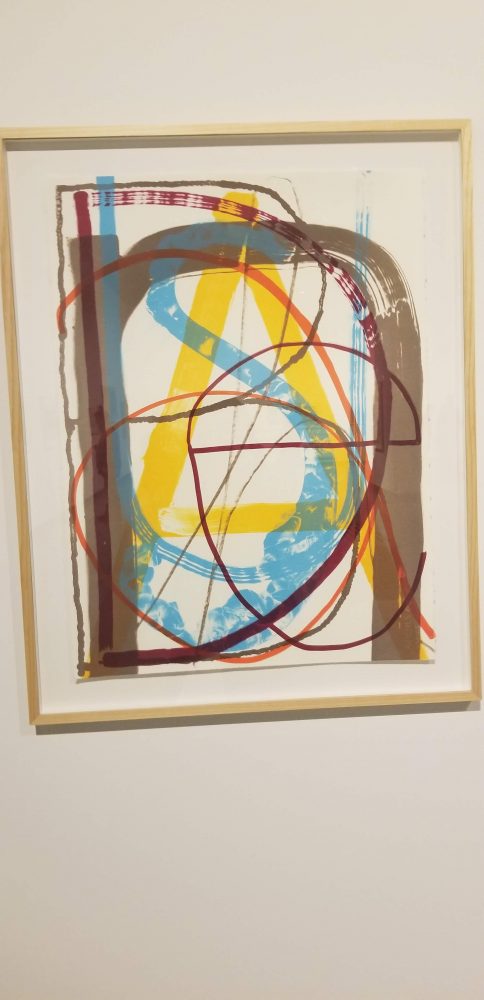
“Unalphabetic #1 (Unabashed)” Pat Boas (1932)

The work I chose was “Unalpabetic #1 (unabashed)” by Pat Boas.  This work is the word ‘Unabashed’ with each letter painted over the other, in various sizes, colors, weights, and cases.  The text here makes the image, the letters become the image, it would be impossible to separate the two from each other without compromising the composition of the piece.  Each portion of the  stacked text adds to the painting, it actually creates the composition. At a quick glance one might not even notice that the painting is made up of stacked letters, and when realized people will see different letter first, or not even be able to discern all of the letters.

This piece is rather symbolic and abstract. The word written is “Unabashed”, a word that is defined as, “not embarrassed, disconcerted, or ashamed, bold.”  The word choice here is purposeful, the painting is unafraid to be bold, unabashed – The meaning of the word is reflected in the painting itself.  It is purposefully chaotic, the idea is to “confuse the at of reading and looking.” The chaos and playfulness of each letter form is purposeful.  Each letter is used to create composition and visual flow.  The overlapping curves and edges of the letters create shapes in themselves.  The viewer sees the lines and movement created by each brush stroke and can find meaning in the space between the letters, before even realizing that there are letters.  This begs the question, ” is this a word, or an abstract thought.”
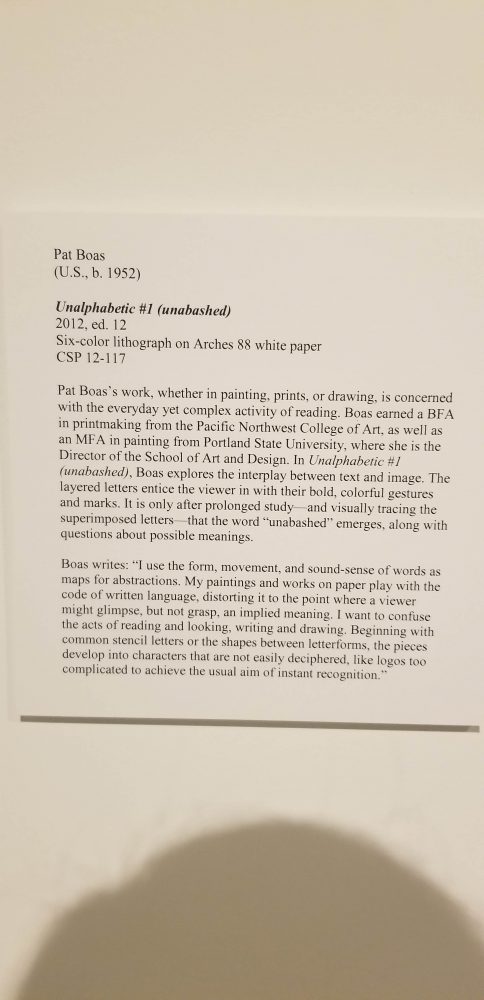
Pat Boas was attempting to play with the idea of language and letter-form. To purposefully distort the perception of a piece to play with legibility.  A viewer can decipher letters and portions of the piece, but as a whole it remains a mystery.  The meaning is in the  chaos, hard to decipher.

Posted in Fall 2018 Archive (336) | Leave a comment

Art Museum Visit: Mikaela Thomas

46118896_349793079121186_4783897929070936064_n

“I Beseech You” by Carrie Mae Weems, 1996 

The art from the museum I have chosen is called “I Beseech You” by Carrie Mae Weems in 1996. The photograph is in black and white and appears to be very dated as it was actually taken by a 19th century French photographer. The words were later added as a political statement. I think the combination of the words and the photo make it have a different meaning. The coloring of the words against the coloring of the image makes it hard to read the words, and you have to look at it up close to read it. If it was just the words, and no image, I would know that it was something political easier. If it was only the photograph, I would never guess that it was making a political statement. I think the phrase “cast it to the wind” really resonates with the photo because the sail boat and the idea of sailing away into the wind. I think the medium is this message in this case because the photo is showing the idea in a certain way that would change if it was a different medium. For example if it was a drawing instead of a photograph you wouldn’t get the same sense of realness. A drawing could make it look many different ways that would all convey something different than the photograph. The typography of the letters are very formal looking and has very large serifs. The photograph gives is a “realness” that other forms can’t, because you already trust that it is real, and don’t have to be convinced. I think the words and the photograph are visually integrated because they both have that same color tone. The color of the text matches the darkness in the photogrpah where it feels like it is part of it and engrained into the photo. The type matches the same kind of tone as the photograph which I think is important for my project. The type and the rest of the poster should seem to go together as one and not be two separate things put together. I think the colors as well as how they integrate together is important to remember for my own project.


Posted in Fall 2018 Archive (336), Uncategorized | Leave a comment

Art Museum Visit – Hannah Talarico

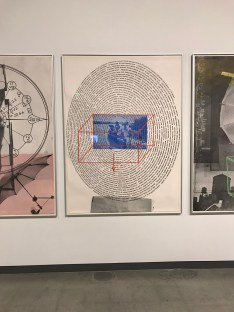
IMG_9687 When we visited the Art Museum on Washington State University’s campus, I felt that this particular graphic was the one that reached out to me, and related to me the most. The photo on the far left explains the man’s body, an outline of his actual skeleton. It also has his coordinates of his horoscopes. I thought this was interesting because it conveyed him as a bare, vulnerable person, expressing his insides and exposing himself as an individual.  The next photo, looked like a thumb print to me. The artist was intending this, and around his thumb print was a writing of his life’s experiences. I thought that this was so inspiring to use text in this way. To use a serif font, in a matter to create another figure into something bigger. The text in this photograph also inspired me on my own font that I have been creating. On the far left photo, you can see how it is hand drawn, and clearly created by sketching. I thought this was inspiring to create my personal font, because it is something that I am creating with my calligraphy pen, that I am sure he used as well to create his art piece.
Posted in Uncategorized | Leave a comment

Art Museum Visit: Sanna Wright

Photo by Sanna Wright, November 2018

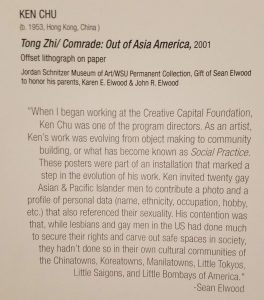
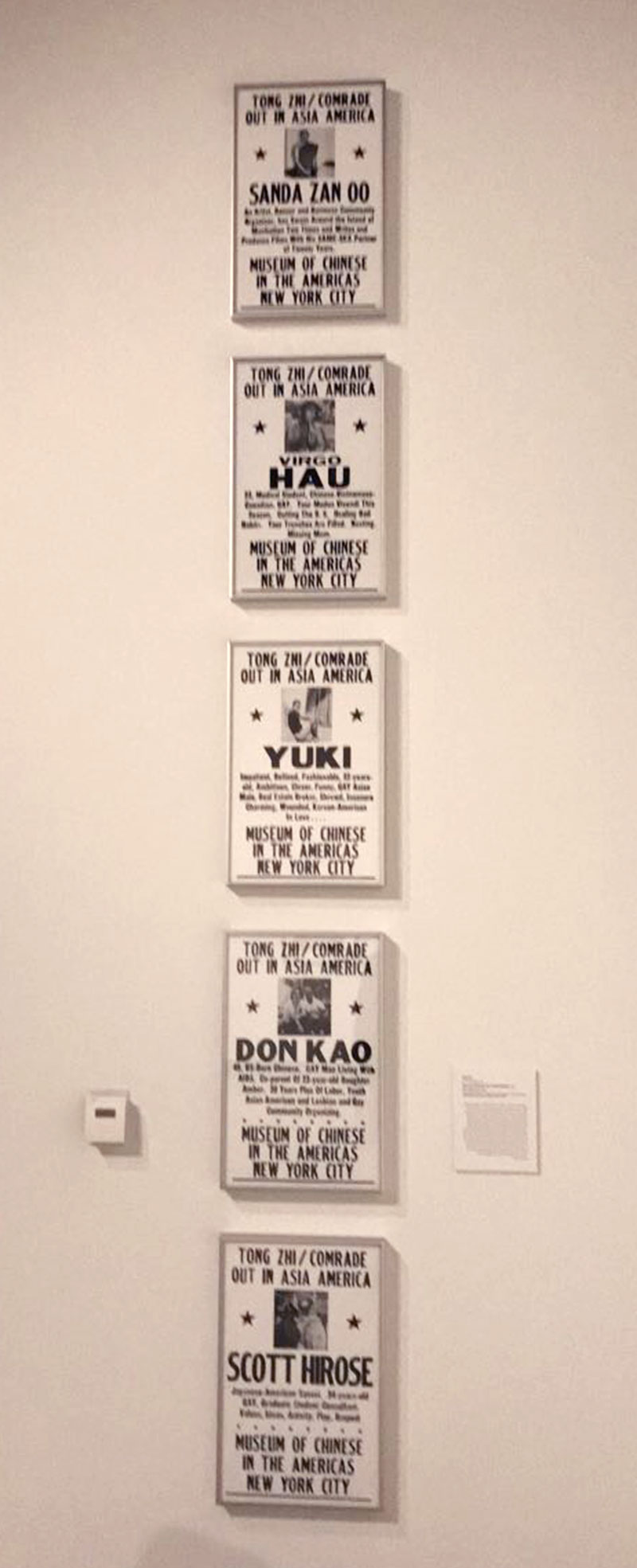
In the Washington State University art museum, these posters caught my eye. I think that they have a powerful message, and are very thought-provoking. The series of posters were created by Ken Chu to highlight and normalize the gay Asian American community in the US. His work Tong Zhi/Comrade: Out of Asia America highlights the lack of acceptance in Asian American communities in contrast with the US. The posters use an important and newslike text to explain the hobbies, interests, and family lives as well as their sexual orientation.

In these pieces, the text makes the images much more powerful. The images have little to no meaning to the viewer without the context of the words around them. Additionally, the style of typeface creates a serious tone, which impacts the message portrayed to the viewer. The typeface contrasts the otherwise playful images.

Photo by Sanna Wright, November 2018

These posters also demonstrate the concept “the medium is the message” from Timothy Samara text about illustration. The way that these posters were created is reminiscent of political posters, as well as posters that explained the forced relocation of Japanese Americans into internment camps, a dark side of America’s history. The typeface appears to be old-fashioned, created from blocks, with the strong emphasis and changing hierarchy throughout the piece. This medium transforms a simple message into a political one. It contrasts the normal description of their lives with the power of old-fashioned news poster layouts. The images also make the posters a college, with symbolic meaning. We are taking a look at the subjects’ lives.

The letters in this typeface are blocky sans-serif letters. The changing size and weight of the font bring extra emphasis to the name of the individuals and the name of the museum. The star elements draw the viewer’s eyes towards the image.

With these posters, I think that Ken Chu wants to draw attention to an important issue that has been swept under the rug in his community. Using this style of type he wants to emphasize his subject’s lives, and how they interact within their community. Overall, I think that his choice of typeface was very deliberate, and it helps spread his message well.

Photo by Sanna Wright, November 2018

Photo by Sanna Wright, November 2018

Posted in Fall 2018 Archive (336) | Leave a comment

Art Museum Visit: Jane Doe

Dam Breach by Daniel Duford is a realism drawing that caught my eye in the museum.  The way that ‘KRAKOOM!’ is drawn/written is how I would experiment with drawing letters when I was younger.  They are just as imperfect as the ones I used to draw.  None of the letters sit on a baseline nor do all have the same height or width.  None of the letters are the exact same.

The way the letters are drawn are reminiscent of the same bold headlines we saw on a few posters in the MASC (Blog 6).  These posters used bold sans-serif fonts in red to depict all the headlines.  This illustration’s writing also happens to be in red and is also a bold sans-serif font intended to grab attention.

I was inspired by our trip to the museum and seeing this drawing as well as another that utilized this type of lettering.  It was a type of lettering that I used to hand draw for fun all the time and I thought it was a type of lettering that would be interesting to recreate on Illustrator.  I focused on how to recreate the letters in that style and create it in a way that would be different since I would be using a computer, not drawing by hand.

Posted in Fall 2018 Archive (336) | Leave a comment

Art Museum Visit: Kelly-anne Cubley

Set of 5 posters in the Tong Zhi/ Comrade: Out f Asia America collection

One piece that really caught my eye was Tong Zhi/ Comrade: Out of Asia America. This is because I myself am part of the LGBT community. I see how it affects people on a daily basis as well as how it affects me. I am also a big fan of poster design, and this helps to show the hierarchy of text versus the photo included.

About Tong Zhi/ Comrade: Out f Asia America

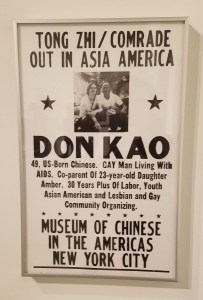
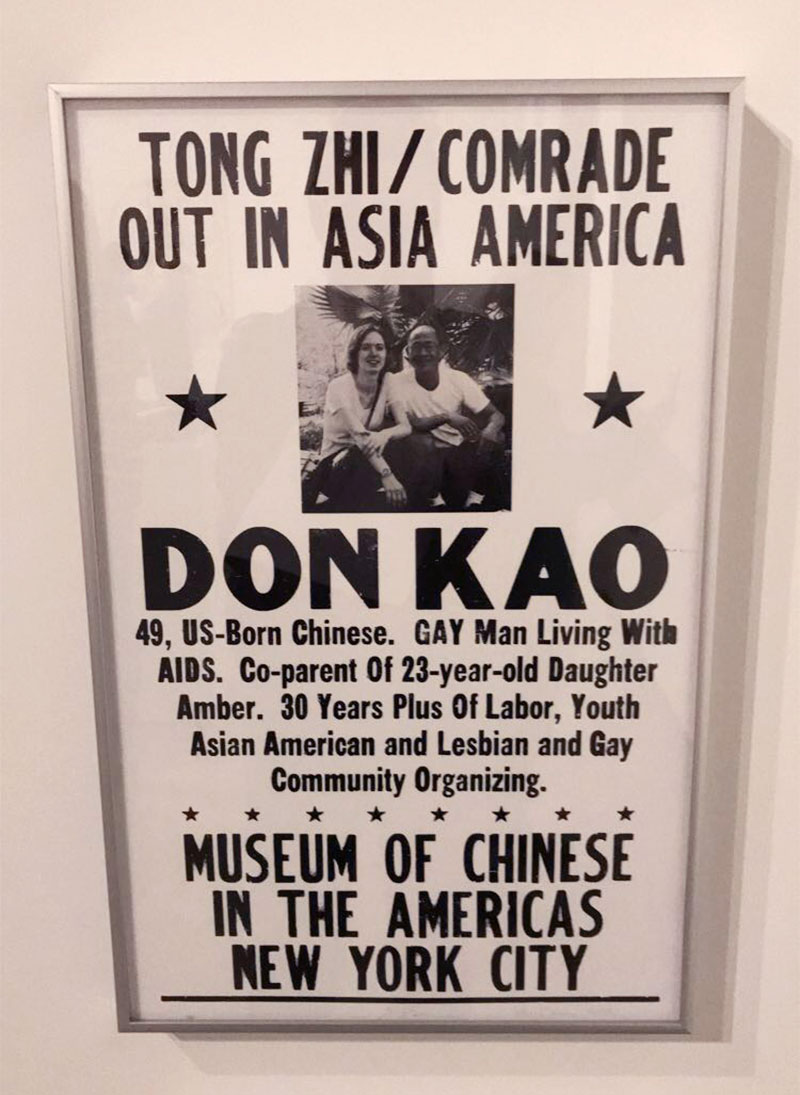
Don Kao

This set of posters evolved from object making to community building or Social Practice. This is especially relevant for my life goals. I want to be able to include diversity in the works that I create in the future.

I really enjoy the simplicity of these posters however they are quite complex in their own right. The posters reminded me of the one that we saw in the MASK about the internment camps.

This is because of the large bold fonts creating a sense of urgency and importance. There are also stars used to pull our eyes towards the images. I believe that “The medium is the message” is definitely applicable here. These are in the form of posters and are laid out on display as they would be on telephone poles over on the coast. When I visit Seattle and Portland I notice a large amount of these posters. There is also a higher amount of Asian American population. This makes me think of that area of the country.

The photos are in black and white. This was definitely a thought out choice as they were created in 2001 where one was able to create colored images at a relatively low cost. The photo is a main focal point, it is placed in the upper third in the center. They allow the viewer to connect with the people depicted and it isn’t overwhelmed by the text or star symbols surrounding it.

The font is especially interesting to me as it looks like it was made with wood forms. Each letter looks slightly different from the overarching set of rules and this is definitely important because it keeps the eye moving.

I really enjoy this poster set and what it stands for.

Posted in Fall 2018 Archive (336) | Leave a comment

Art Museum Visit: Clara Mui

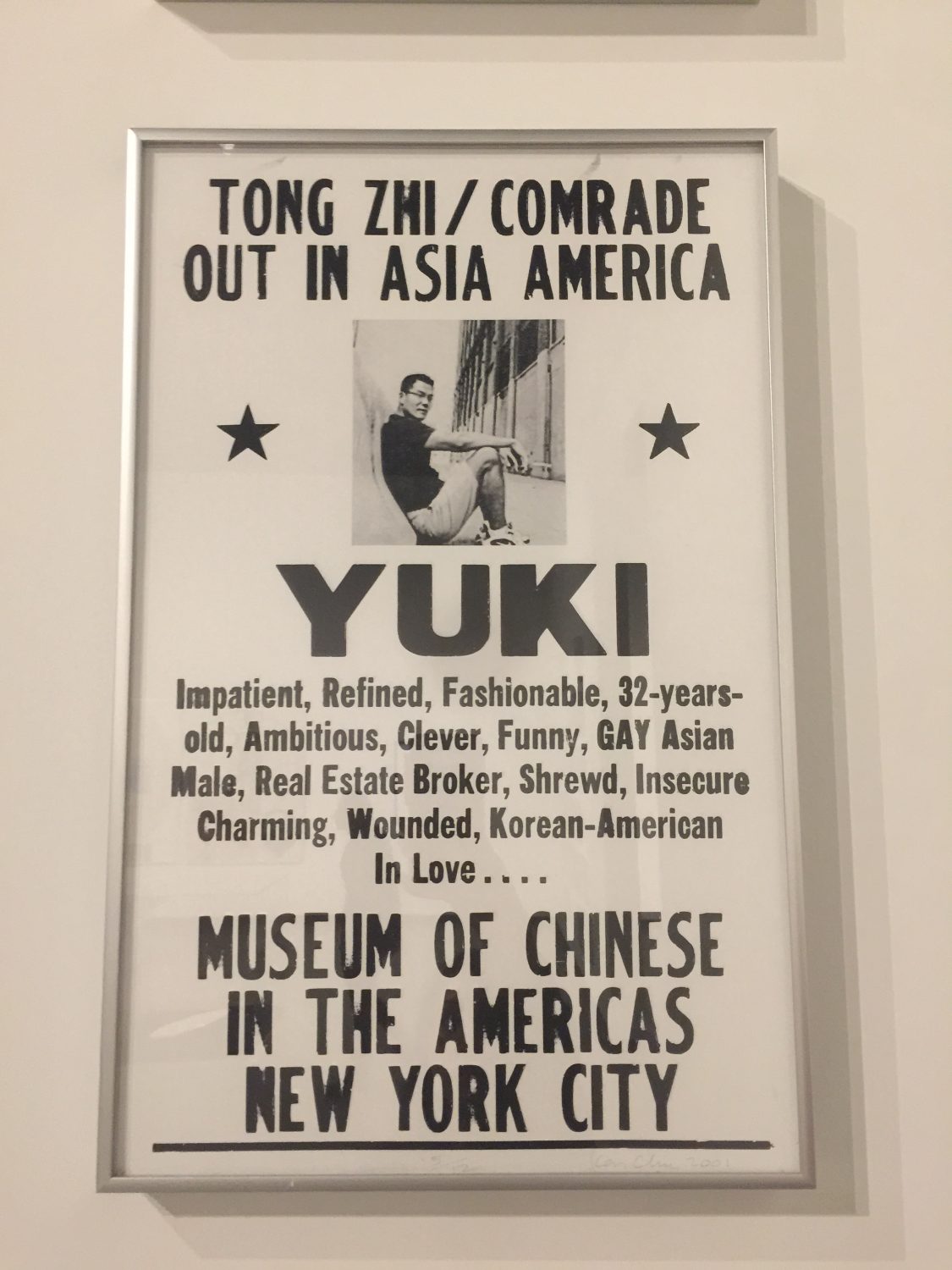
Ken Chu – Tong Zhi/Comrade Out in Asia America: Yuki (2001)

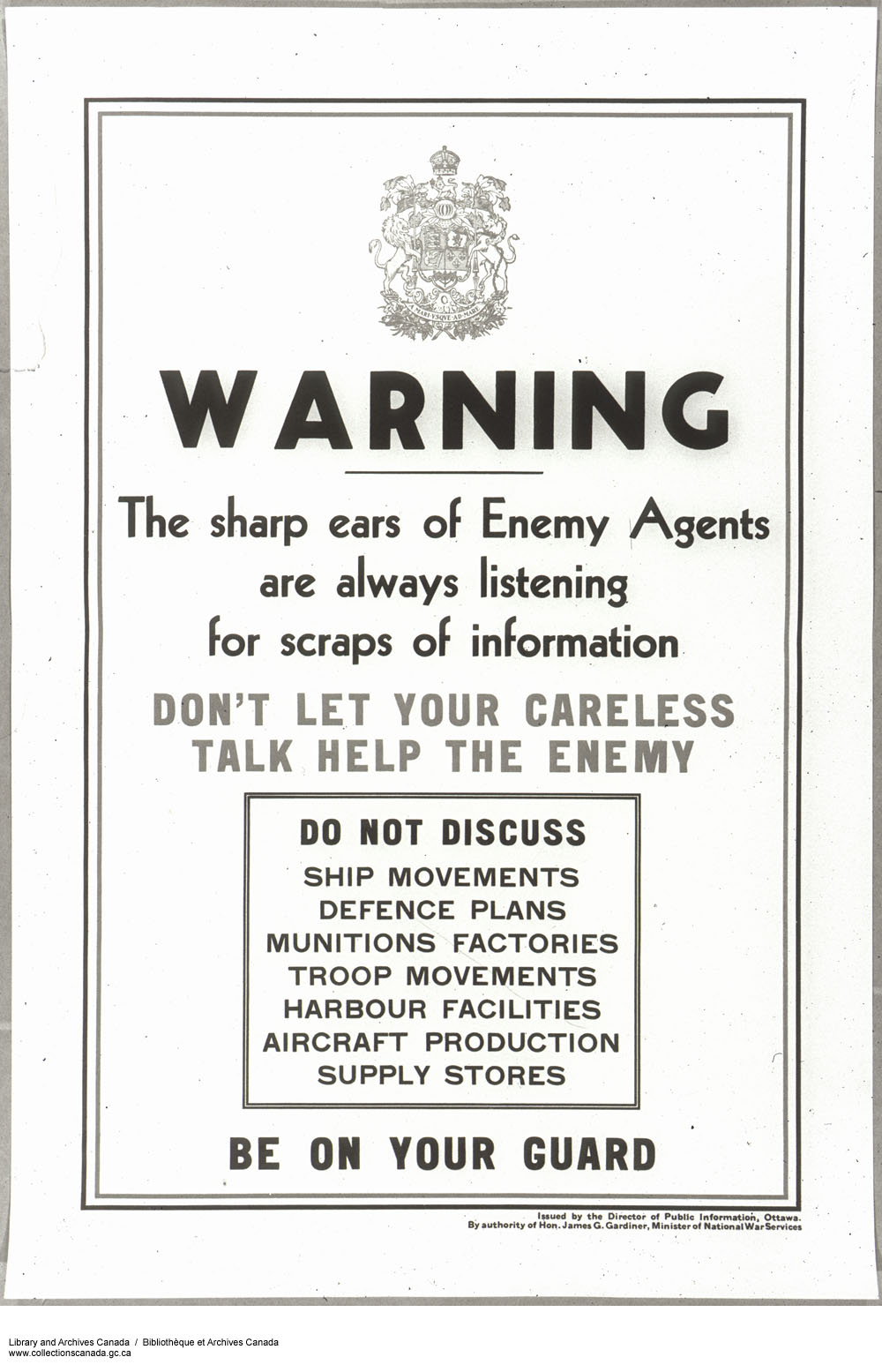
This collection of art pieces called “Tong Zhi/Comrade: Out of Asia America”(2001) caught my eye because of the middle poster here has a very bold Japanese name “Yuki” on it. This is a collection of stories and photographs of Asian and Pacific Islander men that the artist Ken Chu put together in the form of posters. The pieces are in black and white on tabloid size papers. The artist mimicked the poster style that is similar to the war time notices such as this military notice during WWII.

A military notice during WWII

They both have mixed typefaces on a single media and used a bold and chunky typeface like helvetica bold to catches the attention of audience, then a leaner typeface for details. The star ornaments added on the sides of the photograph also gives it a sense of official document as  you see them a lot in older official posters. This is reminding me that having things outside of typography such as ornaments or illustrations, is important to emphasize what we want to convey in our final poster.

Chu was trying to point out how queer minority like asians were treated badly like they were criminals in their communities by making the posters look like warrant posters back in war time, like how Americans treated Japanese Americans as outsiders and considered as dangerous. It’s the discrimination against one community’s own member that Chu wanted to emphasize.

Another similar form of poster is lost human poster. As Chu used capital case for the first letter of the descriptions, and without connections like a sentence. Just having facts on the poster giving it a sense of urge and kind of objectifying the characters of the stories a little bit.

Posted in Fall 2018 Archive (336) | Leave a comment

Art Museum Visit – Grey Kumar


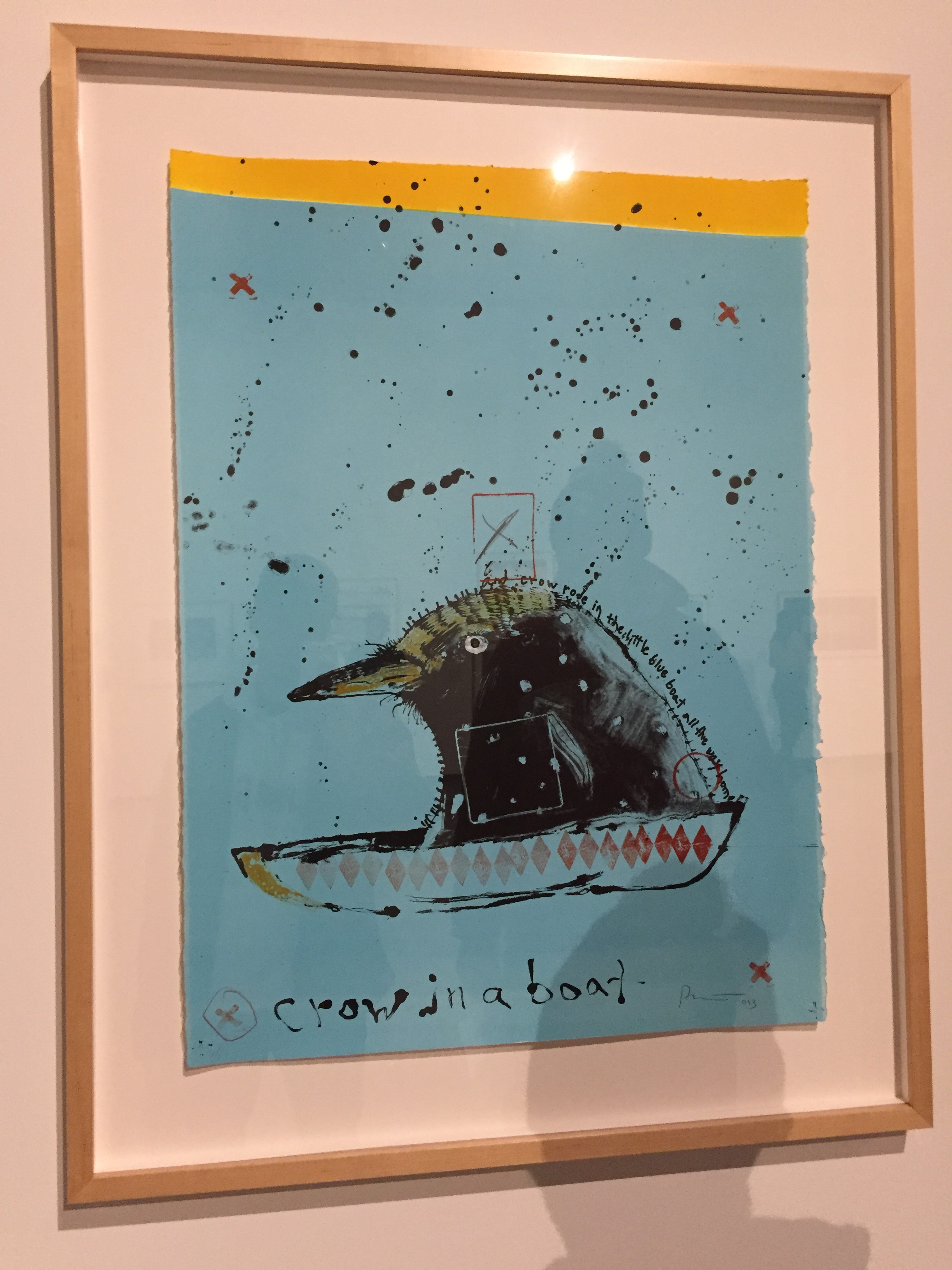
“Crow in a Boat” Rick Bartow, 2013

For my analysis from the Art Museum visit, I chosen the painting titled “Crow in a Boat” by Rick Bartow. This painting originally caught my eye with the bright colors and heavy contrast that is used. The heavy black from the head of the crow against the light blue background creates a very appealing contrast that I really enjoy, along with the slight strip of yellow that travels across the top of the painting. Another aspect of this painting which really stood out to me was the text that is placed in the lower left hand corner of the painting. In most works, the artist does not usually include the title in the same frame as the painting or creation. It is generally placed on a placard that sits in the same vicinity as the painting. I found this to be very interesting because it adds a sense of completeness to the painting. The text in itself becomes a separate entity within the painting, which allows one to draw meaning from just the text alone.

The text fits very well with the painting because it matches the aesthetic without overpowering the main image. If the typeface were to be styled differently, it would not fit with the painting and the black spots that cover the canvas. The two entities, the crow and the text, would class with one another making the painting feel incomplete as a whole.

For my type design, I want to use the same consistency that is shown in this painting between the image or graphic that I have in my head, and what the type actually looks like. For example, the text I have chosen revolves around the sea, yet also the battle between a man and a fish, and the peace that he finds at the end. To represent this in my type design, I have chosen to include straight portions of fishing line to create the letter, as well as curved and “relaxed” portions of fishing line. The straight pieces represent a taught line, one that is under pressure and in the midst of a fight. Whereas the curved portions represent a relaxed line, one that is at peace and in harmony with the sea.

Posted in Fall 2018 Archive (336) | Leave a comment

Past, Present, and Future Technology: Interview Ideas: Chandhni Jayakanth

For this assignment, I have decided to work on the Soundscape project instead of the Interview project, to give me a challenging task by working on multiple sounds without a specific transcript, dialogue, or monologue. After the reading, these are few specifics that I learnt about soundscapes. It is an abstract way of communicating a specific story or experience through the use of sounds. It could be a real place or an invented place but the sounds being communicated are the only mode of experiencing this specific location. Soundscapes are also multiple sounds that overlap each other, giving out the ambience of a specific location. For example, the soundscape of a busy Sunday Farmer’s Market might be the vendors talking to customers, the music that might be playing in the background, the sounds of children screaming out of joy or the sound of wind breezing through. Sounds are really important to live this experience because as you read through a book or a descriptive paragraph, you can relive the sounds but how about when you listen to the sounds?

Reading it further, I could realize that there are a lot of factors and categories that come into play with soundscape projects. For example, the mention of the ‘hi-fi environment’ and ‘lo-fi environment’ makes me realize how varied the outcome of each soundscape project can be. The specific categories such as sound walks, sound maps, and transects also talks in depth about a lot more specifics. It is also very interesting to see how sounds could be used to create instant experiences such as sound walks where people follow a specific path to gain more knowledge and have an unique experience.

After reading the resource, I have finally thought out the idea for my soundscape project. I want to work on documenting a lot of my personal tourist experience in New York City. I want to be able to focus on all three aspects: human, mechanical, and environmental. Even if I am not able to show it all in one final outcome, I am looking to have multiple soundscape projects that go for 30-45 seconds that reflects my ideas. As for the environment is concerned, I feel like a major part of this project might focus on ‘lo-fi’ environment because of New York being a huge city but since I am also looking to focus a lot on specific places, maybe I might be able to switch that environment a little. There will be a lot of keynote sounds like wind and traffic noises that might affect a lot of the final outcome but I will make sure to minimize those noises. If I can find any sound marks, I will make sure to add those in as well.

Posted in Fall 2018 Archive (201) | Leave a comment

Art Museum Visit – Juan Nolazco

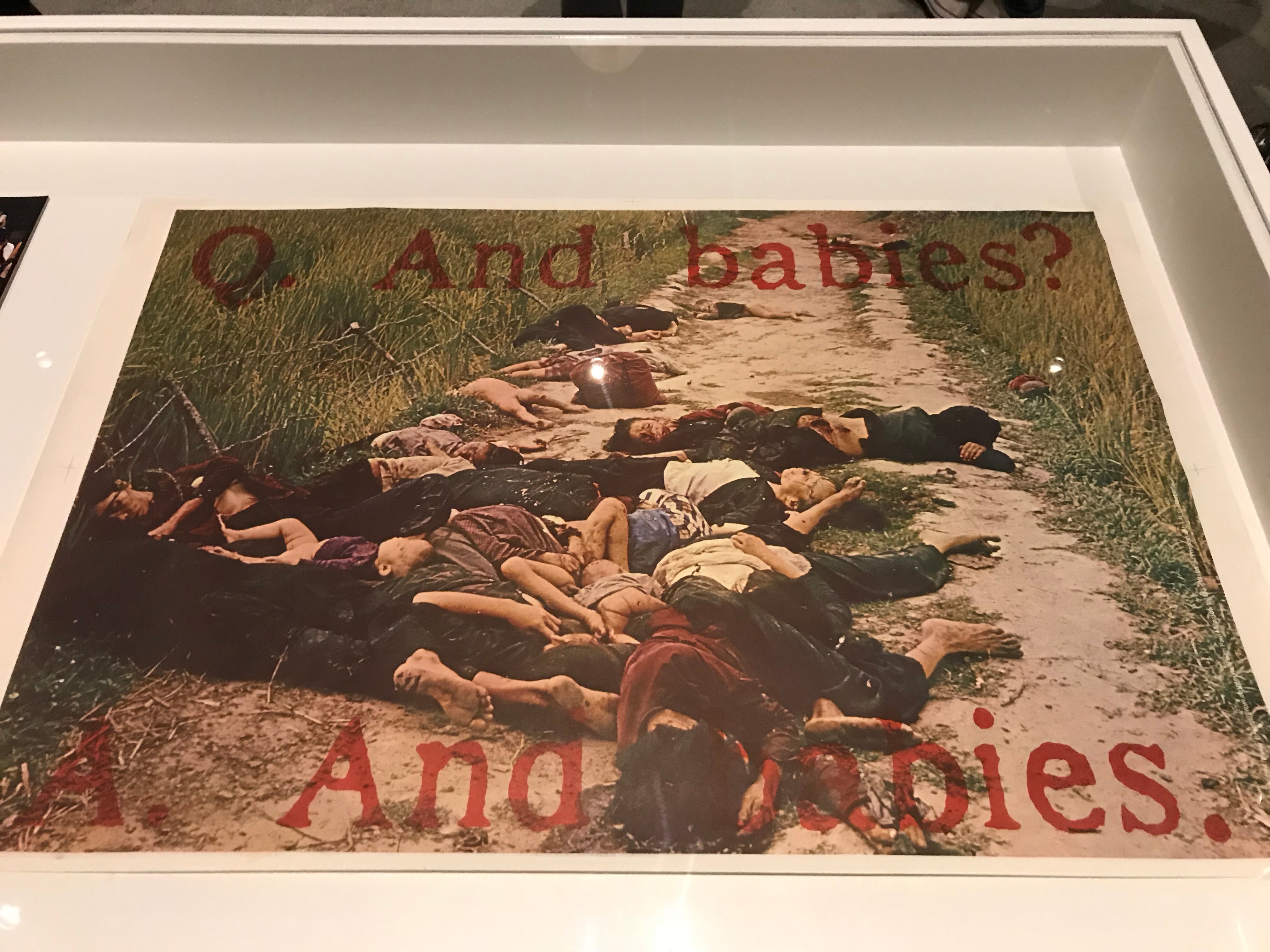
Photo taken by Juan Nolazco, November 2018

The artwork I am discussing is called “And Babies” by the Art Workers Coalition from 1969. This piece caught my attention because of the powerful message and weight it carries. The work combines an image of the corpses of women and children and text reading “And babies? And babies.” The image itself is a photograph by U.S. combat officer Ronald L. Haeberle and does not show any visible alterations that change the tone of the image. I think it is important that this image wasn’t altered because any changes would have taken away from the reality of the situation. The only addition to the artwork is the type laid over the image. The type is red and slightly opaque in the form of a serif font. The type itself resembles an older typeface that you would typically see used in formal print work, which immediately gives off a serious tone. It becomes apparent quickly that the type was meant to resemble blood, moreover the blood of the dead women and children in the image. However, this resemblance is abstract in itself because the artist could have chosen a type that literally resembled blood, with long drips that distort the letters to a more literal iteration. I appreciate that the artist chose not to use a type like that because it would have taken away from the seriousness of the message. In the class reading on illustration, metaphors in type and imagery is addressed. I think the type in this piece works as a metaphor because it symbolically resembles bloodshed in this context. The artist is trying to communicate the harsh reality behind some of the horrific atrocities that American soldiers committed during the Vietnam War. This piece exposes the military and stands opposed to this massacre.

This piece has shown me how impactful color is to a type. I would not have normally thought of combining this type with this image, however, changing the color and opacity alone gave the type a drastically different purpose and it meshed well with the photograph, thus delivering an impactful message. This also helped me understand how important it is to choose images carefully, and to be intentional with how I pair images and text. I’ve learned that I can also afford to be more abstract than I initially thought. It is okay to make viewers have to work for the message, and that cryptic messages are just as impactful as obvious ones in art.

Posted in Uncategorized | Leave a comment