Closure and Time Frames: Kristine Zorn

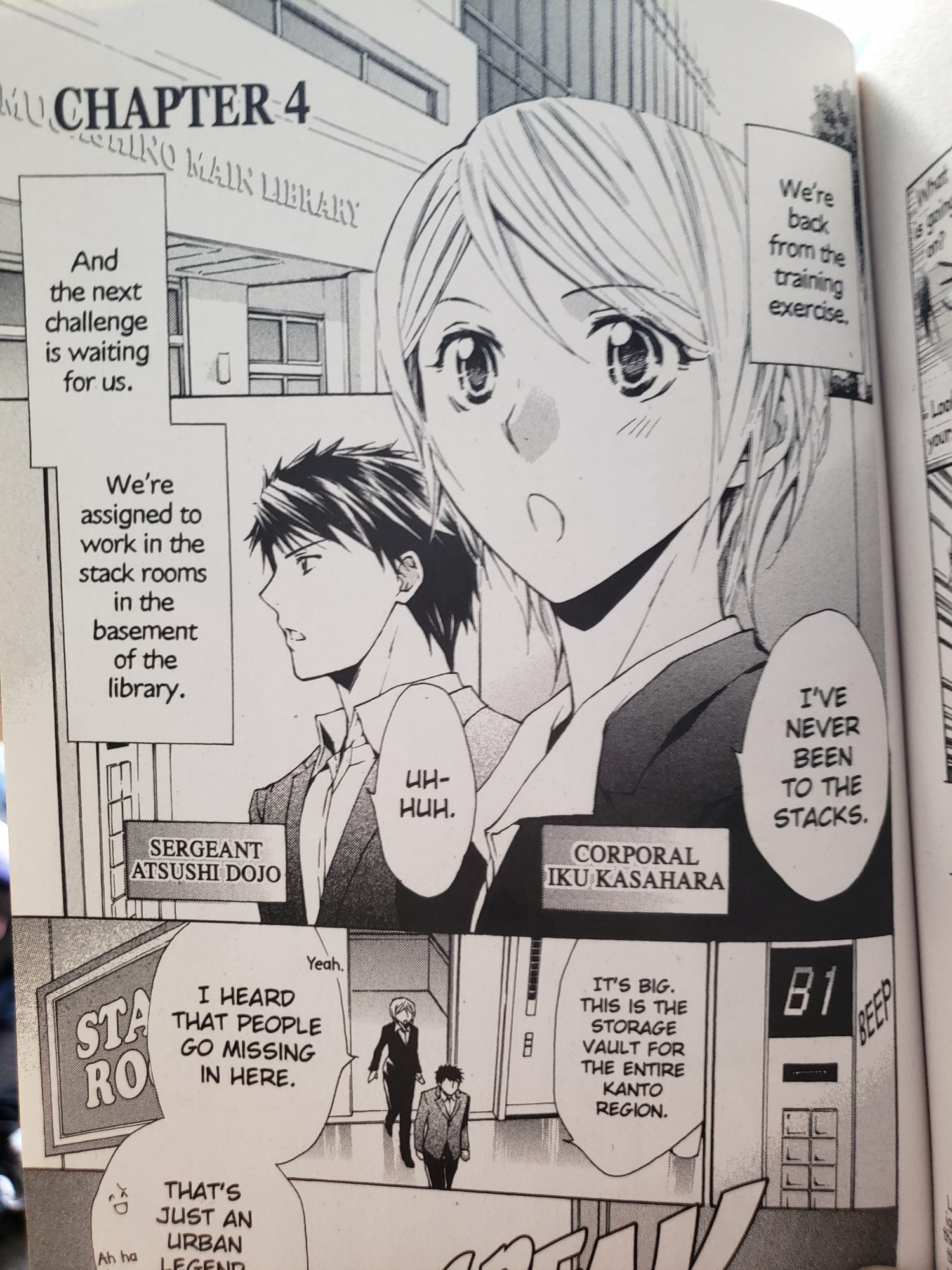
An example of subject-to-subject frames from the first volume of Library Wars: Love and War by Kiiro Yumi

At first, I thought this was an example of scene-to-scene, but since the frames don’t change by a significant distance or time that was not accurate. This is actually an example of subject-to-subject change because even though the location changes slightly, both frames remain the same general area. The first frame shows the characters outside of a building and in the next frame, they are inside that building. Another subject-to-subject change occurs when moving to the small frame that shows a keypad within the room they entered. All three frames remain in the same idea that the two characters are visiting the library making them an example of subject-to-subject. I chose this comic because it is a manga and I thought there might be a higher chance of finding aspect-to-aspect since Scott McCloud explained aspect-to-aspect was more often found in Eastern comics. However, it seems the author did not use aspect-to-aspect in this manga.
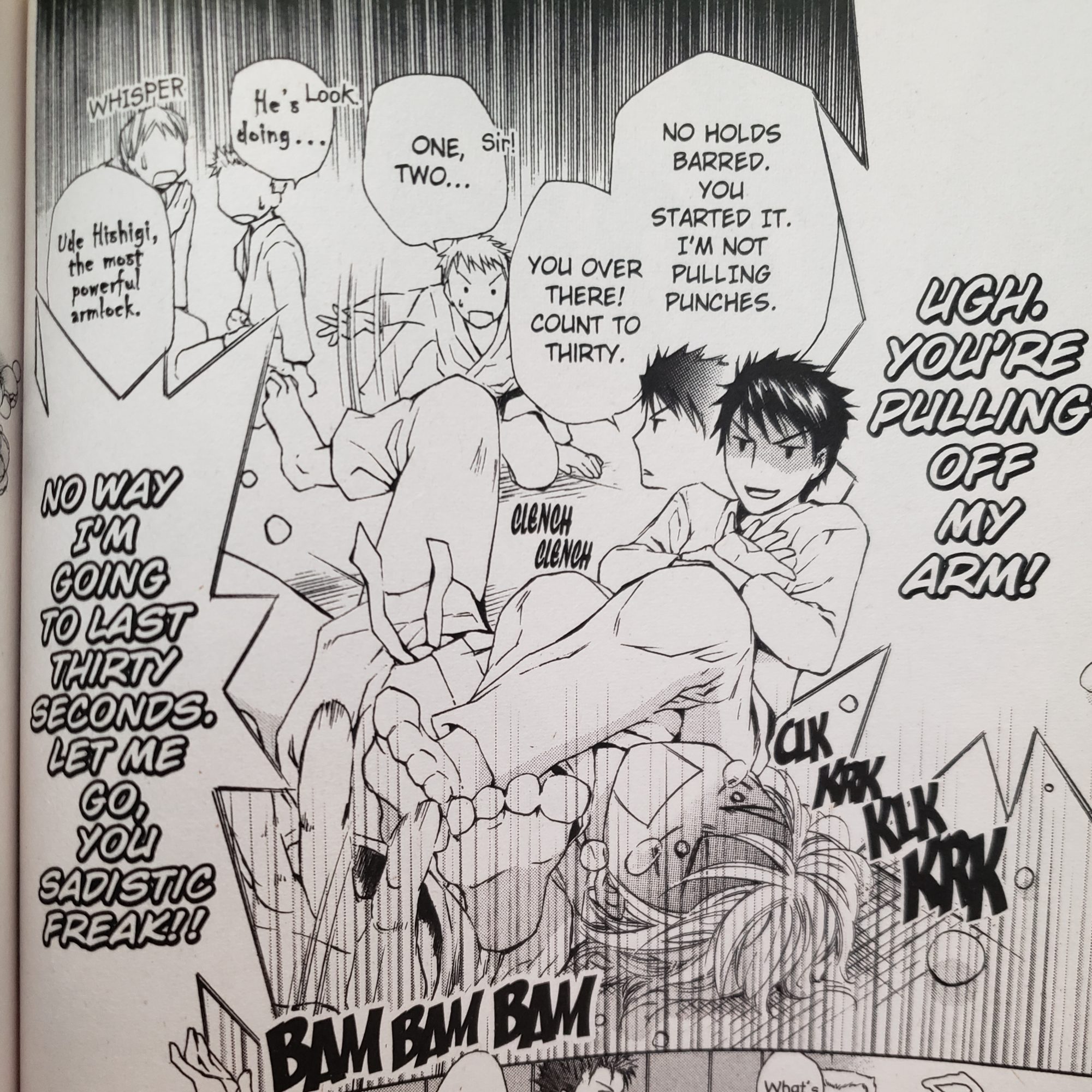
An example of time and motion in a frame from the first volume of Library Wars: Love and War by Kiiro Yumi

There were not any extremely unique examples of time frames in this manga so I just picked a frame where I thought there was a more complex use of time versus the other frames in the book. This frame lasts at least several seconds. The first, the most obvious use of time in this frame the black-haired character’s head which is drawn twice, once looking at the girl he fought and the second looking at the men in the room. Drawing his head twice in that way gives the impression of motion where the character is looking back and forth from the girl and the other men. That on its own adds at least a few seconds of length to the frame. The other example of time I wanted to focus on in this frame is the guy that is supposed to be counting to thirty. The speech bubble clearly shows him at least counting to two which adds about two seconds to the scene, however, the ellipse gives the impression that he continues counting mostly likely to thirty. That makes it fair to infer that this scene lasted at least around thirty seconds.

Posted in Fall 2019 Archive (201 Blog) | Leave a comment

Closure and Time Frames: Grace Kannberg

When choosing what graphic novel to use for this project, I was a bit lost. I have never read a graphic novel before and I didn’t know what I would like to read. After looking around I decided to go with Beautiful Creatures: The Monga because I have been wanting to read the book for a long time but just haven’t had the time to do so. This way I will be able to compare the two types of books with each other. Moreover, the book aesthetics were pleasing to me because of the Japanese drawing style that was used to tell a story that takes place in a small southern town.

Beautiful Creatures: The Manga, By: Kami Garcia, Margaret Stohl, and Cassandra Jean, October 09, 2019

One interesting example of closure comes from Chapter 5 (there are no page numbers). This page is showing Aspect-to-Aspect. Aspect-to-Aspect gives a better idea for what the mood, place, or idea for the scene is about by giving the viewer extra information. From this page we see two characters sitting on bleachers talking. In the two frames surrounding this, we see how the characters response to each other. The girl is holding a book close to her chest and the boy’s knuckles are clenched on a bench. From this, the viewer gets a tense mood from their calm setting. I was not surprised to find this in the book because of the Japanese style it is in. Aspect-to-Aspect is mostly used in these regions compared to the West.

Two interesting examples of time frames that ask for serious viewer participation or interpretation are from Chapter 5. The first one asks the viewer to look at events as it accurses seemingly at the same time. A girl stands in the middle, as everything is going on around her.

Beautiful Creatures: The Manga, By: Kami Garcia, Margaret Stohl, and Cassandra Jean, October 09, 2019

The DJ playing music, lights breaking, sprinklers going off all around her, people screaming. Each action bleeds off the page to leave it up to the viewer to interpret how intense and chaotic this moment is.

Beautiful Creatures: The Manga, By: Kami Garcia, Margaret Stohl, and Cassandra Jean, October 09, 2019

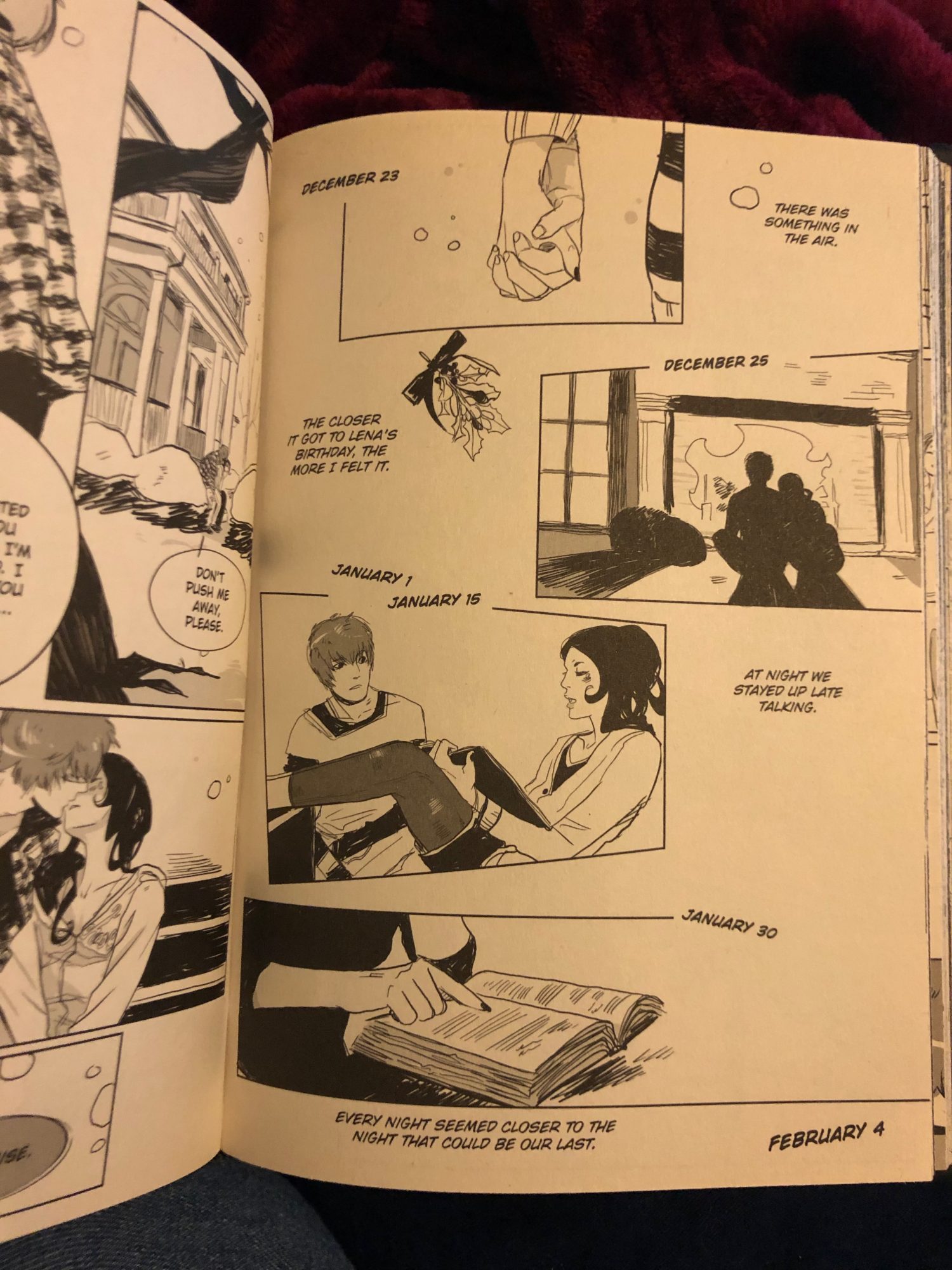
Another example that shows time is when the two love interest get closer together with the direct passing of dates. We know that time is passing by from this direct approach, where reader participation and interpretation comes into play is how the two characters have become closer. We, as viewers, fill in the days of there relationship through the gaps that we are given and how they are depicted from date to date.

Posted in Fall 2019 Archive (201 Blog) | Leave a comment

Closure and Time Frames: Libby Fletcher

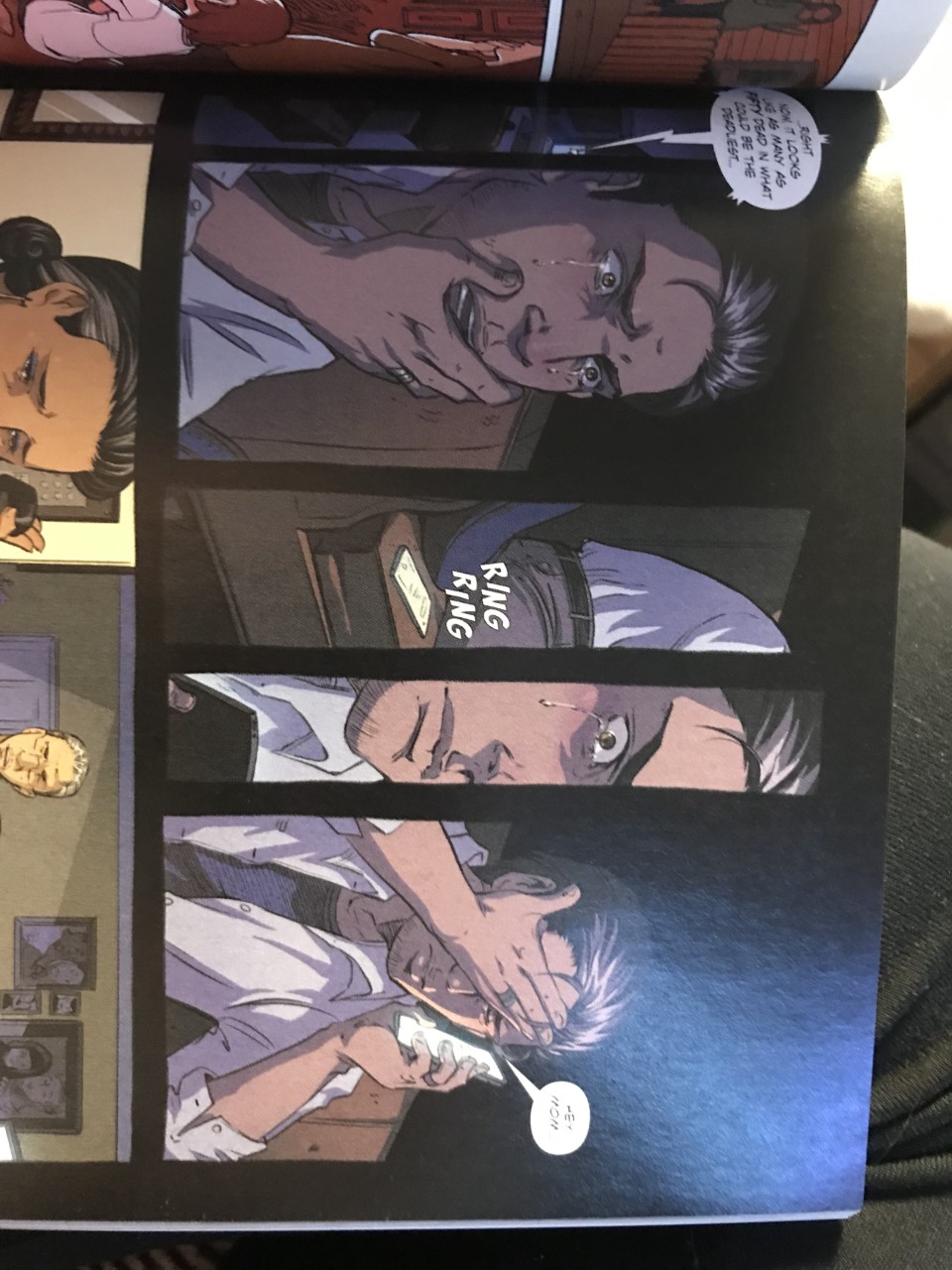
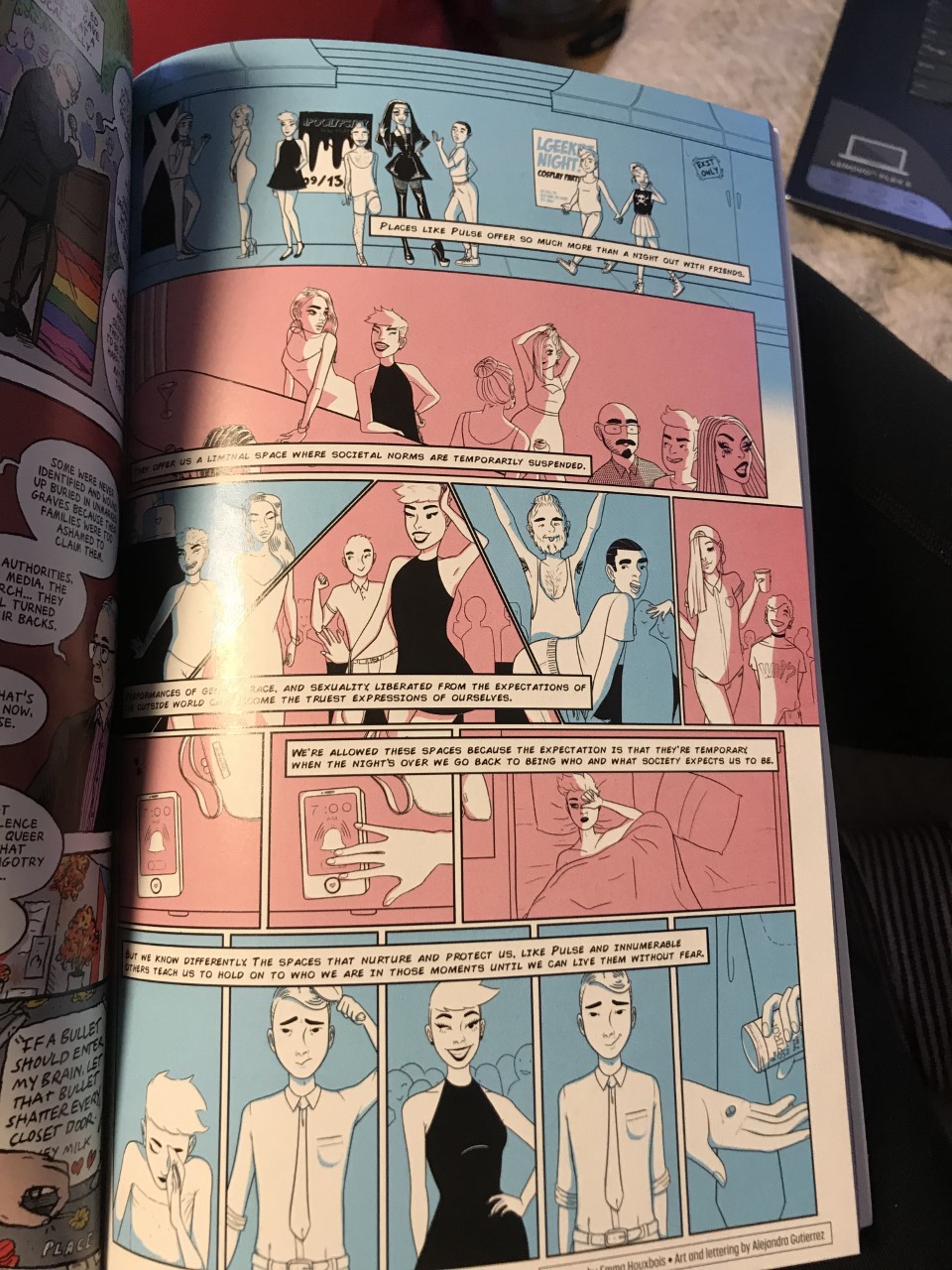
I decided to pick up the comic book Love is Love because I liked the way the book was laid out.  The example I chose for closure is moment-to-moment.  The panels are showing a man’s reaction to learning about the shooting at Pulse Night Club in Orlando, Florida.  This is an example of moment-to-moment closure because the reader can tell that very little time has passed between the panels.

I thought this was a good example of how time can be manipulated within a comic book.  The page is explaining why night clubs like Pulse are so important to the LGBTQ+ community.  However, at first, the time frame was a little bit tough to understand because of how the panels aren’t structured uniformly.

Posted in Fall 2019 Archive (201 Blog) | Leave a comment

Closure and Time Frames: Nicholas Kawaguchi

The graphic novel that I chose to analyze is from a series, written originally by Akira Toriyama and the manga interpretation by Toyotaro, entitled “Dragon Ball Super.” This book is comprised of both heavy dialogue scenes and quick action sequences that stick to the more Japanese style of comics. As previously mentioned, both in lecture and “Understanding Comic,” this manga is read in the eastern style of literature, going from right to left rather than the opposite. 


One example of closure from this manga comes from a set of six panels on a page with each transitioning using some of the crafts of closure. Beginning from the top right, the character in that panel has a flashback to events that took place years before the present. To signal this transition of scene-to-scene, the shape of the panels shifts from a standard square to one with more rounded edges and much more contrasting tones within. From there the closure between that panel and the one to the left is a much smaller area and also has Japanese characters, acting as sound effects, that span across both of them. The amount of interpretation needed decreases in retrospect of the past panels. Thus this transition becomes a more subject-to-subject change as it takes place within the same scene moving the focus from just that character to that of him and a highly emphasized shadow figure. Moving down, it seems that change between panels may be action-to-action. From a different point of view, the back of the shadow figure, it can be seen that the longer-haired character has gone from sitting up, clenching his fist at the figure, and ready for a fight to slouching over against some trash as he holds his arm in pain. Although it is not a whole lot of action, there is some there. From here on till the end, it seems that the closure establishes a more moment-to-moment transition. These panels are comprised of more dialogue as the view of the shadow figure closes in on his ominous face. 


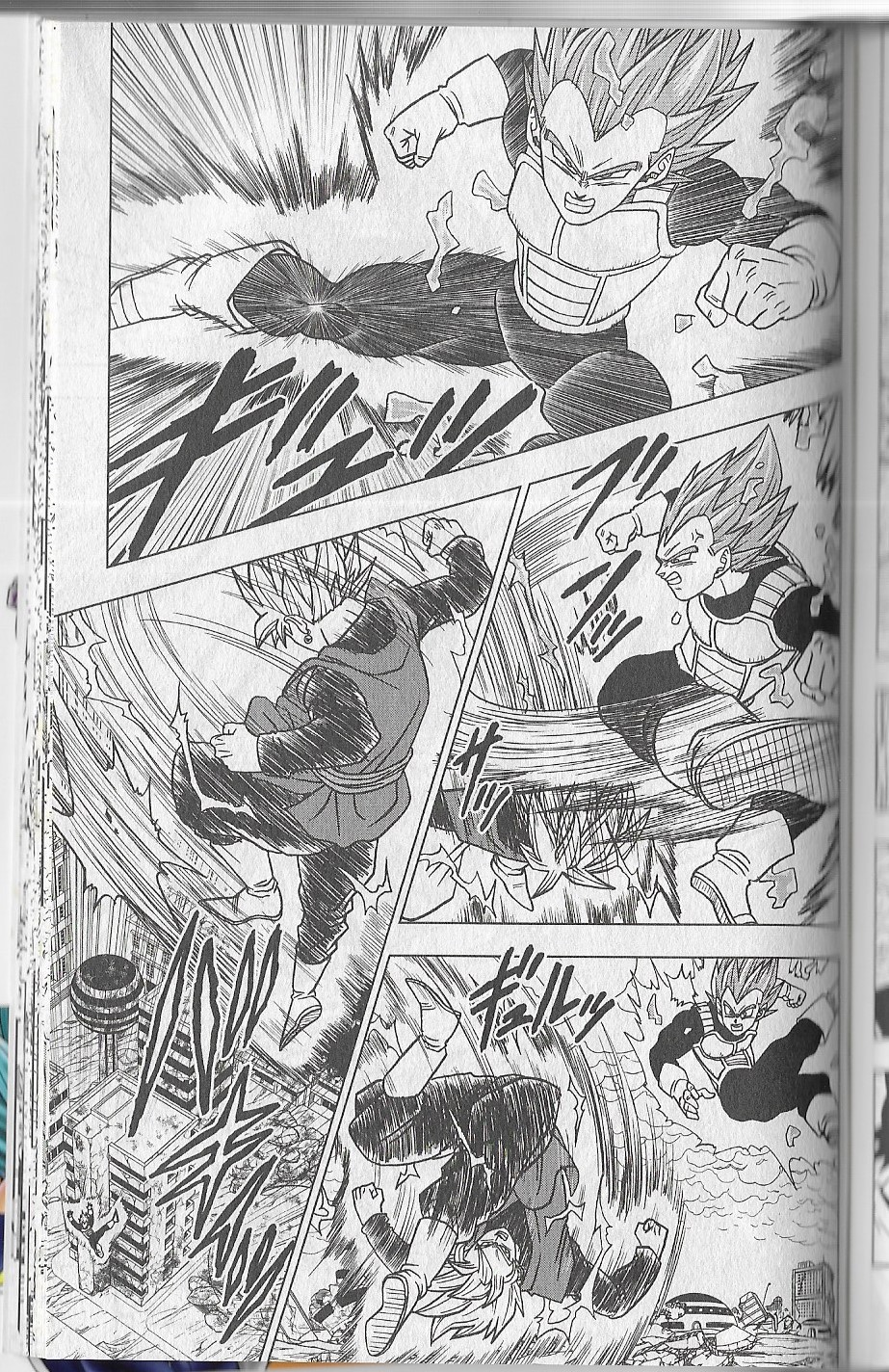
An example of an interesting time frame can be seen in many of the fights scenes throughout the book. This one in particular, although it may not seem like it, needs the audience’s participation in making a more fast-paced action sequence. In these 4 panels, it is clear that each of them is trying to kick each other, but one misses and others manage to hit. Along with the slanted shape of each panel, depicting action rather than dialogue-heavy scenes, the author illustrates their motion, and in turn time, by creating streaks and blurs in the shape of their executed or intended motion. This can be seen especially in the bottom three panels as one of the characters dodges a kick, and by showing his motion through streaks in a circular path, fluidly flips and kicks the other character into the distance. By connecting all those motions with those streaks, the speed of that action can come to fruition, with large of the reader’s imagination fueling everything. Also as the final panel on the left bleeds into the side of the page, it further pushes that emphasis of all of this action occurring within mere moments despite being seen in four still images.

Posted in Uncategorized | Leave a comment

Closure and Time Frames: Isaiah Wilkerson

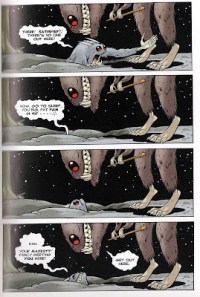
For my selected comic, I chose Bone: Eyes of the Storm by Jeff Smith. I chose this comic because it had caught my eyes when I saw the cover page. I’d remember people in my elementary class reading these books but I’ve never really read them myself, which is why I chose this for my selected comic. I wish I could read the first one because the most recent book they had was this third book.

kingdok

Bone: Eyes of the Storm, pg. 11, 10/10/19

I chose this image as the closure. It shows two monsters hiding from something or someone and are arguing about who should check out from their pit to see if someone had caught them. The blue monster then pops out to justify that there was no one on to them, not realizing that their leader was standing right above them. This is closure because after they nervously said hello to him, he then responds, saying “get out here.” This is closure because we, as readers, assume before turning to the next page that they were in trouble and were going to get punished, even though we don’t know their relationship with each other off of the first read.


80099009d460754a2ca6768f47b43c4f

Bone: Eyes of the Storm, pg. 102, 10/10/19

Scott McCloud’s definition of “subject to subject” is to take the reader from one subject to another while staying within a scene or idea. In these panel, you can see the old lady, the little girl and the bone guy hiding from something or someone. The reader can’t identify who their hiding from until the lightening strikes and you can see all the monsters in the background, looking for them. You can also see their reactions to the lightening and can feel the tension as the reader after noticing the enemies.


Posted in Uncategorized | Leave a comment

Closure and Time Frames: Tom McLean

Example of closure – Scanned 10/9/2019

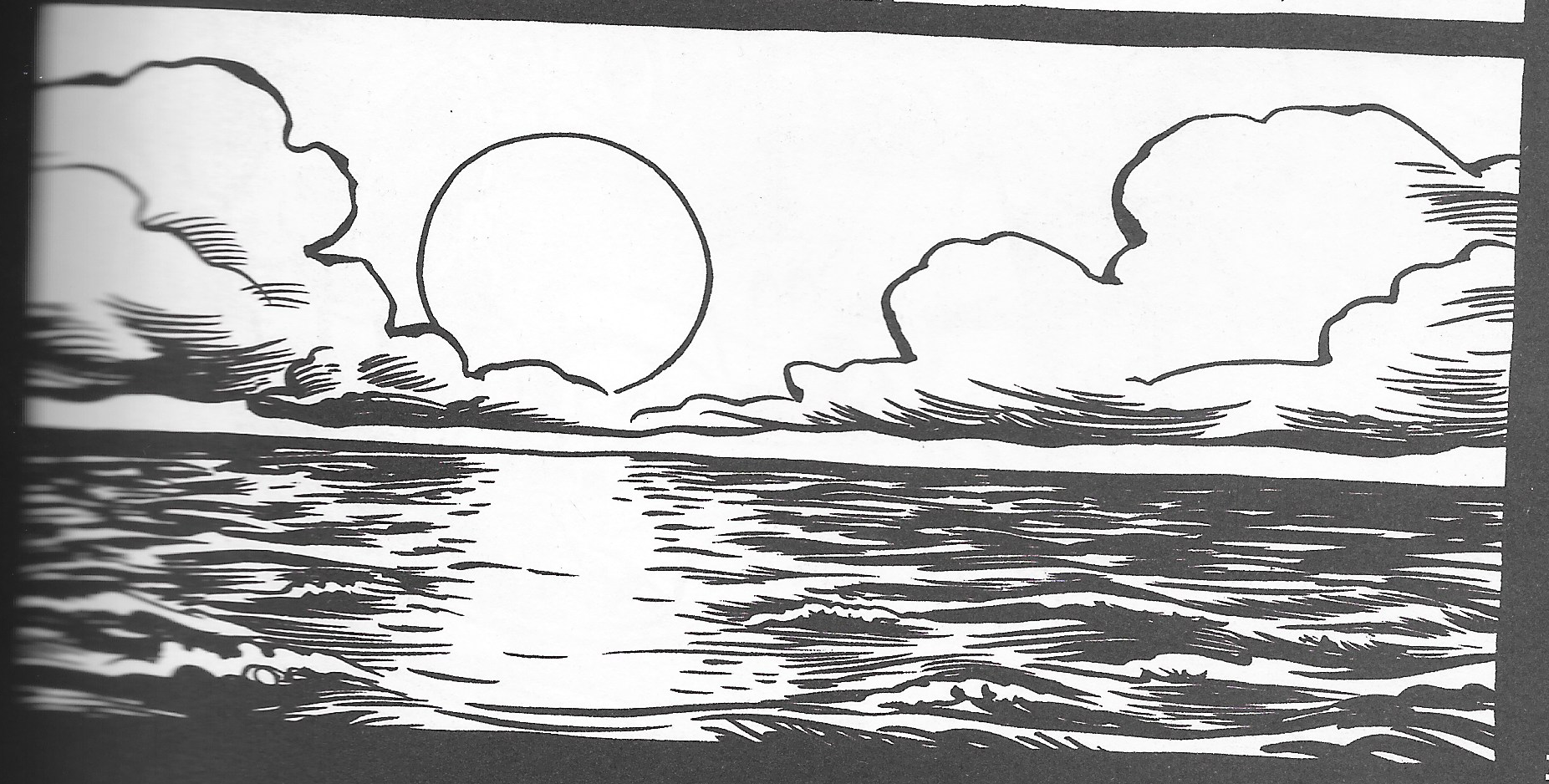
For my graphic novel, I have chosen to read “Goodbye Chunky Rice” by Craig Thompson and after looking into the graphic novel, it was not hard to find examples of scenes of closure and scenes of serious viewer interpretation. This first image is an example of closure due to the landscape image. This image shows the end of one train of thought due to the end of an idea identified in the novel. The image above comes from when two friends are taking with each other and one is trying to convince one to leave town with him. The friend wants to stay and says to the other “You should find where you belong”. Then the picture is used to show that the trail of thought is over and the reader is moving on to something new.

Example of viewer participation and interpretation – Scanned on 10/9/2019

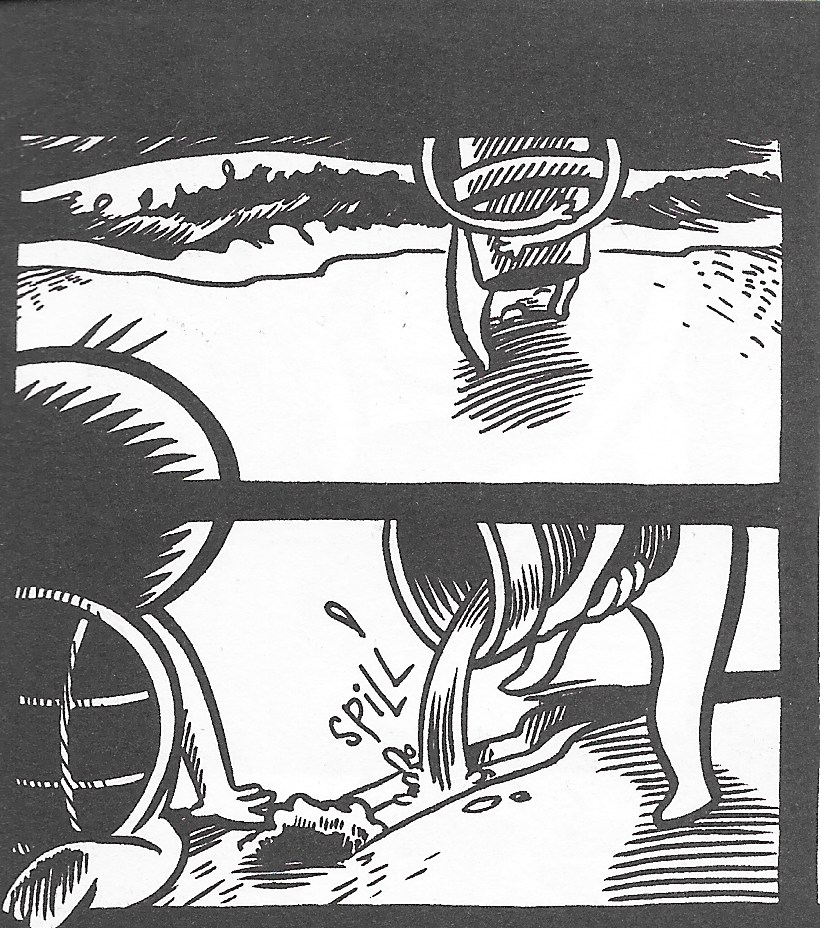
This next image is an example of the reader needing to become a participant and become more involved in this part of the graphic novel. In this part of the graphic novel, the two friends are building a moat on the beach and the author uses two frames and connects them with imagery creating a sense of quickness and an idea that is connected. The unique use of the “gutters” in the comic makes the reader try and piece together the two frames and connect them. This is all done at the same time of a total of three different actions happening all at once. This part of the novel is early on and makes the reader not know who to side with when choosing who to trust/believe in.


Posted in Fall 2019 Archive (201 Blog) | Leave a comment

Closure and Time Frames: Ivy Padayao

The graphic novel I chose for this blog is Urgent Request by Gene Luen Yang and Derek Kirk Kim. It is loosely about a woman named Janet who receives an email from a said Nigerian prince who needs her bank account information, and soon she falls in love with this prince over email.

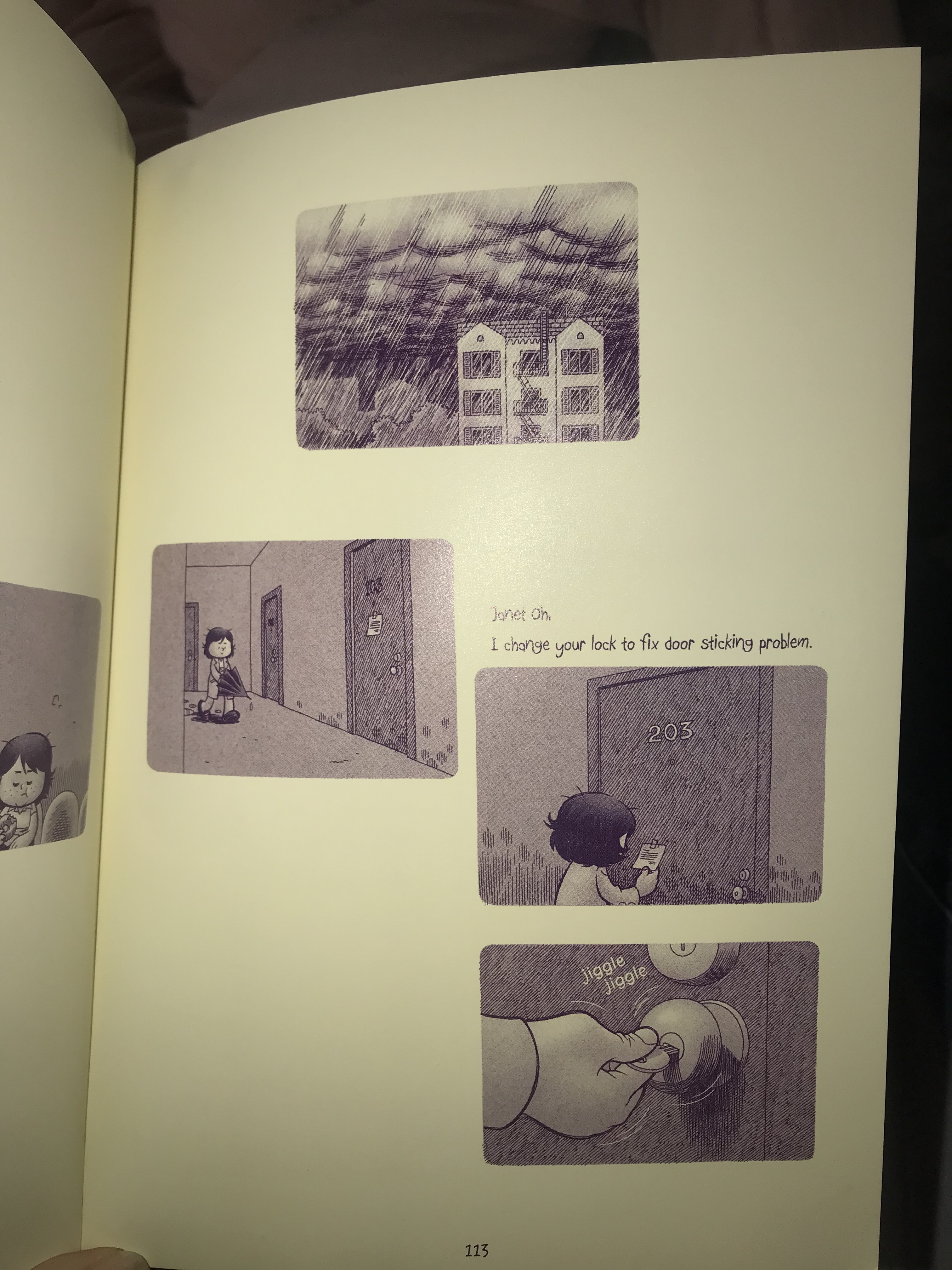
Graphic novel Urgent Request by Gene Luen Yang and Derek Kirk Kim page 113 (closure)

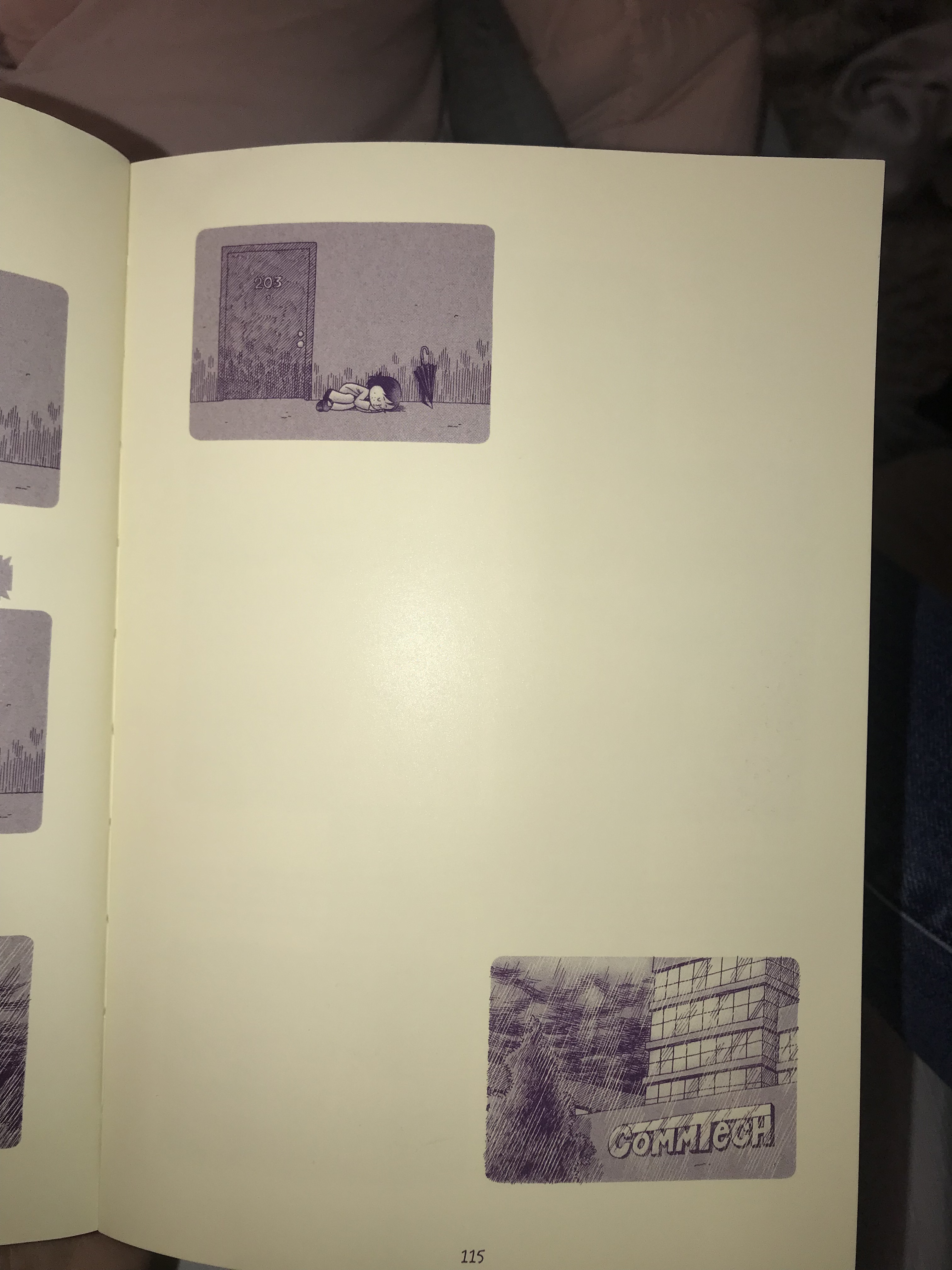
One example of closure that really stuck out to me over and over again within this story was action-to-action. Within the book, there is a lot of examples of the girl completing various actions throughout the panels. This leaves it up to the reader to determine how she completed these actions and how much time it took up. Thus, letting the reader create the closure with the various gaps between the actions. In this example on page 113, you can see there is what looks like a storm, then her walking into a hallway with an umbrella that’s wet, her reading a note on the door, and her continuing to open the door. These are all separate actions carried out in different panels on the page. The author is meaning to leave the reader to create closure and to infer what is going on in the story.

As for the author creating time frames, each page within this story has a lot of “blank

Graphic novel Urgent Request by Gene Luen Yang and Derek Kirk Kim page 115 (time frames)

space” around the graphic panels; this seems to create a tone with the reader to infer that there is a lot of time passing between each action of the panels. In this example on page 115, you can see a panel of Janet sleeping on the ground in her hallway and a lot of blank space, then another panel of the outside of her workspace; letting the reader infer that a lot of time had passed between her sleeping and then going to work the next day. 

Posted in Fall 2019 Archive (201 Blog) | Leave a comment

Closure and Time Frames: Maria Alvarez

I decided to read the book “MoonCop” by Tom Gauld because I was really attracted to the basic colors and the simplisity of this comic. I find that overactive comics sometimes are overwhelming and they can be hard to read at times. This graphic novel is straight to the point and funny. I am only a few pages in and I am really enjoying it so far. This comic is about a cop on the moon who tries to fight crime but there is non for a long time since its the moon.

Time Frame

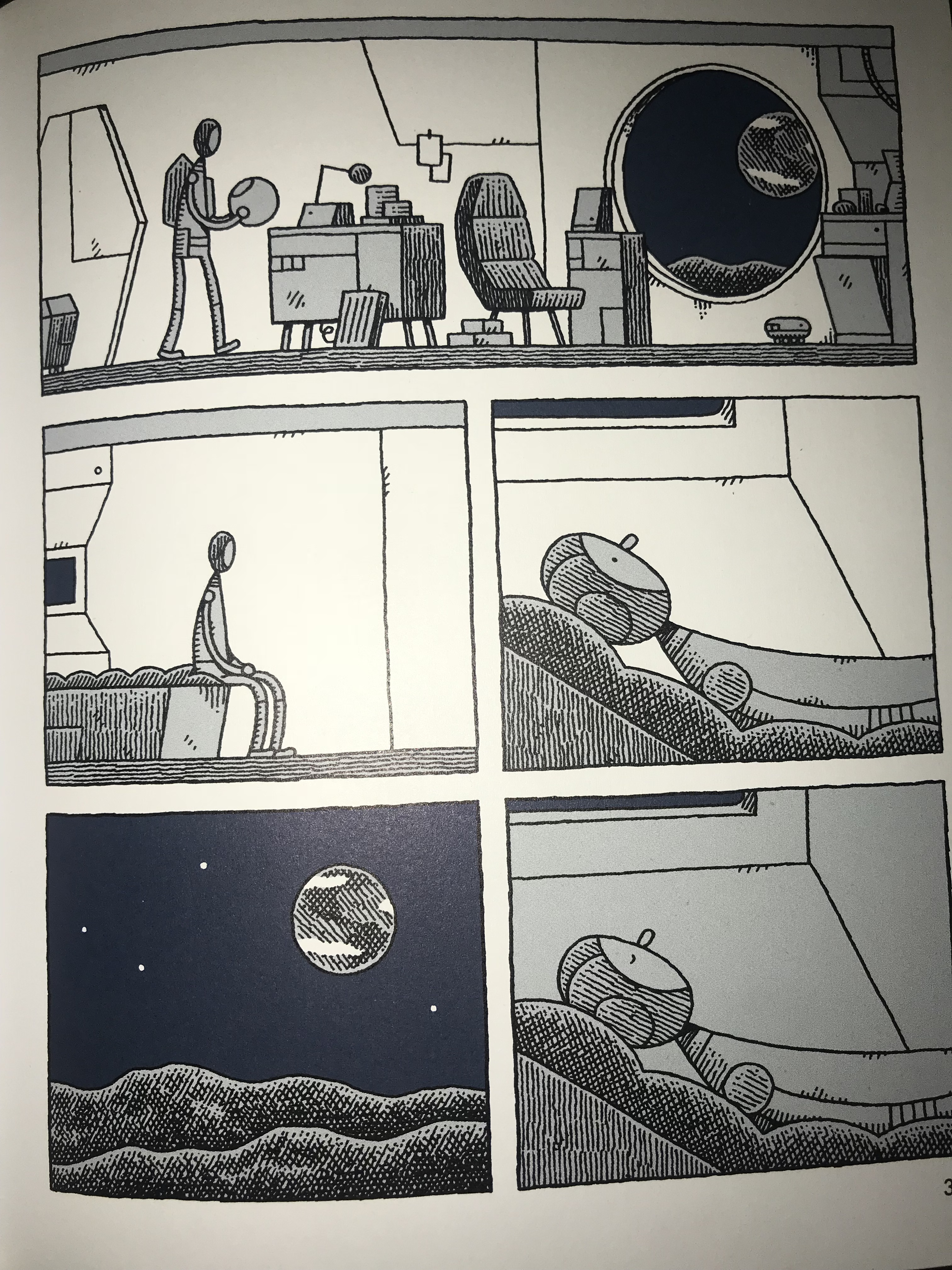
When it comes to time frames, I flipped through almost all the book to be able to find a good example of a time frame. This example of time frame is the  cop looking through his crime data base to look for any crimes. In these frames, you see him sitting, then looking straight into his computer, then typing, then looking again, then typing one more time. This is an example of time frame because at the end, we dont know what he was typing after that last clip. The last clip could be interpreted in many ways.

Closure

Closure was something I was a bit confused about but I think I might understand it a bit better now. For this example, I chose a frame of the cop getting home from work, sitting down on his bed, laying on his bed with his eyes open looking and looking at earth, and then shutting his eyes for bed. This is an example of closure beceause we know exactly whats going on. We know that he is going to bed or sleep because he is laying down on a bed and he shuts his eye. The reader does not need to decifer this clip. Overall, I am exicted to keep reading this novel to see what this cop gets himself into.

Posted in Uncategorized | Leave a comment

Closure and Time Frames: Bailey Tompkins

The graphic novel that I have chosen for this blog is called Displacement a travelogue, by Lucy Knisley. This novel is about a granddaughter who leaves New York to go on a cruise to the Caribbean to accompany her elderly grandparents.

Displacement a Travelogue, by Lucy Knisley, Page 119

Within the comic, there are many different types of closure. One example that stood out to me as a very common occurrence in this book particularly is an example of action-to-action closure. The example in the figure displayed on page 119, portrays a girl talking to her grandmother about making and appointment to go to the spa, and then she walks to the phone to call and book an appointment, and then she calls the spa but she also picks up a bill on the table that she didn’t know was there. This is an example of action-to-action because this scene displays the girls action from talking to her grandmother in the kitchen where she is taking her medications, to then being in a different room where she is calling the spa, to then being on the phone with the spa. These events are not happening at the same time, but rather in sequential order and in different sceneries of the house. As McCloud describes action-to-action closure on page 70, it is the “transitions featuring a single subject in distinct action-to-action progressions”.

Displacement a Travelogue, by Lucy Knisley, Page 118

The majority of this novel utilizes text bubbles as a easy to follow time frames for the reader, however there are a few instances where the author allowed participation and interpretation to be influenced by the readers discretion. On page 118, the text does not read simply left to right or have a clear order of top to bottom. The layout could be read in many different patterns which could potentially change the way the reader perceives the message if read in a different order.

Posted in Fall 2019 Archive (201 Blog) | Leave a comment

Design Elements and Principles: Zach Morgan

Both McCloud and Lovett have a similar goal in comics and design, respectively. They both attempt to convey message through visual compositions. McCloud would describe this as trying to make “one sense speak for all five,” meaning allowing the viewer to hear an image, for example. I will examine a page of Scott McCloud’s Understanding Comics through a design lens to see how elements of John Lovett’s “Design Overview” are reflected within the panels.


On this page, McCloud shows how each panel has an entirely different feel depending one what visual art is shown. The top left panel is particularly interesting to me because I think that it is a great example of harmony, and how that helps convey its purpose to the viewer. McCloud’s character says, “Can one sense speak for all five,” directly juxtaposed with a very realistic image of a human eye. He then shows examples of how seeing various images can produce responses from your other senses. This exhibits harmony because McCloud never says that he is talking about the one sense being vision, because he knows that the image of the eye paired with his commentary is enough for his audience to follow along. Another aspect shown in these panels is dominance of size, particularly in the one that says, “Quiet.” This panel is dominated by the size of the negative space giving it a still, or uneasy feeling. Value is another element of design that I found prevalent on this page. In the last panel, McCloud conveys the warmth of this image making the image very bright, with very little contrast. Similar to the images of the repair shop, the panel that says, “Warm” feels much more inviting and happier than the panel that says, “Sour.” These are only a few of the design elements and principles shown in McCloud’s book, but they each have on thing in common.


In these comics, the words and images work together in a way that evokes all the senses through only using sight. Not only do each of these panels use sight to represent the other senses, but they are all used in order to evoke an emotional response. In the first panel, you feel like you are having a conversation with the character because he is not overexplaining himself. You feel the sense of uneasiness through the “Quiet” panel, just waiting for something to happen to it. You feel the happiness coming from the brightness of the “Warm” panel. Each of these panels are intentionally composed of various design elements and principles in order to make the viewer feel some type of way.

Posted in Uncategorized | Leave a comment