Type Anatomy – Sean Mirts

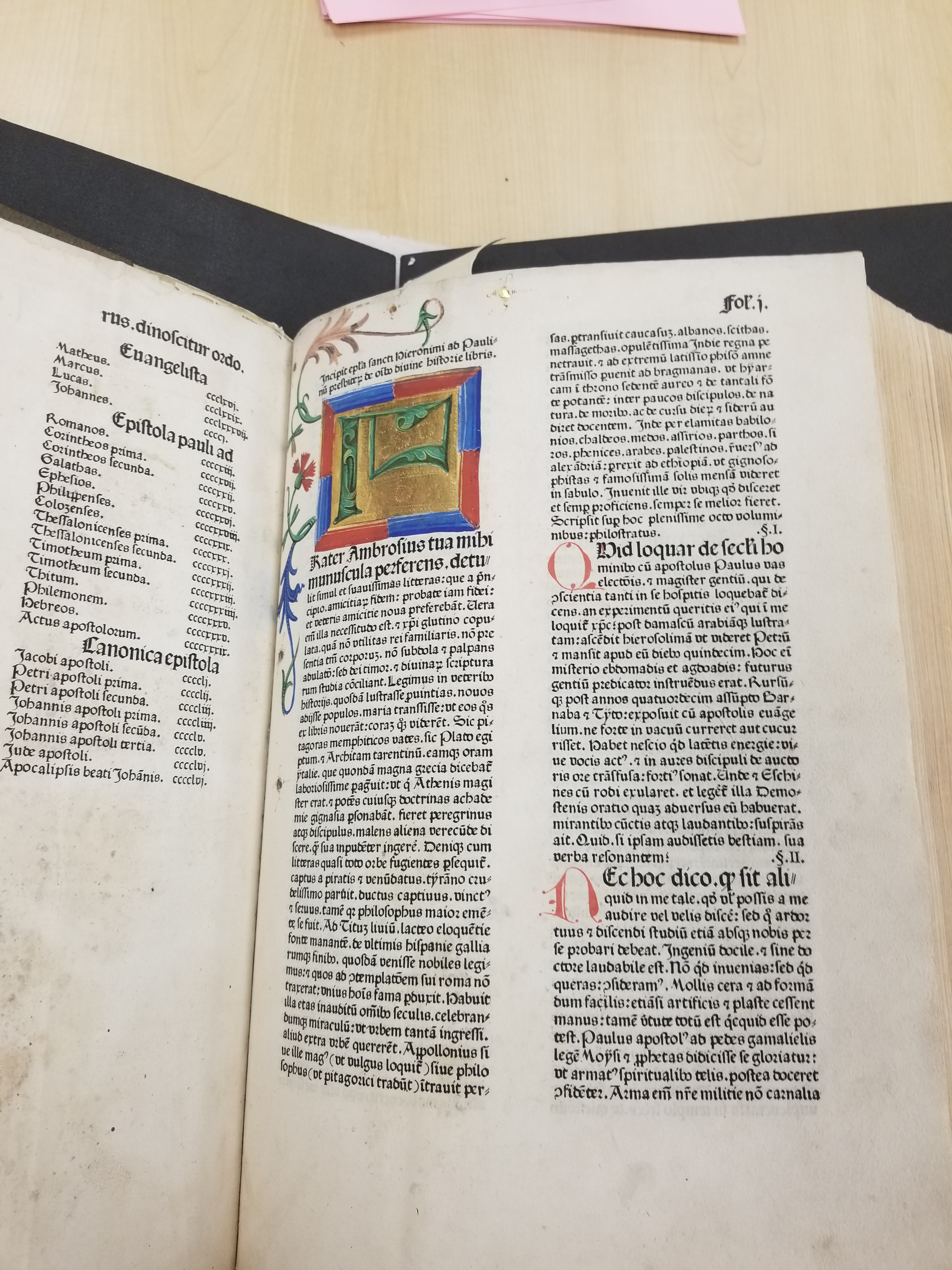
This example that I found interesting during our library visit has some very unique characteristics. The page is portioned out to find the center for the type to be placed properly on the page and the guide lines are still visible on the page. The language is also not English which adds another level of different characteristics that are not seem in text today. With the different lengths of words and spacing of letters it all seems very unique. The letters themselves are very detailed and all have extra details added to each. Some also carry small pieces of red ink on them throughout the page. The large character that is very ornate has blue and red ink in it as well as drawing lines that follow up and down the page. The details in each letter could only be done by had as there are minor imperfections on each letter when comparing the same letter.
Posted in Fall 2018 Archive (336) | Leave a comment

Type Anatomy: Rumnik Cheema

I was not present the day the class took a trip to see typography examples because of a stomach flu, however I did find the “Letter” reading quite fascinating. I have learned a bit about typography from previous design classes, but never in the depth that I learn from the reading. One of the most fascinating things was the different names for the components of a type. I did not know there was so many different categories of type and each categories has their own segment names. Another thing I found rather interesting was how well the book explains how type went from being just that to a form of expression used by renaissance artist all the way to our modern day.

Posted in Fall 2018 Archive (336), Uncategorized | Leave a comment

Type Anatomy: Victoria Henry-LeMaster

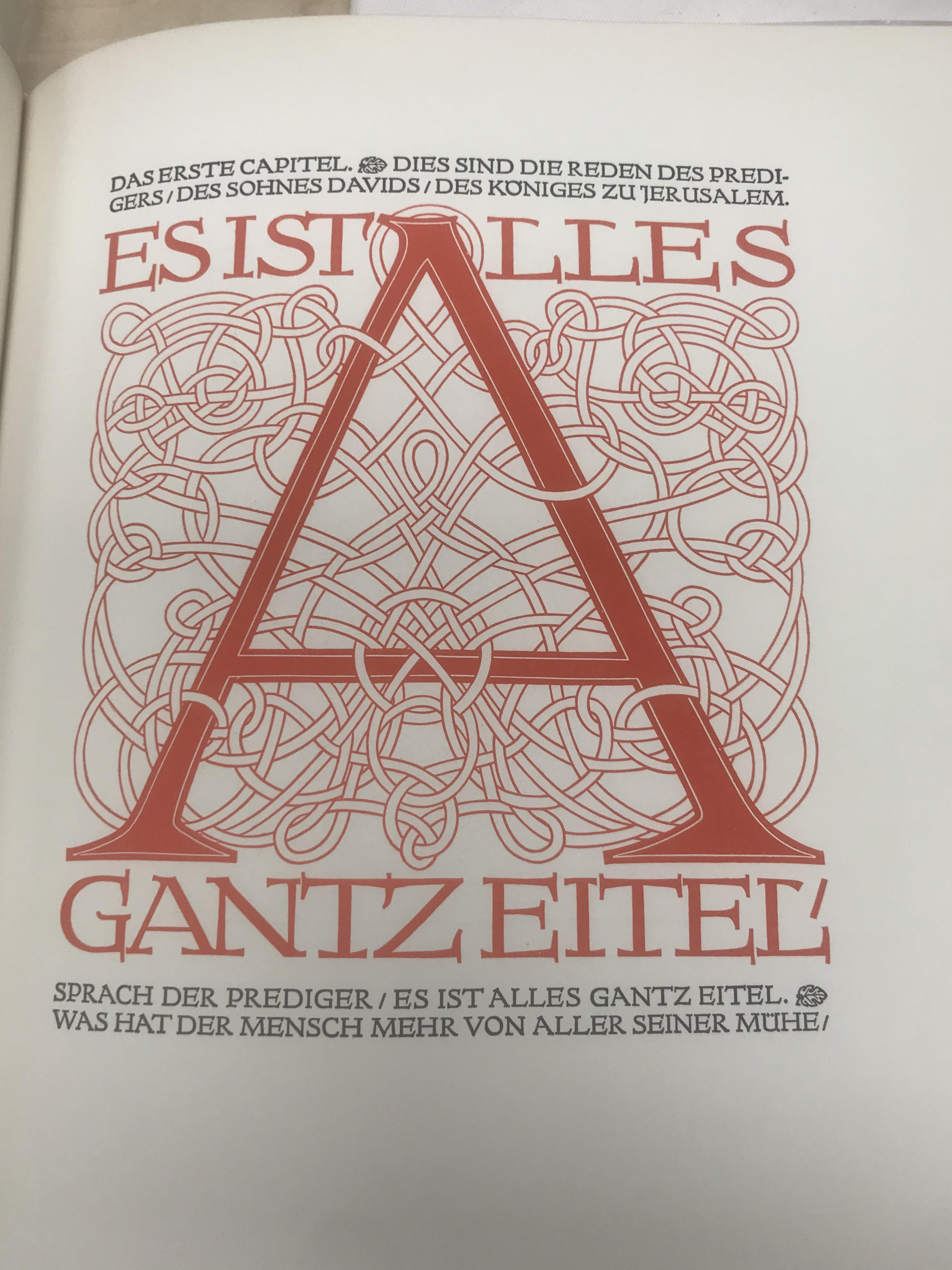
Author: Olive Simon; Julius Rodenberg, 1884-1970; Beatrice Warde, 1900-1969. Publisher: London: Peter Davies Ltd. ; New York; Harper and Bros.

I think that the example that I chose has the presence that it does because not only is the normal letter itself different from a general serif font like times new roman, but it also creates a more medieval atmosphere to the text. The wording and lettering above and below the main letter frame the larger one showing it in an almost grid-like context. It is an all capital type font so there aren’t any visible ascenders or descenders that I can see. The roping or artistic design around the main letter almost resembles Gaelic knots. Which adds even more to the old or ancient aesthetic that the type gives off. If I was to use this font in anything I think that it would likely be for either a medieval or mythical setting. It looks similar to Tolkien’s fonts within the book The Hobbit. Looking back again at the roping it is almost like netting, an organized mess of a design. The design around the type most definitely adds to the overall image, it created a context for the typeface; without the roping, the type almost loses it’s emphasis and begins to almost look like an old style of handwriting. The serifs of the type are very exaggerated while the stems/body seems to be a consistent weight creating a very neat collection of letters. The lettering has a curve to the bars and serifs, this is likely why it might seem to be similar to a handwriting or organic font-style. I decided to choose this font for the blog post because it really stood out to me right away, I have always been fascinated with medieval-style art or inspired items. This type was one of the few more modernly created styles that reminded me of older penmanships or written styles.

Posted in Fall 2018 Archive (336) | Leave a comment

Type Anatomy: Callie McCluskey

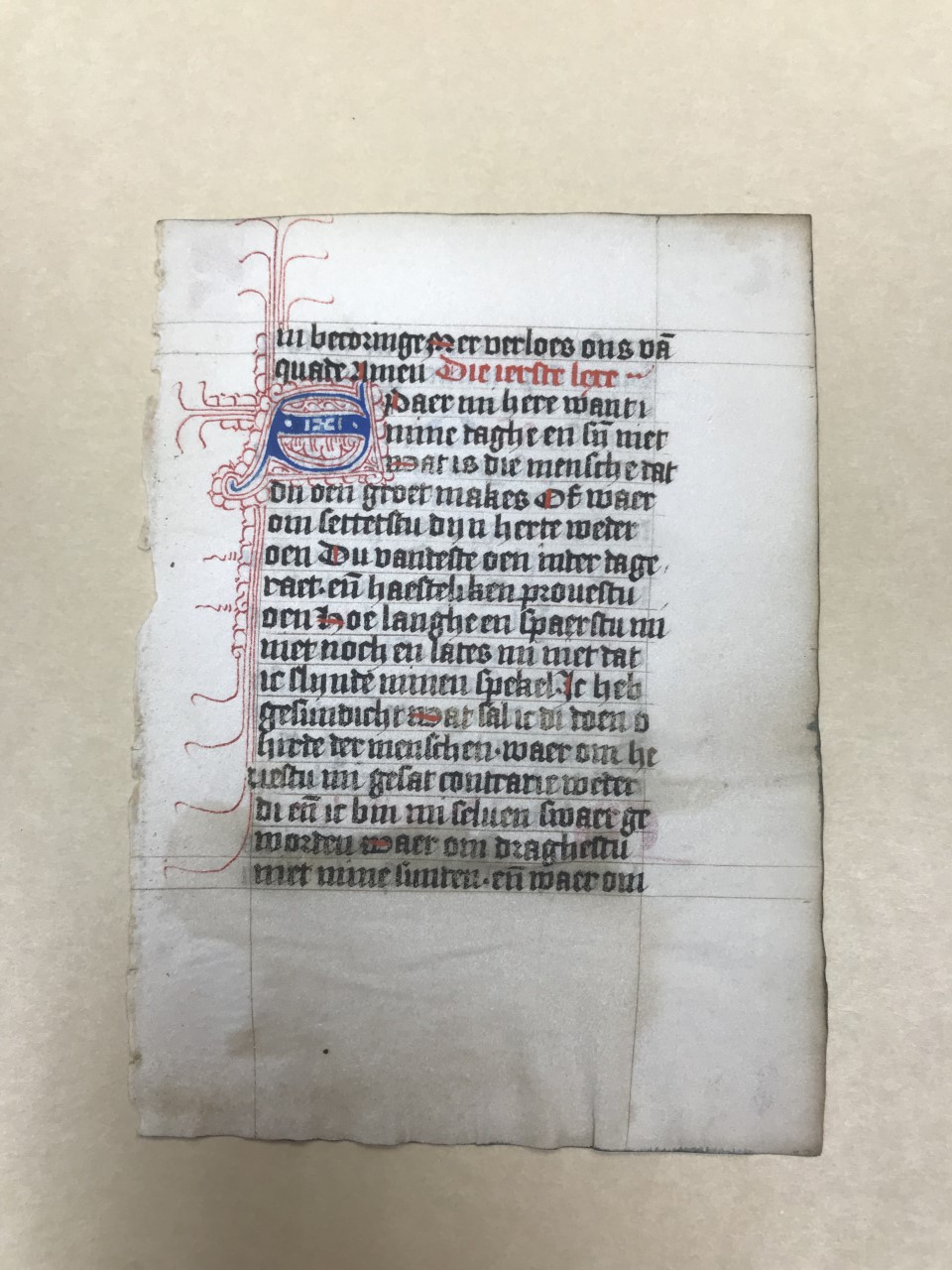
Leaflet from MASC at WSU

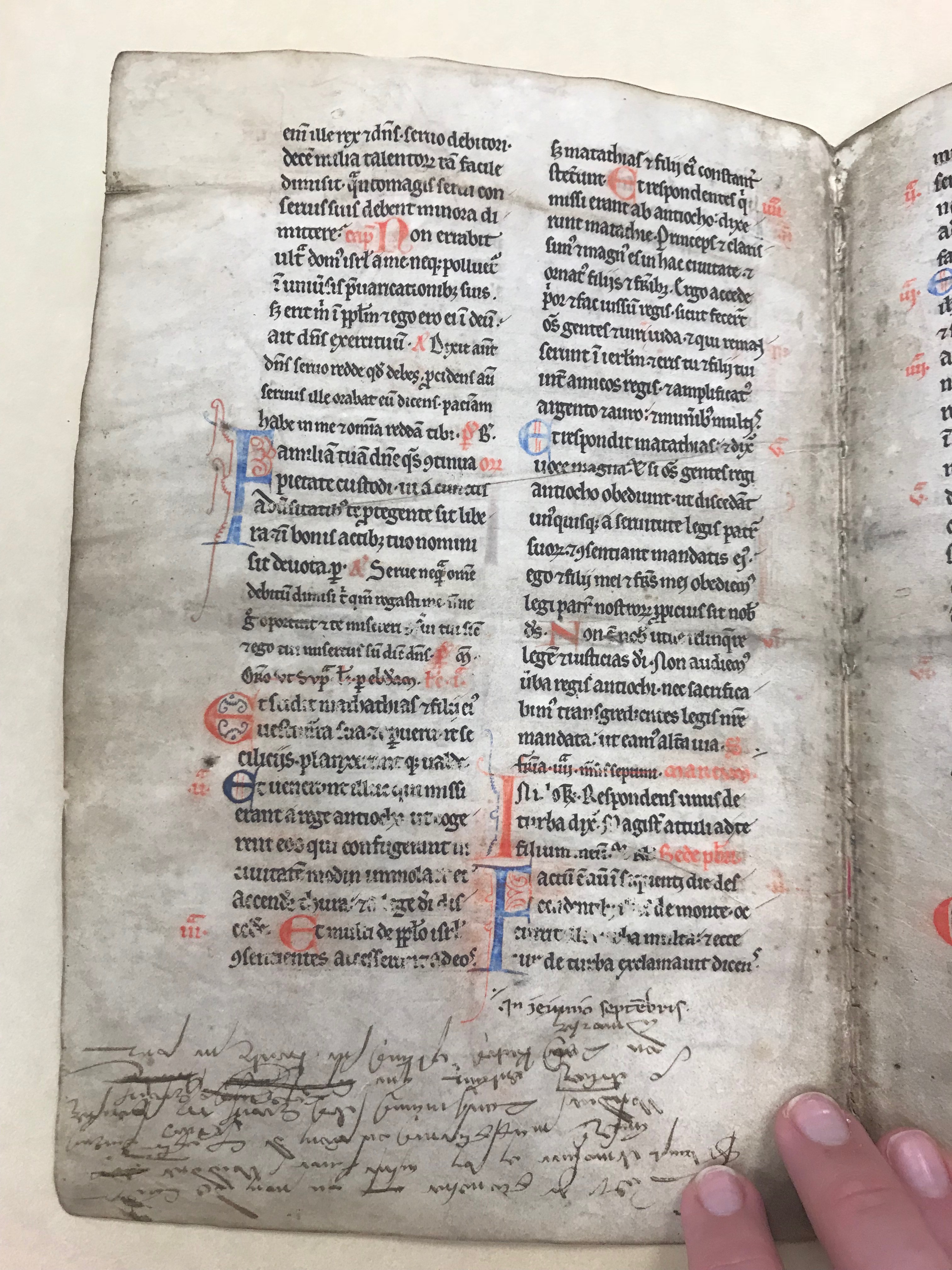
I thought this leaf from a book was interesting because of all the care that this page has seen. The calligraphy is very uniform and the x-height of the lowercase letters is remarkably even. There are no ascenders or descenders written in black. For every uppercase letter, the scribe used either a red or blue ink along with enlarged the size to make it stand out. Letters at the beginning of a paragraph are even larger and have added linework for decoration. The lettering is definitely in a humanist style and is very upright. There is a little bit of contrast because of the way the pen is moving on the paper, if it is moved at a certain angle, the line will be thinner or thicker. The letters sit very evenly on the baseline, making it hard to believe that the text isn’t printed on the page. There is a part of the page that has words crossed out with a red ink and I’m very curious if that was a mistake by the scribe or if it is intentional.

Another thing I thought was interesting with this page was that there was handwriting on the bottom of the paper. There are definitely some similarities between the handwriting and the calligraphy. The writing is very angular instead of rounded just like the text above it. I think this was due to the way the pen works. The x-height is very uniform, however, the ascenders and descenders are much longer than in the text above. Unlike the slight serif in the text above it, the handwriting doesn’t have any serifs on its letters.


Posted in Fall 2018 Archive (336) | Leave a comment

Type Anatomy: Eilish Rising

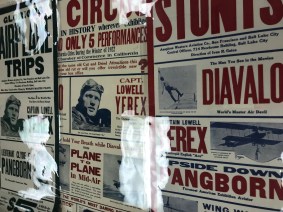
This san serif font printed on an air circus advertisement in the 1920’s caught my eye.  The simplicity of the letters follow the theme of the poster, which is to catch the attention and make it easy to read.  The bold body of each letter makes it the focal point of the poster, which then leads your eye down the page.  This poster is meant for advertising, so the fact there are so serifs or detail on the heading letters make it easy for a passersby to read easily with no effort, then possibly stop to read the rest of the poster.  Because there is so much information on the poster, a more decorative font would have made it look cluttered and hard to read, but since it is simplistic and almost gothic, it is more pleasing to the eye.  The letters are spaced just right so there is no over or under compression to strain the reader.  There is no material behind the font, just the simple modularity to advertise the airshow.

Posted in Fall 2018 Archive (336) | Leave a comment

Type Anatomy: Mikaela Thomas

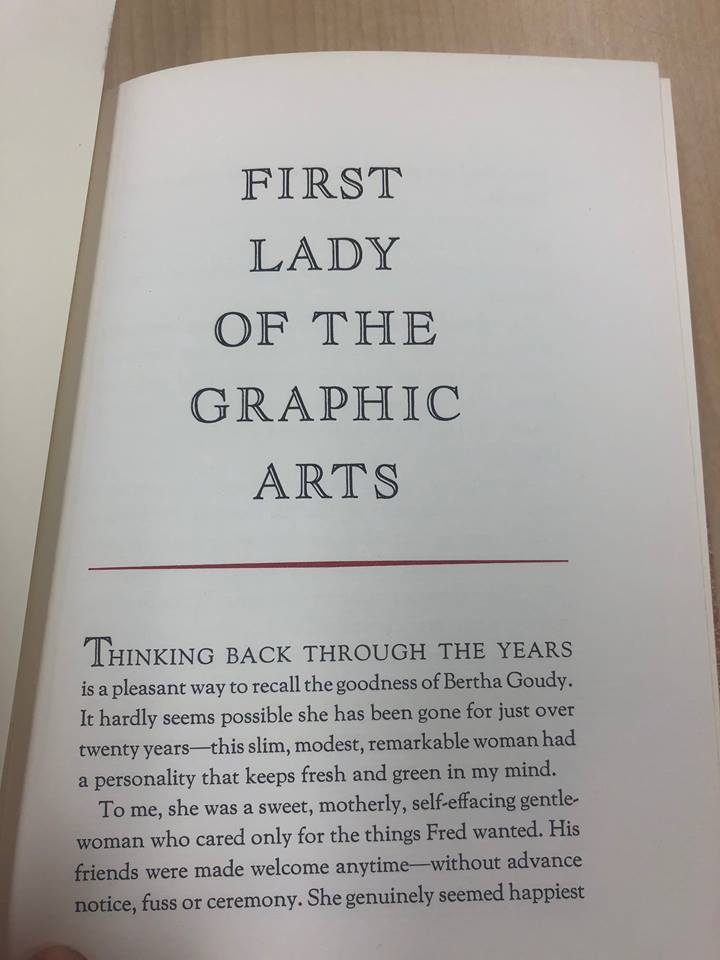
“First Lady of the Graphic Arts” title and text about Bertha Goudy.

I thought all the different type faces we looked at in the library were very interesting. One that I specifically picked out was from a text from Bertha S. Goudy: First Lady of Printing. The title is a decorative serif font that really stood out to me. It has a hollow center, so where the lines would be thick usually, it is hollowed out. I think it gives it a very formal and almost regal look. This title is paired with another serif font in the main text that is less decorative and better suited for a main text. This typeface is less decorative than the title, but still has elegant looking flairs and extra accent pieces. The title text with the hollowed out pieces really stood out to me as something I might use as inspiration for my own type design and poster for project three. I liked that it uses the negative space in a way that isn’t distracting and makes it look very fancy and elegant. It reminds me of something from Medieval times which could be something I can incorporate into my decision of what text to use for my inspiration for project three. I think the way the text looks also goes hand in hand with what the text is actually saying. The words “First Lady” makes me think of someone very important and regal, which is matched in the type. If the actual words were different, the font makes it have a different meaning. I think that is also important to remember for project three because how I chose to make the font appear should directly correlate to what the words are saying.

Posted in Fall 2018 Archive (336) | Leave a comment

Type Anatomy : Kelly-anne Cubley

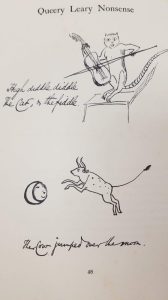
A page from Queery Leary Nonsense (1911)

The letter C in Queery Leary Nonsense.

When looking through the texts in MASC, the book, Queery Leary Nonsense (1911) caught my attention.

This book was interesting as the content was handwritten and drawn. The style of this book was fun and I enjoyed the aesthetics. One thing that really stood out to me when I flipped through the pages was the letter C.

The baseline for this letter acts more as a descender height, This can be seen with the letter j in jumped. The c almost touches this letter. The end of the C is not a barb, in my opinion, it is more like a tail that you would find on a Q.


Queery Leary Nonsense (1911)

Queery Leary Nonsense (1911)

When flipping through the book, I found the letter C used in a variety of ways. This was especially prominent within the bird section.

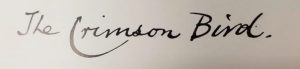
When looking at the Crimson and Orange bird pages, there are two very different letter C’s displayed. This interests me as they are both capital letters. The top barb is more intense on the bottom one which makes sense as the letter stays balanced. Another thing that is strikingly different is the counter space. The top C, used most often, is wide open and this allows the next few letters to sit inside of it.

A similarity that these letters have is the stress line, it is not exactly the same though. However, It does look like the stress line is rotated.

In general, I love looking at handwriting and I think a lot about letter formation when writing my own works. With these vocabulary terms, it is a lot easier to explain what I am seeing to others.

Posted in Fall 2018 Archive (336) | Leave a comment

Type Anatomy – Hannah Talarico

IMG_9191

Circus Air Show, California Cities. Winter 1922

The poster that I chose to evaluate after our museum visit was the large Posters that were advertising the Air show, and the daring tricks that they did. This specific poster had a large serif type face with bold block letters. The bold letters created a sharp, clean, and eye grabbing font that draw viewers in to see the show. On the posters you can see how each heading, name or important information was in red, bold letters with the largest serif font. The surrounding fonts are at a slightly smaller size, with the names of the pilots, the location, and other trigger words such as ‘Plane’, or ‘Mid Air’.

Another aspect that our instructor informed us about, that we see on these posters is the importance of the information. The larger the font, the less important the information is, and the smaller the font, the more important the in formation is. We see that on these posters for example; at the top it says ‘Circus’ in the largest font, then one line below it says ‘In history’ then below that, ‘Only  5 Performances’, then below that the date and location with ‘California Cities During the Winter of 1922’. Throughout the posters they also add various photos that include pilots, and the tricks that they do. These photos also compliment the posters and add another eye grabbing aspect to them.

Posted in Uncategorized | Leave a comment

Type Anatomy: Julia Midkiff

This sample of typeface from the book Printing of To-day features a very curvy and decorated cursive style that has both uppercase and lowercase letters. The simpler letters, such as m, r, t, and v, are contain small serifs while letters like d, s, and y are more extravagant in their overall shapes. The x-height is very short in comparison to the long ascenders and descenders of the f, h, g, y, w, d, and b letters. All of the letters are fairly geometric in their bodies, consisting of both straight lines and very rounded curves, but the ascenders, descenders, and the way that letters like h and s drop below the baseline give it a slight organic feel.

The uppercase letters are much curvier and more organic in comparison to the lowercase letters, and interestingly most of them drop below the baseline. For example, the body of the P in Peronnik has a body that takes up all of the space above the baseline and the tail extends down below it. Typically we see that only in the lowercase p. The uppercase are also much wider and spacious feeling while the lowercase letters are very compressed, especially seen in the word “narrative”. The font feels very bold overall due to the little contrast between thin and thick lines, and it has a predominately upright posture (with the exception of h and t) which gives the typeface a very strong and firm presence despite it’s curvy decorations that extend from the geometric bodies. We can also see an example of parenthesis used in this sample, which are very angular and match more with the style of the lowercase letters.

IMG_3919

Printing of to-day: an illustrated survey of post-war typography in Europe and the United States by Oliver Simon, 1928

Posted in Fall 2018 Archive (336) | Leave a comment

Anatomy Blog Post Jan Rac

For My Type Anatomy blog post I chose to write about the Bible it was written in the 15th century. This book largest produce early life of printing in 1450 was a copy of the holy bible. It has been translated to German translation including the gospel verse and everything is translated into German. The thing that struck me was when the person was talking about the bible and how it has been translated to german. Growing up Catholic I found that super fascinting because I never seen a bible translated in a different language the only thing I got close to see is through images on the internet but that about it. Something that is super eyepopping about the text they used different bold colors and used different sized fonts. Another intersting fact about the holy bible is that every captial letter has a colored letter to start it out it was probably a sign of the start of the capital letter. Something else to consider is that the text is written in such a different form from the gospel to the actually bible verses. 

Posted in Uncategorized | Leave a comment