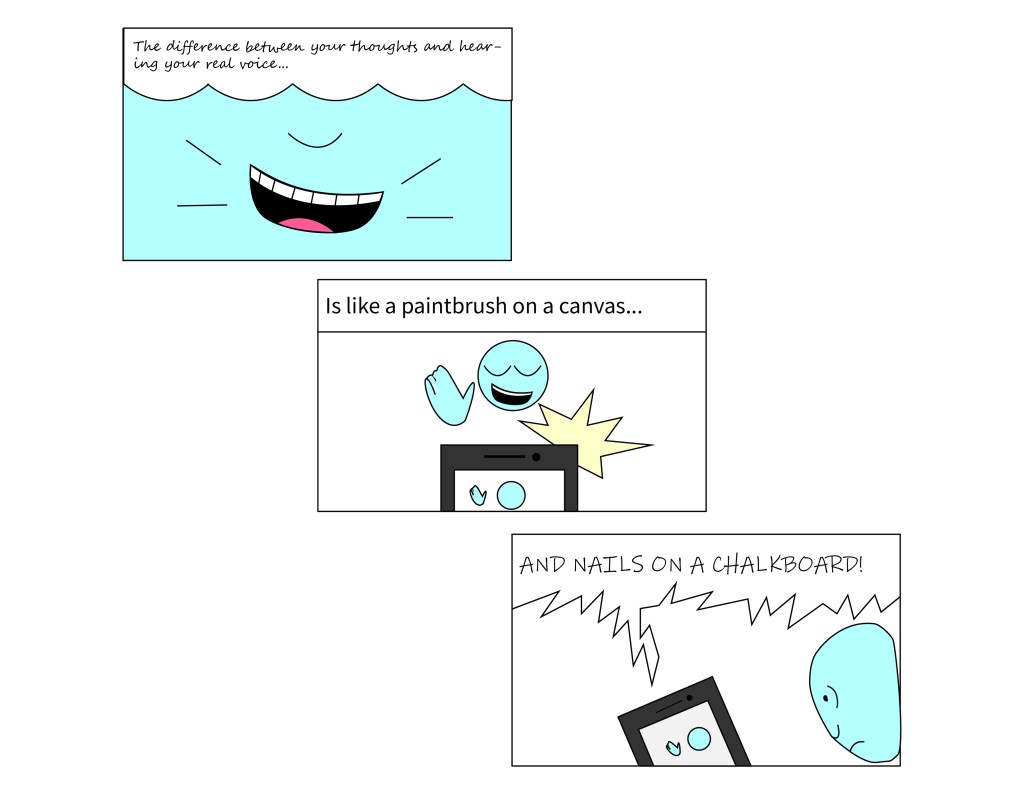
For this word specific assignment I wanted to test some new techniques and tools. I came up with the idea of the joke of hearing your own voice when I learned that this project should focus on word scripture and text. I also wanted to show a clear downfall in the quality of the text. From elegant and nice, to basic and ideal, down to erratic and unpleasant, just like my voice. I also show the decline by having the panels go from top left to bottom right to keep the left to right reading pattern but also a panel display of dropping.
I first drew a mock up visual to make the Illustrator process easier and with guidance. I minimized the the colors in this comic because I wanted to let the narration or text be the main focus. I used the eyedropper, pen, ellipse, and swatches to create the images. For the texts, I used the pen tool to make the two different text bubbles. I also changed fonts and different bold lines. The fonts I used in order of top to bottom were: Segoe script, Source Sans variable, and Ink Free.
the assignment was cool and I had a good time changing the focus of the comic from the visual to the text and making use of the joke about talking.
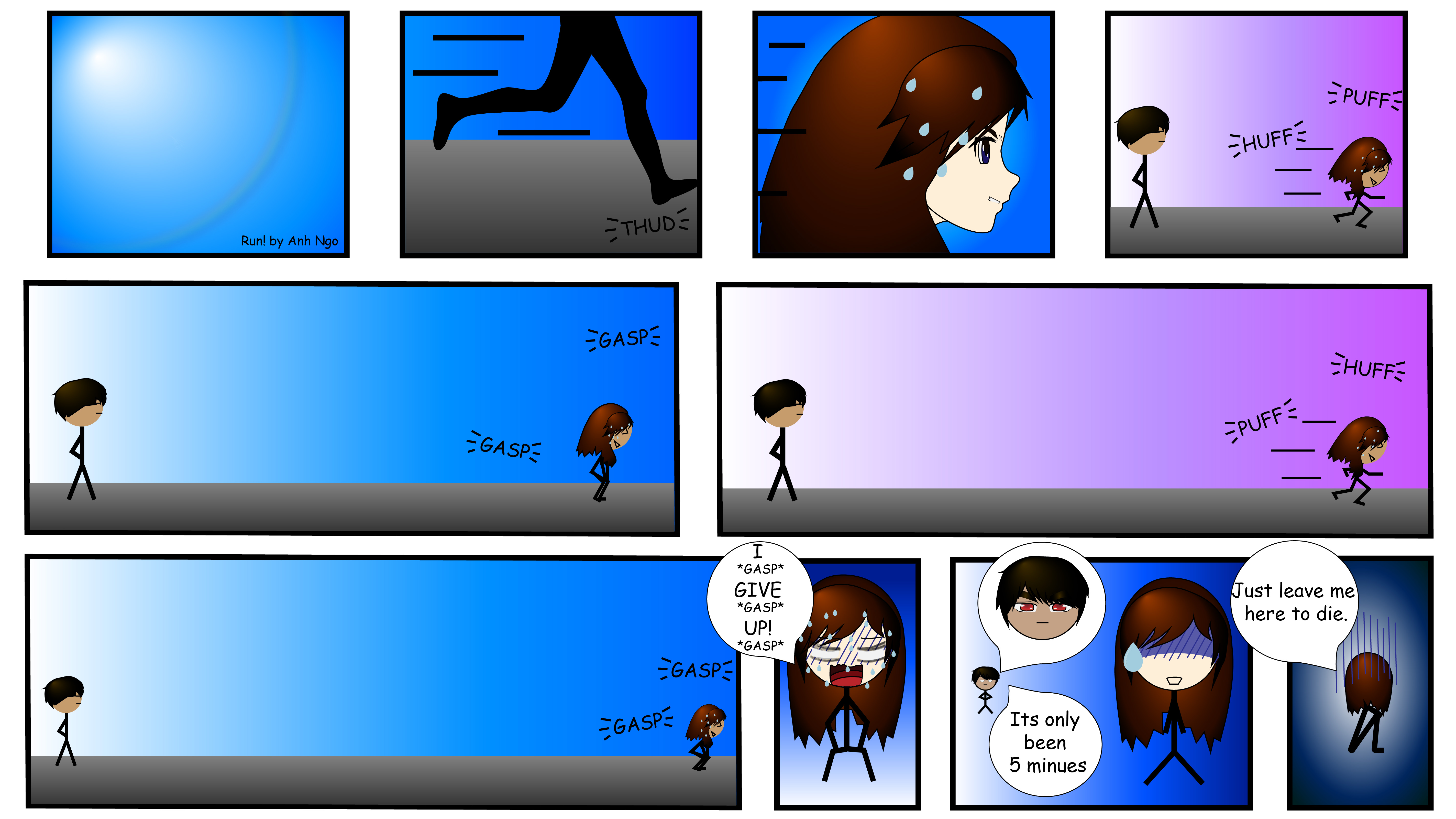
In chapter 6, McCloud talked about the importance of having a balance between words and pictures. Without balance, the story would differ from the author’s intention. For my comic, I created a visual representation of how it is like whenever I go running through the use of Illustrator. The tools that I used to create the characters and backgrounds were the pen tool, shape tool, gradient, clipping mask, and text. I used the pen tool to manipulate the character’s facial features, hair, body shape, and speech bubble. I used the shape tool to create the rectangular panels and the smaller version of that character’s heads using the eclipse tool. The gradient tool allows me to create some 3-D feel to the comic.
Run! by Anh Ngo
Although the comic does not contain too many words throughout, the dialogs that are provided towards the end of the comic still plays a crucial part in allowing the readers to understand the story. With too many dialogs, the words would not add much value to the story as the montage gives the readers a visual cue in understanding what the characters are doing until the very end of the comic. However, without the use of dialogs, the readers might come up with many different interpretations that could be unrelated to what the story is about. For example, instead, it is about a person being exhausted after running for only 5 minutes, without words, the reader could see a character is trying to run away from another person but failed and got kidnap. Similar to what McCloud said in his book, “the different ways in which words and pictures can combine in comics is virtually unlimited.”
With that in mind, I used both the picture specific combinations and interdependent word-picture combinations. In the first 7 panels, I used picture specific combination by creating a juxtaposition of a character’s running montage. To add some dimension to the comic, I added some sound effects. In the last three panels, I used the idea of interdependent by adding some speech bubbles for the characters. Without the speech bubbles, you are able to see that the female character is feeling exhausted through the expression of her face and that the male character in the back said something that made the female character face turn blue and then being by herself in a dark area in the end. By adding in the text, the reader can now understand that the female character is done running. However, she has only run for 5 minutes. She feels embarrassed and wants to be left alone. The “words and pictures go hand in had to convey an idea that neither could convey alone.”
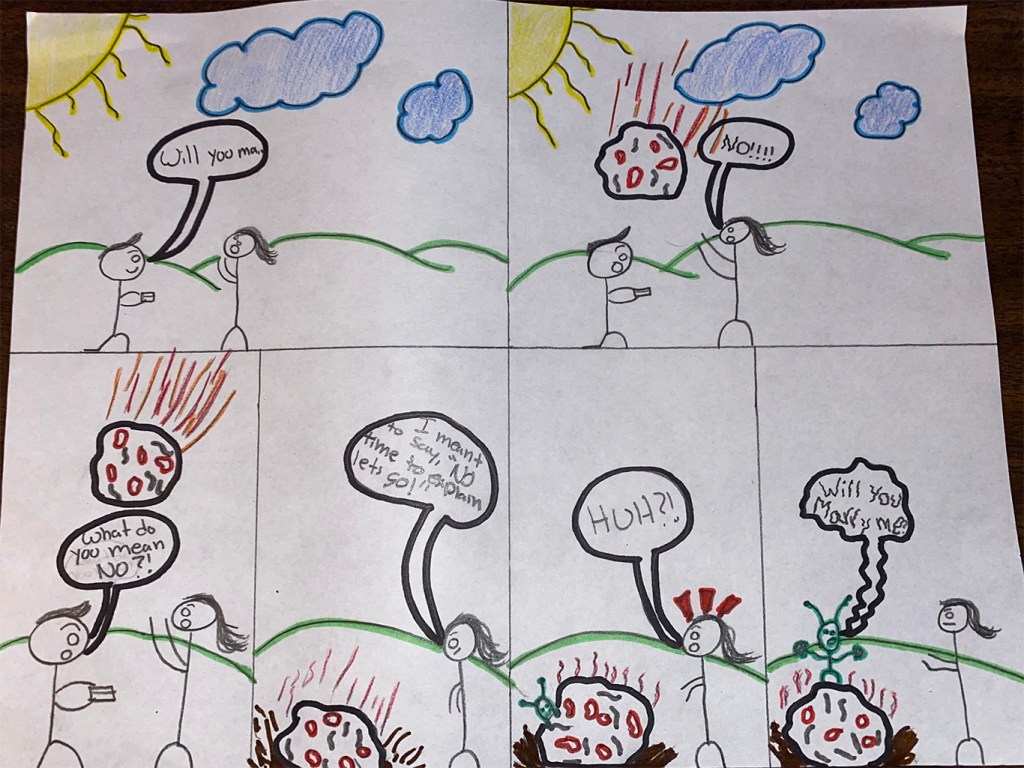
For this week’s comic, we were asked to make a comic that represents how words and pictures can be used to help the viewer connect and feel emotion. This week I took a break from illustrator due to my program repeatably crashing, so I went back to the roots. I drew a comic that showcases a worst nightmare for those who plan to marry, something that you may never think could happen… actually could. A meteor flying into earths atmosphere hurling directly in the destination in which you are on one knee about to pop the biggest question of your life. The car-sized meteorite quickly takes your spot, as your soon to be fiance is standing there in shock she notices something odd. Ahhhh the plan all along, his timing was perfect.
Th
This comic was very fun to make and kept my imagination alive during the process. For the use of words and pictures, I feel that I did a pretty good job displaying emotion through the words and having the pictures to show what the words connect to. For example, when the girl yells NOO!! we know that she is shouting up to the meteorite in fear it is gonna land on them. There are a few things that lead us to know that she is saying no about the meteorite and not to her boyfriend. The first and most obvious one is that there is a meteor hurling towards them, another is her arms and eyes pointed at the meteor and not the boyfriend. All of these play a part in helping the scene be more understandable and readable. Another aspect of this comic is the color, having the color be able to highlight certain things in this comic helped greatly.
For this week I learned about how words and pictures go hand and hand in order to convey a message. In Scott McCloud’s, “Understanding Comics” he talked about the different ways words and pictures can combine in a comic. The comic I created for this week, I attempted to use interdependent word-picture combinations in all the panels to create a type of atmosphere in order to tell a story.
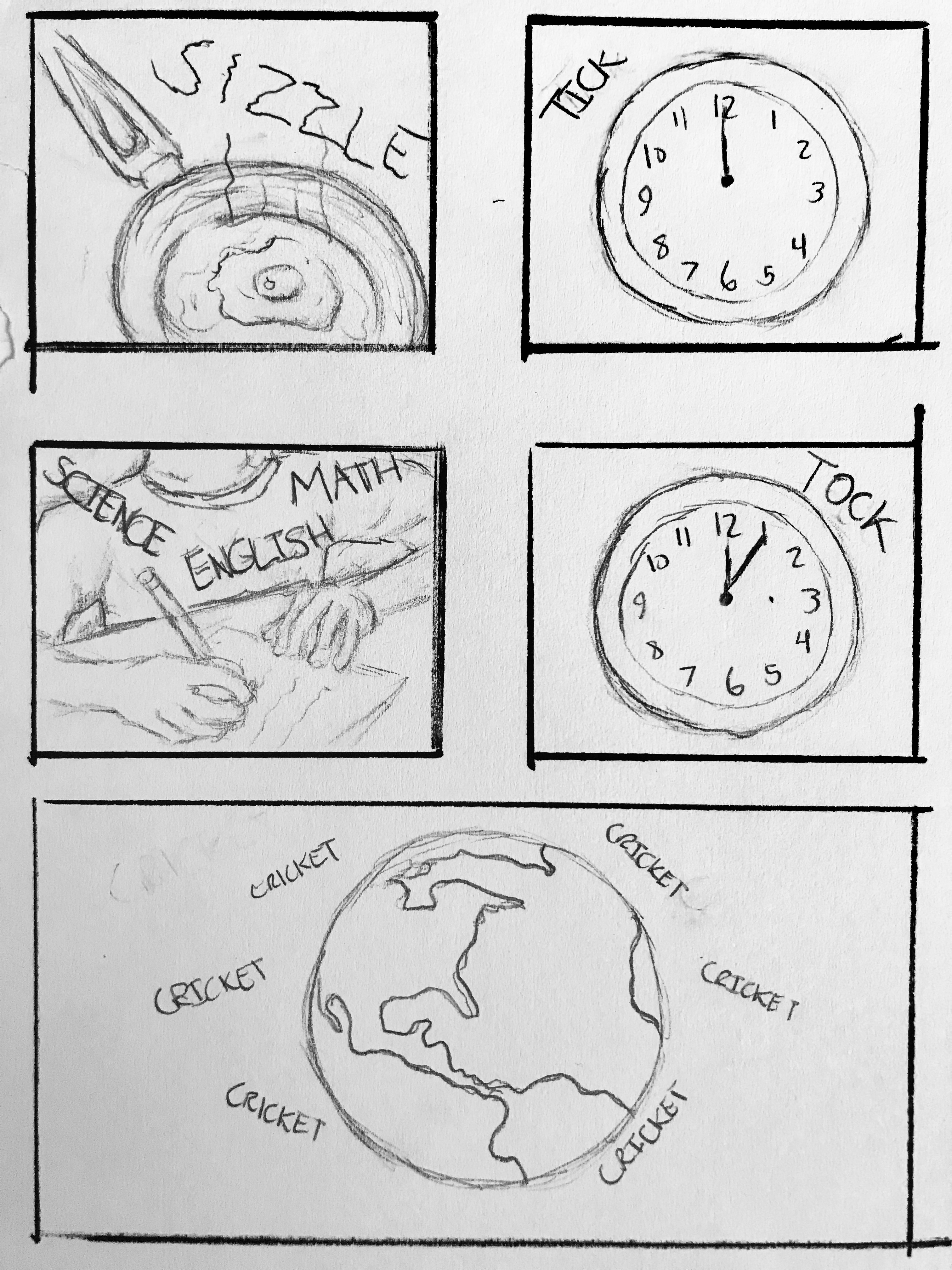
“Life” by Edison Soliman
For my comic this week I tried to convey how life feels during these weird times. For the first four panels I drew everyday tasks that I do at home as time goes by. The way I combined words and pictures together is through montage. I made the words more of an integral part of the drawing. In the third panel I drew a me writing on a piece of paper, but with the words floating around it that say “math, english, science”, it helps the reader figure out that I am doing my homework. The rest of the panel are more sensory in order to describe the atmosphere. The eggs sizzle as they are being cooked and time goes by real slow as it takes two panels for it to go “tick tock”. Finally in the last panel I tried to bring everything together by switching to the whole world as it is at a halt as described by the sensory words of “cricket” that I put around the Earth.
The way I created this comic was through a simple, paper, pen, and pencil. I still believe I am able to convey emotion more through hand drawings rather than digital. I also wanted this to be a very simplistic comic to help go with the message that life I currently really relaxed but repetitive that it could get really dull fast.
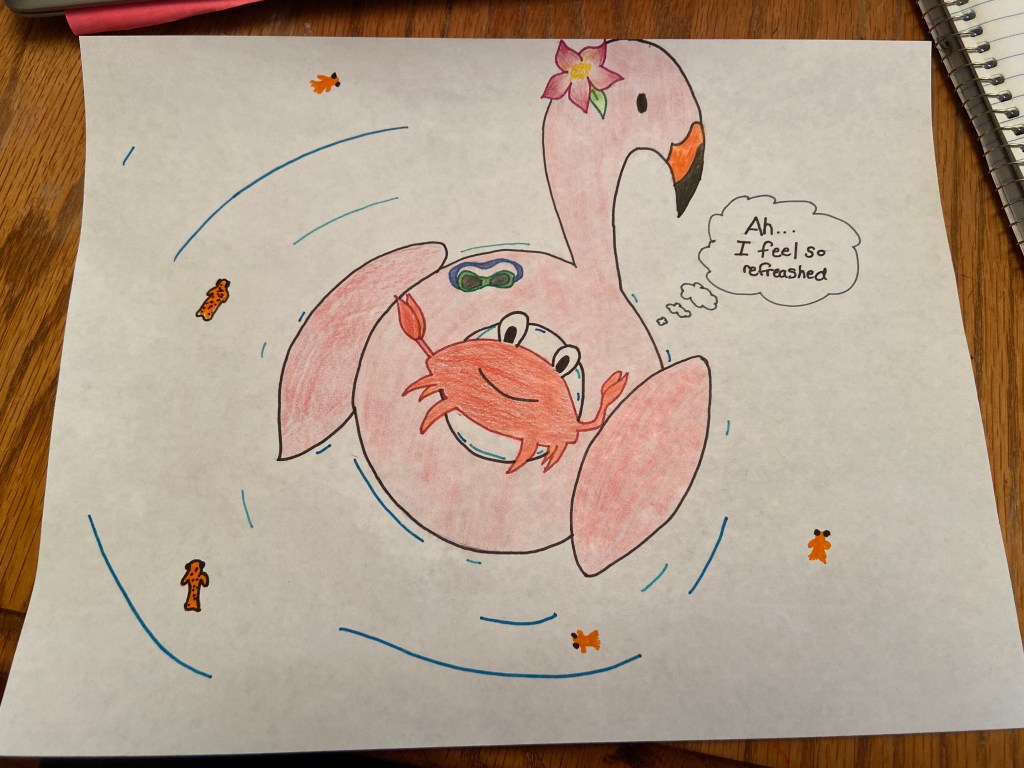
This week my comic is about relaxation, because I think that is something we all need. My comic uses interdependent work-picture combinations by showing the picture of the crab and then with the speech bubble on the top confirming what the crab is feeling and doing. I think my comic is using interdependent word-picture combinations because of the relevance between the picture and the text. I made this comic on paper again, just like my first weekly comic. I used colored pencils and flare pens for color, then I used a regular pencil in order to draw everything. I think that the specific nature of these tools affected the visual presentation of my words by not being your average image. Each person has an art style, and because of that art style some things may look different or each person sees the same thing but in a different way. So I might take the crab relaxing, but someone else might think that the crab is doing something else. This week is really similar to last weeks techniques. I just tried to draw what was in my head and picture how I could improve from last week, from the coloring and the drawing. Last weeks was really simple and this week I wanted to try a more complex drawing with a bit more detail. I also wanted one main subject compared to the whole page being the main subject. I also tried to shade with coloring and adding more movement lines and making it look more like a cartoon than realistic compared to the first one. Some type of closure that are taking place between the panels of my comic is that they are mostly one frame long, so a very short comic, but it gets its message across. Each one displays the main part as to which they need to show for the assignments, then I added a bit of detail and that was it. I think for this comic I do work inventively with time. I say this because in this comic it looks as if time has stopped, but in fact it is still moving, but just moving slower. Compared to the first one where time stopped and I was trying to show what was happening as if a picture was taken.
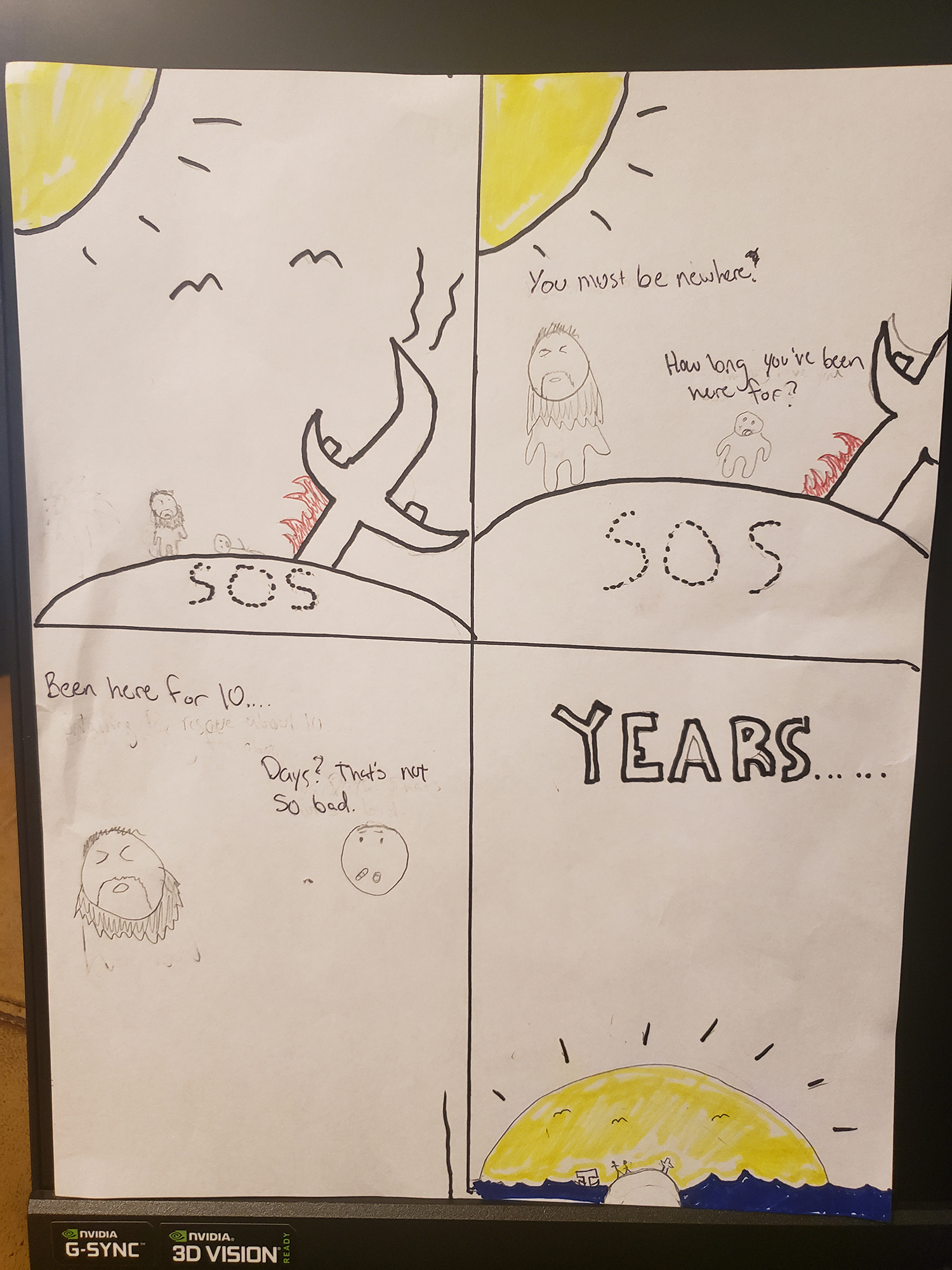
For my second blog I chose to use a combination of words and pictures to convey my story. I used interdependent word picture combinations for my comic because there are times when you can only use words to get your point across, while other times you can only use pictures. The picture specific elements are most prevalent in the first panel as there are no words. Words are not needed because the illustrations already tell that part of the story, so adding words would be deemed unnecessary. In the last box I used a duo specific element by using the combination of words and images that end up telling the same story. I wrote the word “years” in large print, and drew a zoomed out image of my background to both tell the reader that the character has been stranded on that island for a long time.
I hand drew my comic this time because I wanted to take a break from illustrator and try something a little different. It was a little difficult as I did not have any color pencils and had to scurry around the house to look for different colored writing utensils. I felt like it was more difficult then using illustrator because drawing with your hand isn’t as precise as using a pen tool on illustrator. It would also be a lot easier to fill in things like the sun and ocean on illustrator rather than having to fill it all in with a marker.
I feel like the type of closure that is taking place in my comic is moment to moment because not a lot of different actions are taking place other than the two characters communicating with each other. I think the last panel is an example of how I work inventively with time. Due to it being scaled differently than the rest it could show how slow time has passed.
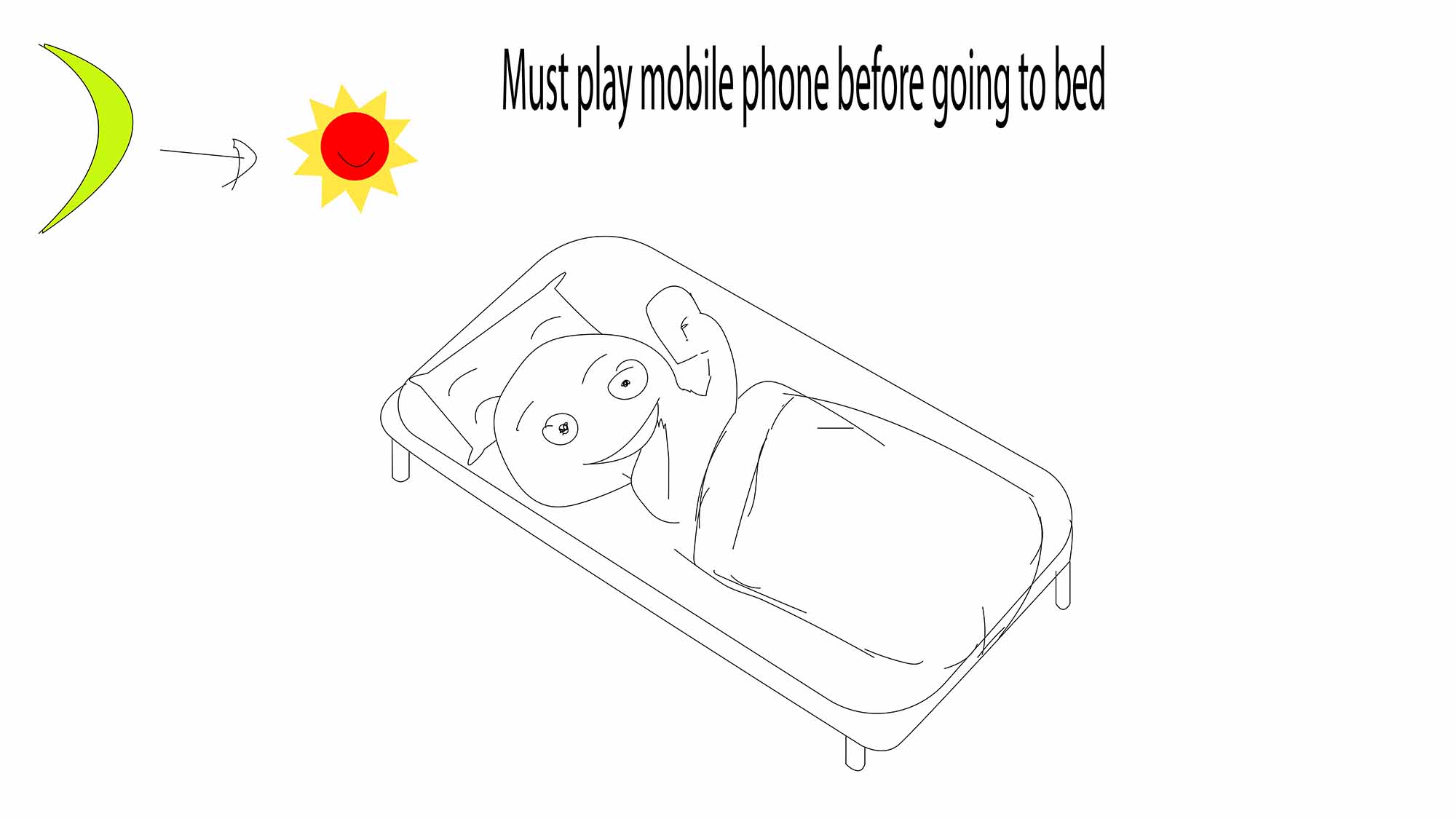
This week’s comics, I chose to form a story with words and pictures, or that this artboard is not a story but should be a very popular phenomenon. In the drawing board, I used duo-specific, additive, and parallel.
Through the combination of text and pictures, I told people that many people like to play mobile phones at night and lie in bed, and they ca n’t stop after playing mobile phones, which affects their sleep. I chose Illustrator for this cartoon.
Although I am not very skilled, I still finished it. I used Illustrator’s pen tool and pencil tool to draw and assemble this cartoon. I think it might be easier to use a pencil, but I think this is a learning process.
Illustrator is very good and will definitely be used in the future. Then my cartoon about the concept of time is still useful. Because I tell the readers events through words and the passage of time from the moon to the sun.
The way I chose to incorporate interdependent word picture combinations is with the split panels and the different kinds of text that I used in each. The first thought bubble is of plain text and is surrounded by plain color. The next panel however I made a completely custom text that started as large font that I was able to separate and add to. The text portion of this project probably took the longest to assemble because of the detail that I was trying to put into shaping, coloring and giving it some depth. Unfortunately a lot of the smaller details that I put into the custom text is some what difficult to see. I wanted the text to emulate what the word actually was in contrast to the other side of the comic. Obviously to make two conflicting styles in the comic one side is straight forward and unchanged text while the other panels text is more reflective of what the word is. I think that the interdependent word picture combinations that I did were interdependent and duo specific. I used a lot of the shape builder for certain parts of the comic, however to build the custom text I broke the text up after adjusting it to be big enough to manipulate. After that since each of the letters were now separate shapes I could add to the shapes with the pencil tool. Once I had added all the shapes that I wanted to the lettering I then made it one solid image again. Although it is hard to tell there are soft accents to the lettering that give it a sort of highlight or shine in some small areas. To do this I actually had to create my own art brush and apply it to lines that I put inside the lettering to make it look like small highlights within the letters.
After reading chapter 6 of Scott McCloud’s Understanding Comics I had a little bit of a hard time coming up with a creative Idea for my comic. When I did figure out an idea, I had a little bit of a rough time conveying it to where my story could make sense to the reader/viewer. Eventually, I came up with this comic:
Comic By Chloe Brusseau, hand drawn (week 14 comic)
In this comic, it tells the story of 2 boys who are contemplating exploring an old attic. They are a little scared, and are thinking about what is holding them back (the dark and scary critters). Ultimately, the two decide to leave and come back the next day to explore, justifying that there is nothing to worry about and they are probably over exaggerating what might be in the attic. As they walk away, a snake slithers out of the attic, confirming their fears and leaves a foreshadowing effect that things might not be so good for the boys.
I utilized interdependent word-picture combinations in 3 out of my 4 panels. In the first panel, the words describe the attic without saying the words “attic”, so the picture of the attic is necessary in order to understand what is going on. In the third panel, one boy says “Just think of all the critters up there,” and there are pictures of spiders, bugs and snakes which goes hand in hand with what he is saying. The fourth and final panel shows the boys walking away saying that they were probably overthinking the dangers of the attic, but a snake slithers out behind them without them knowing. This is interdependent because without that dialogue along with the picture, the comedy and irony would not have been conveyed. In the second panel, I utilized a montage word combination, “where words are treated as integral parts of the picture.” (McCloud 154). The word “dark” is integrated into a big black cloud. Having simply a black cloud or the word dark standing alone would not have the same effect as they do being morphed together.
I first tried to use Adobe Illustrator to complete this project but with technical difficulties I ended up using paper, markers and chalk. I think these tools were able to help me emphasize the linguistic aspects of my comic such as the word “dark” being roughly colored around with a marker and chalk, it gives a spooky and eerie feel which is what I was going for. I am going to try to sort out kinks and use Illustrator next time.
Since this comic is short, there is a lot of room for closure that is up to the reader. In between the panels, the reader can decide what happens. There is aspect-to-aspect within the panels switching from the boys in the room and their thoughts, as well as subject-to-subject between the last two panels where the frame is fixed on the boys and then goes wider to show the snake slithering away. There is also room for closure even after the last panel; the reader can decide what they think might happen now that they can assume there are critters in the attic.
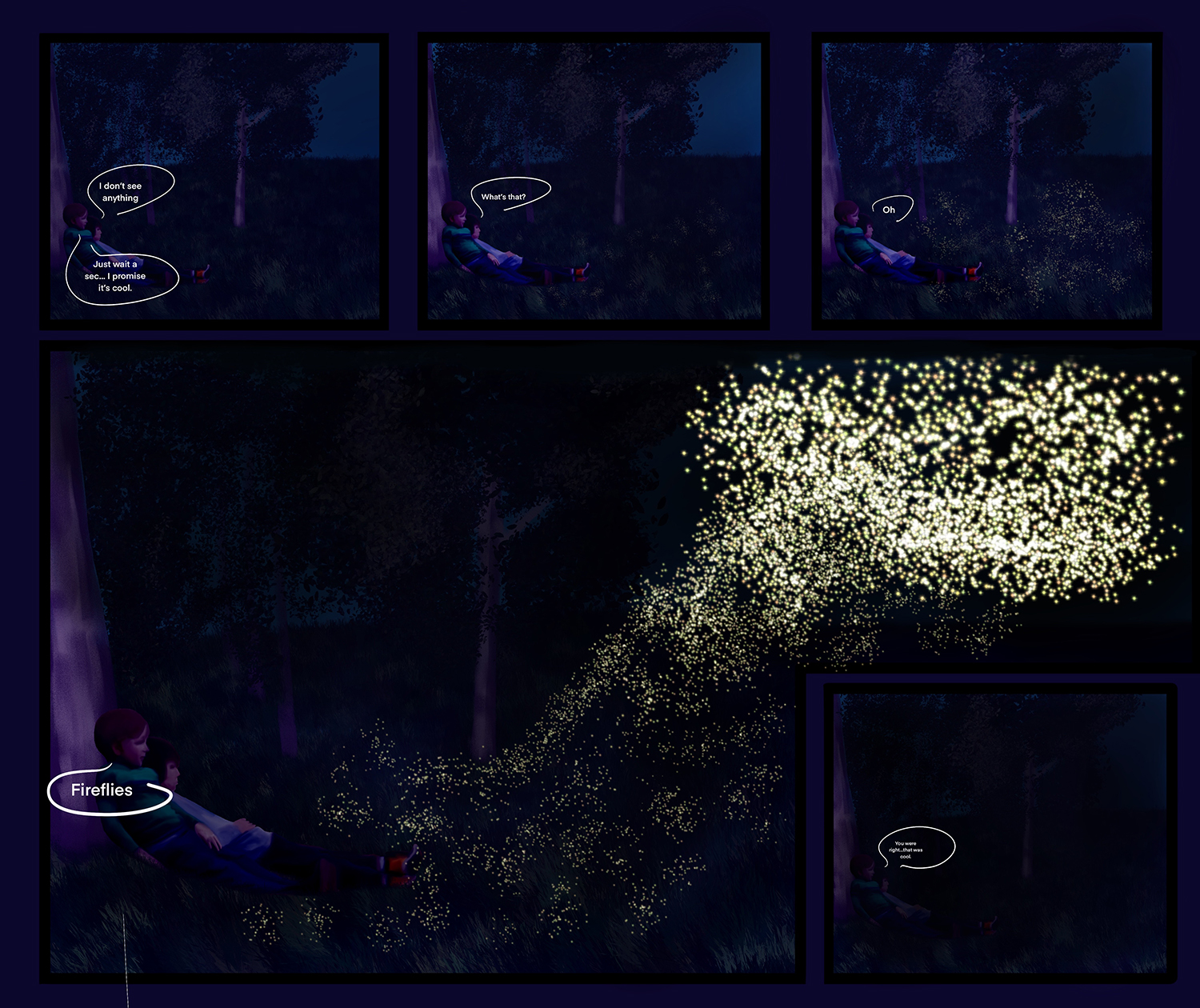
My comic uses inter-dependent word picture combinations Through the relationship between the visuals and the text coming together to create an entire story. Without one you can kind of assume what’s happening but the text confirms what the visuals are saying
I Think that my comic could potentially be duo-specific as the text and visuals line up together and the text amplifies the visuals however I don’t believe it is additive, parallel, or montage based on McClouds definitions of each.
The tools and techniques are used to create this comic including shading, line work, texture work, and the manipulation of visual light. And I think the specific nature of the tools that I used affected my visual presentation in that it’s a realistic scenario with I believe realistic dialogue that is representational of the situation.
In terms of closure taking place in between the panels of my comic I think that while there is a little bit it shows more of a transition of time between the panels as the visuals progress. People can infer what is taking place in between the panels as they are sequential and easily related to one another so in that sense I think there is a strong sense of closure implied throughout the panels and visuals.
Truthfully I don’t think my use of time was inventive throughout this comic as it’s very sequential and easy to follow one thing I did try was in the last two panels was to almost combined them into one situation with the emphasis being on the action within panel four and a gloss over of panel five as I think panel five brings a complete closure but it’s not of any true importance to the comic besides representing the end.



 Kristin Becker's DTC Classes at WSU