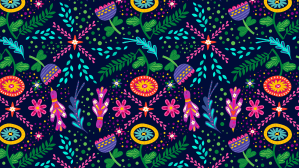
This illustration was made by DavidRockDesign and can be found on Pixabay.
Within this illustration, there are many colors against a dark blue background. Two of these colors really stick out to me. These are the pink and orange colors. Blue and orange are opposites on the color week and pink is a near opposite. This makes the small intersections of the small intersections of the orange in the pink stand out. There is also Analogous color scheme with the dark blue, light blue and various shades of green which all sit close together on the color wheel. This gives a sense of calm to the chaos of the Pinks and oranges.
All of the colors used have a strong intensity as the saturation is on the higher end of the scale. The background is what makes the piece cohesive. In all, I really enjoy these colors and the scene of balance that they create.
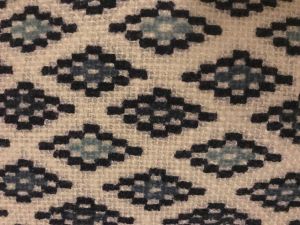
photo taken by victoria
I think with this pattern that is apart of one of my pillows really shows how contrast can affect a pattern. The dark blues stand out against the white background, however, I found my eyes drawn to the lines of the white before really seeing any of the colors within the diamond patterns. The separation between the diamonds creates almost a dot-like aspect of the diamonds and the white then becomes the defining lines. The white is most definitely used to create a harsher definition for the diamonds because it creates those intense contrasts. The two different hues draw your eyes to the dots of the pattern while also creating a pattern within the larger pattern as well. I think it is very interesting how the hue and different colors interact. I know that white isn’t always ideal however I think it works very well here. The use of multiple hues of blues within the different diamonds most definitely draws my eyes in different directions I felt that in this small section it made me feel as though I was jumping from one to another even though it was structured. Due to the colors changing in the diamonds I ended up jumping all over and not having as much of a consistency between all of the diamonds in comparison to the strict white lines. The Analogous blues work really well with each other simply because if they were complimentary I feel as though the overall feel of the pattern would be highly overwhelming and my eyes wouldn’t know what to look at first. Thinking about what this would look like with complimentary colors there would have to be a low saturation to make it less loud and look more appealing to the viewer’s eye. Overall other than the white background I think that the pattern is successful.
I found this pattern on Vecteezy and it immediately caught my attention for multiple reasons. The pattern is a conglomerate of what appear to be simple blobs. The combination of curves creates a fluid look like something is melting. The melting effect is intensified by the colors portrayed in this image. There are two different groups of colors that complement each other in this pattern: a group of red hues and a group of blue hues. There are about 3 analogous shades of red and about 3 analogous shades of blue, all varying in value and saturation. When the group of red hues are together they create a subtle gradient as your eyes go over them which helps give off the illusion of melting and helps you visualize what it would look like if there was motion in the image. The same goes for when there are groups of blue blobs. When I take the entire pattern in, the red hues stand out to me the most because of the high level of contrast between the darkest red and the darkest blue. While some of the colors are more saturated than others in this pattern, collectively they are not a highly saturated selection of colors; in fact they’re fairly pale. Both groups of hues in this pattern are polar opposites when it comes to temperature, since blue feels cool and red feels warm, but also since the colors have very low saturation it makes the entire pattern look cool.
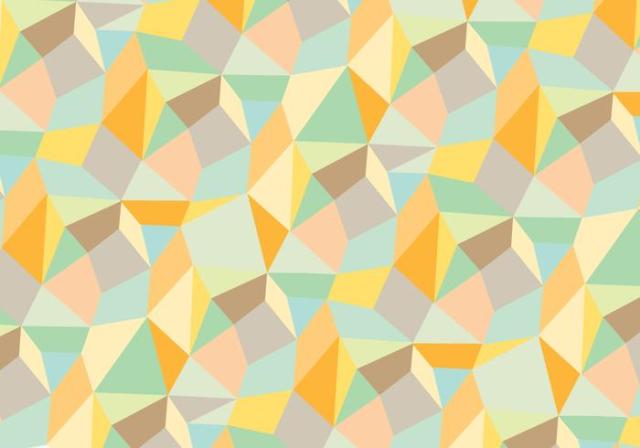
Created by Vecteezy
In this photo we see multiple colors working together to create a pattern that leads your eyes. We see the darker hue of brown intensify the the yellow hues in the pattern. In the opposite we see the light blue get less intense because of the lighter shade of green which has low contrast. The colors all have a pretty low value of intensity except for the dark hue of yellow/orange. Lastly , the colors are in fact complementary, but lack high contrast.
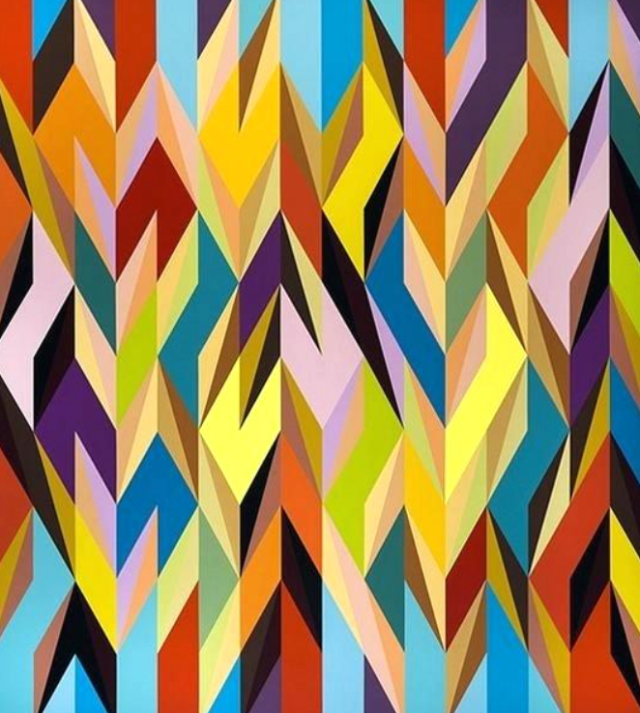
I chose this pattern because of its abundance of colors that are used. For example, it seems that each color on the color wheel was used, in addition to different values of each of the colors. Some versions are more vibrant than others. Value is defined as relative lightness and darkness of a color. This creates an interesting color interaction because some of the colors are more eye-catching than others. Therefore, the brighter colors seem to be the more dominant of the group.
In addition, the pattern is made of polygons. So, the size of the polygon and the color used on it influences where the the eye is directed towards. The colors with the bright values and bright hues are dominant compared to the dark colors. Especially the colors not considered to be on the color wheel like the brown and black–those seem to very irrelevant compared to the values of yellow and green which are bright and eye catching. Another thing I found interesting regarding this pattern is the contrast between warm and cool colors. The edges seem to contain cool colors like the blue and yellow but it is in conjunction with the warm colors like the red and oranges, ultimately creating a combining mood because of the combination of temperatures. The colors are both analogous and complementary. However, it seems like the complementary colors are next to each other while analogous colors are separate from each other. However, because this is an organic pattern there is little repetition so each block is separate from each other and new so the colors alternate from sometimes being complementary to each other and sometimes being analogous.
Moreover, in terms of ground and figure of the image, the image is made of polygons so it is hard to tell the difference of “ground” and “figure” because the same aspect of polygons seems to take up the majority of the pattern.
 I chose this pattern on unsplash of patterns and stuff I chose this unique basketball court because they have a lot of patterns and the shapes in this background. Also their are different types of patterns on the basketball court. What makes the color in the images standout the warm and cool colors are orange and light magenta/pink color for the basketball court and the background. the warm and cool colors blending the railing in the photo. there are a lot of shapes and size of the court because every basketball court is different. I think that the apartment/condo has a nice view of the patterns.
The color that really catches my eye in the photo is magenta and orange. The color saturation in this image is very light colors and I think that if you took this photo during the day it would have a nicer tone and shape for the background. If you took the photo at night I think that the color tone would’nt be as nice such as the day photo. This photo and colors are useds as postive colors because their are no negative colors. Things that portray negative colors are black, and dark purple and red. But overall the photo is a postive tone.
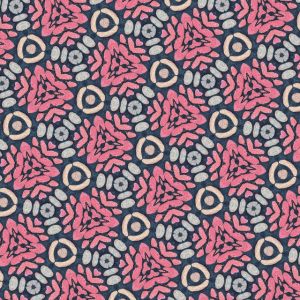
An askew hexagon pattern made with oblong shapes and red, blue, and yellow colors with a dark colored background.
The main color, or hue, in this pattern is red, a warm tone, which makes it stand out against the cool blue outline. The blue and red are broken up by yellow, which is also a warm color and also stands out because of the cool blue. All of these colors work well together because they are all high value, low saturated colors. The blue and red colors complement each other as do the yellow and blue colors. The red and yellow colors are analogous colors, but because they broken up by the blue, they still work well together. Since the pattern is light in color and the background is a dark color (a dark blue or black), the colors of the pattern are much more vibrant than they would be with a white background. The colors are so muted, but the dark background gives them brightness and vibrancy. The dark background makes a pattern that would otherwise fade into the background, stand out.
Color interaction is what can create the most emotion when it comes to design and composition. That is one of the primary reasons behind design, photography, etc. A black and white photo compared to a full color photo can create an entirely different mood and appearance. When it comes to patters, color selection can determine how the pattern shapes together.
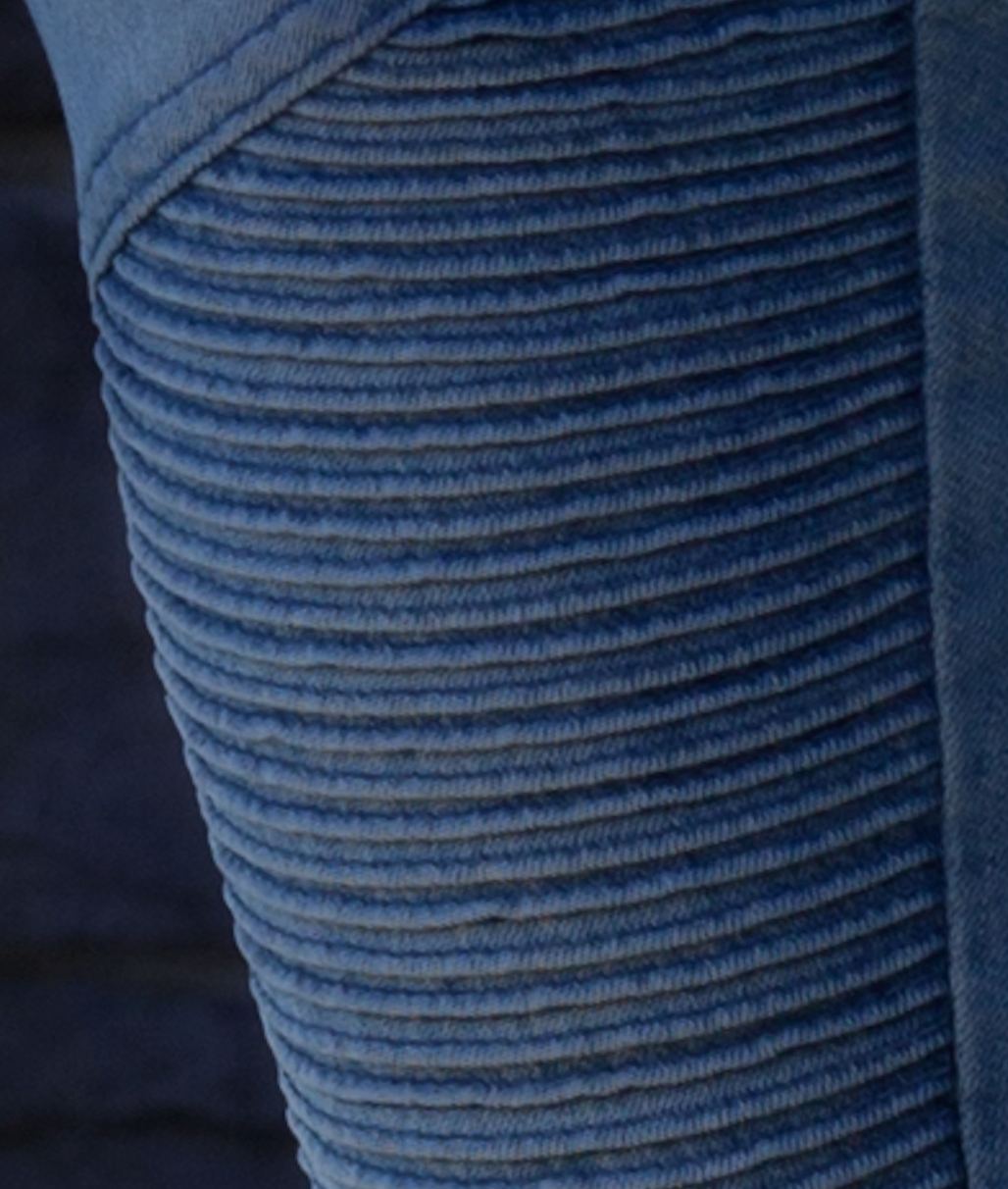
 In this image I took, I will be focusing on the detailed pant ribbing this model is wearing. A close up look shows a stripped pattern with fiber detail to create even smaller patterns within the horizontal ones. Because of the slight wash on parts of the denim, it c
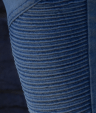 reates a darker line in-between the lighter ones, giving it only a slight contrast. The pattern looks very smooth and does not have much conflicting with each other. The lighter pieces stand out just a bit more than the darker ones because they look like they are layered in front of the darker ones, bringing it the attention.
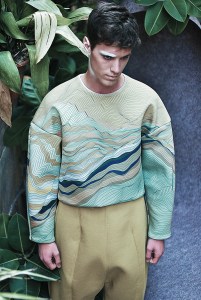
The pattern in this image from a fashion lifestyle blog shows how cool colors interact with each other. The color pallet creates a particular mood from the ow saturation and high contrast. The selection of how the colors are placed in this pattern bring attention to the very dark line in blue. The colors start much lighter on the outer parts, and darken very gradually as they come to the center (the blue line). The major contrast of the individual blue line to the rest of the shirt bring attention to the value as well. These colors all fall under blue, green and yellow hues, making the color scheme analogous, while still creating a major contrast. It is what helps create the gradual flow through the shirt as well. The asymmetry of the pattern is what helps the selective emphasis.
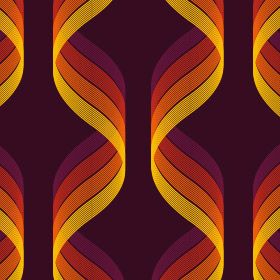
This paper pattern is an example of how triadic selection of colors on the color wheel play well together. The colors chosen bring a warm feeling to the viewer. The shade of purple cis normally seen as a cool color, but put with the other ones gives it a warm tone. The tapering of saturation throughout the paper helps guide the eye along the pattern. It has an organic shape the way the lines move, but create a geometric feel all together because of the symmetry.

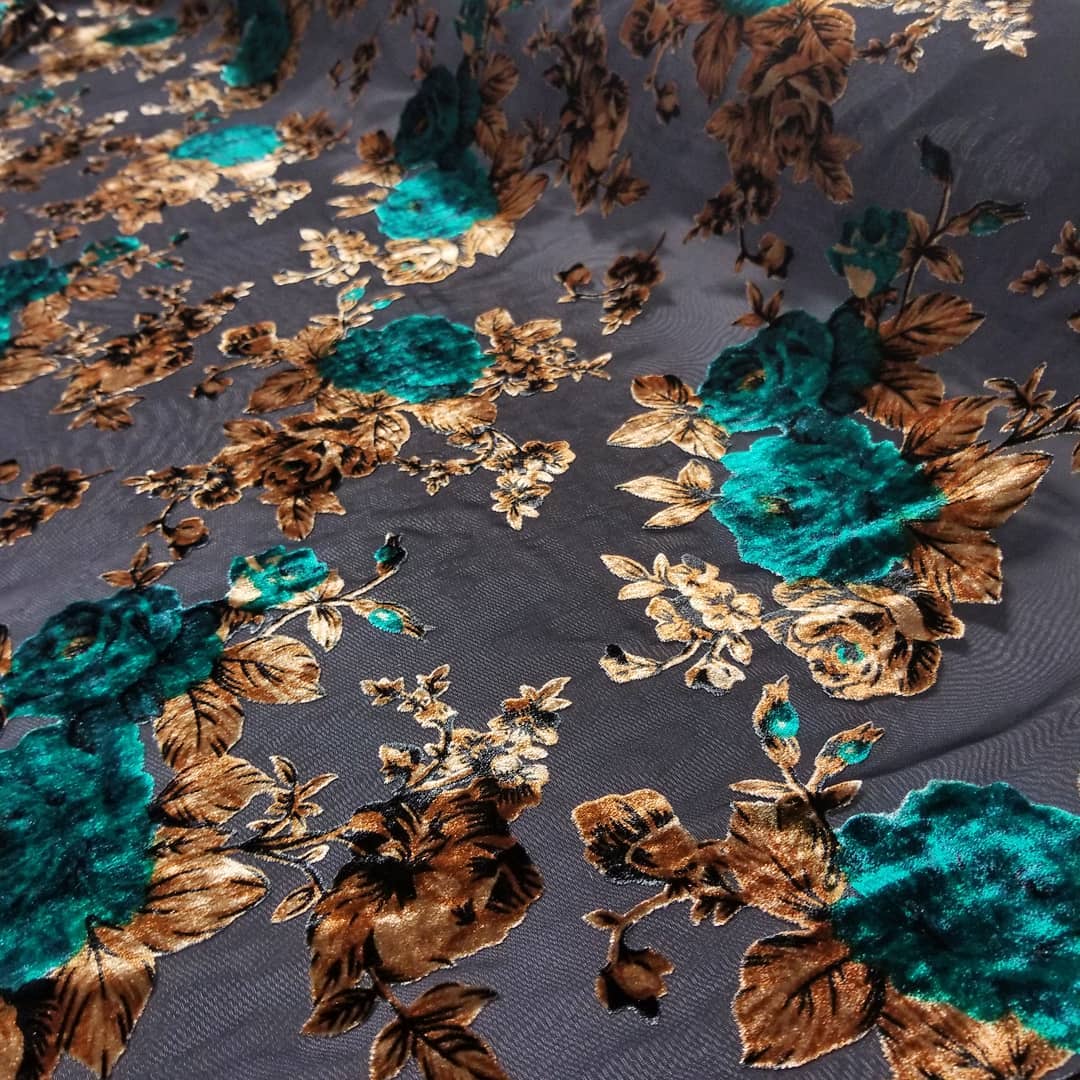
This photo of a velvet material was posted on Instagram by Mood Fabrics, an online fabric store. They created the image to promote there 15% off velvet fabrics sale. Mood Fabrics, September 2018
In the photo to the left, Mood Fabrics is showcasing a popular velvet fabric they have for sale. The pattern of the fabric features a repeating flower pattern with slightly different orientations and sizes.
The colors gold and blue/green stand out to my eye. The gold is a very muted hue, with a lighter value in most areas. The gold velvet is very saturated. The bluish green color is very vibrant hue, and has a lower value compared to the gold. The saturation seems to be very high in this color.
The contrast of the blue and gold intensifies the eye’s experience. The colors interact in a way that almost makes it difficult to know what to look at. Despite the foreground colors being very vibrant in hue, when placed close together they create a darker overall color structure. Together they create a darker almost victorian mood (amplified by the intricate pattern design).
The darkness of the purple background creates figure/ground with more attention being drawn to not only the colors but also to the texture of the velvet. The dark purple contrasts with the reflective nature of the gold, which most likely would appear more muted if isolated.
Blue and yellow (in this case gold) are primary colors and the greenish blue tint compliments the gold due to being near opposites on the color wheel. Together they almost clash, drawing the viewer’s eyes to the most important elements (the flowers and leaves).
The pattern is very organic, you can see some similarities but there is no clear direction or repetition to the pattern. The changes in color indicate to the viewer the type of texture that the fabric is made out of, and tells us how were the pattern was spatially compared to the camera.


 Kristin Becker's DTC Classes at WSU