Design Elements and Principles: Ivy Padayao

Within Scott McCloud’s book “Understanding Comics” you can see many similarities between what he is trying to express to his reader about design choices and what John Lovett is explaining in his design overview. Within Scott McCloud’s book you can see him portraying his design choices very effectively, but what stuck out to me most as a reader was pages 132 and 133. Within these pages the elements that really popped out were his use of lines, texture, and harmony.
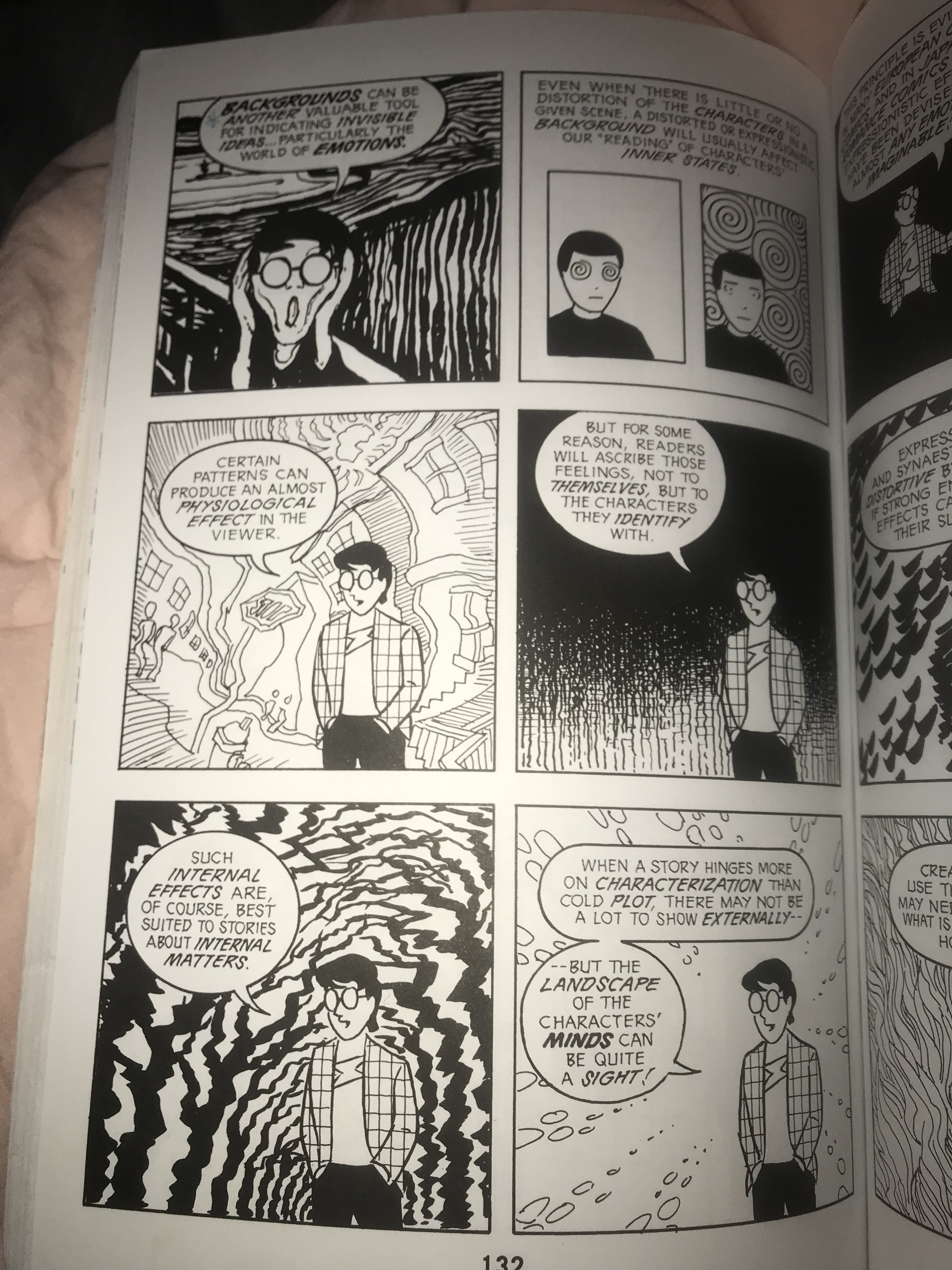
Page 132 of Scott McCloud’s “Understanding Comics”

The use of line seems like one of the most “simple” elements to create as an artist, but it really sets the tone for the whole art piece. If it doesn’t flow just the right way it might throw the artwork off and make it harder for the viewer to comprehend. For example, on page 132 the second box down on the left , you can see how specific he meant to make the lines to look warped to the reader– a kinetic line. He used to the line to make it seem like the picture was moving or warping into something else, or in his textbook he describes it as a “psychological effect”.


The use of texture, to me, is what hooks me into a design or piece of art the most. The different values and lines interests me so much. Within page 133 of Scott McCloud’s book in the bottom 4 boxes of the page, Scott McCloud does a really great job at showing different kinds of textures and how they can effect the reader. While it may not be physical  texture since the work is in the book, the reader can imagine what each picture would “feel” like in the sense of drawing. For example, on the bottom right box of page 133, the reader can sense that the squiggly spiral drawing would feel a bit rough compared to if he had just drawn the spiral in a straight smooth line.
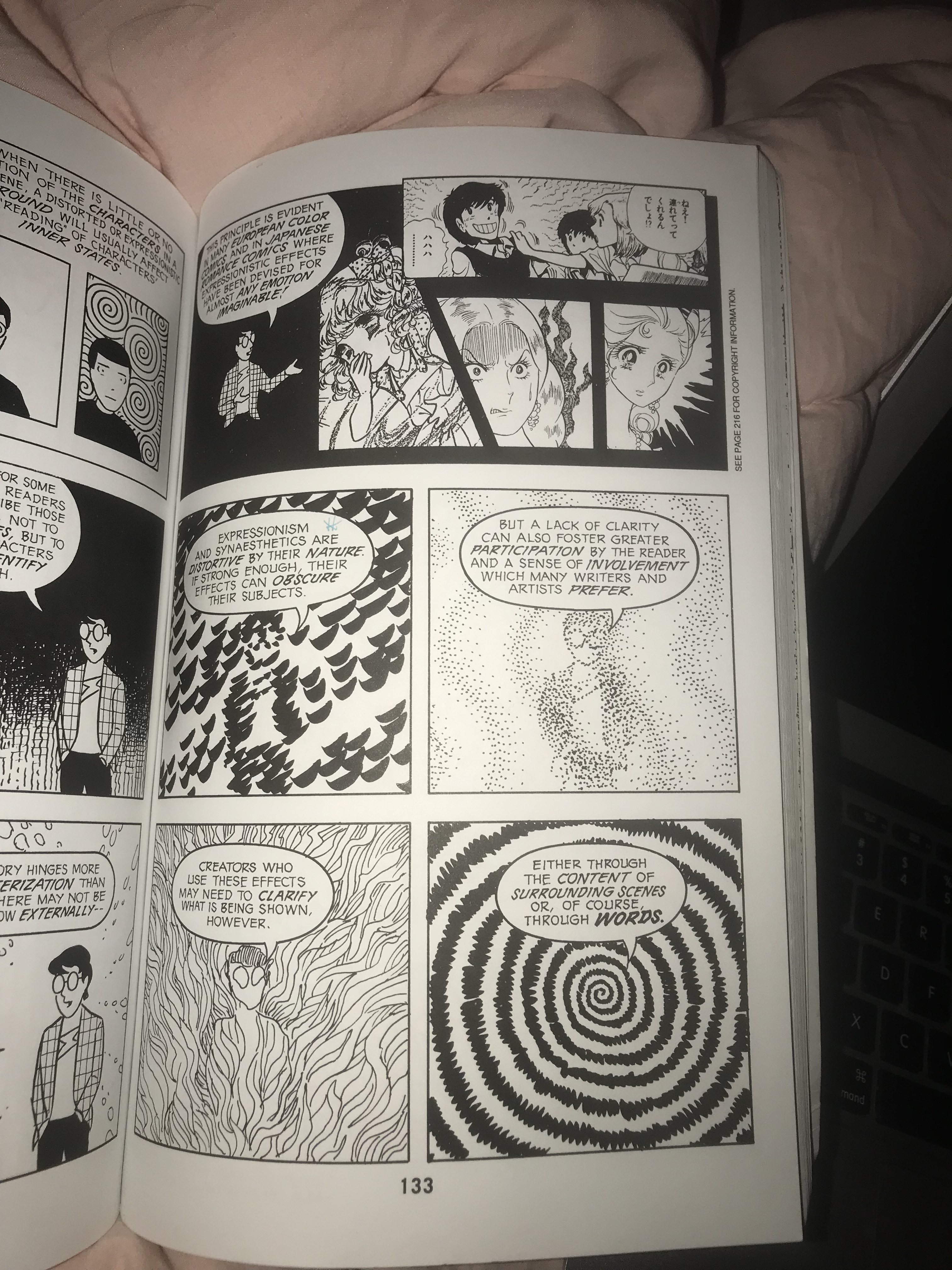
page 133 of Scott McCloud’s “Understanding Comics”

Harmony is also another element that is keen for the reader to feel while looking at a design. As an artist, you have to make sure your layout is even and doesn’t feel “uneven” or “weighted” more to one side than the other. Whether its by color (how John Lovett describes)  or the amount of objects on one side compared to the other. Within the 2 pages in Scott McCloud’s book (pages 132-133), you can definitely see the harmony he expresses within each individual boundary and between the two pages. For example, on page 132 he has a box with a lot of heavy black ink filling about 3/4 of the boundary, but on the other he has 2 boxes with pretty heavy black ink, seemingly evening out the “heaviness” of the black ink on each side. This creates a better flow for the viewer and makes it easier for their eyes to flow across the pages.

Pages 132 and 133 of Scott McCloud’s “Understanding Comics”

 

Posted in Fall 2019 Archive (201 Blog) | Leave a comment

Design Elements and Principles: Grace Kannberg

A frame from page 39 of Scott McCloud’s ‘Understanding Comics’

Spreads from McCloud’s Understanding Comics are effective in showing Lovett’s element of design in lines, shape, size, and as well as showing Lovett’s principle of design in Gradation. When looking at Lovett’s definition of lines and how they add elements to a drawing or painting, hatching lines can be used to show tone. McCloud’s uses this technique when drawing a man’s tuxedo in his fifth frame on page thirty-nine. By using tone where he did, it allows the viewer to get a better sense of what Kinde of tux the man has on.

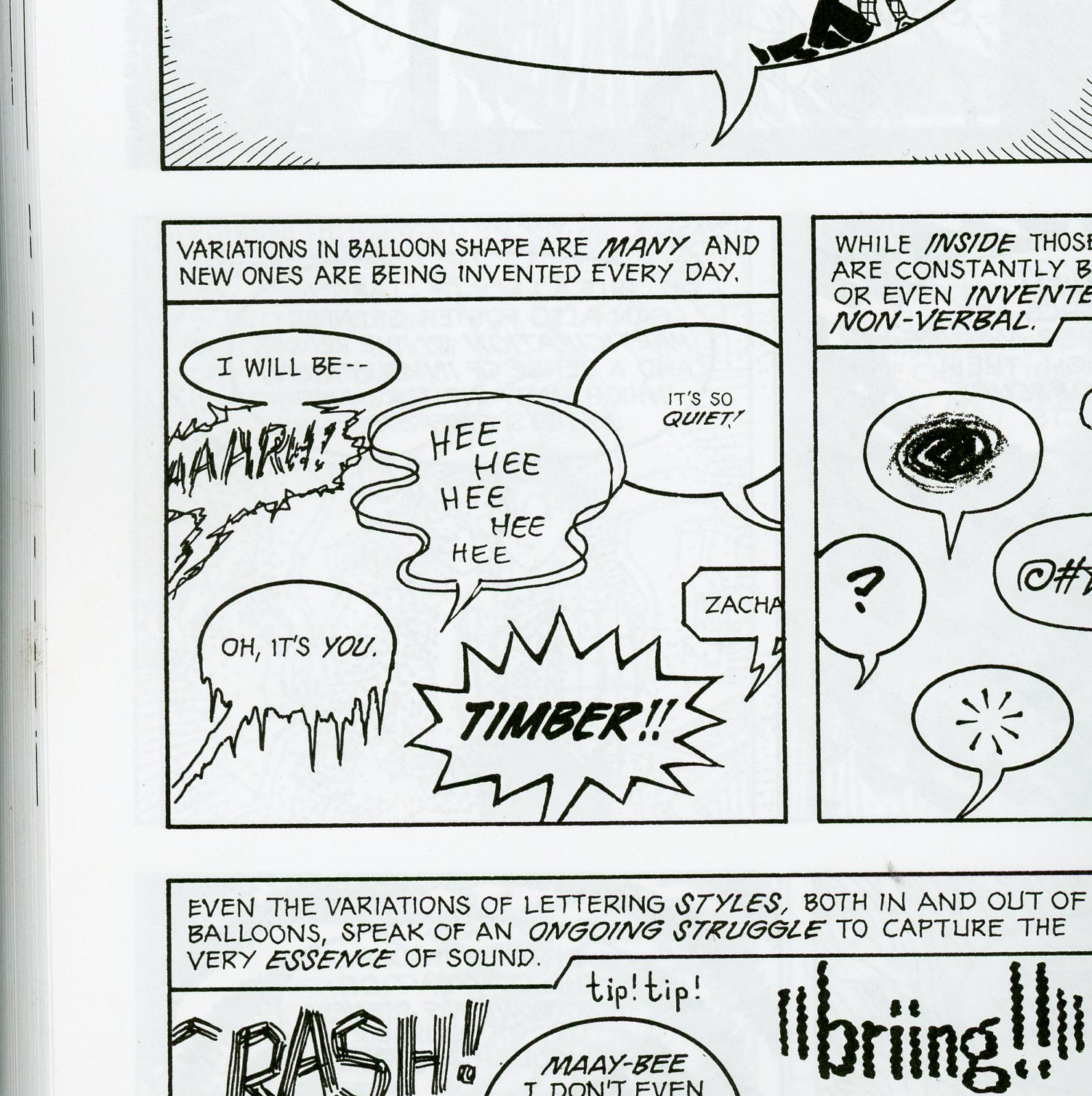
A frame from page 134 of Scott McCloud’s ‘Understanding Comics’

Shapes in elements of design are central when creating a drawing or painting. It is what brings an object or idea to life on a page. Lovett describes abstract shapes as being used to trigger a response when used. Each speech bubble in McCloud’s frame (from page 134) is drawn a certain way for the viewer to read it depending on their response to it. For example, the speech bubble with ‘Oh, it’s you’ can be read as if the individual was severing because the shape of it suggests that it’s dripping with icicles.

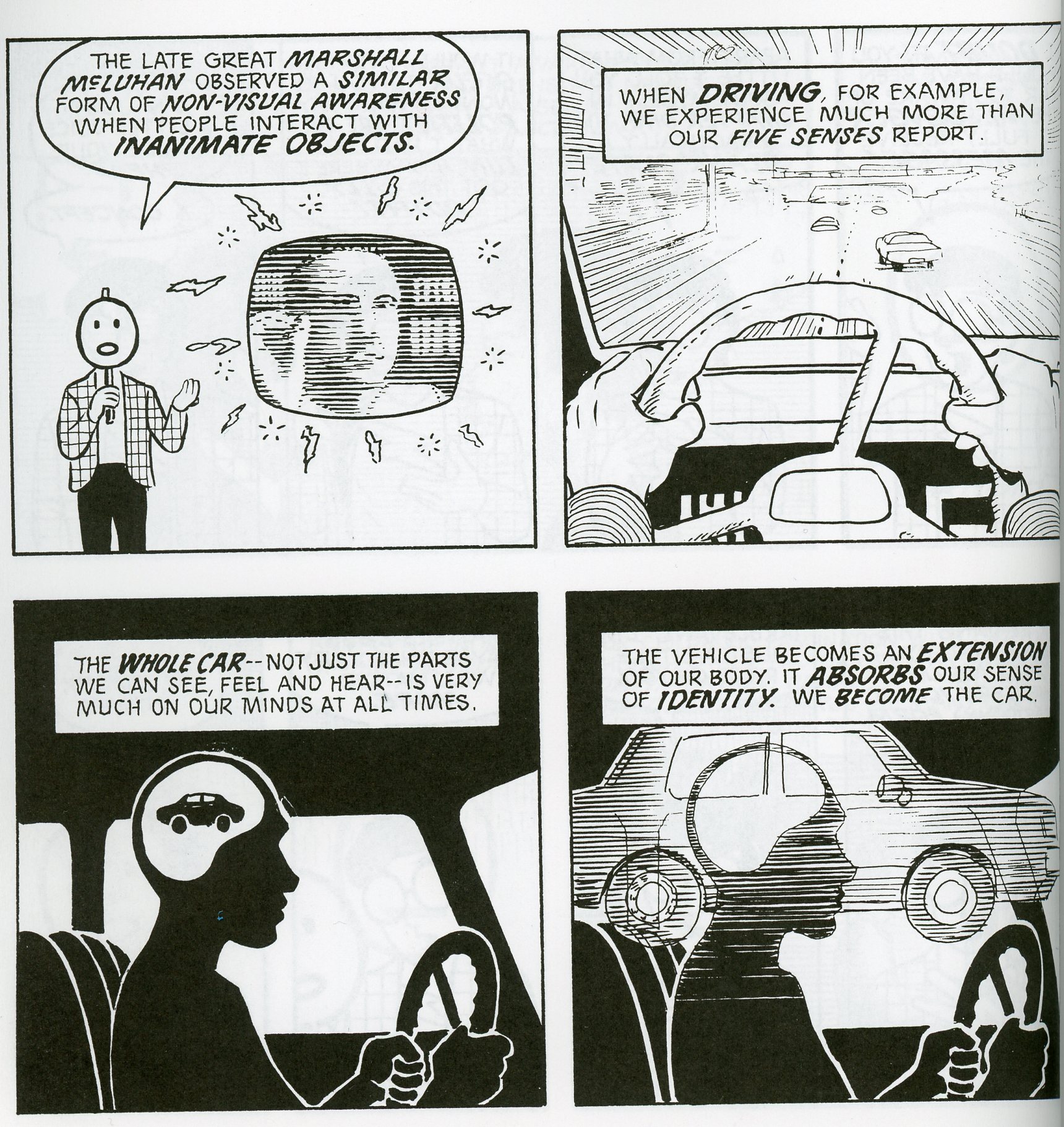
A frame from page 38 of Scott McCloud’s ‘Understanding Comics’

Lovett places the sizes of objects as what it is compared to other objects. When looking at a painting or drawing, your eye tends to first look at the biggest object in the painting. In Understanding Comic’s our reading is narrated by the same guy (McCloud). Even though we are used to looking at our narrator in Understanding Comics, the size difference in the first frame on page thirty-eight draws our eye to the lined photo of a man. This is because the little size difference commands your eye to look at the dominating shape.

The design principle, Gradation, is what Lovett refers to as an element in a drawing that applies to the gradual change with movement and direction. Gradation is being used by McCloud in the seconded frame on page thirty-eight to show linear perspective. The lines in the penal give the illusion that the car is moving in a forward direction and ahead of them looks smaller because it is further away.

Posted in Fall 2019 Archive (201 Blog) | Leave a comment

Design Elements and Principles: Nicholas Kawaguchi

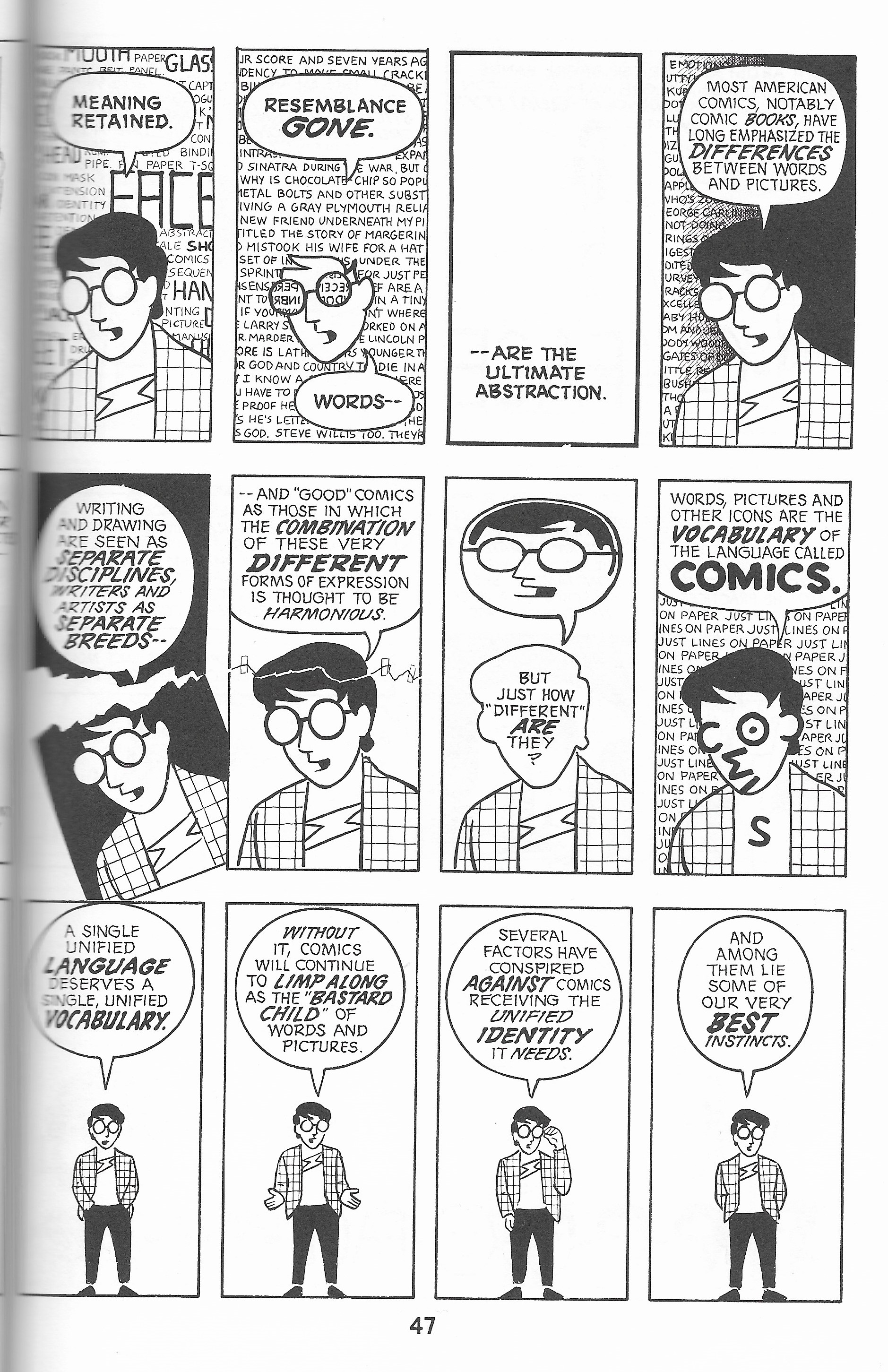
Throughout “Understanding Comics,” McCloud effectively implements the design elements and principles, each working in tandem to create an interesting layout while still being very informative. It is apparent that McCloud’s application of these elements and principles are practically present on every page within the book. One page that I would like to point towards is page 47. 

Scott McCloud’s “Understanding Comics” Page 47,
On this page, McCloud is continues his in-depth analysis of the “realistic” and “iconic” scales of comics, particularly diving into the seamless intricates of writing and drawing. The first thing that is very apparent is his use of repetition. There are 12 frames, each exactly in the same shape and almost two-thirds of them having the exact same image of McCloud while the other third has another image of him but in a different view. The key to the repetition is not necessarily in the repetition itself, but rather in the way breaks it. In one image it is just his face surrounded by words, while another is the same but his face and the speech text are swapped. This variation amongst repetition draws a certain attention to what he is trying to get across.  For instance, take the middle section panels. In the first two, McCloud alters the shape of the frame by ripping it in the middle and then mending it back in the next. By altering just one element, he emphasizes his point that writing and drawing are not in separate domains and have the potential to work harmoniously, in one unified frame. The same can be said for almost every frame on the page as size is used to create dominance over certain words. The bigger and bolder a word is the more prominent it becomes and thus the reader has a larger imprint of the particular key words after finishing that section. Looking back at the top two-thirds of panels, there is a slow transition that takes place. From the fourth top panel, the small text that lays in the background slowly begins to fade to black through McCloud’s use of gradation. Eventually, the background transitions back to white then to the small text again. This is also meant to further symbolize that perceived idea that writing and drawing are separate and the revealed concept of their coherence that culminates in an image of McCloud that is also comprised of symbols and letters. One of the final things to point out is the comparison between the top two-thirds and the bottom third. Although not complete, there is a sense of balance among the page. Due to the top two-thirds being so dense and heavy with texts and changing images, the bottom third compensates by using the repetition of the same four panels with similar looking image of McCloud to, in a way, sum up the page’s discussion.

Posted in Uncategorized | Leave a comment

Design Elements and Principles: Tom McLean

Scott McCloud’s page scanned 9/23/2019

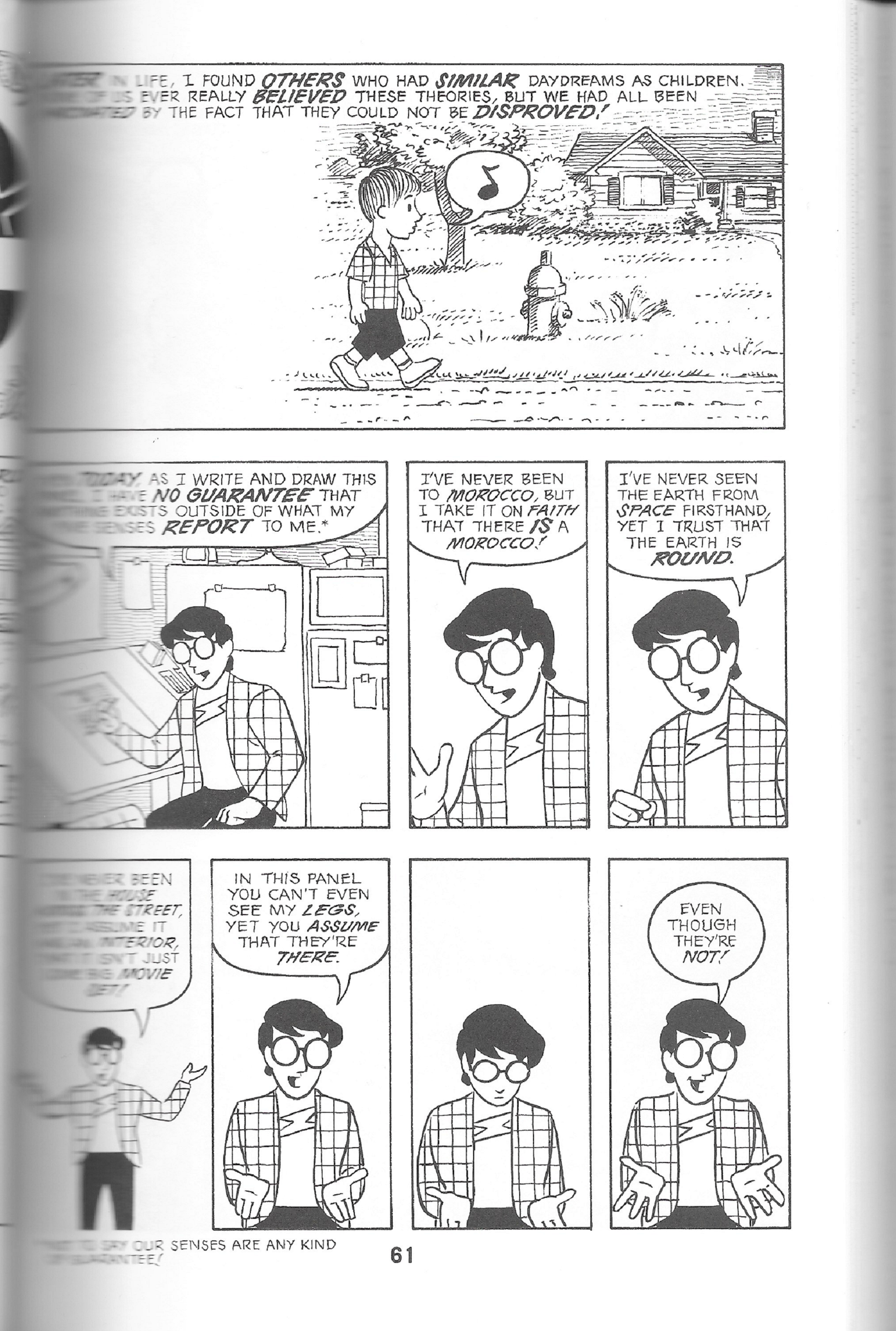
Design plays a major role in the creation of comics and for other pieces of artwork. In the picture to the right, there are examples of Scott McCloud using the elements of Direction, Size, and Texture.

With the first element of Direction, the comic is illustrating where the comic is going in the sense of purpose and meaning. From John Lovett, he describes that direction has three options: horizontal, vertical, or oblique. In this case with the comic from McCloud, the sense of direction is horizontal with vertical movements of pushing the narrative that he is describing.

The next element is Size. This element is a basic but important one to understand when creating a comic. Here, McCloud uses different sized panels in order to give a sense of space and importance in each panel. McCloud  wants the reader to understand that in his smaller panels, he is describing something in detail and needs to be payed attention to from the reader. With the larger panels, McCloud is is giving the reader a sense of space and using the larger size to give more artistic space to convey his message there. Size of panels and the space between them all have their meaning and are created for a specific purpose.

The last element is the element of Texture. This can be clearly seen in the largest panel on the page, being able to see depth, the use of the grass, and the texture of the house in the background. It give the reader an easier time to make sense of the illustration so that the illustration can give a sense of visual or physical texture as defined by John Lovett. In this case, Visual Texture is used to give the illusion of a physical texture. While this may not be the Mona Lisa painting, the comic still gives a sense of visual texture and it really makes the visual more believable and lifelike.

Posted in Fall 2019 Archive (201 Blog) | Leave a comment

Design Elements and Principles

Choose a single page or 2-spread from Scott McCloud’s “Understanding Comics” that you’d like to discuss in terms of your new design vocabulary. Explain why you think McCloud’s layout is effective in terms of at least three of the elements and/or principles described by John Lovett. Make sure you demonstrate an understanding of both Lovett and McCloud.
This image is located on page 36 from Scott McCloud’s “Understanding Comics.” Based off of the reading described by John Lovett, this image contains texture. You can see the drastic quality change from McCloud’s original “cartoon” self and a more realistic figure

Image result for understanding comics

of himself. You can also see many different lines used for these two images. The image on the right is more simple, so he uses bold lines while using simple shapes to create his “go-to” image of himself (e.g. his glasses, his face structure, his fingers, etc.). The image on the left, however, uses more detailed lines to add more value to his facial structure to add another element to make his second self more realistic. 

Texture, in his description, is the surface quality of a shape – rough, smooth, soft hard glossy etc. Texture can be physical (tactile) or visual.

Line , in his description, can be considered in two ways. The linear marks made with a pen or brush or the edge created when two shapes meet.

A Shape in his description, is a self contained defined area of geometric or organic form. A positive shape in a painting automatically creates a negative shape.

Value is the lightness or darkness of a colour. Value is also called Tone

Posted in Fall 2019 Archive (201 Blog), Uncategorized | Leave a comment

Design Elements & Principles: Janet Okeago

In Scott McCloud’s understanding comics we see that he uses different designs in every part of his book which makes it way interesting to read through. I also feel that Lovett and McCloud had the same idea and goal into how a comic should look like in terms of the design they used thus making it easier for the reader to understand what the comics are all about.

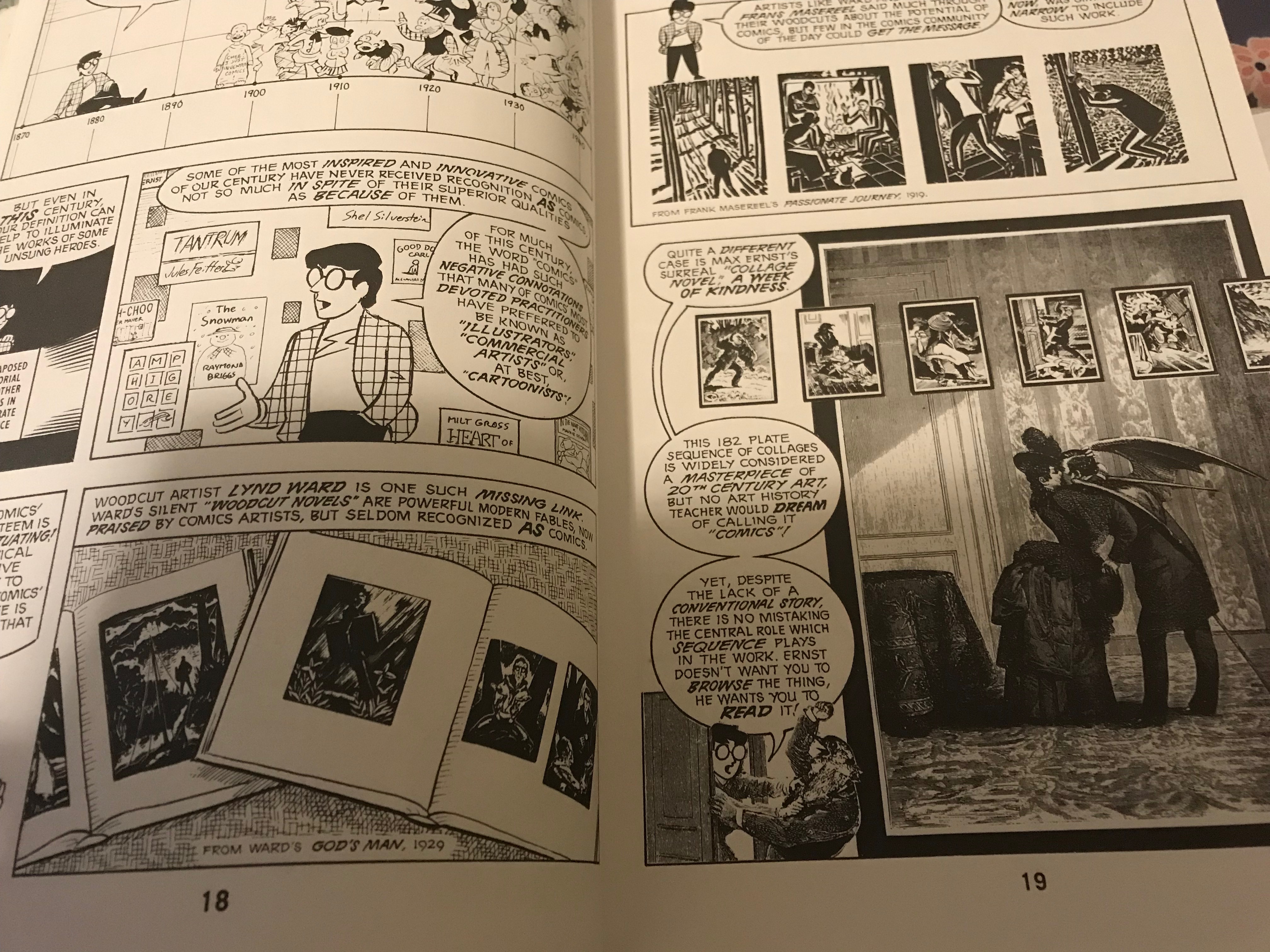
Understanding Comics By Scott McCloud pg 18-19

I came across 2 pages in the book that caught my eyes that are page 18 and 19 where we a different design being used in terms of the images used that seemed to me that some real pictures were used to show the activity that was taking place in the story. and also the use of visual mode where use of images are seen by the reader via use of color, the size of the images, the flaming and the size. McCloud clearly used all these to keep the viewers entertained in one way or another.

The text in these two pages are written in an artistic form where McCloud uses dark text to emphasize something in the story. it is interesting how he catches our attention by visualizing thing in a more creative manner. We can also see some pictorials taken from a book and the line up he uses make it easier to follow and this is something new to me since i didn’t know that a comic writer could do this to be able to give more details in as much way possible to the readers. It does make it more appealing .

Posted in Fall 2019 Archive (201 Blog) | Leave a comment

Design Elements & Principles: Bobby Brown

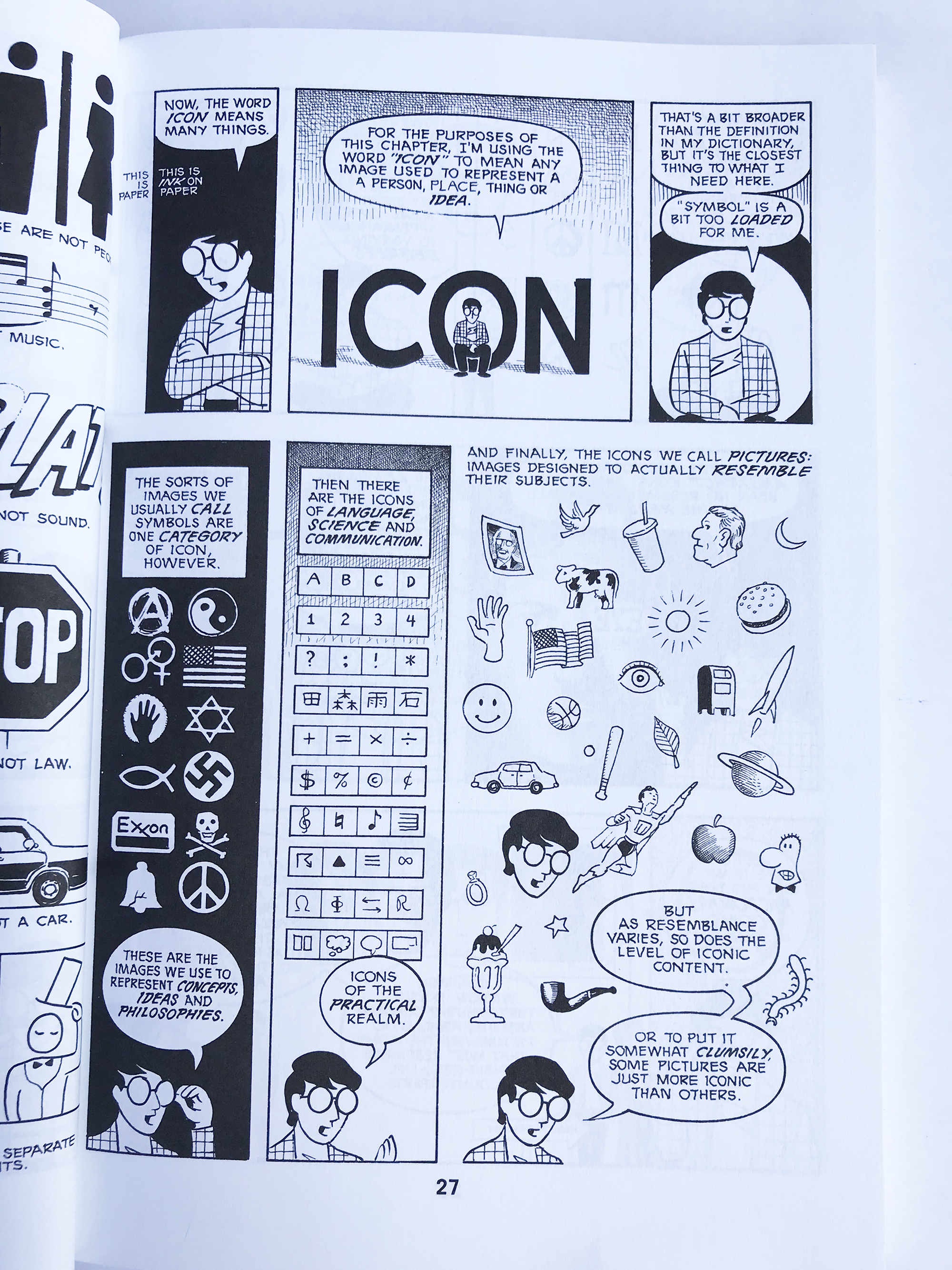
After reading John Lovett’s “Design Overview,” I feel like I have a better understanding of the perspective Scott McCloud is coming from with his work in “Understanding Comics.” One page that specifically stood out to me was page 27, where McCloud discusses the use of icons. Throughout this page I was able to relate many of Lovett’s elements to that of McCloud’s work.

McCloud Scan: Page 27

Page 27 from Scott McCloud’s book, “Understanding Comics: The Invisible Art.”

One of the most basic elements of design, Line, can be seen at use frequently on this page. Not only is it at use in the physical framing of the panels that McCloud uses to communicate through, but it’s also at use throughout all of the icons he draws. Whether these icons are symbols, language, or pictures, they all use lines. Besides the element of line, I also found the element of size to play a large roll in McClouds work. He does an excellent job of sizing his illustrations in a way that catches the readers eyes, and allows them to interpret the remainder of the information at their own pace. When I first read this page, my eyes were instantly drawn to the large “ICON” writing that McCloud has his character sitting on. Following that I quickly glanced over the floating picture icons that he drew, then proceeded to read the entire page from left to right. I now have a better understanding of the significance of the area occupied around one another, and how that affects the way a reader will comprehend the information on a page.

One of the most prominent principles of design that I noticed on this page was that of Gradation. Lovett describes gradation how “color from warm to cool and tone from dark to light produce aerial perspective, and add interest and movement to a shape.” McCloud uses gradation throughout this page in the tops of his panels, as a way to add shadows to his illustrations, and draw the readers attention. McCloud clearly uses these elements and principle throughout his work, and I have a better understand of Lovett’s work as a result of that.

Posted in Fall 2019 Archive (201 Blog) | Leave a comment

Design Element and Principle: Emily Bartholomew

In Scott McCloud’s “Understanding Comics” he uses many different elements of design throughout his book. One page that really stuck out to me was pages 22-23. This page gives a prime example of color. In this page he talks about how there’s an endless amount of possibilities that you can make into a comics. He also doesn’t just talk about endless possibilities, but he makes it feel like you’re in space to hint at, that you can do anything, and it won’t just stop from that idea. The coloring in this page is very harsh and dark, but it brings the reader into the story to make them feel like they’re actually standing there with the Scott McCloud character in space. My favorite part about these pages is that he has added the stars and some other planets with in the black empty space throughout those two pages.
Throughout the book “Understanding Comics” Scott uses all different types of elements in design. The one that I thought that he uses the least was color. Now I know that you can use black and white as color, but when I think of color I think of dark blues, bright yellows, and grimy greens. I expect those different colors to catch my eye and make me what to think of other things that are that color or even, memories that remind me of color. I think color within a comic can tell another part of the story that some people might be missing out on, but then again people can still tell a good story that doesn’t use color in it. It’s kind of weird to me, not seeing color in this book because on the cover its full of many different colors. Its bright, eye catching, and brings a different life to the character within the book.

Posted in Fall 2019 Archive (201 Blog), Uncategorized | Leave a comment

Design Elements and Principles: Zach Morgan

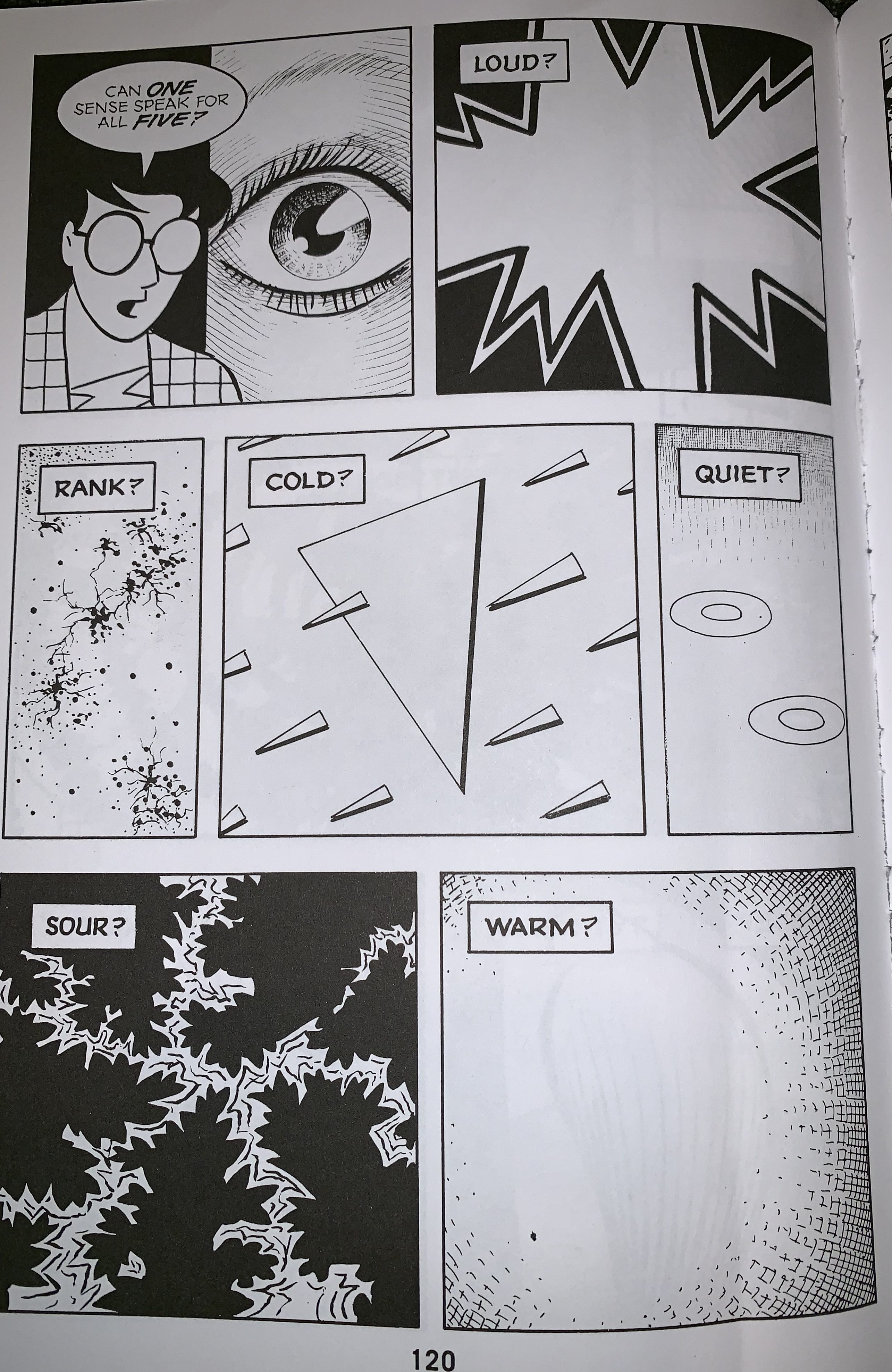
From Scott McCloud’s “Understanding Comics,” 120.

Both McCloud and Lovett have a similar goal in comics and design, respectively. They both attempt to convey message through visual compositions. McCloud would describe this as trying to make “one sense speak for all five,” meaning allowing the viewer to hear an image, for example. I will examine a page of Scott McCloud’s Understanding Comics through a design lens to see how elements of John Lovett’s “Design Overview” are reflected within the panels.

On this page, McCloud shows how each panel has an entirely different feel depending one what visual art is shown. The top left panel is particularly interesting to me because I think that it is a great example of harmony, and how that helps convey its purpose to the viewer. McCloud’s character says, “Can one sense speak for all five,” directly juxtaposed with a very realistic image of a human eye. He then shows examples of how seeing various images can produce responses from your other senses. This exhibits harmony because McCloud never says that he is talking about the one sense being vision, because he knows that the image of the eye paired with his commentary is enough for his audience to follow along. Another aspect shown in these panels is dominance of size, particularly in the one that says, “Quiet.” This panel is dominated by the size of the negative space giving it a still, or uneasy feeling. Value is another element of design that I found prevalent on this page. In the last panel, McCloud conveys the warmth of this image making the image very bright, with very little contrast. Similar to the images of the repair shop, the panel that says, “Warm” feels much more inviting and happier than the panel that says, “Sour.” These are only a few of the design elements and principles shown in McCloud’s book, but they each have on thing in common.

From John Lovett’s “Design Overview,” demonstrating value

In these comics, the words and images work together in a way that evokes all the senses through only using sight. Not only do each of these panels use sight to represent the other senses, but they are all used in order to evoke an emotional response. In the first panel, you feel like you are having a conversation with the character because he is not over-explaining himself. You feel the sense of uneasiness through the “Quiet” panel, just waiting for something to happen to it. You feel the happiness coming from the brightness of the “Warm” panel. Each of these panels are intentionally composed of various design elements and principles in order to make the viewer feel some type of way.

Posted in Fall 2019 Archive (201 Blog) | Leave a comment

Design Elements and Principles: Maria Alvarez

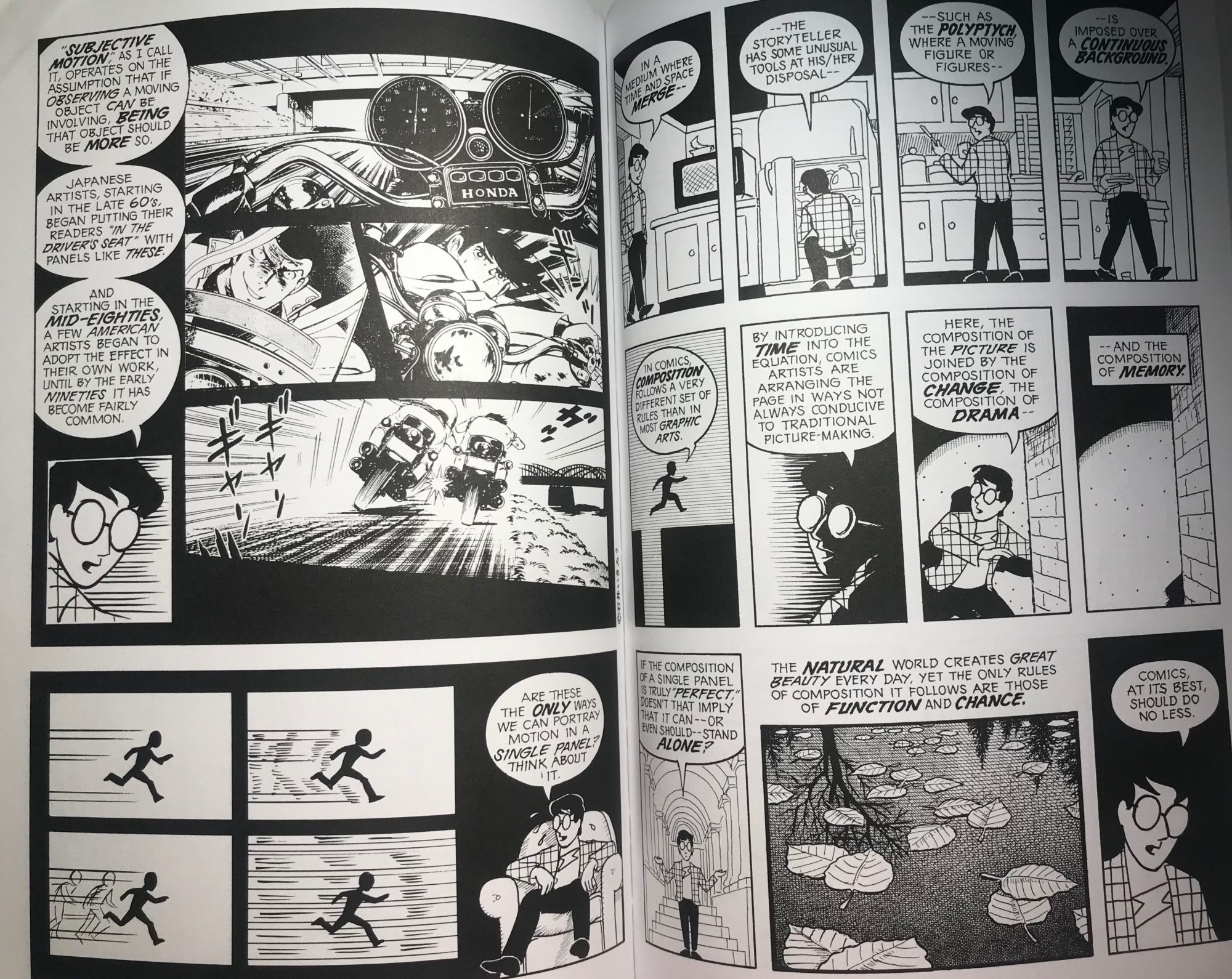
Scott McCloud Book

There are a bunch of design principles that McCloud uses for his comics but there is two pages that I thought were very interesting. I like the lines that are being used in the bottom left corner, it shows movement, and it makes the photo more realistic. The lines also show direction because the lines are showing that the figure is running to the right of the page. The other principles that he uses are shapes and size. He used big leaves that take up a full-frame and he also uses one big box to put three pictures in them (top left page). His shapes are also perfect but messy at the same time. For this comic, Scott does not use color and prefers to use only black and white. He only uses color towards the end of the book. The principle of color is huge for these two pages because on the upper left page, you see that there are two people riding a motorcycle and you can see the texture of the street. The texture is also used in the bottom-middle right-hand page with the leaves. Scott wanted to make the leaves look like they are floating on water and that the tree is a reflection by using texture. The texture is key for a lot of comics to make them look more personal. There is also a lot of unity in these two pages. Almost all sections are united into creating a story and they are all saying something. For example on the top of the right page, all four frames are united and go together. Finally, a big part of these two pages is tone. There are some frames that are lighter than others or more shaded to add more effect in the design.

Posted in Uncategorized | Leave a comment