Blog #7 – Image as Text (Emilee Shimazu)

4ea5b50e50424965a163572531f888fd 093ec1573ccccaef0c1ebf3165994e24 607e8c4d635ea74f7435c7b70d299b59  The images I have chosen to show here are all going along with the poem and have a 4c7393335f82cff13f82186d06959b7a semblance of narrative interplay that I feel would have a profound impact on the broadside. The images of hands were chosen because they are only ever mentioned once, but more so because the narrator of the text seems to be less whole and more broken. They’re rubbed raw from the weight of the world aroue62e562f5c0c78f88d9c7faa3a91a76cnd them, seeking solace in things to try and make themselves feel less empty. I added more than one because I feel like all of theee27296789769af5bea669419f8b8f92m have a weight to the imagery that would lend itself to the poem itself. The words of the poem are meant to be fragile and quiet. The imagery will lend something to draw readers to it.

The second image I chose is a rather interesting image of a woman from behind, with snakes wrapped around her neck. While there is no actual mention of snakes in the poem, there is a lot of religious reference. I think that images like these would definitely help the poem graphically through metaphor. The last image I chose is a more obscure photo meant to represent the sky during the eclipse. Allusions to a “sky garden” are made in this poem, and the poet and I have talked a lot about space being related to this poem. However, while searching I realized that many images of night skies were too bold or bright for what we were aiming for. This is the closest I could find so far to what I am looking for.

I definitely chose these images with the idea in mind that I wanted them to be very unsaturated and dark or unsaturated and very light. I did not want to have bright colors associated with this poem because it would take away from it. This is because again, the poem is meant to be fragile and subtle. It wants you to look at it twice and draw you in slowly. It is not something that hits you from across the room like a firework, but instead draws you in because you want to see it clearer. I have also decided on cooler hues. Warmer ones would denature the poem it is being used for, and thus take away from the overall broadside.

Posted in Fall 2014 Archive (336) | Tagged | Leave a comment

Student Broadside Critique – Evan Matthews


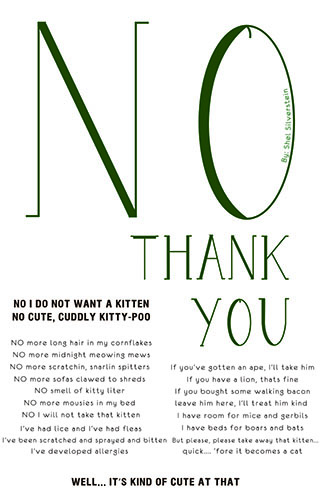
Broadside made by Shannon

Broadside made by Shannon

The text of the broadside is about someone listing the many reasons why they do not want a kitten. The author goes on to say how they would much rather take other animals that could not even be pets rather than have a kitten. However at the end, Shel says, “well… it’s kind of cute at that”. Almost as if they had started to give in to the thought of having a kitten.

The mood conveyed in this poem/broadside seems to be almost stubborn or unreasonable. They have a firm stance on their view and give all the reasons they do not want a kitten. They even resort to mentioning lions, pigs, apes, boars and bats as potential pets over a kitten. But then at the end of the text, the author seems to have lost that firm stance and their stubbornness and has become more open to the thought of a kitten just from it being cute.

The visual hierarchy is presented and well defined. The No Thank You catches your attention from a distance and makes you want to read why this no thank you is as large as it is and what no thank you is being said to. The broadside keeps your attention because once you get closer you see the bolded text of underneath the No that shows why no thank you is being said and it makes you then want to read on and see what this person has against a cute, cuddly kitten. The bold text is at different parts of the poem (the start and the end) but without reading the poem you can see how the authors mood changes. The smaller text in the middle relates and describes the bolded the reasons for what was said in the bolded text.

The display level text (created text) seems to use an appropriate type style. The typeface made has a cartoony feel to it much like Shel Silverstein’s poems and his drawings in the poems. The typeface’s thick and thin contrast helps it to stand out. When I remove the serifs, the typeface doesn’t seem to have that cartoony feel to it anymore especially with the letter O. Also, Shel Silverstein’s poem titles utilized a typeface with serifs in books like Falling Up and Where the Sidewalk Ends. As for the running text’s type style, the typeface difference in the bolded text and the thin paragraph text contrasts and displays nicely. The main aspects are more prevalent and noticeable. There is only one line that is overly long that seems to be almost connecting with another line. Spacing of the two bodies of text could solve this or moving some of the text from that line to a new one could also help. The one long line is the only thing that could distract or throw off the reader as there is no excessive hyphenation within the text.

The size of the display level text grabs your attention from afar and draws you towards the broadside and has a different scale for each word to draw your eyes down the broadside. The bolded words start to become more visible as you inch closer to the piece. When you are within reading distance of the running text, your attention has been brought to the main body of text through the 3 different scales of text used. The alignment of the main body of text is centered and utilizes two columns for display. As for the leading, the consistency of it is used in the running text. The leading for the display level text seems to be different as the scale of each word decreases but when looking more into it, the line spacing seems to be same throughout except for the last line which has a little more but this helps to separate the author’s change or understanding. The tracking of the No Thank You is noticeably different. The No has major letter spacing, the “thank” has minimal letter spacing, and the “you” has some large letter spacing also. This could be due to the scale of the text being used. The kerning is done nicely though within the display text as the word Thank displays nicely and does not have noticeable difference in spacing because of letter shapes.

The piece uses black and white. You could interpret this as though its black and white like there is no medium or gray area about it, there is only yes or no and no in between. The use of space though could give a feeling that even though there is this main point of NO, there is room for change like the how the author started to change his mind on kittens at the end of his poem.

Posted in Fall 2014 Archive (338), Uncategorized | Tagged | Leave a comment

Image as Text – Sean Jones

Being a visual learner like myself, I am naturally very excited to be starting the Image as Text part of the Final Project. I decided to choose 3 relatively simple images because I am going into a pretty large amount of depth as far as image manipulation goes, however, they represent the feelings and transmit the information I want the viewer to collect.  They say “a picture means a thousand words” and I completely agree; the stimulation one can accumulate from a visual image is definitely earth-shaking, especially to non educated viewers.  Here is the poem by Regan in Chris Arigo’s Class:  (not quite titled yet) The way you sat, arm slung across my scuffed leather headrest, your hand shaping the wheel of your ‘84 Volkswagen Rabbit, and the way my fingers caught in the ridges of the volume knob when Chicago came bursting to life on the speakers; it was as if we’d known each other our whole lives and driven that way countless times before, down that same stretch of highway, in that same dirty sundress, following the same finger of light. our solitary corona clutching the chipped yellow paint.”  Wanting to possibly use the realistic factor of photography, my friend Jordan Nicholson gave me a a photo he took one snowy morning of a road.  The act of choosing a photograph is safe in itself, as the client perceives it easier and understands it for what it is.  I chose a snowy road because although the poem comes off as lovey-dovey, there is still the negative uncertainty of the future.  The second image I chose was the outline of hands holding each other.  The initial insertion of an illustration opens up almost endless possibilities, so I went for one of the most minimalistic images of hands holding that I could find.  Using this illustration continues the realistic concept although it gives the viewer a more emotional feel, the negative space leaves more to the imagination of the viewer and promotes ambiguity to the degree of detail.  Lastly, an image of a painting.  A collage of colors can mean a lot to the person viewing it, and I wanted to set the mood right off the bat with this image.  The feelings Regan and I developed from this poem was warmth, yet doubtfulness, along with of course, love.  A collage of these earthy, redish yellowish hues set the mood pretty close to what we felt reading the poem.  I think these 3 images capture best the depiction of this poem, and although these are just tiny sprouts, they will grow into a great flower.

A photo taken by Jordan Nicholson

A photo taken by Jordan Nicholson

Posted in Fall 2014 Archive (336) | Tagged | Leave a comment

Image as Text – Alden Paguada

wired.com

wired.com

flicker.com

flicker.com

earthgauge.net

earthgauge.net

The Three images that I have chosen to represent Alice Tranum poem ” Down at the Bottom” are in some way related to one another. In her poem Alice talks about feeling really cold and trap at the bottom of an immense body of water. This could be interpreted in the picture of the ocean, depicting a notion of something coming up to the surface. At the conclusion of the poem, Alice mentions how this character feel saved and relieved to have a firm grip on the sand. Feeling somehow free of asphyxiation, feeling free after the struggles this character went through. This can be depicted in the pic above of feet walking on the sand, kind of feeling or being a peaceful environment. Alice also describes in her a poem a sense of being extremely cold, and this is why I chose the icy waters running down a stream.  In this case with this images, illustrations are very concrete and realistic. The are very realistic in how it illustrates the subject. At the same time with poems illustrations can be abstract and can become symbolic depending on the details added by the designer.

Poems in some ways are metaphors; it creates so many different meaning to what the actually text is referring. They are designed to be self interpreted, same goes for images. An image may represent something entirely different than what the text is actually saying. It goes back and forth, they go hand in hand with all these options available to designers. It will be challenging to tie these three images together and to come up with a broadside that illustrates balance.

Posted in Fall 2014 Archive (336) | Tagged | Leave a comment

Image as Text – Becka Prater

Suicide with rainbow splatter

Suicide with rainbow splatter

dreads crumpled money


I chose the poem, “We Are Our Sins” by Emily Page. The three images above are pictures that I plan to use because it sums up what the whole poem is about pretty well. These images also create a narrative interplay of the poem since I chose to go about with a more literal approach. The first two pictures are going to be silhouettes, which puts a darker hue into the broadside. I also think it will add more digital transparency since I may be changing the opacity of the silhouettes. The reason I will be doing this is because, although I want attention brought to the two figures, I want more attention to be brought to the crumpled dollar bill and the more saturated colors I’ll be adding into the broadside.

The dollar bill photograph is also something I will be turning into a silhouette so that it won’t be as detailed but the saturated green color will still be seen as a dollar bill. All of the images will be used as illustrations. The reason for this is because explicit detail isn’t important and I do not have to manipulate photographs in order to portray what I need in the poem. Finally, this way I will be able to put more of a symbolic spin to it and also input my own personal perspective and interpretation into the broadside. A perspective and interpretation I want the audience of the poem to see.

Posted in Fall 2014 Archive (336), Uncategorized | Tagged | Leave a comment

Image as Text-Chidi Odoh


These are the three photos that I thought would work well with the poem I am working on called “Seven” by Becky Sharpe. It is a little bit darker than most of the poem but finding pictures to represent it is quite easy. To start off with the blood stain. At on point in the poem it describes drying blood, and I thought to myself that a blood stained background for my broadside could really work. Thinking about Digital Transparency it could help it look more liked  dried blood if I were to change the opacity of the blood stain in certain areas of the broadside.

Next is the ceiling fan. Because the opening statement in the poem I fell like is the strongest I feel like adding in the ceiling fan that corresponds to the hands creates a narrative interplay as it tells how this story is being told by the opening statement in the beginning of the poem. Messing around with the opacity of the fan somewhere i  the broadside could also work.

Onto the hands it goes something like this “Seven set of hands hanging from my ceiling fan” incorporating an illustration of a set of seven hands on the broadside could really add to the overall look and feel to it. Without the hand tying together that very powerful opening statement wouldn’t work without it. These three images really tie together what the poem is trying to say. Finding a way to balance these three images into my broadside will be very interesting.

Posted in Fall 2014 Archive (336) | Tagged | Leave a comment

Student Broadside Critique – Lisa Gaviglio

Kelsey Johnson Broadside

Mood

The text Kelsey chose to use in her broadside is from The Beautiful and Damned, about sounds in the night, hope, and love, written by F. Scott Fitzgerald. The display text reads, “It gave love hope in its own survival” reiterating one of the last sentences in her passage, putting emphasis on its importance and setting the mood. This text is glittery and bright contrasting with the darkness of the background which helps to create an almost haunting/ethereal mood. Words like evanescent, dissolving, moon-flooded, and crying also help to create that hauntingly beautiful feeling. The color of the background reflects the mood created by the text as well as being an actual representation of the words “All the city was playing with this sound out there in the blue summer dark…”

Hierarchy

There is a definite hierarchy being created with the large display text overlapping the running text. Its size (1/2 the page) and placement (top) both work together to make it stand out the most.  There is a lot of reference to throwing things up in the air which is what the display level text seems to be doing. It is at a slant and it is reminiscent of something being thrown into the air. The dissolving background gradient also makes the glittery text stand out more starkly against the black at the top. The overlapping of the text makes the eye flow into the white running text next to see what exactly the display text is covering. It is a little difficult to read at some points with the display text overlapping it, but the text is interesting enough that you want to keep reading and figure out what is going on. The name of the author F. Scott Fitzgerald is also written in the same font as the display text, which gives it a sense of importance even though it’s at the very bottom of the poster. While it might not be the most important thing in the poster, the type used hints at his importance as a prominent author.

The broadside does a good job capturing my attention from far away with the rich blue color and beautiful glittery text. It kept my attention as I got closer because I wanted to figure out what the text was about and how it related to the larger text. The type itself is very engaging and all the letters are very unique drawing the eye for an extended period of time.

Type Styles

Display level text type style:  I absolutely love this type you created and I think it goes well with the passage. I think it also goes very well with the author and the period in which he was writing. It matches the mood of love and hope and the glitter texture you gave it also brings to mind the bright lights of the city that are present in the darkness of night as well as the mention of moon-flooded roofs.

Running text type style: I think the type you chose looks good, but I don’t quite understand why you italicized it. What exactly does it represent or bring to your text that a non-italicized font wouldn’t have?  I do like the fact that you chose a serif font, which speaks to the age of the passage and the traditional/somewhat romantic mood it is creating. There is a lot of space (leading) in your passage that helps to create an open feeling letting the dark blue take over most of the passage.  The justified text is very uniform, but there is one line,  “pebble-strewn, moon-flooded” that has an awkward space in the middle, disrupting the flow of your text.

Overall I think that the fonts you have used work well together and the design you have created on your broadside reflects the text and the mood it creates.

Posted in Fall 2014 Archive (338) | Tagged | Leave a comment

Image as Text – Katie Malberg

My partner for the project is poet Lucy Reyes. Her poems are family focused, specifically memories of her little nieces and nephews. I chose “Hand Turkeys,” to be the poem for the broadside. As the title suggests, her mischievous nieces and nephews were “painting” handprints on the walls. From its vivid imagery, I believed this poem would give me a wide range of ideas to consider, and also be an enjoyable one to work with.

I believed this painting would make a suitable backdrop for the broadside. The paint in the picture is smeared, almost as if a hands ran down the wall. There is no sense of realism inthis painting, which is the route I wanted to take. I wanted to reference the paint used in the poem, but not the literal little handprints t she writes about. I believe it would add to the interpretation of the poem as a whole.

Created by me on Photoshop

Created by me on Photoshop

This is a rough version of paint I made myself in Photoshop. An idea I had was to make the paper blend into the wall, and make these marks to look like actual paint marks on the wall. The poem would be placed in chunks. The idea behind this was to make these elements a sort of indexical sign. The chunks of text added with the paint smudges could be interpreted as the handprints smeared on the wall.

Taken by me

Photo taken by me

This photo I took is probably the least obvious and most interpretational of the three. This photo acts as a digital medium that references the wall the paint is on. It would act as the backdrop to the poem, and acts as canvas for people to paint the poem onto. They can imagine the handprints and smears themselves rather than have them literally in the image. It would keep the simplicity I want to achieve in relation to children, and also create a more open way for people to interpret the poem.

Posted in Fall 2014 Archive (336) | Tagged , | Leave a comment

Image As Text- Megan Thompson

The three images that I have chosen below go along side the poem Dead Family Tree by Shen Tan. Within the poem Shen describes what it is like for someone to know their family history and the effects that it has on a person. The reason I chose tree and leaf images is because it goes along with the poem as narrative interplay. Trees and leafs are never mentioned in the poem but do act as image metaphors for the poem.

When I visualized putting images with this poem, I imagine tress of branches and connections in the dead of winter because the family three is unknown. This sense of winter puts a darker hue type on my mind as use of colors within the poem type as well as image. The first singe image of a leaf curled up correlates with the poem as the author describes loneliness and curiosity. The leaf curled up by itself represents that isolation feeling that the author is conveying. I also strongly correlate the leaf stem lines with the lines that connect this “dead family tree” that Shen is referring too. The way the leaf lines move in different directions that are unknown I believe to go along with an unknown feeling. Digital transparency helps add more of an affect to the dark color choice by changing the opacity of the color over lay.

The second image that is a single leaf as well has other leafs and ground materials surround it. I found this image to go along well because of the grass that is surrounding life just like how Shen describes her awareness of these other family members. It gives a little more comforting feeling about knowing that her original family is out in the world somewhere but he only knows the slightest information, just like the outside objects and the single leaf.

Finally, the large single tree photograph is a larger representation of an actual tree similar as to how Shen starts her poem. The poem begins with lineage lines that connect her unsure family. This is like a tree in how it starts with many branches and then comes down to a trunk. I chose this particular photograph because it reminded me of more grey and dark colors that set more a mood to the poem. I like how a tree reminds of how families have so many different connection that all lead back to each person’s roots. By having this close representation it can act as a narrative interplay that explains Shen’s family story.

Each of these photographs could have positive starting points or ideas for the imagery to go along with Shen’s poem. I imagine any of these image types could easily go along with the narrative interplay of Shen’s poem and create an emotional message from her words.

"After Leaf" by Keonl Cabral  Flicker.com

“After Leaf” by Keonl Cabral
Flicker.com

Leaf Bed by Michael Cessna Flicker.com

Leaf Bed by Michael Cessna
Flicker.com

Trees by Safar Fiertze Flicker.com

Trees by Safar Fiertze
Flicker.com

Posted in Fall 2014 Archive (336) | Tagged , , , , , | Leave a comment

Image as Text-Joseph Varnadore

These are the three images I’m focusing in on. One of the overlaying themes of the poem I’m working on, I feel, is the sort of thinness and how floaty dreams themselves are. One of the comments about the latest design I had made was that it was “like a cloud or a shadow,” which was a purposeful choice on my part, as I wanted to try to catch that same feeling with my design. As such, the photos I choose for it are supposed to reflect it.

The first image, titled Feather of Life, is a good example of the sort of mix of dream like surrealism with a sort of light, airy mood. Despite it not directly connecting back to the poem itself, I feel like it mixes well with the intended message and meaning of the poem. Also, I think it matches the mood, as said before.

The next image, just titled Bed sheets [Explored 2013-04-27], connects back to the concept of sleep, and also serves as a direct metaphor to the poem itself. The poem is about waking up from a dream, and has lines about the sheets and blades of light coming in through the window. Here, this is a photograph being used to literally represent the scene of the poem, almost being narrative interplay, though missing a few important parts to it, like an action being directly connected.

Finally, Cloud Shroud is going back to the original metaphor I had created using the clouds. This one is taking the poems text more literally, with slivers of light breaking through the dark clouds. I want to try to be more abstract with this design, in the same way that dreams themselves are abstract. I’m not sure if I want to use a photo, but I think these are good examples of photos that I would want to use.

Posted in Fall 2014 Archive (336) | Tagged | Leave a comment