Image As Text – Colin Weickmann

For my broadside, I chose three images that related to the poem Sking, written by Jesse Purvis. In the poem, Jesse talks about this notion of sking as an adjective to describe people who float away into the sky, or let go of the fear that rules theirtheir daily lives. As such, I chose pictures that represented people floating away. My first image comes from the album cover of a band called Circa Survive. In the image, a girl is tied to a hot air balloon and her head is the fire making the balloon float in the air. I believe this image strongly depicts what the poem is trying to describe. The girl tied to the hot air balloon seems to be letting go and letting the air balloon take her away into the sky. This image parallel with the poem creates an image of floating away and letting go of fear. In addition, I like that this image is hand drawn as this depicts a simplicity surrounding the monumental notion of sking and it is more natural.

Sketch by Diane Krouse

Sketch by Diane Krouse

Sketch by MIKEnergizer

Sketch by MIKEnergizer

Photo by Sky Photography

Photo by Sky Photography

My second image is simply a drawing of a hot air balloon. Though this image does not have any noticeable people within it, it is a strong image that ties to the poem as it represents the notion of floating away into the sky. If somebody reads the title of the poem on the broadside and looks at the image of the hot air balloon it will not seem out of place. Additionally, it will allow them to visualize a person floating away in a hot air balloon as they read the poem. Again, I chose a sketch rather than a digital image because of the natural and simplistic feels this gives to the reader.

Finally, I chose the image of balloons because it is common knowledge that if you let go of a balloon it will float into the sky. While the image of a balloon is not quite as strong as my other two images I think it would still work well in my broadside because of this common knowledge associated with balloons. If someone were to read the poem and look at the image, they would think of someone holding a balloon, fearful of letting go for it might float into the sky. Overall, keeping the images simple and natural were important to me because I believe the author is talking about some deeper thoughts. This material matched with simpler images would balance the broadside out.

Posted in Fall 2014 Archive (336), Uncategorized | Tagged | Leave a comment

Image as Text – Ashley Davis

Aline Spitzer. http://www.recantodasletras.com.br/prosapoetica/4695017

Aline Spitzer. LINK

Letting Go by TheMadScientist on Deviantart. http://themadscientist.deviantart.com/art/Letting-Go-10657534

Letting Go by TheMadScientist on Deviantart. LINK.

Paper by Unknown. http://the-crown-of-obedience.blogspot.com/2011/05/paper.html

Paper by Unknown. LINK.

The three images I chose, in each of their own way, have to do with being “pulled away” whether its physically pulling your hands away, or ripping a piece of paper in half. The reason I chose these three is because the poem I will be visualizing is about a breakup; and these pictures represent that in their own way. The hands especially, show two people breaking away from each other, breaking up. The paper on the other hand, is more of an abstract visualization of breaking up. She refers to the relationship as being “torn”, and when I read that I immediately visualized it as a paper being ripped. That’s the main idea I had for the broadside; having it on a piece of paper, being ripped in half.

With these pictures together though, they create a sort of narrative interplay. It tells a story, a sad on at that, of something being ripped apart. The first is a guy walking away, followed by the hands pulling apart, and finally the paper being torn. With those following each other consecutively, they influence the others in a way that shows the story doesn’t have a happy ending.

There could also be a strong visualization if the pictures were layered together, especially of the hands pulling apart and paper being ripped. If they’re put together, it would show the viewer the idea of something breaking apart, which is the tone the poem conveys. The layering, and usage of different opacity, would create a sort of digital transparency to mix the two visual elements.

Posted in Fall 2014 Archive (336) | Tagged , , , , | Leave a comment

Stefan Lindeman – Image as Text #7

alcoholfianlalcohol3 alcohol1

The three images that I chose for this blog post are all of alcohol bottles. This is because my poem for my broadside is “titled” alcohol and tells the sad story of an alcoholic who lost it all. Initially when looking for images, most of them were modern real images of bottles that you would see in a grocery store. This didn’t fit the context of my poem because in the poem, the setting is more dark, ragged, in the past and takes place on a farm. This is why I want the medium of my image to be hand drawn, encompass rough hand drawn lines that are black and white. This gives the bottle an older feel that fits the poem which is dark and about death, not about clubbing and partying. In addition, using a hand drawn image gives the image a more personal, honest, genuine feel that a realistic image wouldn’t be able to give. The poem is about a man who looses his daughter, is alone and desolate and drinks his sorrows away. By using a dark, black and white picture of a bottle, it represents his personal account of his sadness and loss.  Due to the fact that it is a personal account and story, it makes sense to use an image that represents that.

Posted in Fall 2014 Archive (336) | Tagged | Leave a comment

Image as Text – Eileen Lim-Hing

Image by Neil Saunders Link

Image by Neil Saunders
Link

Image by Glenn Marsch Link

Image by Glenn Marsch
Link

Image from: "The elements of astronomy" book Link

Image from: “The elements of astronomy” book
Link

The three images I am choose are pictures of the moon. All three images are of moons but the reason I choose this was because the poem I am using is called “Luna” and is about someone is seeing a person in their life and telling a story about how they remind them of space. The poem talks a lot about night time and how the person is drowned to it. By adding the moon into the poem it gives it a more story feel to the poem and this causes narrative interplay, which gives it semantic content. This gives the photo more emotion and creates an image for the reader. The first two images are actual photographs taken by people. By adding real life photographs gives it a more realistic feel to the poem. I think adding one of the first two images could put together the poem. The third image looks as if it were drawn and I think this could pull together the poem as well and give it a more ancient feel to it. Since the poem is more of a darker poem it would be a good photo to incorporate. It doesn’t show realism which is the opposite of the first two. Since the poem wasn’t shaped into paragrapghs it gave more room for creativity with how I would put together the poem. The author wants the poem to be simple, so keeping the images simple helps leave the simplicity of the poem.

Posted in Fall 2014 Archive (336) | Tagged | Leave a comment

Image as Text – Jesse Pearson

Day 018/365- The Birds, by  Great Beyond, on Flickr

Day 018/365- The Birds, by Great Beyond, on Flickr

For my poem, I was thinking that I could use one of these three pictures as the background of the broadside. Ideally, I would use these images alone, but I was thinking that I would combine them with layering and illustration, and possibly other images. Shen’s poem describes clouds being “pulled by the atmosphere’s fingers”, and I think it would be cool to have an illustration overlaid against the picture. For example, I could make an

Valley View Clouds, by Sonny Abesamis, on Flickr

Valley View Clouds, by Sonny Abesamis, on Flickr

outline of a hand pinching, and combine that with a picture of a cloud, and overlay that on the yellow image of the trees and birds. I think the juxtaposition of the illustrated outline and the photorealism of the picture would be really neat. I could also use transparency to do something similar to my other idea, but in this case, I would have a solid hand (not an outline), and use transparency to show the trees underneath. In a similar vein, I could overlay the pinching hand (either outline

Tree, By Dave Morris onFlickr

Tree, By Dave Morris onFlickr

or transparency) on the image of the valley. While the picture of the gray tree (“Tree”) doesn’t lend itself to the direction I was going in the other two pictures, I think it does a good job of conveying the bleakness of Shen’s poem. After all, the title is “Seasonal Decay”, which evokes more washed out, neutral colors to me.

Posted in Fall 2014 Archive (336), Uncategorized | Tagged | Leave a comment

Image as Text- Stephanie Jones

I chose these three images that indicated fire, because the poem “Ephemera” is about a fire and how someone is fighting it. I chose images that were more simple and didn’t have a background story with them. I chose this because the poem does not give details about how the fire was caused or were it was, but instead lets the reader use their imagination. I felt like these photos lets the reader keep thinking of possibilities. This is an example of semantic narrative interplay, because it allows the reader to know a little about the reading but still gets them thinking about the details.

For the smoke image I would like to do some text overlay and have the text follow the smoke throughout the page. This would be an example of typographic layers, causing a poetic look to the broadside.

The other two images I was thinking about using as a background and the text be the foreground, again as a typographic layer. I will use digital transparency to alter the opacity of the image in oder for the reader to see the text, or I will fade out the text so you can see through to the background. By changing the opacity and overall contrast allows the intensity to change.

These images tell the reader about what the poem will be about without saying too much. They build up the emotion of the poem before the reader even reads it. The dark backgrounds add to the dark emotion and feel of the poem.

image by Camila MP

image by Camila MP

image by drimage

image by drimage

image by Maro Gelleto

image by Maro Gelleto

Posted in Fall 2014 Archive (336) | Tagged | Leave a comment

Student Broadside Critique – Melissa Tsitsis

Design by Karen Marten

Design by Karen Marten

The mood of the text seems hopeful because there’s many different genres of music that suit different tastes, personalities, and moods. It starts off as a simile: “Human lives are composed like music.” This is the first line of the broadside and it stands out because it is framed by a huge black rectangle above it and also a thinner one below it. From there on the rest of the information on the broadside explains why these two unlike things are similar.

I started at the top because from close up and at a distance the black rectangular box at the top of the broadside stood out because it was mostly empty and also because the text was clearly aligned to the left unlike most of the running text on the broadside. After that I naturally went down to the next line of text and read that and repeated the process until I got the section of text with three distinct sections. From there I read left to right and then repeated the process for the next section of text. From there it I read the left block of text from top to bottom and moved onto the black box of text. The way that Karen arranged her text on her broadside really made logical sense to me. Although there is a lot going on I think that she did a good job creating a hierarchy that flowed without me having to think where am I supposed to go next. This broadside was able to attract my attention from a distance. When I was looking at in relationship to the rest of the broadsides on the same wall it stood out the most to me. One reason was its readable from a distance. I could read the entire broadside from at least 6 feet away without any problems. It is also clean. There are a lot of different typefaces that are being used, but it also helps draw my attention without there being any recognizable illustrations which I think is a prominent characteristic of a broadside. Since I could read the broadside from a distance it was not necessary for me to look at it up close aside from the fact that I was interested in looking at the detail of the different typefaces that Karen used. Despite that I do not think that it lost my attention because it is visually appealing from different points of view. Smaller parts relate to the larger parts by dividing the sections of text. Some sections of text are larger than others, but the size relationships separates blocks of texts to enhance readability and to create a hierarchy. For example, the large black rectangular box is at the top of the page and is mostly empty, but it draws my attention because it is the largest block on the page. There are also two other black rectangular boxes, but for me they do not compete with the one at the top with the title.

There are a lot of different type styles that are used to create the broadside. I think that not one typeface is used twice. It feels appropriate to me because all of the typefaces have an organic feel to them, which makes sense because the text is talking about how life is like composing music and when I think of music I think of something that has fluidity. The fact that all of the typefaces are different exemplifies how life is composed of different events but also maintains the organic feel, which helps create a relationship between human life and composing music. For me the entire broadside feels like it could be composed of display level text. The title of the piece of piece is clearly the largest on the page, but the running text is not much smaller. The type style and running text seems appropriate for this broadside because it does have an organic feel like the nature of the content on the broadside. Sometimes I feel like it might be a little much, but the fact that every section or line has a different typeface helps create a hierarchy throughout the broadside.

I think that Karen did a good job at dividing the sections in order to keep the broadside organized since there is a lot of stuff going on typographically. Her broadside was large and I think that it worked well with her design because it helped with readability. I did not see it at a smaller scale but I think that if it were smaller, like and 11×17” poster, her design elements would have been overwhelming and maybe felt cluttered. She used black, white, and gray it felt clean and went with the mood of her text. She also uses different alignments. Her title is aligned to the left and most of her body text is centered. She does a good job with line and letter spacing to increase readability because some of the type is more decorative and harder to read at a distance.


Posted in Fall 2014 Archive (338), Uncategorized | Tagged | Leave a comment

Image as Text – Susan Cannarella

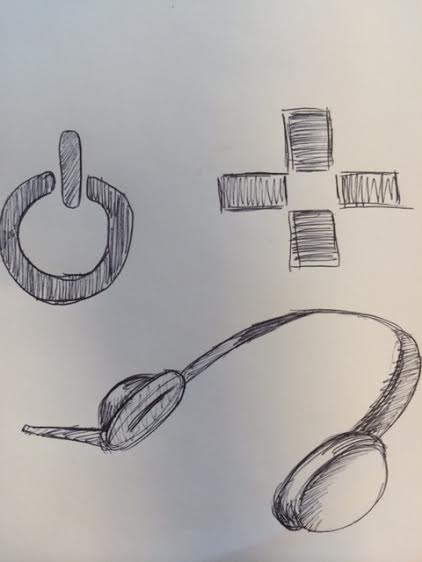
Drawn by Susan Cannarella

Drawn by Susan Cannarella

The images I have chosen are all game related pieces. They do not specifically relate to the game itself, which is (League of Legends), but it does pertain to the more general universal icons that are present in the gaming community. This creates the semantic narrative interplay by adding these images of technology in the gaming community to imply the setting without saying it’s on a computer. 

I have considered using one of these symbols to do thick text overlaying and create a dark positive space and emulate a rough image of the illustrations above. The positioning of these images would vary. The headphones would likely be on the side of the paper cutting some of it off as if it was sitting on the desk. Another idea is to have an outline of a key and place the poem inside as if it’s a key on a keyboard.

I want to draw the images out and have them be Illustrations because of the fact that I can control the level of detail in the image, I can put my personal perspective on the object which appeals to my aesthetic design choice and control conceptual overlay.

Also because I’m an art major and since this is a visual piece, I want to put my spin on the project as well. Sometimes its hard to choose between concrete, realistic, and objective vs. symbolic and abstracted so being able to control the level of one or the other gives more room for customizability.

These sketchy images can carry a certain emotion due to the scratchy rough sketching making the piece active and fast pace and busy. This is in hopes of showing how the gaming community is very fast pace and requires split second reactions.

Posted in Fall 2014 Archive (336) | Tagged | Leave a comment

Image as Text-Meli Barajas

James Lautner  June 20, 2012  Pussingtonpost.com  Retrieved from: http://38.media.tumblr.com/tumblr_ljcbqyNFjz1qzrip0o1_500.jpg

James Lautner
June 20, 2012
Pussingtonpost.com
Retrieved from: http://38.media.tumblr.com/tumblr_ljcbqyNFjz1qzrip0o1_500.jpg

The poem that I am considering to use for the broadside I will soon create is Animathematics by Laura A. There are many images that I could find that would be literal to what is referenced in the poem; however, that would be repetitive. For the purpose of this blog post I chose three very different images. When I read the poem I first thought that it explained how math is part of our everyday lives and math concepts are somewhat the basis of what surrounds us. Nevertheless, the poem does have some dark undertones. The first image is a plant and of course for anyone that reads the poem and is looking for a statement relating the plant, they will not find one because the plant represents the Fibonacci sequence. The second image is that of a cat. What makes this cat unique and different from the rest is that it is white with two different colored eyes. The uniqueness of this cat is mysterious like feel of the poem because it leaves the reader thinking. Also, A cat is mentioned in the poem and there is a referenced to a humans eyes which makes this picture particularly interesting. The last is the coffin for the son that the mother weeps over at the beginning of the poem. I though the ruler was a perfect touch considering it means that the carpenter must use math to make it, but also to calculate the necessary feet for it to go underground. I believe that these images would not work together. According to the reading when images are put together in a sequence they can tell a story. When they are rearranged they can portray another story because the story depends on the order of the series of events as well as the person whom is reading them. In this case, the images that I could possibly put together are the cat and the coffin. If I were ask to describe the story that I though was behind these two images standing together, I would think that it meant that being different “kills” or is a negative thing. However, that is not related to this poem.
The style that I was looking to use is gray scale with pops of color because I felt that that portrays the overall mood of the poem. However, when reading the concepts that relate to math in this poem, I think of bright colors. I feel that that is because when we learn about numbers as kids they taught to us in as big numbers with colors, blues, pinks, greens, etc. Nevertheless, it does depend on the images used because to uniqueness of a picture sometimes depends on color.

Posted in Fall 2014 Archive (336) | Tagged | Leave a comment

Student Broadside Critique – Hannah Croskrey

Broadside%20BW%20Final

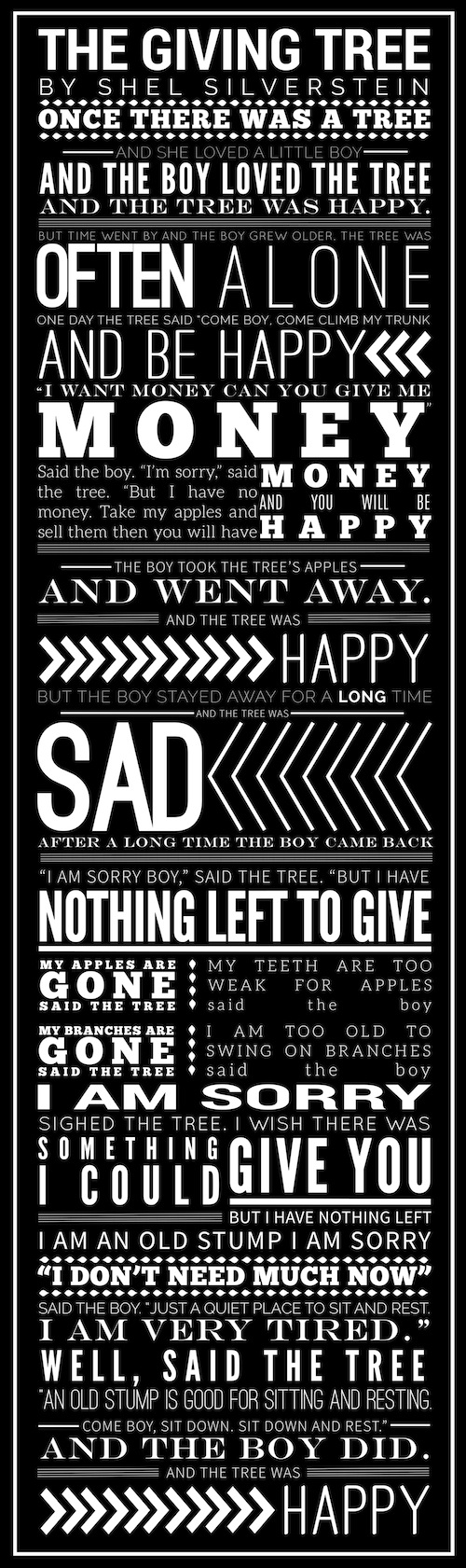
Lauren Turner’s Broadside: The Giving Tree

This text is very heartwarming and thought provoking. There is a simple yet complex story being told of a lifelong friendship built on helping one another. The tree helps the boy and the boy makes the tree happy by taking what it has to offer. The mood   has a somberness about it as well as a pleasant gentleness. This feeling is not only conveyed by the text itself, but is also shown through the way the text is represented.

Visually, this broadside draws a person in right away. Hierarchy is present throughout the whole broadside. Not a single area lacks hierarchy of some sort. A person first sees certain words like “sad,” “money,” “often,” and “give you.” These words would lead a person to believe that they are more significant to the composition than the rest of the words. These words make a person want to know what is so important about them and why they are more significant than the words set in smaller type. Once a person steps closer they realize that all of the text goes together to tell one story and the words are not just randomly placed. This draws in the viewer and makes them want to read through the whole broadside to piece all of it together. The larger text is usually statements or parts of the story that seem very important or pointed while the smaller text is the filler part of the story that tells details of what is going on. The hierarchy does seem random in some cases but it makes it visually engaging from far away and draws the viewer in very quickly.

All of the type styles seem appropriate for the broadside and keep the reader engaged. Because of the style of this broadside, there is no real division between the running text and the display level text. There are obvious words that seem to stand out as display level but are included as part of the running text to be read along with the text chosen to be smaller. All in all the broadside is easy to read, some text uses very thin type that can be a little more difficult to read at certain angles, but does not distract from the piece as a whole. The amount of words per line is very reasonable and does not make the reader feel like it is dragging on. Some chunks of text are confusing to piece together where they go in the story but do not stump the reader for long. If the running text were all one size and style and the title all one size and style, the broadside would not be nearly as engaging and the viewer would not want to read the whole piece. Overall the display and running text levels seem appropriate throughout.

The spacing throughout the text all seems very thought out. There are portions of text that the kerning appears to be very tight while other areas it is quite loose, or just right, but in all of these cases there seems to be some purpose behind her choice to change the kerning. The leading also varies in the same way as the kerning, but it does not hinder ones ability to read through the text easily. The alignment of all the different typefaces and sizes looks very planned out so that it could all fit within the box restricting the text. Because of this, there are areas where the text appears in paragraphs and others where one word takes up a whole line. All of this adds to the visual aesthetic and draw of the piece. It seems very purposeful.

Keeping all of the text and negative space black and white keeps the piece cohesive and shows the viewer that it is all one piece of work. This color scheme also adds to the mood stated above. Everything seems balanced with all of the different sizes of text throughout. If the broadside were not as large as it is, it would not have the same effect and readability. Making it this large was definitely a key decision. The lamination does make it somewhat difficult to read in certain lighting, but does not hinder the feel of the broadside in its entirety. All in all, this broadside is very strong.

Posted in Fall 2014 Archive (338) | Tagged | Leave a comment