Point, Line, Plane, and Balance: Ryan P Schimack

Rammstein concert poster

Rammstein concert poster

This typographic poster for a Rammstein concert in 2012 is a good example of the usage of point, line, and plane. My eyes move from the bottom of the poster to the top because of the use of bolder text and points. Point is used in this poster by the cross on the right hand side making a “point”, line is used because of the orientation and direction of the text going across the poster in a upper right fashion, & plane is used because at the bottom of the poster there is a flat plane with different colors butted up against each other. Dynamic balance is achieved in this poster because of the placement of different text elements and the consistency of the text direction, and as your eyes go down the poster the balance turns to more asymmetrical because of the abstract point and plane.

Posted in Fall 2015 Archive (336) | Leave a comment

Alternative Self-Portrait: Kristin Becker

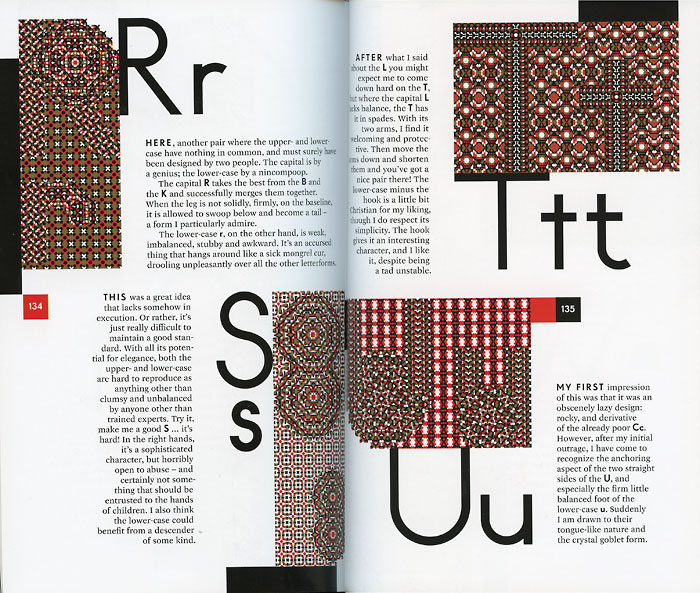
Marian Bantjes's essay "A Critique" uses the concept of modularity to communicate her thoughts about the design of the Roman alphabet. Since Bantjes is a typographer, this could be considered an alternative self-portrait. (Marian Banjes, I Wonder, Monticelli Press, 2010, pgs 134-135)

Marian Bantjes’s essay “A Critique” uses the concept of modularity to communicate her thoughts about the design of the Roman alphabet. Since Bantjes is a typographer, this could be considered an alternative self-portrait. (Marian Banjes, I Wonder, Monticelli Press, 2010, pgs 134-135.)

Marian Bantjes is a graphic designer and typographer known for her intricate, decorative, and personal type designs. She has worked for major clients, such as the New York Times, and with other well-known designers/firms, such as Pentagram, but she also fuels her creativity through more intimate projects: In 2007 she drew 150 different unique Valentine’s Day cards for her friends. Considering this background and practice, her essay titled “A Critique” from her book of essays, I Wonder, could be considered a type of alternative self-portrait. The text of the essay systematically critiques the design of each letter pair—capital and lowercase—for the Roman alphabet. In the example shown here, she complains that the capital “R” and the lowercase “r” have nothing in common. However, she finds the design of the letter “T” with its two arms to be “welcoming and protective.” The capital and lowercase forms share enough similarities and possess enough differences to be recognized as a successful pair. In addition to writing the essay, Bantjes designed the accompanying illustrations and page layout, using both ornamentation and the concept of modularity to reinforce the critique presented in her essay. Each letterform is presented both clearly and crisply in black and white, but also embedded in an intricate design made up of contrasting tiles (modules). If it is easy to recognize the letter’s inherent character inside the complexity of the contrasting patterns, then presumably she finds that letterform to be clearly designed. The tiny decorated tiles through which the letters are revealed are the smallest level of modularity in this design. Designers use grids and individual units (modules) to give themselves a structure in which to work. Imposing limits often fuels creative problem-solving, as well as making a design feel unified. Emphasizing the notion of modules in the essay layout seems especially appropriate since letterforms themselves are individual units, sharing many similarities, that are used to build a greater whole.

Bantjes likely created the crisp illustrations for this essay in Illustrator, using vector graphics and the ability to copy, paste, and repeat forms. Page layout and typesetting of the essay was likely completed in InDesign. However, the final product was obviously meant to be held and treasured rather than viewed on a screen: The book of essays is beautifully printed on thick, glossy paper and bound in a shiny black, gold, and silver cover. (See detailed images of the printed book on Bantjes’s website.)

Posted in Sample Posts by Your Professor | Leave a comment

Menu Design – Karen Marten

Screen Shot 2014-12-02 at 12.41.40 AMScreen Shot 2014-12-02 at 12.41.46 AMScreen Shot 2014-12-02 at 12.42.21 AMConfession: Occasionally I watch a trashy “reality” TV show called Bar Rescue. I’m not proud of it. But, I actually learned something from it that I can now relay to real life, so at least there’s that. The narrator of the show fixes up run down bars and when he re-designs the menus with what he repeatedly calls “menu science” it was noted that the highest profit margin items should be drawing the attention somehow. This menu, from Foodology and designed by Somewhere Else, does just that by placing the additions in a red box in the corner, your eye immediately takes note and before you’ve even made up your mind you are considering the add-on option.  The negative space makes it clear what the headlines are, as well as a clear color hierarchy. The red headlines catch the eye first and the blue menu item names are an obvious second choice to look at. Leaving the descriptions in black is a nice option as well because it keeps the necessary explanations intact without an obvious attempt at looking innovative. The sans-serif font, paired with basic colors portrays a modern look. There is a grid involved. The space is split into what appears to be the rule of thirds. The headlines for food types are aligned in the center and the food items are aligned right, this is successful and does not distract from the intention of the menu.

Screen Shot 2014-12-02 at 12.41.28 AM Screen Shot 2014-12-02 at 12.41.18 AMThe Paradise Creek Brewery Menu is very hard to read. The lack of hierarchy is obvious because when you look at it your eye doesn’t have anywhere to rest, with few exceptions. On the first page one could think that “Pub Pretzel” is a header, and the other appetizers below it are Pub Pretzels as well. There is also a lack of an established grid on the second page. I think the creator was attempting to make a modern visualization for the menu but in that quest s/he forgot about usability. The font for the headlines are too light and too small, although they are interesting to look at, they also lack readability. There are too many fonts that contrast too greatly for this menu to be successful. The main point of a menu is to relay information and this one does not do that successfully. The lack of a grid makes it even harder to read than the mismatched fonts. The middle alignment on the first page would be nice if all the prices at the end of each line matched up and if the right alignment stayed the same. It is an interesting choice to have the sides in the middle of the page and surrounded in a bold box, and while I do think it is nice for people to see what sides are available despite not wanting a burger or sandwich, the bold box is overwhelming and unnecessary. I also think the layout of food types was poorly designed, soups and salads commonly go together so people would be expecting that, and I don’t think people need to know who the head chef, bartender and brewmaster is (at least not before they’ve chosen an entrée).

Posted in Fall 2014 Archive (338) | Tagged , | Leave a comment

Student Broadside Critique – Kelsey Johnson

Lisa Gaviglio's broadside

Lisa Gaviglio’s broadside

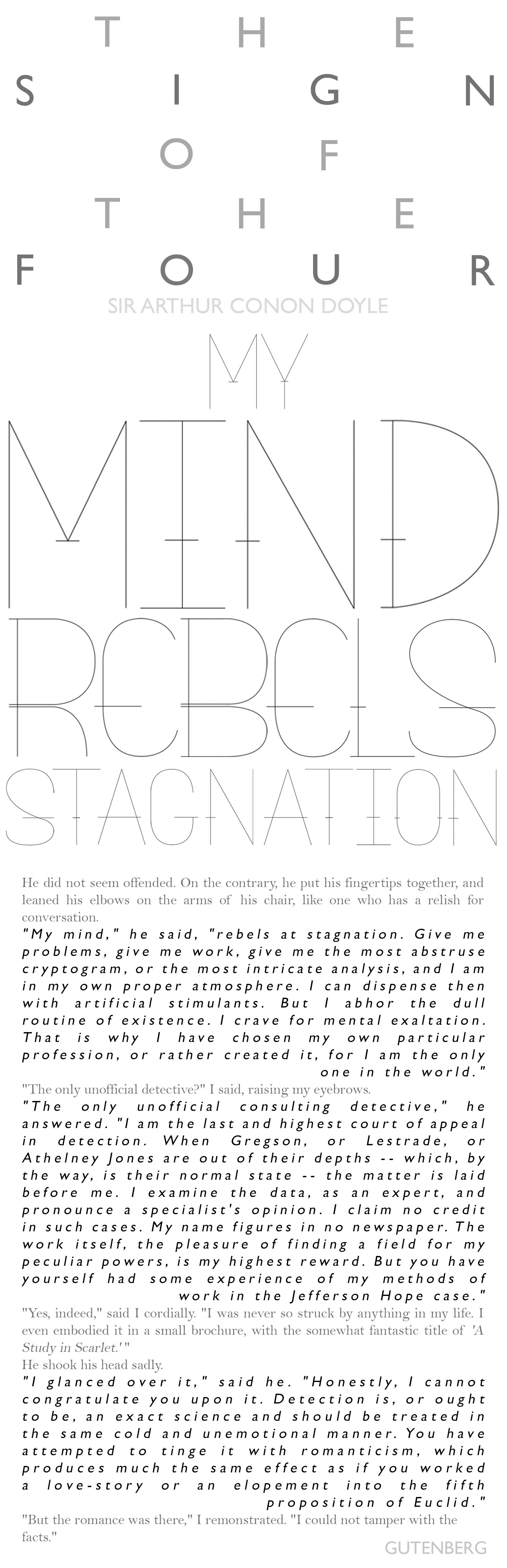
Lisa’s broadside displays an excerpt from Sir Arthur Conon Doyle’s The Sign of the Four, a Sherlock Holmes novel.  The mood of this text is meditative and aloof and has the feel of classic literature because of the use of old-fashioned language.  Sherlock Holmes is a detective and the stories fall under the mystery genre.

There is a pull quote that becomes the focus of the broadside.  It is in the largest type and is in the designed font.  Although the font is very thin and hard to read from far away, it is noticeable enough to catch a passerby’s attention.  The next largest type is the title of the novel the excerpt is from, printed in a thick sans serif font in varying shades of gray.  The letters are set with extremely wide kerning and the letters are staggered like bricks from line to line.  This makes it hard to read each of these words as well, but is visually engaging and more easily noticed from far away.  When the kerning is set so wide like that, it makes the reader think harder about what the words say, as a sort of puzzle.  This could have been done on purpose, given the genre of the text.

The running text is split into two styles.  One is a bold, black, sans serif font, for the dialog of Sherlock Holmes.  This type is also set with wide kerning that causes the reader to read the text more slowly, much like the title text.  The other running text style is a smaller, serif font printed in a light gray.  These two styles seem to demonstrate the mood of the running text, as well as showing the differences between the two characters — who I believe are Sherlock (the bold sans serif) and Watson (the small serif).

The fonts all work well together visually on this broadside.  The changes in each show distinct sections that help the reader better understand the text.  The designed font of the words “my mind rebels stagnation” is appropriate and complements the overall mood of the text well, although it is very thin and not easy to read from far away as display text.

The text itself is well set and there is no hyphenation.  However, there are a few places that use a double hyphen (–) instead of an actual em dash.  There are also a few orphaned words, like “conversation” in the first section of running text, and “facts” on the very last line.

Overall, I really like Lisa’s broadside.  The typefaces all work well with the one she designed, and they fit the mood of the text she chose.  Choosing a gray scale for the design instead of color is fitting for the text.  The long and skinny paper/layout is flattering and different.  I just wish the print was bigger, and that the display text was thicker so it could be read more easily from far away.

Posted in Fall 2014 Archive (338), Uncategorized | Tagged | Leave a comment

Student Broadside Critique – Brian Tomsovic

Broadside_Danielle Clement

I was paired with Danielle, whose text was the poem, “Be Positive” by Nedra Johnson Aswad.

The mood conveyed by the poster is one of happiness, which I thought fit the message of being positive. The color in particular conveys this. The light purple and the Yellow contrast each other despite being fairly light colors. Also, the text fits the mood, there’s no gothic or dark feeling to it.

The hierarchy is pretty straight forward, the Title of the Poem is the highest, at the top, and the biggest, and it’s a separate Typeface from the rest. Then on each line that “Be Positive” repeats it’s the next thing, followed by the rest of that line, then the line that explains those lines in tiny white, lastly the Author and Source seem to be the least important parts.

The poster was easy to read from a distance, especially the title, The bigger yellow lines were readable from a distance as well, the smaller white lines were barely readable from across the room, however I believe I’m a smidge far sighted so that may be cheating. Overall I think the hierarchy made the poem easier to read, by emphasizing the repeating parts, my brain didn’t need to read “Be Positive,” but rather knew each pairing of lines started that way, and so I was able to stay engaged a little easier.

I think the type style is appropriate, despite a kind of blocky feel to the designed text, it doesn’t detract from the message. It makes it feel stronger in a way. The poster has this feeling of, “Be Positive” is the important part, and then if you need a reason to be positive, you should read further, but if you don’t then that’s all you need to take from it. I’m not sure if that’s what the author of the poem intended for his/her work, but I think it’s a really good way to build a broadside.

Letter spacing, Kerning, and Size really work. Line spacing is done well to make it clear that the lines come in pairs. Alignment doesn’t seem quite right, justified left is probably the right way to go, but without something to visually queue the brain as to why it’s aligned like that and in that place, the different length lines makes it seem ever so slightly imbalanced. If the lines were closer in length a full Justified might work, Or maybe just simply adding bullet points or a line running down the length of the list; Some visual queue of some sort. It certainly doesn’t break the design, but after staring at it all class, once I saw it, it was hard to ignore.

As for the rest, the only real criticism I had was that the Author and Source seem really tacked on, like if it’d been printed on a card and placed on top of the broadside it would contribute just as much. It didn’t seem integrated into the design, but added as an after thought because it was part of the assignment.

Posted in Fall 2014 Archive (338) | Tagged | Leave a comment

Student Broadside Critique- Jenna Hayden

Final-Broadside-2

The text is A letter to a friend, From Charlie, an excerpt from Perks Of Being A Wallflower. The mood being conveyed is that it feels like it was handwritten in a letter. The text in the background seems like it could be a typewriter and the text on the top feels more handwritten and natural. The broadside is folded, when it was hanging up I didn’t originally think that it was purposeful but after seeing how it looks in the pdf version it comes across more obvious, a folded letter in an envelope taken out and now is the broadside.

This broadside attracted my eyes over the surrounding broadsides because of the contrast of typefaces and shades of black. It would’ve been nice to see some color on the broadside to grab my attention even more.

The visual hierarchy would appear to be the most important information is the text that is larger and in front but when I asked her about it she said there was not a real reason why some text is larger, she said it could be seen as a kind of a summary. I was slightly confused as to how I was supposed to read the broadside. I realized that I had stopped reading the information in the background and only read the information that was the larger text. If that was what Katie wanted then it’s successful, but if not maybe that is something to be considered. The large text and small text relate to each other and make sense since they are both out of the same letter.

The display level text seems appropriate in this situation because it seems as though it could have been handwritten by a boy/man which I think is what Katie was going for based off of critique the other week. The running text seems appropriate as well. Although it does not look handwritten like the display level font, it gives me the feeling that it was created by a typewriter and when I think of letters, typewriters come to mind as well. Katie did a really good job with letter spacing, line spacing and alignment, visually everything works.

Although it may not be the more visually intriguing broadside in the classroom, I thought that this broadside was very successful because everything connected back to the theme of this being a letter. The typefaces she chose, down to the way she presented the broadside, as though it was an actual folded envelope, all make this broadside successful as a whole.

It may have been cool to see it printed on a thicker piece of paper, or maybe a piece of paper that was not so stark white. Being off white could have been a cool touch, make it feel more authentic, a small splash of color/contrast would’ve been beneficial too.

Posted in Fall 2014 Archive (338) | Tagged | Leave a comment

Blog #7: Image as a Text- Tim White

phone tent smoke

I’m all about minimalism, so I wanted one of the pictures to be a hazy smoke coming out of a stove or a cigarette. Having the entire poem illustrate smoke would be ideal. This particular image would be effective when paired with the poem because there are two occasions in the poem where smoking is reference. However, the illustration of just smoke would suffice as a good interpretation.

Another image I was thinking about using is a circus tent. This image is a bit more under the surface being that there is no where in the poem that mentions anything about circus elements. The reason why this picture would be effective is that the poem mentions an icon named, “hatchet man.” This iconic logo is the main face of a dup called ICP (Insane Clown Posse. I could incorporate the circus tent with another image to bring out that illustration more.

There is a line in the poem that says, “My brother is an unanswered phone call.” I thought that the picture of the telephone off the hook would be a great illustrated interpretation of the poem. It is symbolic to being ‘disconnected’ from the world or possibly just ‘in your own world’; not being engaged with a lot.

Pictorial inclusion or form substitution could also be a suggestion as it brings the illustration into the type by either replacing the counter-forms of the letters of a word or replacing a specific letter all together with an object that resembles that particular letter-form.

Posted in Fall 2014 Archive (336) | Tagged | Leave a comment

Image as Text – Daniel Smith

stock image of women's eyes

stock image of women’s eyes

stock lip print image

stock lip print image

Stock rose image

Stock rose image

The images that I chose are photographs of symbols that I would like to use to emphasize the imagery depicted in Hailey Gibson’s poem titled “Everyone Just Wants To Fit In.” It is a very graphic and detailed poem about the happenings in a teenage girl’s life during her years in high school. Instead of using images to illustrate the words in poem I figured I would let the reader make there own mental decisions instead of telling them what they should think. Instead I decided to use images to emphasize the content matter. I am still trying to decide if weather or not I will use actual photographs or illustrate my own. In any case the images are meant to be used as symbols of female teenage adolescence. Such as the rose is a symbol of a girls purity and innocence that is since lost during this particular girls time in high school. The lips are to represent the maturation of the girl and her growing desire to be noticed as a sex symbol. Also the eyes not only because they are the gateway to the soul but I chose eyes that are heavily done with make up to further the point of a desire to be attractive to the opposite sex. I plan on either doing sketches and creating line work fro these images, cleaning them up and making illustrations of just using the photographs themselves. The main goal of the images, however they may end up being presented is just to be used as symbols to emphasize the imagery described by the words of the poem.

Posted in Fall 2014 Archive (336) | Tagged | Leave a comment

Image as text- Rashaad Siddick

I worked with Jesse’s poem “Skying.” The images I chose all related to the poem as it has to do with nature as well as literally sky references and things associated with flying or in Jesse’s terms, skying. The Savannah image I believe will add great narrative interplay if I had to place the words along the left of the tree in the negative space left there. This would be achieving a more literal approach and image towards the read to help them as they read. All pictures would act as illustrations to help get the correct message of the poem across to different audiences. It would allow for the authors and my personal perspective to be better relayed to the audience through the broad side. That way you wont have to worry about interpretation of the poem getting confused. However I do not believe I would be balance all three images on the broadside. I believe this would make it to congested but each picture contributes a certain amount of realism to the broadside. I want realism in the illustrations because I wanted to be as literal as can be, as the poem seemed literal as can be. This will allow for a uniform flow and balance between poem and illustrations. The poem also uses metaphors such as skying which in term is relating to “flying.” This is why I deemed a hot air balloon as an image that could possible help narrate this poem. The Narrative is one of the most important things in a poem and the image can help solidify it.

2011, Mark Anthony, dart digital render

2011, Mark Anthony, dart digital render

http://www.prosoaring.com/media/catalog/product/cache/1/image/1000x1000/9df78eab33525d08d6e5fb8d27136e95/h/o/hot-air-balloon-57_3.jpg

Creator N\A digital render

http://fc05.deviantart.net/fs14/i/2007/072/e/c/A_day_at_the_savannah_by_exit94.jpg

2010, Devian art Studios

Posted in Fall 2014 Archive (336) | Tagged , , , , , , , , , , | Leave a comment

Image as Text- Andrew Sears

Sam Weber-http://news.sampaints.com/image/42524086316 Karly-http://ilovetypography.com/2008/03/23/sunday-type-bright-type/ Carlos Meira-http://illusion.scene360.com/3d/21236/layered-paper-illustrations/

Sam Weber-http://news.sampaints.com/image/42524086316
Karly-http://ilovetypography.com/2008/03/23/sunday-type-bright-type/
Carlos Meira-http://illusion.scene360.com/3d/21236/layered-paper-illustrations/

type-exercises meira_09

The first piece that I chose exemplifies the use of drawing and painting to create an illustration. Sam Webers work uses painting on the bottom to create the priest’s coat and uses drawing to create the priest’s head that turns into trees. Over by using this combination of media Weber is able to create a design that puts off a darker, more sinister mood than other forms a media can achieve. Use of this medium in my work could help me to design a broadside for Laura’s poetry because a lot of it involves sort of dark messages. The second image by Karly shows the concept of type as image. Her work shows how the meaning of words can be portrayed by how they are presented. By organizing the words in different ways and changing their form she is able to convey the meaning of the word. This could help me in the design of my broadside because while reading through Laura’s poetry there were several times in which I had to look up the definition of the word to try to understand the meaning of the poem. By using type as image I could make it easier for readers on uncommon words to display the meaning of the word within the text avoid confusion or misinterpretation. The third piece I chose is a work of layered paper by Carlos Meira. The use of the layering in his piece brings some depth to the design, which makes it more visually interesting and also slightly more realistic. I could use this in the design of my broadside because by using a collage method I could create the felling of light through the use of layers.

Posted in Fall 2014 Archive (336) | Tagged | Leave a comment