Point, Line, Plane, and Balance: Sydney Elliott

dtc336blog1-sydneyelliott

Théâtre l’Échangeur Bagnolet. This poster was created by Boris Gautier, a student in Paris, France. His illustrations were inspired by isometric 3D graphic video games and a french highway interchange.

While browsing Behance, a creative portfolio site for artists, I came across this poster created by Boris Gautier. I was captivated by the fact that it was indeed typography but I couldn’t initially read, or figure out what the poster was supposed to be representing. My eyes were immediately drawn to each of the letters, serving as points within the piece. From afar, they can be seen as individual points of interest, but as your eyes continue, lines are used to complete the letters and transition the eyes through each element down the poster. Lines are not only used to guide the eyes but also to create texture, giving the “points” dimension and scale. Each letter appears to be roughly the same size due to the height created by the texture of each letter. This technique of scaling  is also emphasized by plane. Because of the letters’  textures, weight, scaling, and shading techniques, the letters appear to be on different planes, imitating buildings and bridges. Shadows on the “ground” also help the letters have a 3 dimensional quality.  This is an interesting concept because the theatre is named after a french highway interchange running through a city. The color gradient also helps the eye travel down the poster by starting at the top left corner and ending at the bottom right, zigzagging the viewer each piece of information about the theatre. The colors used are both calming but also energizing giving life to the poster, giving it a very different feel than if it had just been done in black and white. Overall the poster gives the viewer a sense of balance between the information needed to get across for the reader to understand the purpose, while also providing excellent design choices, making it a very exciting and fresh poster. This balance is also emphasized by the semi-symmetrical balance, if one were to fold the poster into fourths, but has a nice sense of asymmetric balance because the color gradient outlining the poster and the viewers eye path.

Posted in Fall 2015 Archive (336) | Leave a comment

Point, Line, Plane, and Balance – Joshua Coleman

Maryland Institute College of Art students experimenting with different states of typography in a single poster collage.

Maryland Institute College of Art students experimenting with different states of typography in a single poster collage.

When looking through the various examples of typography I was immediately drawn to this poster from thinkingwithtype.com. The the students from the Maryland Institute College of Arts are experimenting with different aspects to typography. In my opinion, each corner of this poster displays a different aspect of each of the concepts.

The word “elimination” serves as a line. Immediately my eye reads from left to right, but also top to down because of the flurry of “t”s that are seemingly falling away. the “t”s also serve as individual points, because my eye follows each of them individually down to the bottom of the poster. Each serves as a method of transportation for the eye. 

The “Immigration” poster in my opinion serves as a plane. One can almost imagine the rectangular shape that the student is trying to create for the viewers here. This plane creates a way of reading, in that my eyes start from the bottom and gradually ventures to the top of the page.

Finally, the “Expansion” corner of this poster serves as a scale, but more of in the sense that it is using a compressive and expansive technique to make the word seem squished together and at the same time expanded out. This makes me feel like although I am only reading one word that my eyes are drawn across the entire page.

In a way every sector of this poster makes use of negative space. The white background brings forward the effects that the typography is achieving and creates the various parts of the words as points. My eye is drawn to whatever parts of the poster of are set in black, because of the sheer expanse that is the negative white space.

These posters have given me a better understanding of point, line, plane, and scaling in a practical sense. I find myself inspired and would love to incorporate some of these methods within my final product.

Posted in Uncategorized | Leave a comment

Alternative Self-Portrait: Leah Baird

Nuttall-resized

“Confessions of a Blog-A-Holic” is a visual representation of data pulled from designer Natasha Nuttall’s blog Graphique Fantastique. The image was found at I WANT DATA – a Tumblr blog which collects and publishes ‘a new datavisualization every day’.

Data visualization is the process of taking data in the form of numbers and facts and transforming it into a visual, graphic representation. The process tends to create more a more palatable representation of the data – visual learners grasp information more easily from a series of shapes than a stream of numbers. It also just tends to be a really cool way to represent monotonous day-to-day actions that otherwise people would shrug off. In “Confessions of a Blog-A-Holic” graphic designer Natasha Nuttall used data from her blog Graphique Fantastique to create a simple poster detailing blog activity from January, 2009 through December 2011. The blog “features posts about [Nuttall’s] design influences, opinions and the journey of her career” and, as such, could easily be classified as a graphic designer’s self-portrait. This graphic itself is an alternate representation of said self-portrait, a visualization of the points of data tied up in opinion and personal growth. I chose this graphic because of my own interest in data visualization, and simply because I find it aesthetically pleasing as a designer.

Nuttall uses many basic design techniques in her creation of this piece – for starters there’s an easy to spot grid in the rows and columns of the triangles. The typography is present and informative without distracting or taking from the overall minimalist design. There is even, arguably, a hierarchy of information. Viewers will first look at the bigger triangles, then realize they mean something more and move in closer to examine the smaller triangles which make up the larger ones. There are pockets of information folded into shapes through simple use of color. Most importantly, to me, the use of color is analogous. Nuttall isn’t trying to distract the viewer from the larger triangle shapes by using bright, contrasting colors. Instead they use a muted series of blues paired with grey and white contrast. The darkest color is a midnight blue that sits heavy on the page, representing the highest numbers on the data scale.

Overall I find this piece well-balanced, and consider it a well-made look into the ‘self’ of a designer via their blog.

Posted in Fall 2015 Archive (338) | Leave a comment

Point, Line, Plane and Balance: Mark Midgett

The name of this piece is called “Picasso’s Quote” it was designed by Peter Bielous with the intent of creating the significance and beauty of art within typography.

For this particular blog post I decided to go with a visual example that held a more chaotic yet organized sense of typography. Elements such as line, point and/or plane are such a large contribution to the overall aesthetic balance when producing any work of graphic design, in this case typography. The name of this particular piece is “Picasso’s Quote,” Peter Bielous designed it with the intent of representing the quote in itself. Peter Bielous wanted to guarantee that every individual letter was constructed with care and extreme attention to detail. Placing each word in a position that produced a sharp, clean, yet significant piece of artwork. Within the piece, the design and placement of the text “ART” serves as the primary focus due to the fact that is the largest text alone in the entire piece, serving as the point. The text within the center of the piece “From The Soul” serves as a source of point and line. The “The” at the center serves as a point because it draws your eyes towards the center, specifically because it has such a strong contrast being that it is the only white text in the piece that is fully surrounded/filled by a black circle. “From The Soul” also serves as a line because it divides the top of the piece from the bottom, creating a sense of organization and balance. Along with the various amount of lines throughout Peter Bielous’ piece that serve as guidelines, outlines, and separation, causing the viewers eyes to wander without getting and/or staying lost also producing a sense of balance in the piece for the viewer. Overall, I really enjoy this piece of typography because it serves as a prime example, showing graphic designers specifically beginners such as myself, that typography can be exciting and an eye full and still contain a sense of organization when the typographic elements are used correctly.

Posted in Fall 2015 Archive (336) | Leave a comment

Point, Line, Plane, and Balance – Alex Weber

050_CordialInvites_141

https://niice.co/search/typography

The design I chose to analyze I felt really captured what the reading went over well. The design uses planes, lines, and balance very well and one could argue it even uses points in a subtle way. All of the words are broken up by color which is mainly what the design consists of. However, when the colors are placed in planes that are broken up neatly by lines they start to form letters. The letters spell out “Make Luck” which is a saying I found really cool because the artist wanted to emphasize that creativity is more reliable than luck. the jagged lines and overlapping planes make for an interesting design. The lines on the top and bottom are useful because they give the artist a balanced space for more information with out taking your eye away from the center design. The lines that are seen in the words are really made up of edges of planes. Because the planes have an opacity they show the lines from darker planes below coming up through the letters. While the design seems kind of chaotic at a glance, all of the colors are easy on the eyes and the lines are all very specifically placed to create a visible letter. The points where these lines intersect are harder to spot but are there if you look for them. This tells me that the artist wanted the viewer to focus on the planes and the letters that are made with them. One thing that I don’t like about this piece is the curves in the “C” and the “U.” I would have much rather seen the artist use more planes along the edge of the curves using more short, straight edges to create the idea of a curve. Let me know what you think of this design and what you would have done differently.

Posted in Fall 2015 Archive (336) | Leave a comment

Point, Line, Plane, and Balance- Francisco Guerrero

Double Vision by Walter Abish book cover

The visual example that I chose was the book cover of Double Vision by Walter Abish. This piece caught my eye because it uses typographic elements in the context. The black circles on the cover are POINTS that help guide our eyes to read the cover from top to bottom. The circles range in different SCALE, the top circle is smaller in size than the one in the bottom. It helps the reader follow the circles down to read the text in between the two circular objects. The text is displayed in a horizontal manner in the center of the book. The book title reads “Double Vision” and the title is displayed twice in a reflective style. The style chosen for the title of this book makes it seem like there in an invisible line in between the reflection. It shows the variety of different elements used in this typographic book title. The cover also shows a good use of BALANCE, if you were to cut the cover in the middle in a horizontal way then it would ASYMETRICAL. There is good use of different sizes of texts and shapes to make a good balance. In the top half there is a small circle with medium sized text. In the bottom half, there is small text but a big circle. It evens out. There is a lot of NEGATIVE SPACE in this cover but it helps put everything in its place and allows it to flow smoothly. If there were more objects or text, it would have been busier and not as effective. There is no apparent use of PLAIN in this context but the two circles are aligned to create an invisible line in between but it isn’t as noticeable. This book cover is effective with a good use of lines, points, scale and balance.


Posted in Fall 2015 Archive (336) | Leave a comment

Point, Line, Plane, and Balance: Katelyn Orum

Magazine/book covers are something really fascinating to me. All designs are created to draw a viewer’s attention – but the cover of a publication is highly competitive and a window to everything inside. This specific one is really intriguing to me. It’s asymmetrically divided by the skier. The headline keeps the design in balance, while not overbearing the top half. The “rips” on the page work  as lines drawing the eye downward as they create an arrow of a sense. There is an abundance of negative space in this piece,

The New Yorker February 2013 issue

The New Yorker February 2013 issue. Click on image for source.

but the simplicity is what makes this design work. The negative space is representational of snow, and since it’s a winter issue of the magazine, this works  wonderfully and since snow is white, with the colors in the skier’s clothes it almost feels as though this piece is printed in color even though it is almost entirely black and white. The skier is a point at the end of two lines. Within the lines is a group of text that works as a plane, but also as a view of what’s inside the publication. “The New Yorker” headline is arguably a plane and a line because on one hand it takes up enough room to be considered a plane, but the eye moves from the left hand side of the page directly to the right creating a line.   The date and price in the top left and right corners are points. Since they are equal in weight, this adds to the sense of balance.

There is also one thick black vertical line on the far left hand side which finalizes the balance. This line seemingly doesn’t have a purpose, but without it the negative space would have been overbearing. Since the two lines trailing the skier hit the right hand edge, it was seemingly necessary to create a shape or line that touched the left hand of the page in this case. It adds structure to this design.

Posted in Fall 2015 Archive (336) | Tagged , , , , | Leave a comment

Point, Line, Plane, and Balance: Maryssa Beare

Marian Bantjes fulfils a custom lettering job for Michael Bierut at Pentagram. This piece is one of a permanent collection in the Smithsonian's Cooper Hewitt Design Museum. (Marian Bantjes, Seduction, 2006, web portfolio)

Marian Bantjes fulfils a custom lettering job for Michael Bierut at Pentagram. This piece is one of a permanent collection in the Smithsonian’s Cooper Hewitt Design Museum. (Marian Bantjes, Seduction, 2006, web portfolio)

Upon seeing the poster, I immediately go to its title, Seduction, but the almost as immediate does my eye go to the point above it, it looks like a Y encircled. After deciding that the Y isn’t pertinent to the poster’s meaning, I take in Seduction’s branches and swirling lines and move downward. Seduction seems to function as a line that extends into a plane with it’s swirling extensions, most of which are up top, travel into Seduction, and pass through to the words below. These words are seen as lines rather than planes given that they help the eyes travel downward in reading the words.

The visual weight oh this piece is balanced. The swirling nature of the title and top half of the poster is balanced with the strong presence of the structured lines created by the wording on the bottom half. While it is indeed balanced, it’s not for symmetry but through the balancing of the asymmetrical elements.

Posted in Fall 2015 Archive (336) | Leave a comment

Point, Line, Plane, and Balance: Erik Lemus

Created by Dylan Spiekermann, Erik Spiekermann, and Ferdinand Ulrich.

The visual example that I chose to review is the calendar created by Dylan Spiekermann, Erik Spiekermann, and Ferdinand Ulrich. This is a very successful example that illustrates my understanding of point, lines, planes, and balance. This calendar cover does a great job with two different functions Points, and Lines. One of the first and most successful functions is Point. As I first look at this cover the main focus is in the top right corner, the white numbers drew my attention. This is where my eyes were automatically drawn to making it the focus point. These numbers read from left to right, which direct my eyes down the calendar. This calendar also contains a lot of negative space because there is a big gap of red with no text in the middle of the page. As my eyes are first drawn to the top corner the white numbers seem to be in pretty big print size, my eyes then wonder to the negative space right under until I make my way to the days of the week. They are located in the bottom right corner of the calendar. Each day of the week were hand printed with different fonts. These days ready from top to bottom pointing the eye down. The text can also be a representation of lines The lines themselves start working as negative space and the space given between each line starts working at the positive space. The lines repetition has a consistent use of weight, thickness as well as texture. This is a representation of asymmetry, the top right numbers that are in white balance with the text at the bottom right which read the days of the week in black with a smaller font than the number at the top right. This was very successful because it yield both tension and balance as you look at this bright red calendar.

Posted in Fall 2015 Archive (336) | Leave a comment

Point, Line, Plane– Maricela Diaz

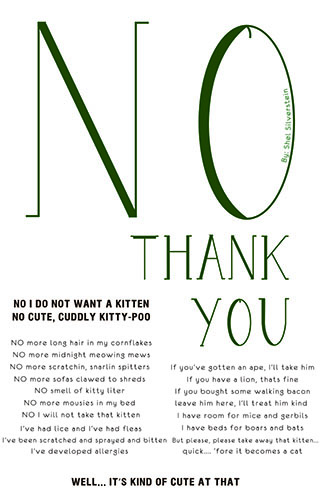
Broadside made by Shannon

Broadside made by Shannon; I found this poster on the media file. I thought we had to choose something from there. I tried to find its source but I couldn’t. There is a link to another post for this but it was made in 2014. I looked that other student didn’t have a link either.

The word No is made at a bigger SCALE than everything else in the poster which caught my eye making it a focal POINT. Since the word “no” is bigger it BALANCES the rest of the small PLANES on the poster. My eye than read the authors name on the side of the letter which was created on a vertical LINE. The placement of the authors name was clever since we read from left to right our eyes will end at the letter O where the authors name was placed. The words “no thank you” are green which get an emphasis of color. After, I look down vertically right to the words Thank you. They are the second biggest word ( they used the SCALE again) on the poster which grab my attention. After the BOLD titles to the left and the bottom center are emphasized. The titles were created to be LINES. At last, I pay attention to PLANES which are separated in  three paragraphs. The  first paragraph  is distinguished by the side lines being even until a small LINE starts the second PLANE. After the second PLANE starts with the smallest sentences and spread from small to big back to  being small. The third PLANE is at the right below the word “you” which stay sort of even from both side of the paragraphs. A weird separation in my view would be the LINE that got created between PLANE 2 and PLANE 3.  It goes from one side of the page to the other.


Posted in Fall 2015 Archive (336) | Leave a comment