Type Anatomy: Camille Oppedal

After doing the reading of Ellen Lupton’s Thinking with Type, I discovered a number of ways to pick apart the various components of font, such as the implementation of cap height, x-height, stems, bowls, serifs, and etc. But perhaps most importantly, stylistic choices like scale, contrast, and fluidity are the aspects to consider when creating a font. It is important for letters to be individually legible and independent without looking out of place when combined– they need to look like they belong within the same stylistic theme.
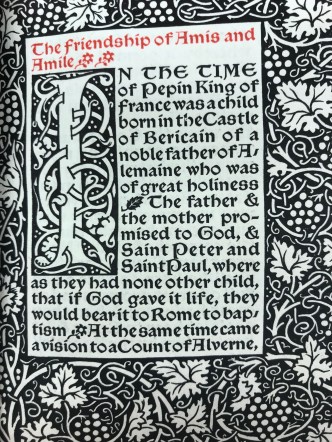
The font that I chose to analyze for this blog post is from the english translation of the originally French novel, Of the Friendship of Amis and Amile. This translation was published in the late 19th century, 1894, but I would say that stylistically, it most closely resembles the Bodoni type classification of the late eighteenth and early nineteenth centuries, as it can be clearly distinguished by the combination of thin and thick strokes. Perhaps the traditional style of the font is to emulate the fact that the novel is translated from ancient french. The serifs of this font are seemingly random, only appearing on capital letters, and in varying thicknesses. The bowls, terminals, and cross-bars emphasize the variable weight of the font, with both thick and thin strokes. The x-height of most letters is relatively tall compared to the cap height, as noticeable in the uppercase B and lowercase e in the word “Bericain.” The ascender case is also relatively small, as seen in the word “father,” where the f , t, and h, are not much taller than the a, e, and r. However, the descender height is comparatively taller than the ascender height, as shown in the case of the various uppercase P’s, such as in Peter and Paul. Clearly, the stylistic choice of this font is to indicate capitalization through wider letters and descending height taking precedence over Ascender height.
fullsizeoutput_245e

The overall impression I have when looking at this font is that it takes care not to overwhelm the eyes with thin strokes, but also seeks to imply importance with bold, thick strokes as well. Overall, I was most taken by this text because of the intricate and beautifully designed borders and decorations surrounding the text on the page. I love the incorporation of nature with images of leaves and berries, as well as coiled, spiralling vines. I think the conscious decision to include such elaborate decoration is to provoke aesthetics of both France and the medieval period in which the story revolves.
Posted in Fall 2017 Archive (336), Uncategorized | Leave a comment

Type Anatomy: Sara Nielsen

Upon reading Ellen Lupton’s “Thinking with Type,” I have realized script, whether it be calligraphy or font, etc., is made unique due to subtle differences created in the type itself. Typefaces are considered as an essential resource to graphic designers, and can be either created or chosen from a preexisting library.

The history of script has been manifested from hand and machine. The first typefaces were created via handwritten calligraphy produced by scribes. It wasn’t until about 500 years ago that printed letters became accessible through Johannes Gutenberg’s movable type and the printing press. Since then, type has only evolved through engraved letters of the renaissance era, pen and quill techniques of the eighteenth century, and the creation of multiple scripts due to the rise of nineteenth century industrialism. To this day digital equipment is only growing more through laser pointers, bitmap forms and online font technologies continue evolving as a visual in print and digital media.

Lupton’s reading also looked into characteristics that make each font unique. Similarly to what we recently learned with patterns, fonts can be structured as well as abstract. For instance, humanist letterforms are traditional and structured in nature. Humanist style is similar to calligraphy and handwritten type. Transitional letterforms are more modern, abstract and less organic. Typefaces can be closely examined based on strokes and shapes created within each letter. Stems and spines, uppercase and lowercase, ascenders and descenders, are stylistic differences that make each font group unique. The placement of letter heights and baselines are also important when it comes to the anatomy of each font group. Type classification can help decipher if a typeface is traditional, transitional, modern, or a variety of serifs or sans serifs. Key components of a type anatomy come down to the type of letterform (humanist vs transitional), stylistic differences, manipulation of height, and classification of type.

AliceInWonderlandArchiveBook

1932 Lewis Carroll “Alice’s Adventures in Wonderland” with Virginia Woolf binder.

While visiting Manuscripts, Archives and Special Collections in the Terrell Library, Virginia Woolf’s copy of Alice’s Adventures in Wonderland caught my eye. I personally grew up hearing and reading Lewis Carroll’s eccentric story of Alice in Wonderland and had a personal connection to the material. Also, since there is a Hogarth Press exhibit in Manuscripts, Archives and Special Collections, I felt compelled to examine this piece.


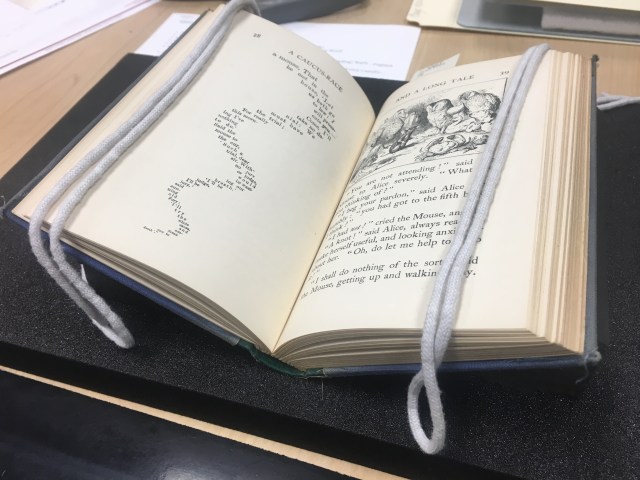
The two pages on display in the Archives were pages 38 and 39. In my opinion, these pages carry the most compelling type anatomy content given the shapes are created within the typeface itself. On page 38 the text itself spirals downward in a “mouse tail” shape to tell the story of “A Caucus Race and A Long Tale” through imagery. The typeface is printed in its normal font size at the top and gradually shrinks in size as the text reaches the bottom of the page. Humanist “old style” type is utilized throughout the entire novel. This font is inspired by classical calligraphy imitated in roman script of the fifteenth and sixteenth centuries. Today this type can be classified under the font name “Sabon.”

Posted in Fall 2017 Archive (336), Uncategorized | Leave a comment

Type Anatomy: Jessica Colvin

Garamond has always been one of my favorite serif typefaces.  To me Garamond feels more professional and nuanced than Times New Roman and it has been my staple for non-design heavy resumes.  As a part of the writing program I have had multiple engaging conversations about the qualities of a typeface like Garamond and the delicate stems of the letters, the open rounded capital letters clearly visible in the G as compared Times New Roman’s blocky more rectangular G.

I found Ellen Lupton’s “Thinking with Type” particularly interesting in the history she gave on the Garamond typeface.  I learned that Garamond was developed around the fifteenth century and is considered a humanist typeface that was in the group of typefaces that rejected older gothic writing styles in favor of the rounded more open feel that I have always appreciated.

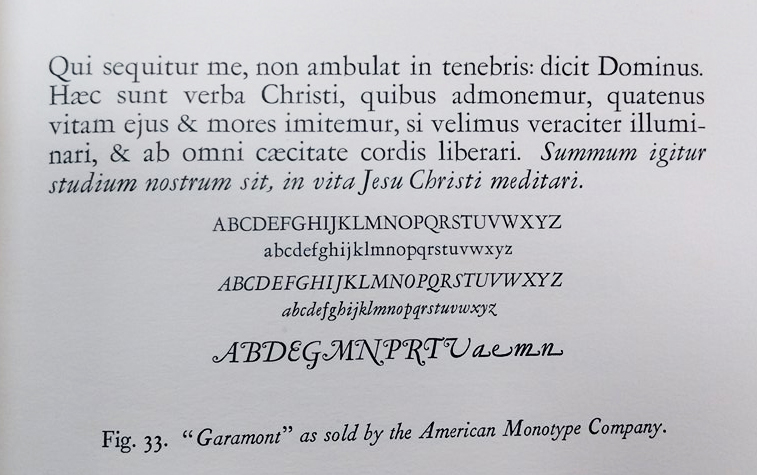
While at the MASC today I found a 1926 example of Garamond in “The Fleuron: a journal of typography” by Oliver Simon.  This typeface example I found particularly engaging because of the stylized Garamond (labeled “Garamont” in this example) type family shown at the bottom.

1926 Garamont typeface example from “The Fleuron” (Simon, Oliver, et al. “Fleuron (London, England).” Fleuron (London, England), 1923.)


While I had already learned from Lupton’s book that Garamond’s x-height has commonly changed throughout the decades, I had not seen or heard of a version of Garamond including these quite elegant swash curls on the letters’ terminals, finials, and descenders.  I find the “N” striking in this family of Garamond for the finial on the down stroke of the N that is so pronounced it could be considered a descender.  A similar emphasis is placed on the tale of the R and to a lesser extend the tail of the G.  The lowercase letter examples in this family are also interesting for the length and curled distortion added to the terminals of each letter.  The width of these lowercase letters are nearly twice that of their equivalents in the rest of the typeface family, however that width is added primarily in the terminal.

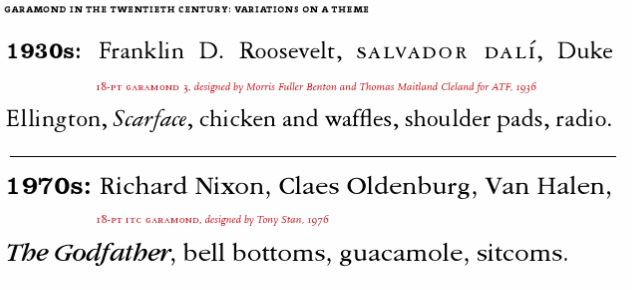
This family of Garamond also has distinctly thicker stems and appears larger than the rest of the examples shown in this image.  It makes me wonder if this is meant as an option for bold Garamond.  If that is the case I would be curious as to the history of where that version of bold Garamond was used and why, according to page 40 of Lupton’s “Thinking with Type”, it was so quickly replaced with a more traditional style of bold.

Garamond variations
(Lupton, Ellen. Thinking with Type : A Critical Guide for Designers, Writers, Editors, and Students, Princeton Architectural Press, 2010, pg 40)

Posted in Fall 2017 Archive (336) | Leave a comment

Pattern Design Reflection: Mary Gerber


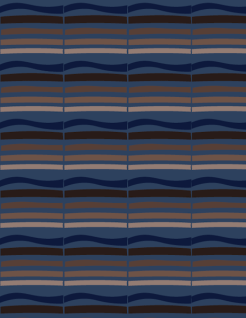
driftwood

Driftwood color scheme.

When creating my designs, I felt inspiration from the beach at my family cabin I spent many summers at when I was young. Camano Island has a particular portion of beach that is filled to the shore with driftwood. My first design is inspired by the driftwood that is pushed onto the shore with the changing tides – the lighter the shade of wood, the longer the driftwood is to have been on shore and exposed to the sunlight; the darker, the closer it lies to the tide. My initial color scheme is straightfoward and represents driftwood, and how it lightens the farther away it is from the shore.

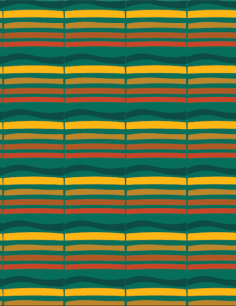
goldenhour

Golden hour color scheme.


For my second driftwood color scheme, I wanted to brighten the colors in order to represent the shore in the later evenings as the sunset reflects upon the water. The shore illuminates and everything but the water appears to have a golden hue, hence my choice of orange and yellow shades in the second color scheme. I kept a teal-green contrast as the background in order to represent the dark ocean at this time of day.


underwater

Underwater color scheme.

I was inspired by seashells for my second pattern. The circular lines represent the ridges that develop on seashells as they age. My first color scheme is bright and has different shades of teal. This color scheme represents the shells when they are sprawled across the deep ocean floor.


washedout

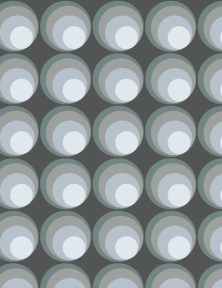
Washed Out color scheme.


The second color scheme is much more bland and grey, which represents seashells once they are cast upon the shore, and bleached by the sun. I chose a grey background for this second color scheme to represent the grey shades of rocks and various pebbles that lie below the shells on shore.


I foresee these images being used in the interiors of beach cabins. I envision them on cozy throw pillows, shower curtains, and other varieties of cabin textiles.

Posted in Uncategorized | Leave a comment

Pattern Design Reflection: Allison Cissna

My inspiration for these pattern designs was a mosaic tile theme that I have seen in my great aunt’s backyard where she lives down in Mexico, these intricate patterns can be found all over her house and ceramic vases that she had when I was little. Some of my inspiration was sparked on Pinterest and often I have been seeing these patterns on things like apparel, office supplies, and much more. Before I created this pattern I had no experience with ever making a pattern so I was excited to try and see what I could possibly create. I wanted to challenge myself so I decided to create the patterns I see a lot of and patterns I enjoy seeing. I wanted to use organic shapes to give off a natural tone because if you look at most mosaic tiles then you would get the same vibe from those as well. Most tiles with such detail are often found in bathrooms, and outdoor patio tiles. For the color schemes I chose to try natural and warm tones and I also wanted to try fun and eye popping colors. With the warm natural tones I added a neutral beige background to give again a natural tone that you would most commonly see in a mosaic tile. I am not a huge fan of the other color schemes I used because they do not go along with the usual mosaic tile theme. I can see my pattern being used on luggage, rugs, or possible tile designs in the real world future.

Posted in Fall 2017 Archive (336) | Leave a comment

Part 5: Digital Pattern Development


The reason I am creating this pattern is because I love the simplicity of the pattern and the symmetry of the pattern itself. A character I created for a screenplay I am writing inspired this pattern. The character wears a black outfit that has a dark blue hood and scabbards. The straps on the scabbards wrap around his torso, making a blue x on his torso. This pattern very much represents the things I like and my style. This is because black and blue are my favorite colors and affects my choice of wardrobe as well. The pattern might represent structure to other people because it might look like some kind of tower or a house of cards. The screenplay is not complete yet, so it is not currently tangible. It is a series of ideas I have in my brain, but that is what makes it unique. It is a design that has deeper meaning for me and that is why I wanted to use it for this project. I knew what to pick for this pattern because I knew what I wanted to get my inspiration from and what attributes I wanted to use from that inspiration. For the first one, I used blue because it is the color of his costume. For the second and final one, I used red and purple because there are side characters who wear a red and a purple costume.


The other pattern is clearly based off of the yin yang symbol from Asian Symbolism. They symbolize many things, but they most commonly represent the good and bad sides of a person. Usually, the yin and yang symbol is drawn as a circle divided with an S shaped line. I created this pattern because I enjoy the shapes used. When I was younger, I very much enjoyed drawing the yin yang symbol. To me, this represents conflict within one’s self, a conflict that can last a long time. The pattern might mean opposites to other being. Other people like to associate this symbol with the ongoing battle between good and evil, but I do not believe it is that simple. The design is inspired by the idea of the yin and yang, and is therefore intangible. I knew what shapes to use because the yin and yang symbol is a circle. The colors I used changed around. For the first one, I used the traditional black and white. For the second one, I used red and blue, which are usually seen as colors that conflict with each other. For the final one, I went with orange and purple because I felt as if I could get some real contrast from those colors being used together. Another interesting thing I wanted to add was that I purposely had some parts of the symbols overlapping others so show that sometimes some parts overshadow others, like good and bad.

Posted in Fall 2017 Archive (336), Uncategorized | Leave a comment

Pattern Design Reflection: Rachel Bigler

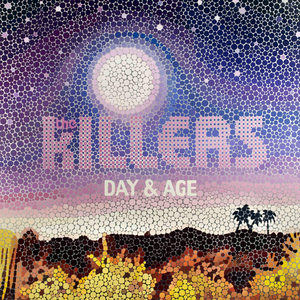
This is the cover of the band called The Killers album day “Day & Ages” that was released in 2008

This is the round-about by the vet school that inspired the circles in my design


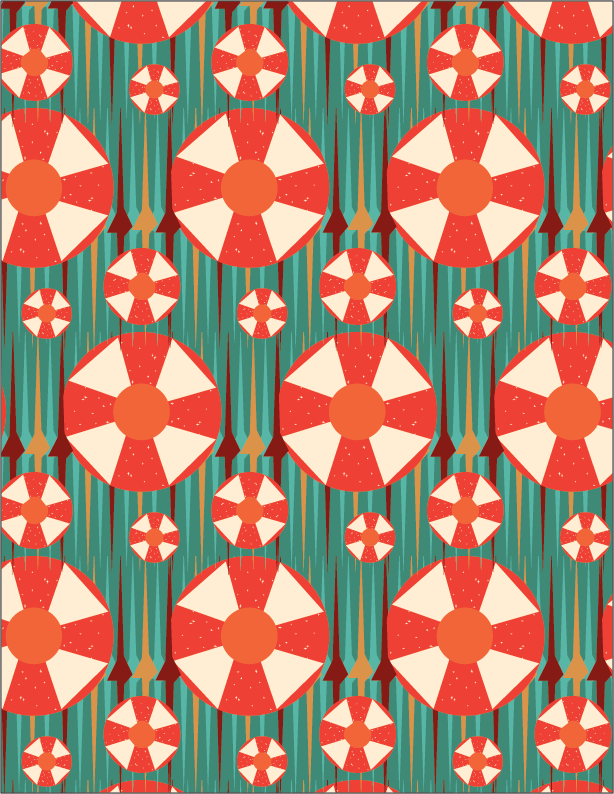
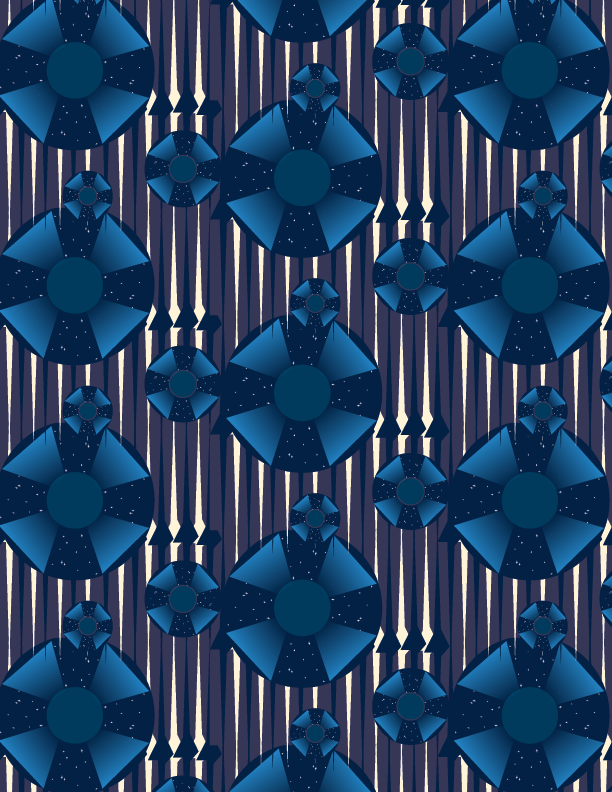
For my first pattern, I was inspired by a song called “Spaceman” by the killers and a sort of round-about area near the vet school on campus. First when I heard that we could look to a song for inspiration Spaceman popped into my head and I instantly knew what colors I wanted to use (those night time and star like colors), and the ideas I wanted to incorporate into this. Within the song there is a line that talks about beams of light coming from the sky which is something I knew I wanted to show in my design, then I saw the round-about that had these lines inside them that reminded me of the light beams and I wanted to incorporate that into the pattern. With the final product of my pattern I could see it being used as a wallpaper either digitally on a laptop or on an actual wall in like a SYFI loving kids room or maybe like a technology classroom. When it came to showing this in another color scheme I got 70’s wall paper vibes from the pattern so I made a scheme that was based off those bright oranges and blues.

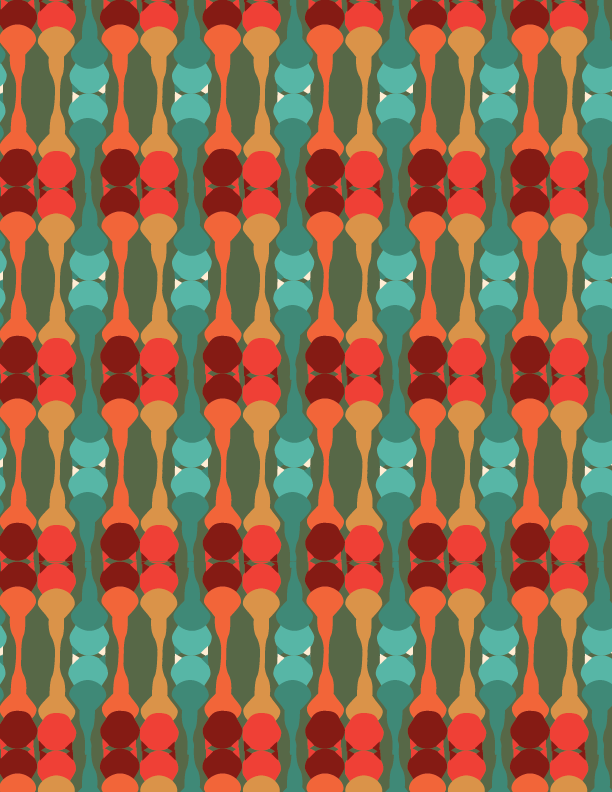
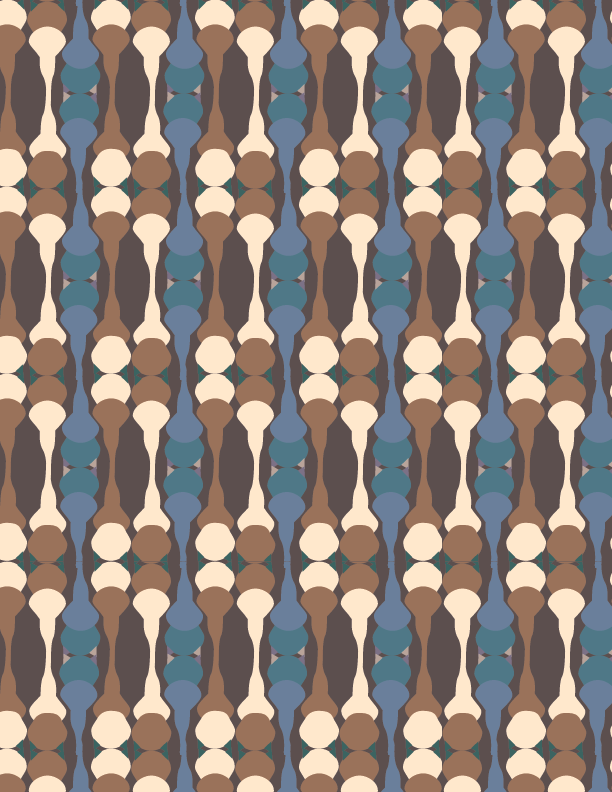
My second pattern was inspired by one of my favorite pictures of my cat and the shape of his head and fur around his chest. I then had the idea to create that outline shape that is seen in my cat and then take the colors from the picture and use those for my scheme. I also got 70’s vibes from the curves in this pattern so I replicated the oranges and blues from the previous pattern and put them In this one. The color was something that I played around with a lot with this patter because I wasn’t sure what aspects I wanted to make stand out to the viewers so I made three different color combos. As far as what this pattern would be used for I could see it being used in furniture for like a couch in a school like WSU or on campus lounges.

This is the second color scheme I chose for my cat pattern

This is the first cat color scheme I did

This is the second color scheme I did

This is the second color scheme I chose for this pattern

This is my first pattern with the space colors


Posted in Fall 2017 Archive (336) | Leave a comment

Pattern Design Reflection: Katrina Bittner

I was extremely excited when we were given the prompt for this project. I instantly knew that I wanted to create a pattern that was meaningful to me, and that I could put more into than just the minimum. I wanted to put my emotion and meaning into these patterns, which is why I chose to take inspiration from two animals that hold deep symbolism to me. The first, being a monarch butterfly- something that symbolizes my Grandmother and love. I have always loved butterflies, but it was not until my Grandmother’s passing that the monarch butterfly took on a new meaning. My mom and I would always see a monarch butterfly when we would visit the place where we used to go hiking with my grandma, and have since connected the two. I wanted to use a butterfly as my basic shape in the pattern- which is where the silhouette and butterfly image come in. I used the colors found in the monarch butterfly image to help create a simple, yet natural portrayal of a monarch butterfly. I also contrasted the monarch butterfly, which has a bright- natural feel; with an ashy blue butterfly. While still beautiful, this butterfly depicts sadness and the emotion my family felt when my grandmother passed. Both butterflies are extremely meaningful to me, and contrast each other deeply in more than just the aspect of color. For my second pattern, I decided to use a peacock for inspiration. When my family went to Hawaii last winter, we saw many peacocks on the island and since then the beautiful bird has reminded me of the fun times I had with my family on the beach. Not only is the peacock meaningful to me, but it also has natural patterns within its feathers, and has beautiful, bright colors. I decided to make a pattern out of a peacock feather and used various shapes and sizes to create the desired effect. The bright blue and green colors seem natural and bright, like a tropical vacation, where as the bleak brown colors remind me of the middle of winter where everything is monotone.

Posted in Fall 2017 Archive (336), Uncategorized | Leave a comment

Pattern Design Reflection: Kim Santos


For my final pattern design, I decided to do something that was a little more personal to myself. I was born and raised on a tiny tropical island that depends a lot on tourism. I grew up around many emphasized island prints and designs that were intended to attract more tourists. They were on postcards, welcome signs, restaurant menus, and more. I was first inspired by one of my images from the first blog post, of simple bushes from around campus. For a while, I stuck to the idea of a leaf, a split leaf to be specific. I then did more research on things related to island culture (graphically, at least). I looked through countless images of tribal tattoos and homemade quilts. Aside from that, I was also taken with one of the floor patterns of the library study lounges.

I played off of a lot of these designs, messing with shapes, their colors, and just the organization in general. I had thought a lot about promoting more of tribal art, but it was difficult to do so without (unintentionally) recreating the entire design. I finally went with a single shape and went with a color scheme that reminded me of island characteristics, such as the ocean or the famous hibiscus flower.

I visualized a lot of my work in places I grew up seeing it, the tourism industry. Another place I imagined it was in the schools I attended and of course the rest of them as well. We often celebrate our culture through many events during the school year. The pattern could be used in newsletters, yearbooks, programs, bulletin boards, and other school affiliated prints.

Posted in Fall 2017 Archive (336), Uncategorized | Leave a comment

Pattern Design Reflection: Zach Prybell

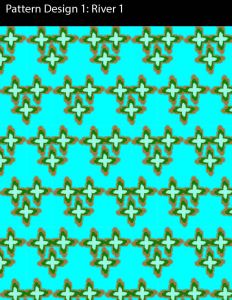
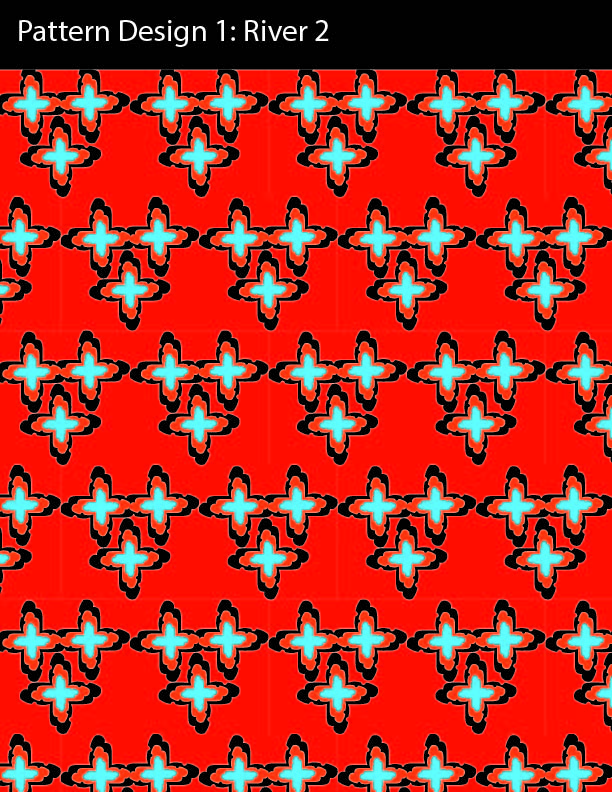
My inspiration for my first design was rivers, I like the way they cut through the earth to form valleys and island. After looking at some pictures of river valleys I started creating

shapes that represent island that you would see in a river. They I decided to make the island that I created form a cross and bunch three of them together so that and put two smaller crosses on top of the biggest cross. Once I had my shape designed I wanted to make it

represent the natural look that the islands I designed it after had, so I colored the bottom cross a light brown like dirt/land, then I made the middle cross a green that looks like a grass type look. And for the top cross I choose to make it a very light blue almost white, I did this to represent snow. I wanted this to give my design some vertical depth, like the island was tall enough to have a snow-cap, and after that I put a blue background for the water. The second colors scheme I went with was based off a hot and cold idea that is loosely based off a volcano.  I made a red background to give it a hot feeling, and the base cross was turned black for contrast, then I made the middle an orange to along with the warmth but I choose the top to be a blue again because I liked the quick change from the warm that the orange and red gave off to the cool feeling the blue gave.


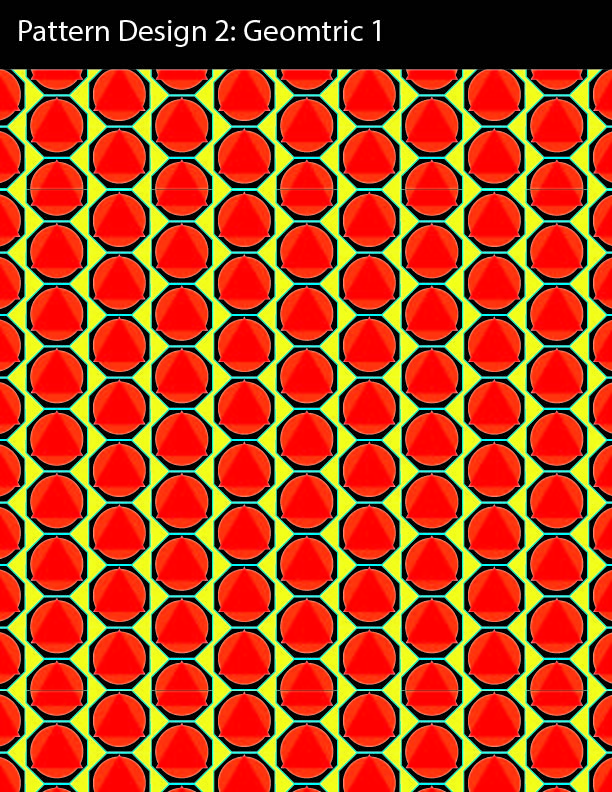
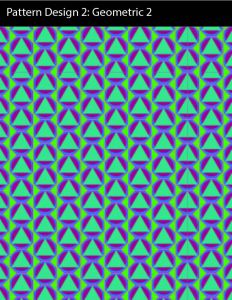
My second design was based of architecture and geometric shapes. This design for the first color scheme is a yellow square background, with a light blue octagon on top of that there is a black octagon. After the octagons I put an orange circle over them, and on top of that is a red triangle. I chose these shape because I felt that I kept seeing them in nature and man built structures and that the angle I was trying to take with this design. The other color scheme I choose to make the background green with a pink octagon on the bottom, a blue one on top of that, a purple-ish circle on top of that and a green/blue triangle on top of it all. The reason I picked these colors is because they are a lot softer than then first scheme so it was less contrast and more blending together.

I see these patterns getting used in the real world as maybe backgrounds to a computer or like a loading screen type situation. They are very bright so I don’t think I could see any of them as a wall paper or article of clothing.

Posted in Uncategorized | Leave a comment