Technological Artifact: Charlie Hanacek

If you are reading this post, chances are you are using WiFi, or wireless fidelity. Before WiFi, any device accessing the Internet had to be physically connected, either by phone line or Ethernet cable. Nowadays, many ordinary web surfers never have to deal with hooking up a wire to their device to access the Internet, thanks to WiFi. A WiFi router like the one here acts as the gateway between many wireless devices and a single Internet connection. My generation has witnessed the shift from wired to wireless communication, either over WiFi or a cellular data network.

Most of the time, I don’t even think about being on the WiFi network nearby wherever I am because in general, my device joins automatically. WiFi is ubiquitous. At WSU, the WSU Wireless network blanket the campus, even outdoors. Coffee shops, gyms, airports, trains, buses, and even airplanes now offer free WiFi, often without a password. So many people take WiFi for granted that when it goes down, people become upset, even if it is provided as a courtesy. Recently, many laptops have been shipped without Ethernet ports to facilitate a wired Internet connection in exchange for slimmer designs, further necessitating WiFi connectivity.

A Linksys WRT54G wireless router. Photo by Charlie Hanacek, August 2018

I chose this particular router because I happened to have it, but also because it was one of the best selling early WiFi routers. The Linksys WRT54G served both consumer and enterprise customers. The blue and gray case with the double antennas was an iconic design that proved to be successful. These routers were designed to be vertically stackable with each other in order to increase the number of possible WiFi users in a single area. I remember walking into my local public library and seeing one mounted on the wall to provide free-to-access Internet in 2008.

The router pictured here would be relatively slow by today’s standards, but certainly usable for normal web browsing. The Media Archaeology Lab‘s mission is to keep new technology in perspective with old technology. In this way, people who are accustomed to browsing the Internet with the latest WiFi standards might get frustrated if they experienced slow speeds. However, those slow speeds would probably be top-of-the-line for this WiFi router. I don’t use this router for my day to day tasks, but if I had to, it would probably work great.


Posted in Fall 2018 Archive (201) | Leave a comment

Point, Line, Plane: Matt Behnen

Everything in the world is made up of points, lines, and planes. These compositional elements are the building blocks of every image and design choice. We design things with specific points to draw our eyes towards those focal points.

The Amazon echo has multiple points of focus – Photo Matt Behnen Aug. 2018

This Amazon echo was designed with four specific points for people to focus on. These points are placed there for our eyes to focus on and understand that they are important for what we are looking at. Our eyes will be pulled towards those points before looking at anything else on the device. Points can be bold and obvious like the four big buttons or small and discreet like the tiny microphone holes surrounding the border of the device.


The Hoover Dam is made of multiple lines connecting together – Photo Matt Behnen Dec. 2017

Multiple points following a direction create a line. Points can also be so close together that you can no longer see them as individual points but as a single line. This image shows lines very well because a line is the connection of two points and you can clearly see the points of intersection where two lines meet. There is also the empty space between each line. The empty space is also knows as planes because a line is where two planes meet. Lines and planes complement each other.


Planes are shown by the connecting lines and points – Photo Matt Behnen Aug. 2018

Planes are created by the combination of points and lines coming together. An easy way to think of a plane is the shape made from lines connection points. You can think of planes as shapes. This picture of windows shows how planes are created by multiple lines connecting and creating a shape in the window. Planes are flat surfaces that extends itself in height and width.

Scale plays a big part in design. When creating an image in illustrator, you can make a single point on your artwork, but if you decide to make that point larger in scale, it will become a plane. The same explanation can work with lines. the thicker you make a line, some people will see that as a line, but others will see that as an individual shape and it becomes a plane.


Posted in Uncategorized | Leave a comment

Technological Artifact Jenna Walker

The technological artifact I chose was my Polaroid camera. I chose this because it mainly defines me, but also somewhat defines my generation. While Polaroid cameras are not new products, they have made quite a come back. Polaroids and the small photos they create have created an aesthetic for my generation. A lot of people post photos of Polaroids and/or have them strung up in various rooms in their homes. Even if you don’t have a Polaroid camera, you somehow end up with a Polaroid photo of your own.

Polaroids have created an aesthetic for my generation. (Photo by Jenna Walker, 2018)

Why I think this defines me is because out of all my friends I feel like I am the one who likes to document the moments we share together. Bringing a Polaroid in to the mix provides actual photos for us rather than what is on our phones or posted to various social media platforms.
These small photos create more sentimental value and something that can be carried with everywhere. Like I said before, Polaroids are not new products. I believe that Polaroids cameras will be around for a long time because they are a very interactive way to take photos. They have been used for many years despite the newer versions of cameras that are available for purchase, people still buy Polaroid cameras.

After visiting the MAL website, it is apparent that there is always something new coming out. Bringing this back to my artifact, it is obvious that the cameras being released and bought now are the new versions. Some cameras now even have WiFi so that photos can be sent directly to a phone or computer. The quality on cameras has improved as well, with today’s cameras no one has to be concerned with how the photos will develop because cameras also have a feature to adjust brightness, increase contrast, and other tools that were not provided on Polaroids or other older cameras. Overall, the MAL showed that there are always new “up-to-date, cutting-edge, tools available,” and compare the old to the new providing a fresh outlook and appreciation for the tools that are provided that once weren’t.

Posted in Fall 2018 Archive (201) | Leave a comment

Point, Line, Plane: Claire Martin

The fireworks illustrate point and line. Photo by Claire Martin, July 2016.

Every image, whether it be a photograph or digital creation, contains some sort of point, line, or plane. However, it’s the way in which these concepts are used that classifies the compositional elements. In the first image, many little points in the form of sparks make up lines (by definition a series of points) that draw the eye towards focal points at the center of the fireworks. The eye is drawn to the center of the fireworks due to the contrast between the dark night sky and the bright fireworks, which act as leading lines.

This photo of British Museum ceiling illustrates line. Photo by Claire Martin, July 2016.

What I find interesting about the second image is that the lines appear to be fairly straight in some areas yet have more curvature in other places. Additionally, the thickness of the lines changes throughout the photo; the lines in the upper right appear to be thinner, while those in the bottom and upper left appear thicker. Finally, the eye is drawn to the sun in the left of the photo because of its brightness and the leading lines that seem to almost open up as them approach it.

This image displays plane and line. Photo by Claire Martin, July 2016.

The sign in this image is an example of plane because it’s simply a flat surface with height and width. I love the juxtaposition of the smooth, 2-dimensional sign with its straight, precise lines and the texture and curvature of the 3-dimensional grass within the forefront of the image. The contrasting white of the sign and boldness of the text draw the eye away from the natural greens in the foreground and background.

This image displays volume, as well as line and contrast. Photo by Claire Martin, July 2016.

This image displays volume as the height, width, and depth of the building’s chimneys and pop outs are visible. I love the many differing textures and styles of architecture pictured and the contrast between the white windows and the dark building. This photo uses the concept of line in the form of leading lines, drawing the viewers eye to the left due to the angle, as well as to separate the different parts of the building. Line can also be seen within the image’s textures, including the brickwork of central tower and the shingles of darker section.

The scale of an object can determine a significant amount about it. A small dot would on an empty canvas would likely be referred to as a point, while a much larger dot may be thought of as a plane. Similarly, a thin line would be thought of as just that: a line, while a much thicker line could be thought of as a plane. An example would be the newly designed Diet Coke can we examined in class. The stripe on the can be thought of as merely a thick line or a plane.

Posted in Fall 2018 Archive (336) | Leave a comment

Point, Line, Plane: Hunter Kozol

The visual world we observe every day is made up of, primarily, points, lines, and planes. These are the base components of design. Any combination of these elements can result in typography, blueprints, patterns, diagrams, etc.

This red plastic cup is an object that most people are familiar with but, it may have taken you a second to recognize what it was because of the angle I took the picture from. That being said, I’m sure it was the first object your eye recognized in this image. Our eyes are naturally drawn to points. They mark points in space. A point can be a visible thing or it can be the lack of something like the holes in the boards in my image.

A red cup creates a point when viewed from above. Photo- Hunter Kozol Aug. 2018

As the eye follows multiple points in a row it forms a line. Lines have a certain length, but no specific breath. The lines in the grain of this piece of wood are continuous and could be measured, but are not wide enough to be considered planes. The viewer’s eye likely picked one of the more prominent lines and followed it around in a circle.

The grain of the wood has natural unique lines. Photo- Hunter Kozol Aug. 2018

In this next photo, the blinds use individual planes to block out most light from the other side of the window when they are vertical. The individual strips can be measured in length, but because they can also be measured in breath or width they are considered to be planes. These planes are outlined by thin strips of lights seeping through the cracks which are negative space. The eye sees them as planes unless the wand is twisted and the planes lay flat and let in the light from outside.

The panels of the blinds create planes outlined by the negative space (light). Photo- Hunter Kozol Aug. 2018


This last picture demonstrates how scale can affect how we perceive things. We know that a quarter is not actually the size of the head of a fan, but at first glace, it looks like it’s larger.

Perspective and scale create the illusion that the quarter is as large as the fan head. Photo- Hunter Kozol Aug. 2018


Posted in Uncategorized | Leave a comment

Point, Line and Plane -Callie McCluskey

Callie McCluskey, 2017. I took this photo at a shop in Moscow, ID.

I thought this image was interesting to use for this assignment because it incorporates a bit of each point, line, and plane. The image is a bunch of boxes stacked on each other, with the shelf making a clear horizontal line through the middle of the composition. The boxes could be thought of as either a point or a plane in this composition. The bright colors of the blue and orange boxes strongly contrast the dark boxes, making them stand out as specific points in the composition. The boxes could also be considered planes since they each have a large block of color. I personally find it easier to see them as a plane rather than a point. The way the boxes are placed next to eachother also form a line along the top and bottom of the composition.

Callie McCluskey, 2017. I took this photo at a shop in Moscow, ID.

This Image has 5 laterns that acts as points in the composition. The points are different sizes and some overlap eachother but spheres are automatically where your eye wants to go in the composition. There are also several lines that lay behind the lanterns created by the lights and the construction of the ceiling. Some of the lines intersect eachother while others lay parallel to the rest of the bars on the ceiling. The lines are much less noticable than the lanterns are because they are in the background of the composition and they aren’t as large of shapes.

Callie McCluskey, 2017. I took this photo at a shop in Moscow, ID.

The last photo is a great example of line. The shelves have both horizontal and virtical slats that act as lines. Each slat runs into eachother forming a grid-like pattern. The shelves also hold each object in a line horizontally and virtically. Because the items on the shelves are taller than they are wide, they form vertical lines more easily than they form horizontal lines.


Posted in Uncategorized | Leave a comment

Technological Artifact: Milo Larson

IMG_4737

These are my Apple headphones I use to listen to music and watch TV shows (Photo by Milo Larson, August 2018).

Growing up I enjoyed listening to music my parents used to play off CDs in the house or on long car rides. When MP3 players were first released I received one as a birthday gift as well as a pair of cheap headphones that came with the device. I downloaded a couple of songs and would listen to them on repeat for weeks. Eventually I bought an iPod Shuffle with the money I had saved up and with it came my first pair of Apple headphones. These Apple headphones are the same type of headphones I use daily with my iPhone because of their availability and growing popularity.

I feel that these headphones not only represent my personal life, but my generation as a whole. People my age, whether or not they use them, usually have a pair of these exact headphones lying around somewhere. Although the idea of an device meant strictly for playing music is gone, the Apple headphones are still often used with any smartphone device. Overall, these headphones have been around for years and although they are evolving in ways such a Bluetooth capabilities, I don’t see them being outdated anytime soon.

Posted in Fall 2018 Archive (201) | Leave a comment

Technological Artifact: Ashley Cole

This is a photo of an amazon echo dot which is something that I use on a day to day basis (Photo taken from amazon.com, 2018).

The technological artifact that I chose to share with the class was my amazon echo dot. This is something that I feel defines my generation because it is one of the first pieces of technology that embodies the sole purpose of listening and responding to spoken commands alone. There is no need to press any buttons on the device—everything can be done through audio. It is really nice to be able to ask a question into thin air and have an answer within seconds.

I think that this device is very important to my generation because it has many convenient capabilities such as turning on various things throughout the home as well as playing music and answering questions among other things. This device is very innovative. My generation as a whole like to have devices that are easy to use and help us in our day to day lives. This device definitely embodies all of those qualities and makes life much easier for some people. This device is especially important for people who may suffer from debilitating disabilities. It could potentially give someone the opportunity to perform a task in which they could not do prior to the invention of this technology.

I think that the Media Archaeology Lab is an extremely important organization because they preserve devices which may have been just as important as my echo dot is to me. However, these devices could have belonged to our parents or even our grandparents. It is amazing that we are able to touch and hold those devices to see how they work rather than just seeing pictures of them on a computer screen. I think it is so interesting that we can actually use some of the devices we have heard older generations talk about but never got to personally experience.

Posted in Fall 2018 Archive (201) | Leave a comment

Point, Line, Plane – Grey Kumar

This tack represents a point or a position in space.

The first image I photographed was a tack sitting upright on my desk. I used this image to represent a point, since the orange plastic of the tack contrasts with the wood finish on my desk, creating the look of small point in space. Additionally, the point on the tack can also be used as another position in space.


These containers can be used to represent both volume and scale.

The second image I photographed was of two containers that I had in my room. I chose these containers because they can be used to represent scale, since the one on the right is clearly larger than the container on the left, and they can also be used to show volume. The camera angle shows the contained space of the containers, which can be measured and filled.


The flat surface of this whiteboard acts as a plane.

The third image I took was of the flat surface on a whiteboard. This image works well to represent a plane because you can see the reflection of  the lights above, and since the reflection of the lights is not distorted in any way, one can assume that the surface is perfect flat. I also like this image because the reflection on the lights on the whiteboard create a line, or a connection of points.


These plants represent individual points, yet they are linear and within close proximity of one another, creating a line.

The last image I look was of a row of plants close to the sidewalk. At first glance, it may just look like one big shrub. However, these plants are lined up perfectly, much like how numerous points in a row create a line. Even though this line may seem large, an arial view would show that these plants are indeed points creating a line.

Posted in Uncategorized | Leave a comment

Point, Line, Plane: Julia Midkiff

A vast majority of media, whether it is a photograph, poster, or logo, can be reduced to points, lines, and planes at their most basic form. Some are more complex than others and there are times were it is hard to distinctly recognize these basic elements, but they are often present as long as some sort of subject is present in a piece of artwork or image. The following images explicitly show three instances of these elements.

This example most emphasizes point, where the ball is a main point where your eye is drawn to and the water droplets can be seen as smaller points that create line. Found online at https://i.redd.it/c3z3ug1rm6zz.jpg

In the example on the left, we see a tennis ball flying through the air with droplets of water spewing off of it’s surface as it spins. This is a prime example of point, as the color and placement of the ball is small in comparison to the whole composition but it immediately draws your eye to that exact spot. As the droplets of water are flung off, it almost seems to create a series of tiny points which, by definition, then create a sense of many spiraling lines around the ball and in the rest of the composition.

The natural lines in the tree stump help orient the eye towards the center of the image, and the area where the lines meet can be seen as a point. Found online at http://www.qualitytreemi.com/index/wp-content/uploads/2012/06/Stump.jpg

In this next image, we see a top view of a sliced tree stump that seems to be aged and therefore cracked in the middle. This creates a series of literal lines that radiate from the center of the stump. These lines are thin, therefore serve as almost pointers to where the viewer should look. This leads our eyes to go directly to the center to the stump where the lines proceed to meet in the middle. The area where they all meet could then possible be viewed as a point.

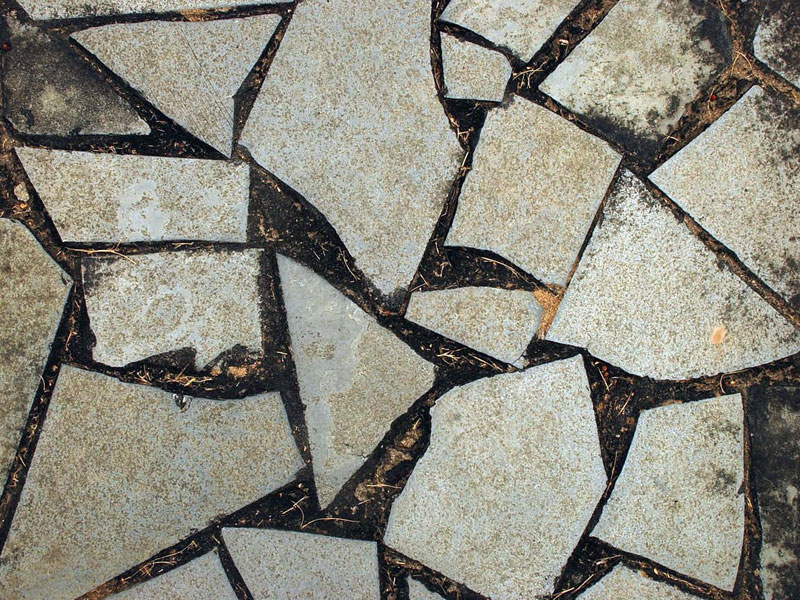
Lastly, the image at the bottom features a variety of different sized stone slabs laid out on the ground in a random pattern. These stones, are large and flat in appearance, therefore can be viewed as planes. This is mainly due to the fact that the image is zoomed in to the point where the stones seem much larger, but perhaps if the camera was much further away and the stones were arranged in a less scattered pattern, their smaller scale would lead them to seem more like points or even as a line if arranged in some sort of lined pattern. Nonetheless, the close-up nature results in large areas of mostly solid color that create a variety of planes and a sense of flatness due to the nature of their placement on the ground.

The surfaces of the stones laid across the ground create repeating planes that create a scattered pattern but uniform color as the planes of stones make up a large portion of the image. Found online at http://www.dsource.in/sites/default/files/course/elements-2-dimensional-design/shape-plane/minigallery/2392/shape-plane-1.jpg

Posted in Uncategorized | Leave a comment