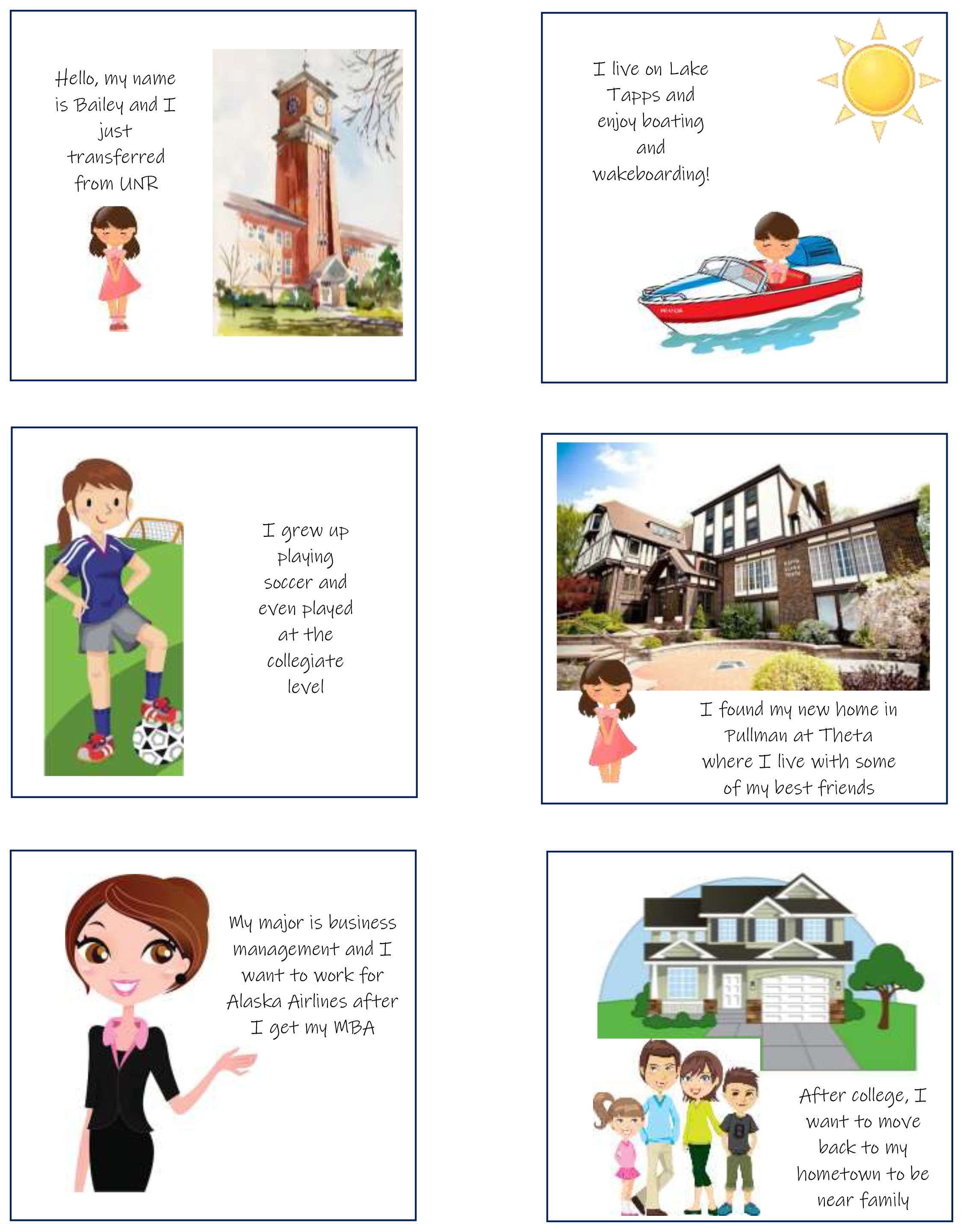
Print Versus Digital Comic: Bailey Tompkins

Digital Comic Strip, Bailey Tompkins, August 26th 2019

Within the past week, I have made a comic strip by hand and by using a digital tool. I personally preferred using a digital tool because it was more time efficient and looks better. When making the comic strip by hand, I came across some difficulties that were harder to fix by hand compared to when I made the comic strip using word. The biggest difficulty with the hand made comic strip was finishing a section of the strip but then not having enough room for the next section so I had to go back and erase some of my previous work, but on the digital comic, it was much easier to move the work around or make it smaller without having to back track or erase completed work. Overall, the digital comic strip was easier for me in the sense of time and skill, but the hand made strip forced me to use my creativity more to problem solve. In respect to reading the comic strips, I preferred reading the digital strip over the hand drawn strip because it was cleaner, and the font brought more character to the comic. Chapter 1 of Understanding Comics compared comics to films and film strips which helped give me the idea that a comic doesn’t have to read like a book, but that it should be more visual like a film. Chapter 1 also reminded me that there are no rules to what a comic can or cannot read which helped flow my creativity.
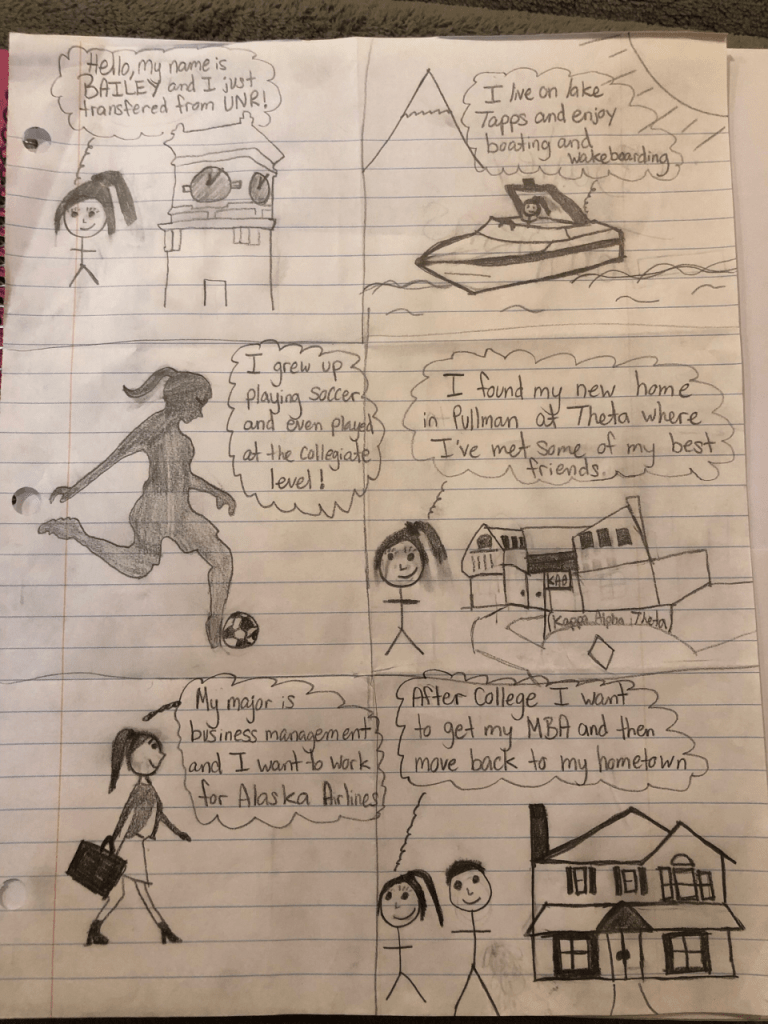
Hand Drawn Comic, Bailey Tompkins, August 21st 2019
Posted in Fall 2019 Archive (201 Blog) | Leave a comment

Print Verses Digital Comic: Cierra Haken

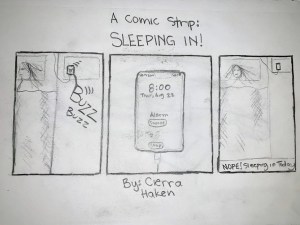
Comics have long been known for being the medium for ‘children.’ As you look deeper into what a comic can be, you can learn that a comic or graphic novel can be just as intellectual as any other written text, or just as creative as any other art. When looking at the way comics can be created, there is really no end to what you can use to create it. Specifically, hand-drawing a comic is and was quite different than creating it digitally. Not only will using these two very different demographics make the comics look different, but their messages can be portrayed very differently as well.

My Comic titled “Sleeping In!”

This week, when I was put to the task to hand-draw a comic strip, I knew that this was not going to be my favorite thing to do. My drawbacks to creating a hand-drawn comic was the fact that I could not draw as well as I wanted, so it was hard for me to show what I wanted. On the other hand, one benefit was that I was able to use more organic shapes that made the comic feel more personal.

My digital comic created on InDesign

When my next task was to create a comic digitally, using any program I felt comfortable with, I was much more excited. Even though I do not have much experience with InDesign, I decided to use this program because I wanted to learn more about how to use it. 

In one of my other classes for Interior Design, I have to use InDesign as well, so I have been learning more and more about it. Some benefits to creating a comic digitally, using InDesign included the fact that I could create clearer shapes, and that I could type out the text. I also really enjoy being able to format and reformat without having to erase and redraw and waste paper and ink/graphite. One drawback to this thought was that I could not draw the organic shapes as easily, at least at first. Both of these demographics definitely effected how the comic strip would be viewed by its audience. Each work well and get the point across, but I think for different people, it will depend on what they really want to portray in their comic.

When reading a comic online vs. on paper, it is much easier to get the whole picture when you have the actual comic or graphic novel in hand. This is because if there is ever any full-page spreads, or page bleeding or any other effects, it will be much harder to grasp when viewing it on a PDF.

Finally, reading the first chapter of “Understanding Comics” By Scott McCloud did help a bit when I began creating my digital comic. I have read this book back in my junior year of high school for a graphic novels class. So, being able to refresh my memory on the definition of a comic and remind myself the fact that any comic can look very unique and different helped me try to break out of my traditional sense of what the comic should really look like. This lead me to feel free to create whatever I wanted.

Posted in Fall 2019 Archive (201 Blog) | Leave a comment

Print Versus Digital Comic: Eddie Abellar

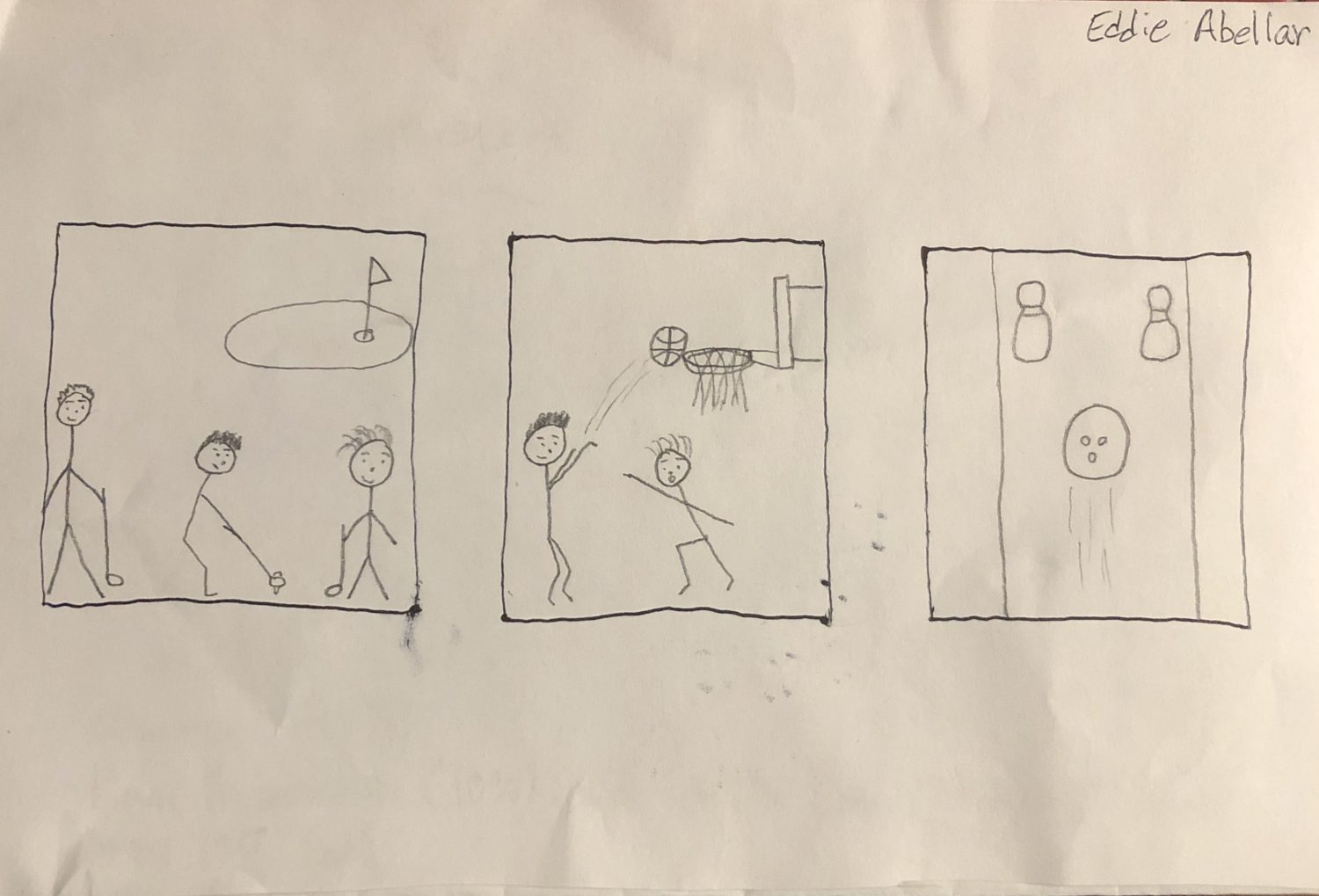
Hand drawn comic by Eddie Abellar, Fall 2019.

I had an enjoyable time creating both the hand-drawn comic and the digital comic. The benefits of making a hand-drawn comic is that you have complete freedom of what you want to create. While creating my hand-drawn comic I was able to re-create my favorite activities on paper. Hand-drawn comics also gave me the freedom to create as many different shapes as I want to create the correct visual I wanted to present. One drawback from creating a hand-drawn comic was that the shapes I created on paper were not perfect. The three panels I created for example were not all the same size, the lines were not perfectly straight, and the lines were not all the same size.

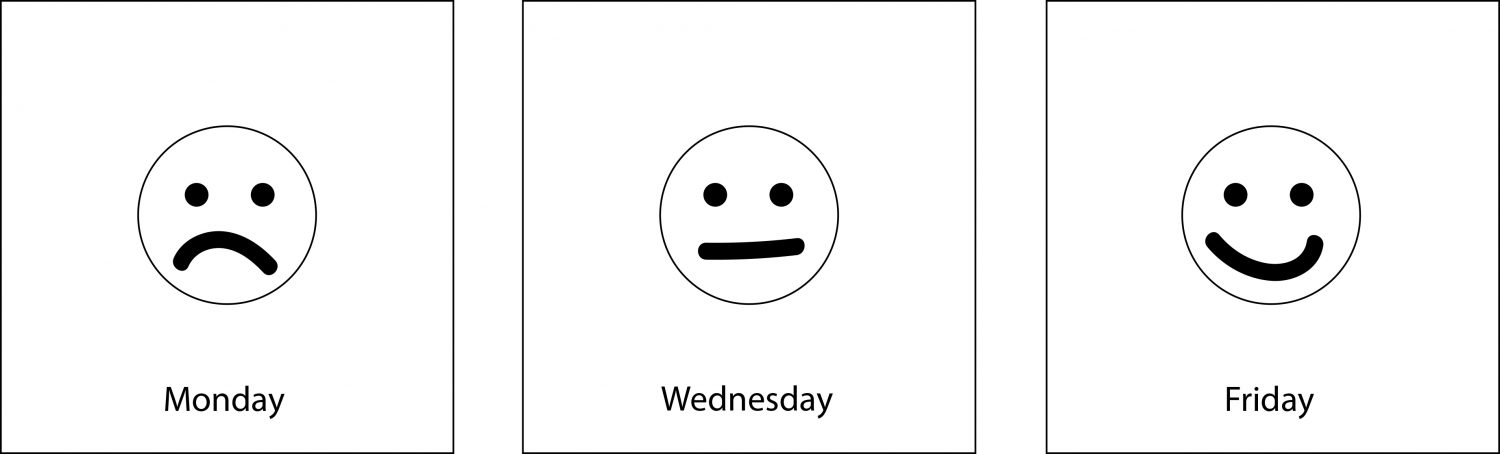
Digital comic by Eddie Abellar, Fall 2019.

Creating my digital comic was a bit trickier because I used Adobe Illustrator to create it and it took some time to figure out which tools to use to create my comic. One benefit of creating a comic digitally is that the shapes you create come out perfectly the way you want them too. The panels I created for my digital comic were all the same size and were all perfect squares. The circles I created to represent my head also came out as perfect circles. Another benefit of making a digital comic is being able to add text and having the text be clear and legible for anyone to read. One drawback of creating a digital comic is that if you do not have a lot of experience with software like Adobe Illustrator you are somewhat limited in creating whatever you want. Having little experience using the toolbar in Adobe Illustrator, I was not able to recreate the athletic activities in my digital comic as I did in my hand-drawn comic.

Reading the first chapter of “Understanding Comics” definitely helped me create my digital comic. Learning about the definition of what a comic is helped me create my digital comic strip in a sequential order.

Posted in Fall 2019 Archive (201 Blog) | Leave a comment

Print vs. Digital Comic: Bobby Brown

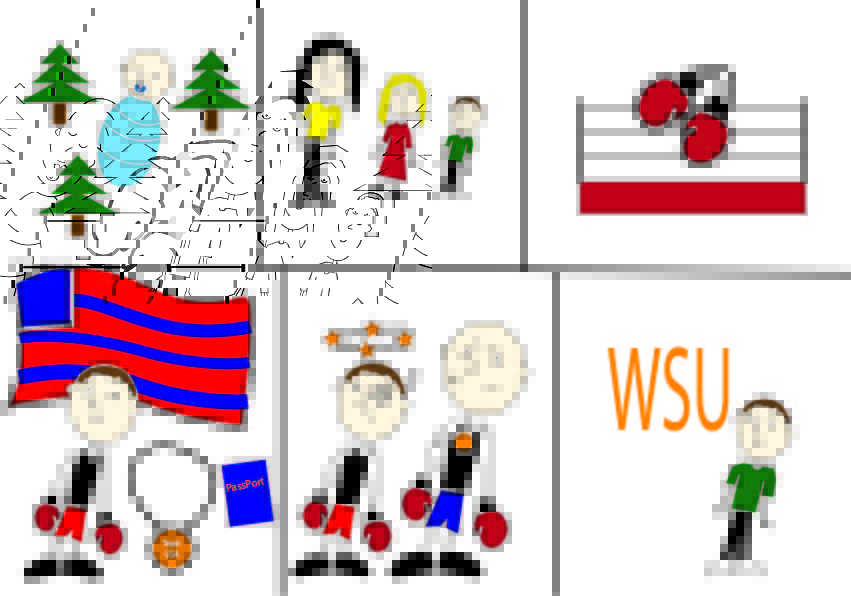
Hello, my name is Bobby Brown! I decided to make my comic strips about myself and my hobbies that I enjoy doing.

Hand-Drawn Comic

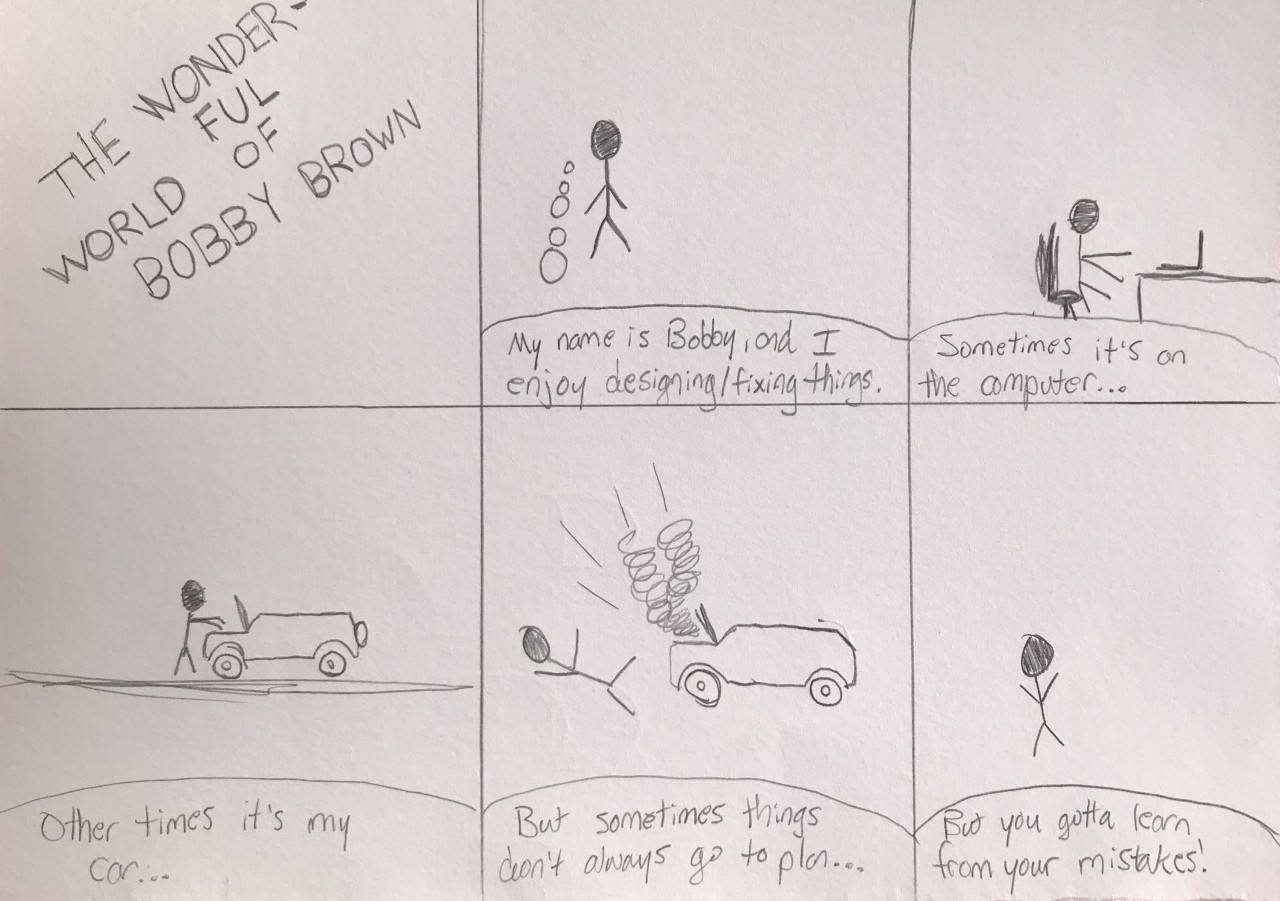
This is my hand-drawn comic strip.

The differences between hand-drawn and digital are pretty clear in this scenario. Hand drawing my comic was a simple and easy task because I was limited on my tools available to create it. I was restricted to simply a piece of paper and a pencil, and while I’m not disappointed with how it turned out at all, I do wish I could’ve done a bit more.

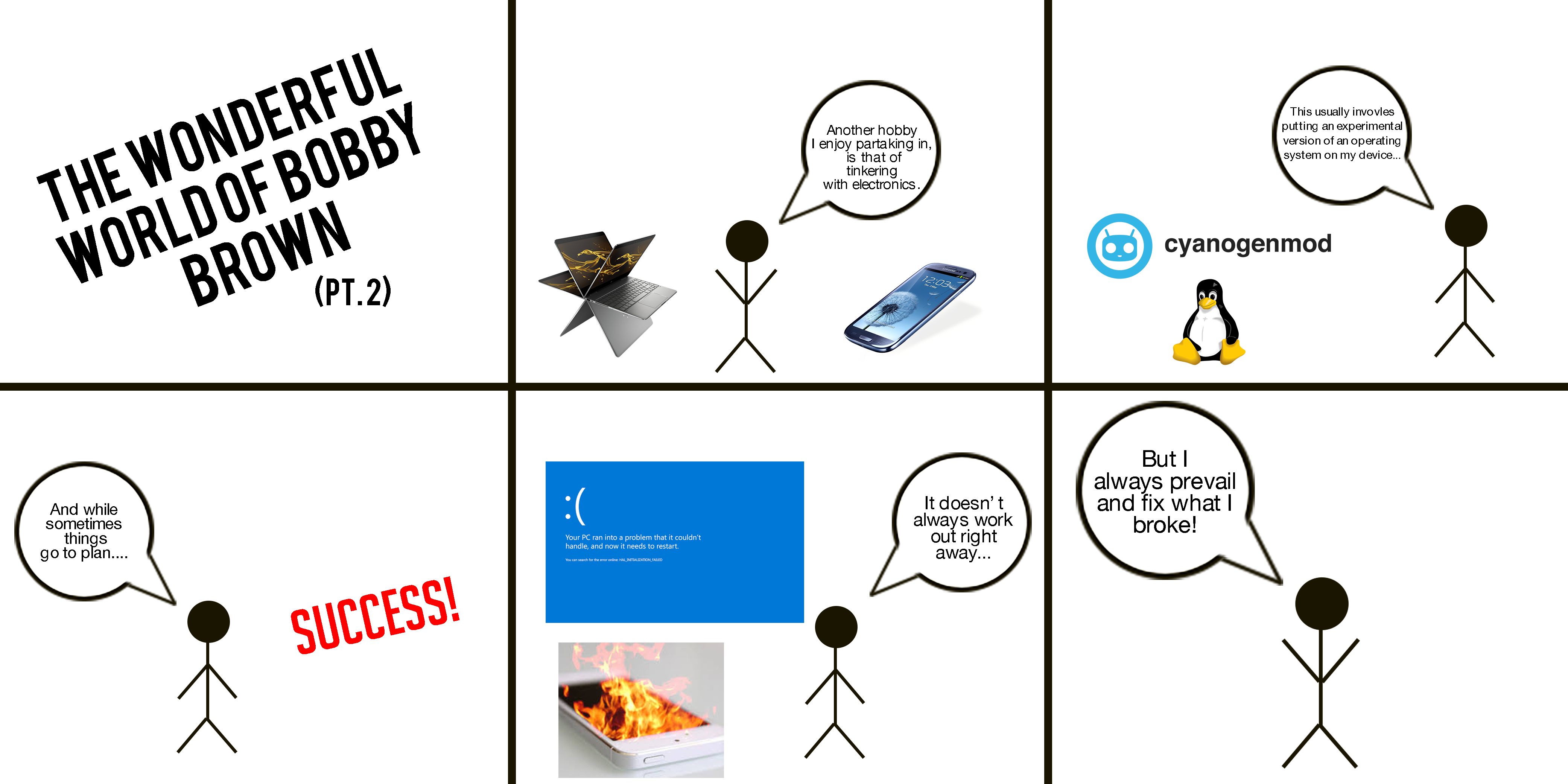
When it comes to creating a comic strip digitally, it was a much different story. I completed my digital comic in Photoshop, and while Illustrator is probably a much more fitting program to complete this task in, I already had some experience using Photoshop, so that’s why I chose to go that route. If I’m being honest, this was not the easiest thing to create in Photoshop, and I found myself regretting choosing it once or twice. At the end of the day though, I found myself able to be more creative while creating my comic with a digital medium, and I enjoyed that a lot.

When it comes to choosing which one I enjoyed more, it’s kind of a toss up. Hand-drawing my comic allowed me to feel more free about putting my ideas onto p

Digital Comic Strip

This is my digitally designed comic strip.

aper, where the digital comic made me feel almost overwhelmed with the amount of ideas I had, and different ways to display them. Overall, I think I enjoyed the hand-drawn portion of my comic, simply because of the way I was able to translate my ideas right onto paper.

After reading the first chapter of McCloud’s “Understanding Comic’s,” I found that I had a better understanding of what a comic can be. Prior to reading this, I thought a comic had to be some sort of silly short-story that ended in something humorous happening, but I now know otherwise.

Posted in Fall 2019 Archive (201 Blog) | Leave a comment

Print Versus Digital Comic: Min Kim

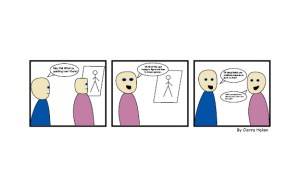
An awkward introduction. Picture by Min Kim, August 2019

Having grown up with the conventional pen(cil) and paper, hand drawing has always been my most preferred method. As an avid doodler, drawing comics were not an atypical ordeal and neither was using its digital counterpart. However; drawing by hand is undoubtedly the most organic and unrestrictive form. To me, it allows for more control in the finer details through different pressures one has the freedom to apply to create complex textures. And without extensive skills in digital tools, it is difficult to replicate and control these aspects. Since I draw mostly using a tablet, digital drawing isn’t too different than drawing normally, though for my digital comic I had to resort to using word. Although these programs enable me to create perfect shapes and copies, when it comes to free hand alterations, it becomes difficult to maneuver and doesn’t allow the creative freedom hand drawing provides. But being accustomed to digital tools and applications, mistakes are much more forgiving and easily rectifiable; sadly, you can’t control Z fatal mistakes away on paper. In terms of reading hand-drawn versus digital, it is as comparable as reading a physical novel and an electronic copy (to some extent). Other than the motor skills needed to scroll or flip a page, the two are not some much different aside from the fact that digital ones strain my eyes.

A simple comic of me waving hello. Picture by Min Kim, August 2019


Posted in Fall 2019 Archive (201 Blog) | Leave a comment

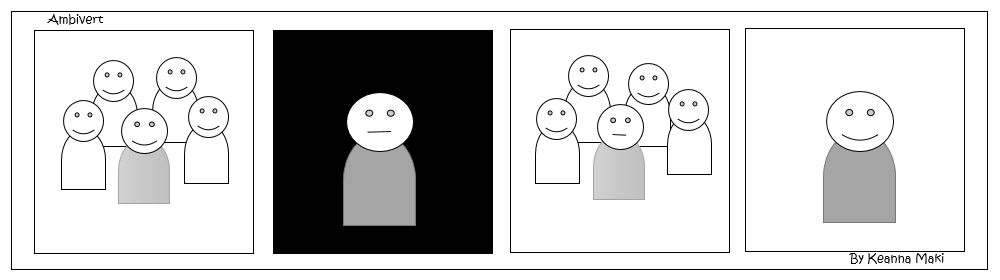
Print Versus Digital Comic: Keanna Maki

Drawing by Keanna Maki. Introduction Comic. (August 24)
Photo by Keanna Maki. Introduction Comic. (August 26)

Making a comic by hand versus using a digital tool definitely adds differentiation between the two pieces of work. The most obvious contrast is the fact that one comic is created free handed and the other digitally. Of course, we see many differences between the two. On one hand, we see that creating a comic with physical tools is much easier to work with if you are not as comfortable using technical tools. On the other hand, we see that having digital tools is easier for designing as you are able to get more resources available to you on the spot. Other differences we can see is the way we actually create the comics.

By hand, I created my comic with a pencil and paper. Others may have used different utensils such as pens or markers, but still were able to grasp the same idea using physical tools. Digitally, we use a mouse or electronic pens to draw out our comics on a device. Either way you create a comic, physically or digitally, you are creating a comic. Each creation is designed for a unique purpose and brings its own story to show.

When I drew my comic, I had that freedom to draw what I wanted and how I wanted. I had nothing to prevent me from to produce. This way is more imaginative because you can include your illustrations exactly how you picture it in the simplest way. When I created my comic digitally, I knew it would be a challenge since I do not know how to use complex digital tools. What I could do was utilize my familiar digital resources which was Microsoft Word at the time. I realized that my drawn comic became animated and that was awesome to see such a shift. I also noticed how my original comic changed from what I produced to something sharp and clear rather than sketched. Having both comics on either paper or having a digital copy shows the possibilities of where your work can excel.

Posted in Fall 2019 Archive (201 Blog) | Leave a comment

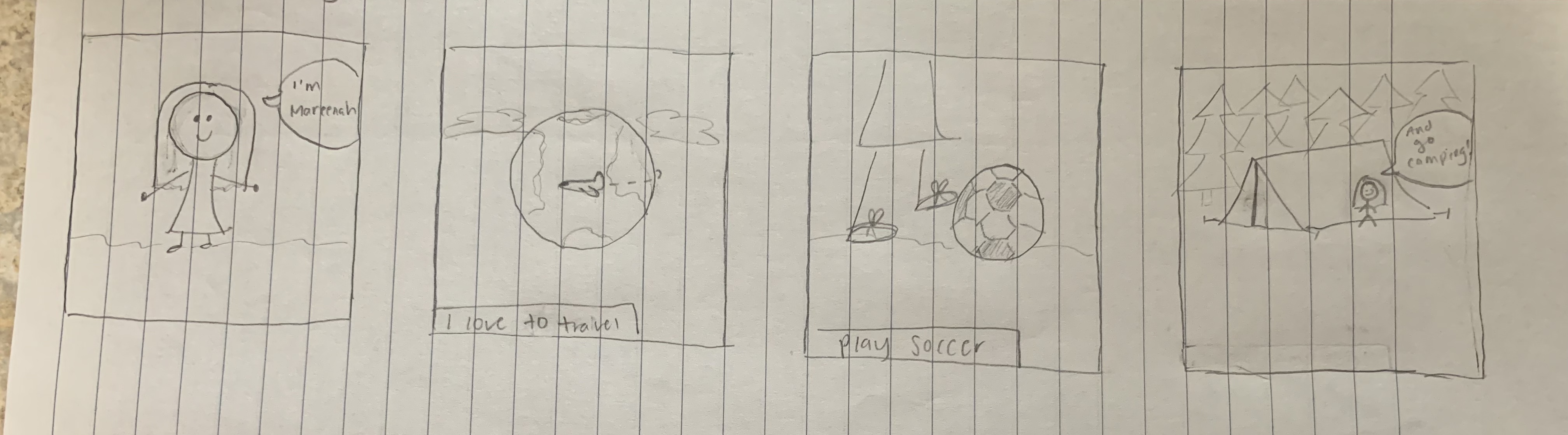
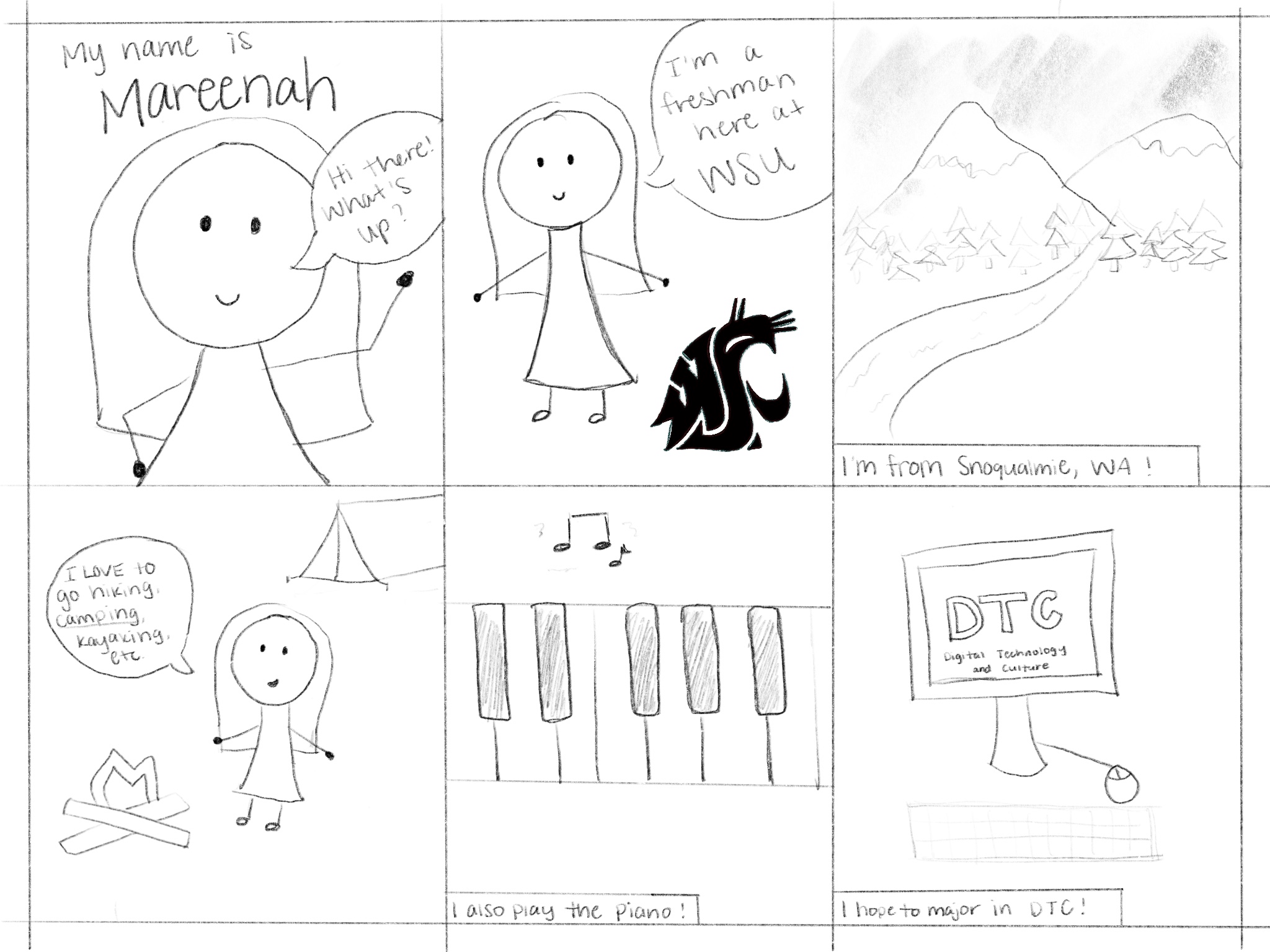
Print Versus Digital Comic: Mareenah Galang

Here is my hand drawn comic.

I enjoyed creating my comics both ways, hand drawn and digitally. However, they are very different experiences. For example, hand drawing my comics was very simple, straightforward, and accessible. I only had to use a pencil and paper. There were no fancy tools or materials. This made the assignment much easier and more convenient, but less creative and fun. With only a pencil in my hand, I felt very limited in what I could do. 

Here is the digital comic I created via an app on my iPad.

With the digital comic, I had a lot more tools at my hands. I completed my digital comic by using my iPad and a drawing app, then uploaded it to my computer. The app that I used had an extensive amount of backgrounds, brushes, textures, and colors to work with. It was like you had every kind of art supply, all in one portable device. Although I didn’t use them all, I did make sure to use the tool where I could make my lines super straight and precise. It is just so much easier to use tools like this on a device, rather than having to use a ruler for straight lines or a bunch of colored pencils for color.

Despite these positives, however, using a digital tool definitely felt less organic as opposed to doing a hand drawn comic. I used an Apple Pencil a lot with my digital comic and it sometimes didn’t feel calibrated enough. It can feel awkward to draw on a glass screen too. Also, there is always the possibility of technical difficulties when using digital tools. 

Both methods have their positives and negatives. Sometimes it’s nice to go back to the simplicity of the hand drawn comic, and sometimes it’s nice to branch out with digital tools. 

Just like how drawing comics by hand and by a digital tool are different, reading them on paper versus on a screen are very different experiences as well. Although I liked using digital tools to create my comic, I prefer to read books and comics on paper; it just feels nice to be able to flip the page and feel the texture of the paper. 

I really enjoyed reading the first chapter of Scott McCloud’s book. I felt like it was very easy to follow along. Although it didn’t really influence my digital comic, I felt like it gave me a lot of information on what comics are and how they tell a story, which I think is valuable information for this class.

Posted in Fall 2019 Archive (201 Blog) | Leave a comment

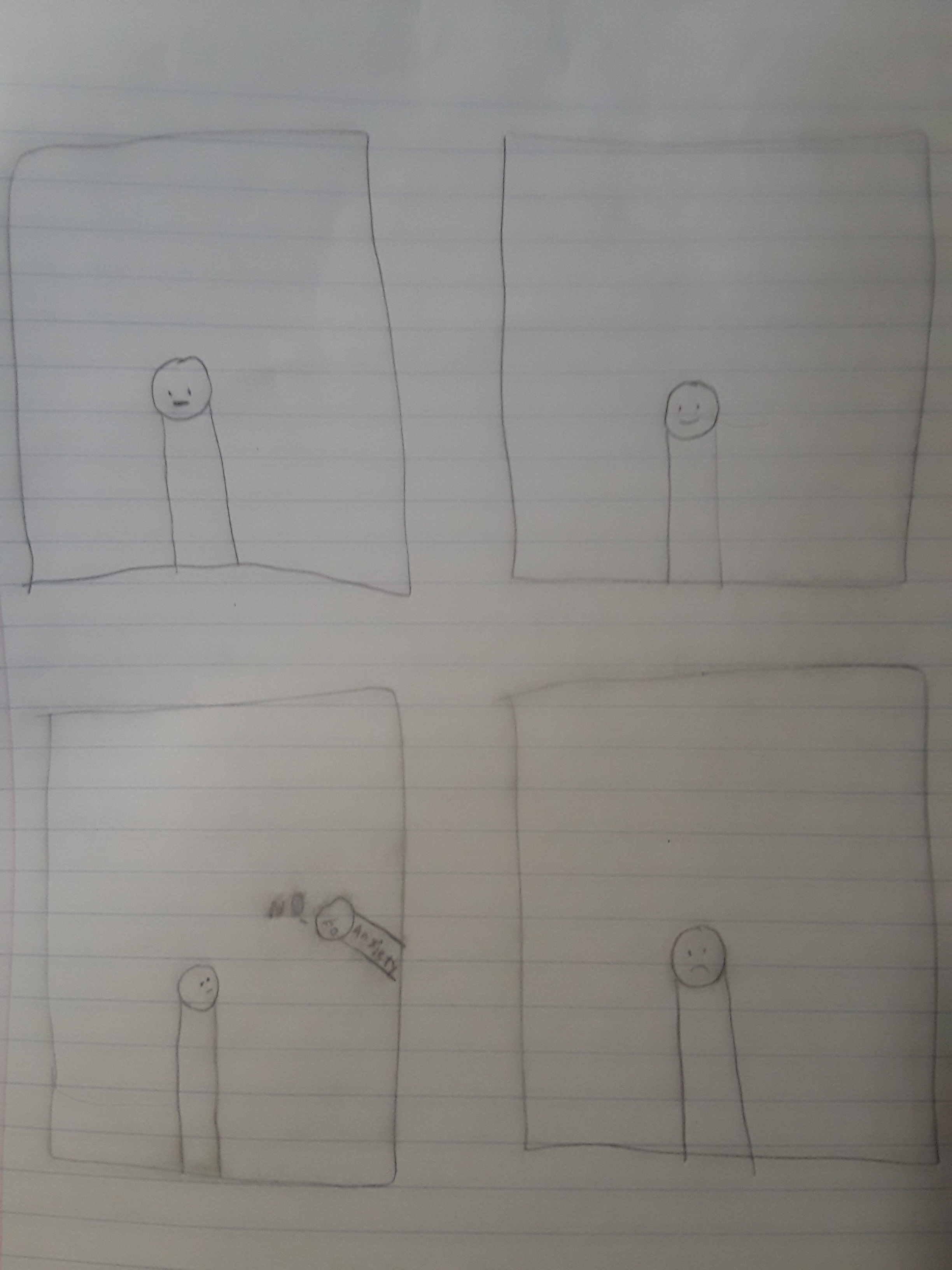
Print Versus Digital Comic: Joseph Alonso


I created this comic during the first week of DTC in August 2019.

When I was drawing the comics, the hardest thing to do was to come up with a story for the comic. The first comic, which was hand-drawn, is a take on how anxiety can feel to some people. You could be starting to feel happy, but then anxiety comes out of nowhere with something to ruin that. Drawing by hand can give you a better feel for what you are drawing, as my sister has said to me a few times in the past. You also have more freedom to draw what you want, with the only limitation being what materials you have on hand. However, if the comic were to be colored, I would have to fill in the shapes by hand, and I have gotten hand cramps before when drawing in this method.  Coloring in the shapes with colored pencils can also wear through them rather fast, as personal experience has told me.  My sister has definitely complained to me about going through them so fast when I color with them.


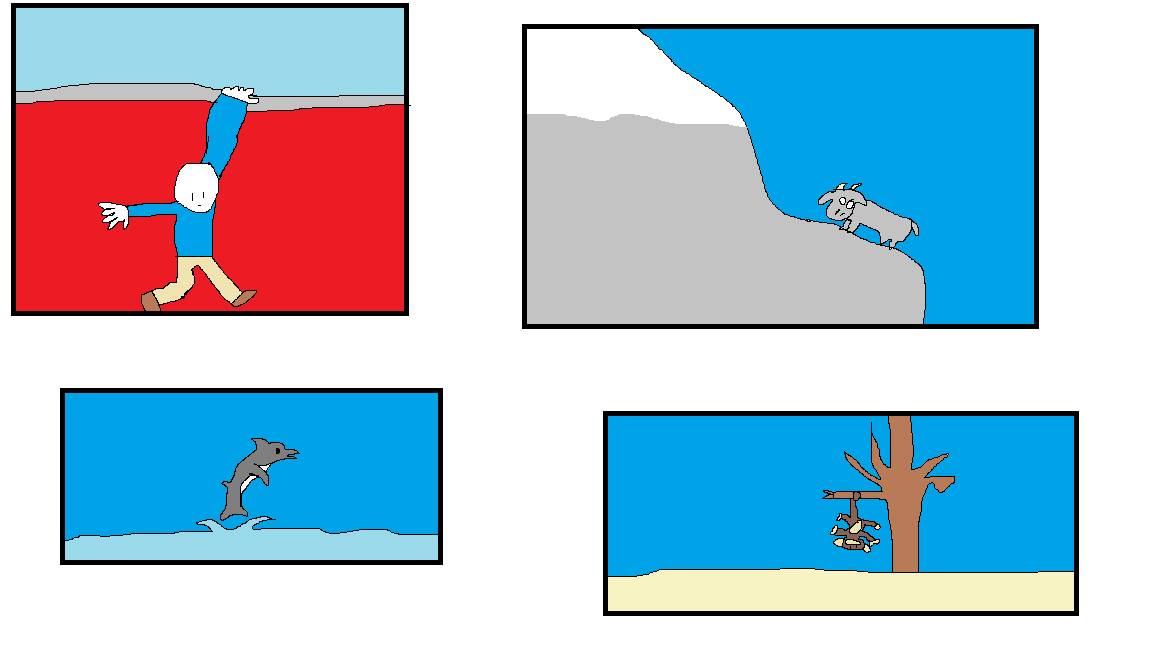
I created this comic during the second week of DTC August 2019.

My second comic, which was done in Microsoft Paint, was done without any full idea of what I would draw, so I drew the first thing that popped into my head when looking at the blank panels. After drawing it out and coloring it in, I noticed a common theme amongst the panels. They could all be interpreted as ways that different creatures have adventures. Such as the human dangling precariously from a ledge, or the goat climbing a mountain, or the dolphin jumping out of the water, and the monkey hanging from a tree.  MS Paint can make things simpler for using simple geometry in your comic, and the paint bucket tool makes coloring in the shapes a cinch. However, I was using my mouse, which led to less than straight lines and zero semblance of accuracy when trying to make curves. The color pallet is also limited despite the ability to create custom colors.

Reading comics is a pastime that many people enjoy. But when it comes to which kind people read, between paper and digital, the experience is both vastly different and largely the same. They are both comics, so the methods of reading them are the same. Paper comics are fun to read because there is something about being able to turn the pages that I can’t really put into words. Digital comics are more easily distributed through the internet, and more “with the times” as some might say due to more people having access to the internet.

Drawing a comic by hand or with a program on a computer are just different methods of creating the same medium. It doesn’t really matter which method you use as long as you are comfortable using it. After all, a comic is just another way to tell a story.

Posted in Fall 2019 Archive (201 Blog) | Leave a comment

Digital vs Print Comic Matthew Mollet

Creating a digital comic allows the author to edit the image faster, and fine tune their art. Using illustrator, I was able to make the comic quicker, but I could not add all of the small details I could by hand. Digital comics also have brighter colors and cleaner lines, but more black space that could be filled.

Making the comic by hand was easier for me to add any details I wanted. Using illustrator, it was difficult to add lines to show the muscle tone and small aspects like that. Drawing the comic by hand also allowed me to fill blank space easier and put more detail into the images. Using no words in my comic, I did not have to write and word blurbs, which would have been easier on a software like illustrator.

Posted in Uncategorized | Leave a comment

Print Versus Digital Comic: Joseph Gardner

Designed by Joseph Gardner, August 2019.

I was excited to hear that we would be making comics in this class. However, for my first post, I wasn’t sure of how to make a comic. I thought of comics as they traditionally appear in comic books and in newspapers. We talked about it in class, and I realized that they could be more.

I wanted to challenge myself while creating my first drawn comic. I couldn’t decide what to draw at first, but I eventually settled on recreating a photo of Edward R Murrow. The original photo is in black and white. When I made the image, it started out monochromatic as well. I ended up adding the blue in the end, because it looked kind of flat.


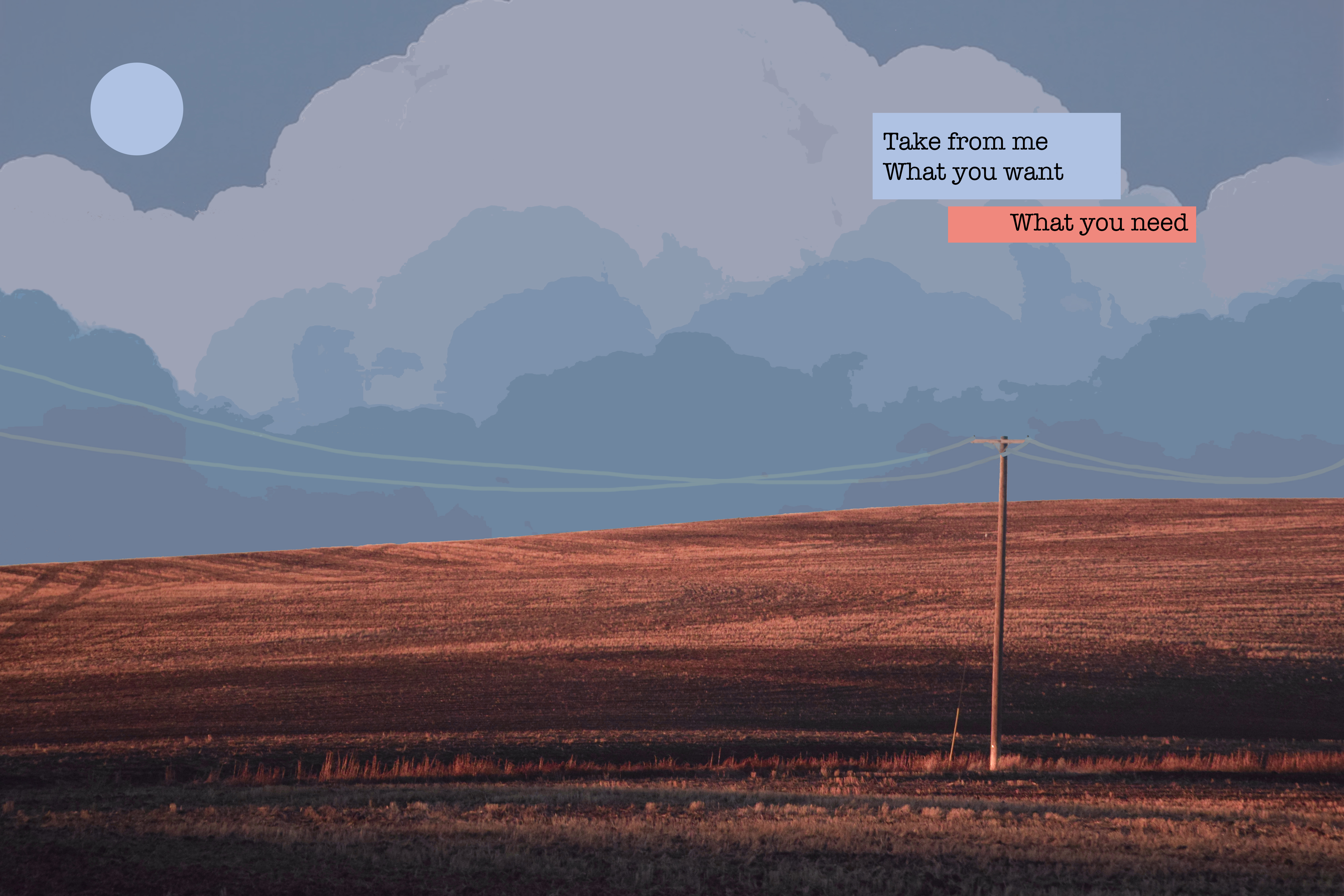
Designed by Joseph Gardner, August 2019.

For my second post, I edited a photo in Photoshop and drew in a cloud background. I also added some song lyrics in a text box. I feel like this comic is a lot more personal to me, because the photo was taken during a very emotional time in my life, and the text was chosen to reflect that.

Creating the digital comic was easier for me. The physical drawing took a lot longer, and I’m not exactly happy with a lot of it. I wanted to put text under the photo where the black box is, but I didn’t like the way it looked so I filled it in black. With photoshop, I messed up just as much or more than the physical copy, but I could undo and erase things a lot easier. However, Photoshop makes things a lot less organic in my opinion. There’s a lot more flat colors, and straight lines, which looks good if you want something simplistic. However, it’s harder if you want to create a complex art piece. I had originally wanted to create a completely digital art piece, but I wanted to keep the texture of the hills to make a more mixed media look.

I think the biggest difference between reading a comic on screen versus in a book is that it’s easier to display a bigger story on print. With digital art, you only have the confines of the screen to tell your story. You can always scroll down or move on to the next web page, but it’s not the same as in a book.

After reading the first chapter of Scott McCloud’s “Understanding Comics”, it gave me the idea to insert text boxes. In the first chapter, McCloud discussed how comics are comics and not exactly just an art piece because they tell a story. In my first comic, I don’t feel like there was that much of a story. I wanted to change that with my digital comic. I added text and created juxtaposition through a contrasting color pallet and a mixed media feel.

Overall, I’m much happier with my digital comic. It looks more polished and shows a lot more of what has happened in my personal life.

Posted in Fall 2019 Archive (201 Blog) | Leave a comment