Closure and Time Frames: Blaine Casil

The graphic novel I decided to use was “Iron Man: Armor Wars”. The reason I chose to use this as my graphic novel was because I was always a fan of Marvel super heroes and I grew up reading Marvel comics. I found that the art work within Marvel comic books are very detailed, even the earlier comics that were made had a lot of detail. I found that with Marvel comic books, they are able to tell most of the story using different frames or scenes with just action and movement and that they didn’t need much wording to say what is happening. This I found very unique.

Iron Man: Armor Wars by Joe Caramagna and Craig Rousseau

One example of closure I found is Action-to-action. In the image above, it shows Tony Stark passing through multiple movements to attack the enemy. As you transition through the panels you can see that he first sprays the enemy with a fire extinguisher then proceeds to hit him with it. In the next scene, he ducks to avoid his enemies attack then proceeds to shock him with an electrical wire before getting hit. I believe this represents action-to-action very well because it defines every single one of his moments that could’ve happened within a matter of seconds and gives the reader an idea of what it going on within the story.

Iron Man: Armor Wars by Joe Caramagna and Craig Rousseau

The second example I chose demonstrates “time frames”. The reason I chose this specific page is because it builds suspense as the reader continues down the page. As the reader transitions from one scene to the other you are able to notice that “Iron Man” is looking for someone. The reader soon learns that the “someone” is Tony Stark. Just like the first example I chose, the authors don’t use any words to show what is going on but lets the images tell the story. Creating an opportunity for the reader to develop their own story. Towards the bottom of the page it shows Tony Stark jumping onto the suit in attempts to either disable it or to see who is in control of it. This creates a moment for the reader to decide what is going to happen next. Will Tony Stark find out who is in command of his suit? Or will he be thrown off and will never find out?

Posted in 201 Blog, Closure & Time Frames, Uncategorized | Leave a comment

Closure and Time Frames: Sabrina Hoenes

Paru Itagaki, Beastars, Akita Publishing, 2017, 15-14

The first interesting example of closure I found is located on the right page (pg 14). This page shows examples of scene to scene and subject to subject. I believe it is scene to scene because the first two panels take place during the night, which is evident by the usage of black and darker hues of grey. It then gets transitioned to day time, which is evident by the fact that the artist is no longer using the dark tones/hues. I also believe it is an example of subject to subject because you go from the first panel, a close up of a opened mouth to a panel of blood. The second interesting example of closure I found is located on the left page (pg 15). This is an example of aspect to aspect as well as subject to subject again. It is aspect to aspect because we go from a close up to the playing cards, to a panel showing the animals playing the cards, to then a zoomed out panel of the same animals still playing. It is also subject to subject because we go from the cards to the animals.

Paru Itagaki, Beastars, Akita Publishing, 2017, 149-148

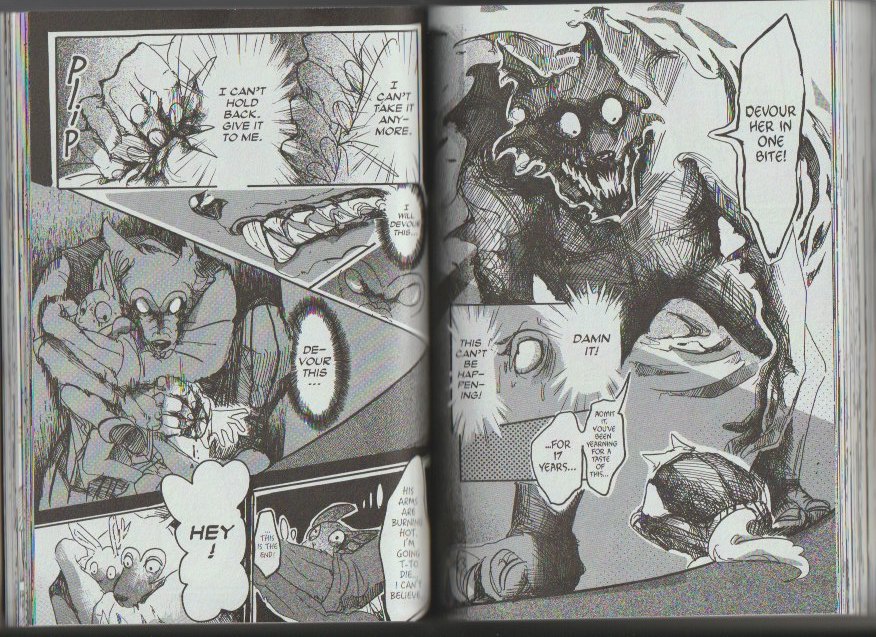
These pages were the most interesting example I found for time frames. I found them more interesting than other examples because as I was flipping through, page 148 (right page), was the only page that was set up and stylized this way. Even though this is a Japanese manga, usually read from right to left, the right page can be interpreted in different ways and it also engages the reader to identify which aspects to read first. Interpretation is also an interesting factor because of the different ways the wolf is drawn. On the right page he is drawn on a large scale using darker tones and hues, while the wolf that is seen throughout the manga is still drawn in lighter tones and hues. The use of drawing the wolf in a more scary and monstrous way is carried over to the left page as well as the reader sees him fighting himself. It could be interpreted as a Jekyll and Hyde trope (man vs self).

Posted in 201 Blog, Closure & Time Frames | Leave a comment

Closure and Time Frames: Devon Anderson

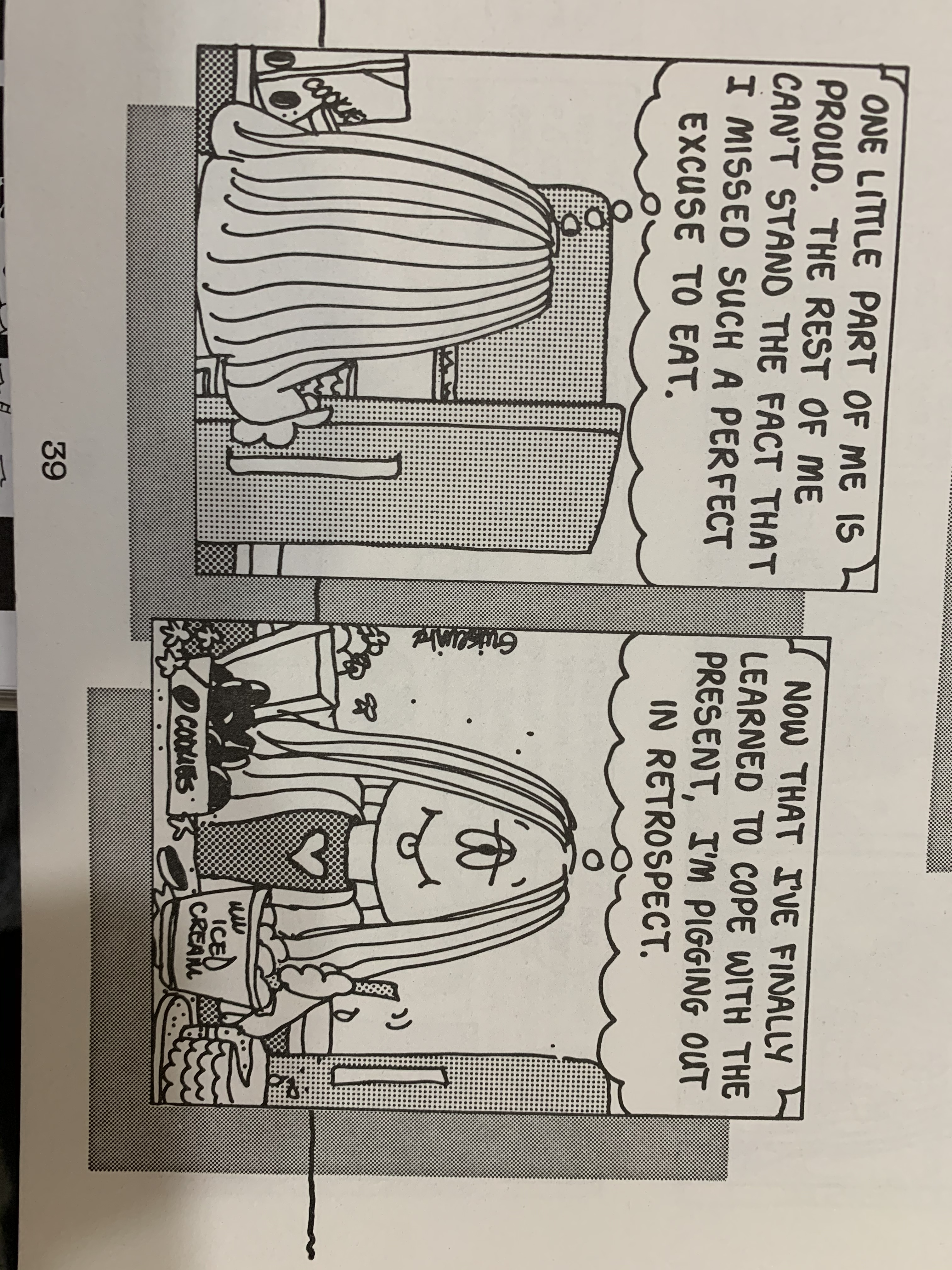
These two panels expresses closure from scene to scene. 
(Thin thighs in thirty years by Cathy Guisewite
page 39, Published by Universal Press Syndicate 1986)

The Graphic novel I chose to read and analyze is called Thin thighs in thirty years by Cathy Guisewite. I then started flipping through the comic and paused on a page that had two panels that spoke to me. The first panel is of the girl looking into the fridge and the next is of her eating food. These panels must have stood out to me because I was hungry at the time. That said, the two panels work for closure in a scene to scene scenario. In the textbook the example is two panels with one saying ten years later however as seen in my comic there is no statement showing that time has passed however you can infer that time has passed from the girl looking in the fridge for food and then sitting down to eat whatever she chose from the fridge.

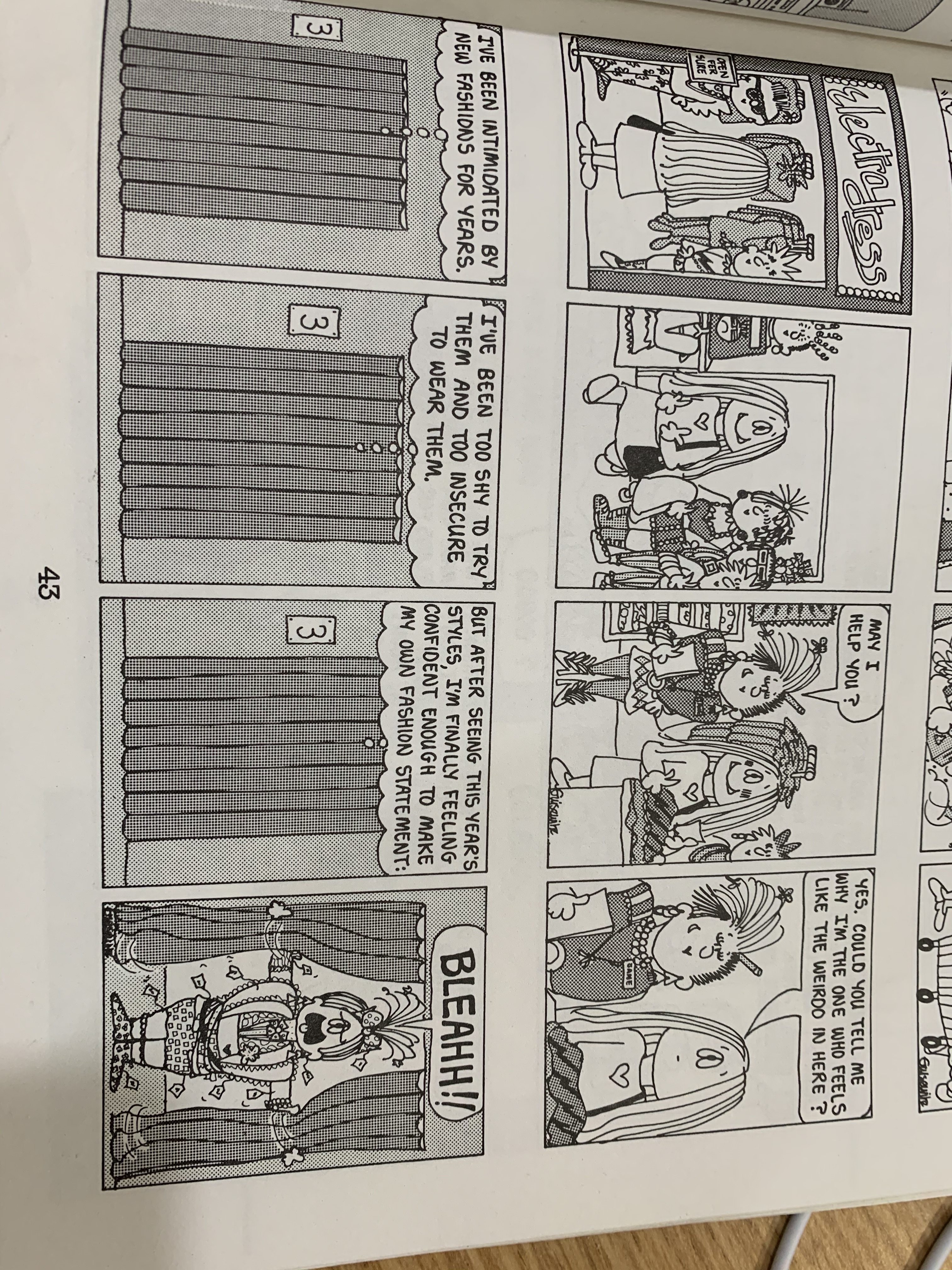
The panels shown expresses time frame.
(Thin thighs in thirty years by Cathy Guisewite
page 43, Published by Universal Press Syndicate 1986)

I chose these eight panels because I believed that they showed a good representation of a time frame. The reader can easily see that from the time the girl gets to the store, looks around, and then comes out of the dressing room to show off her choice that time has passed by. Like in the textbook when you read a panel it in the present but when you look back the past panel was in the past. The reader can tell that at the end of the panel the girls past decisions are what got her to the present, in that specific outfit. Now being in that outfit is in the present leaving the reader to wonder what the future holds on the next page. Will she like the outfit or end up looking for something totally different? Will she buy anything at all? The reader can only know if they continue reading and become present in the next panel.

Posted in 201 Blog, Closure & Time Frames, Uncategorized | Leave a comment

Closure and Time Frames: Zackary Reynolds

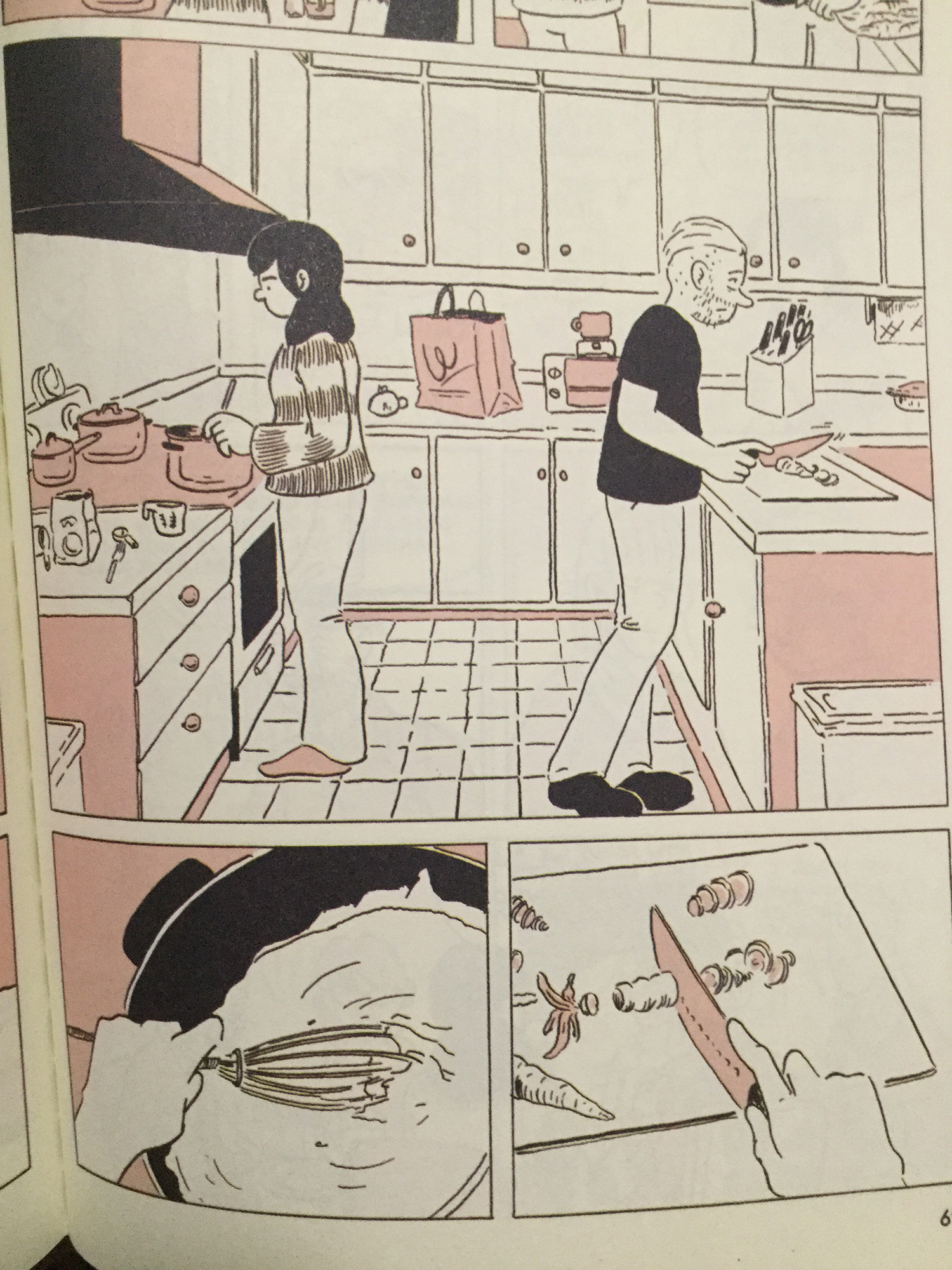
Sean Knickerbocker “Rust Belt” Made to depict aspects of life
Page: 69
Found in the Holland Library

The graphic novel I chose is a new graphic novel RUST BELT by Sean Knickerbocker which was published on June 11, 2019. The closure I chose to show is an aspect-to-aspect closure. An aspect-to-aspect closure means nothing happens and it is used to establish a mood or a sense of the place of the frames of the comic. The reason why this scene shows an aspect-to-aspect closure is because it starts out with the kitchen and then there are two other panels which can give the idea of what it sounds like in the kitchen. The panel with a whisk and the pot provides a sound with the pot and whisk hitting each other. After that panel there is a panel with the guy cutting carrots on a cutting board which provides the sound of a chopping. All three of these panels make an aspect of how the kitchen is in the comic. Which is why I believe these frames show an aspect-to-aspect closure. 

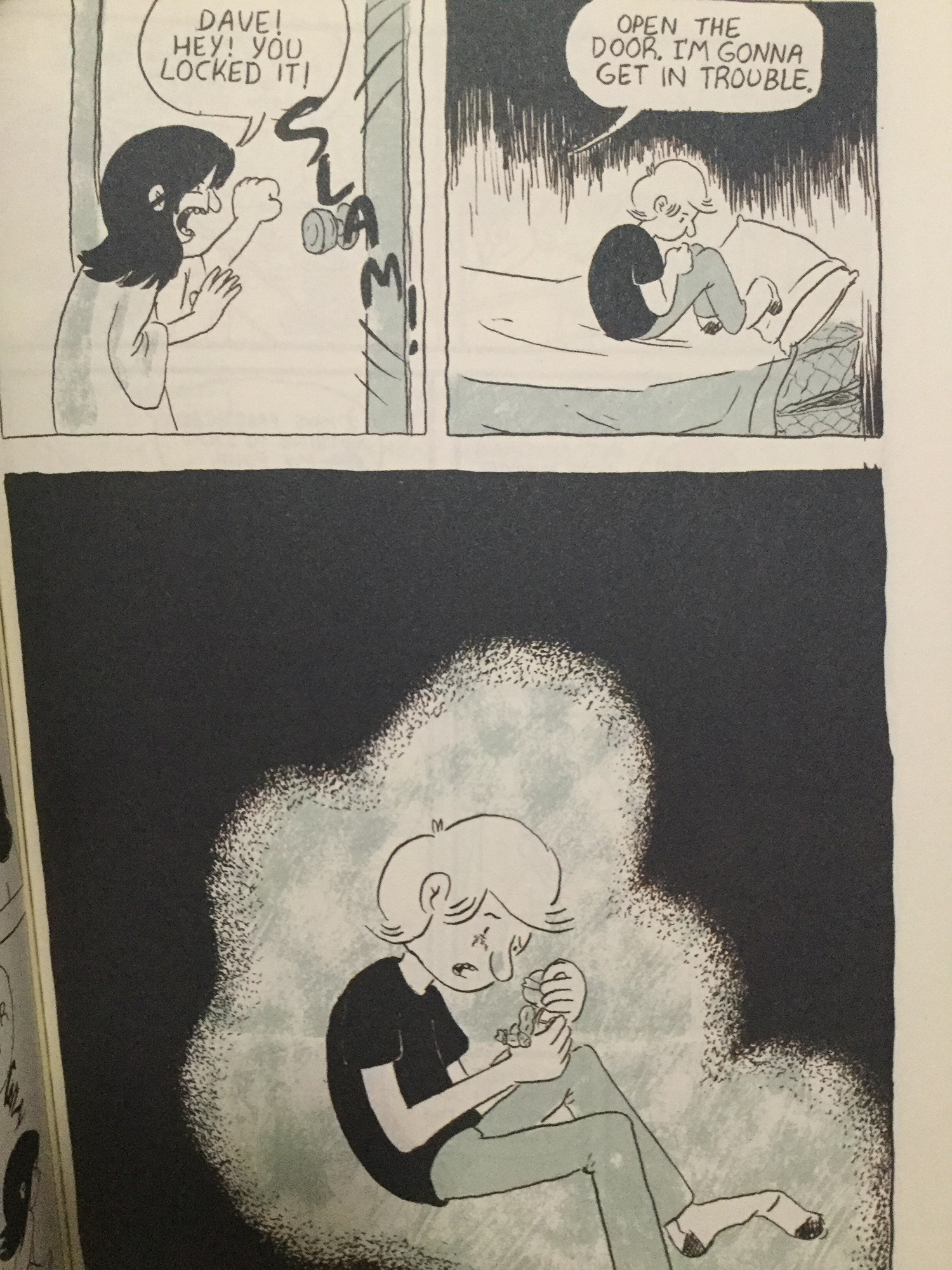
Sean Knickerbocker “Rust Belt” Made to depict aspects of life
Page: 59
Found in the Holland Library

These three frames are interesting time frames because the viewer can look at it either up to down or down to up and still get a similar idea of what is going on. If the viewer starts from the top they might see that the top frames are fast and trying to get Dave to open the door and for the last panel having it be big can show that Dave just sits there contemplating about something. But if the viewer starts from the bottom it looks like Dave is sitting there contemplating something for a long while because the size of the panel and then he gets interrupted to open the door. So, either way the viewer reads this page for the comic it will show Dave contemplating for a longer amount of time than the other panels. 

Posted in 201 Blog, Closure & Time Frames | Leave a comment

Closure and Time Frames: Alexandria Bachmann

The graphic novel I chose was Delilah Dirk and the King’s Shilling by Tony Cliff. I predominately chose this novel because of the graphic style, story, and the feeling of the paper(as I can’t stand old rough paper…gives me awful goosebumps…like nails on a chalkboard but with paper instead).

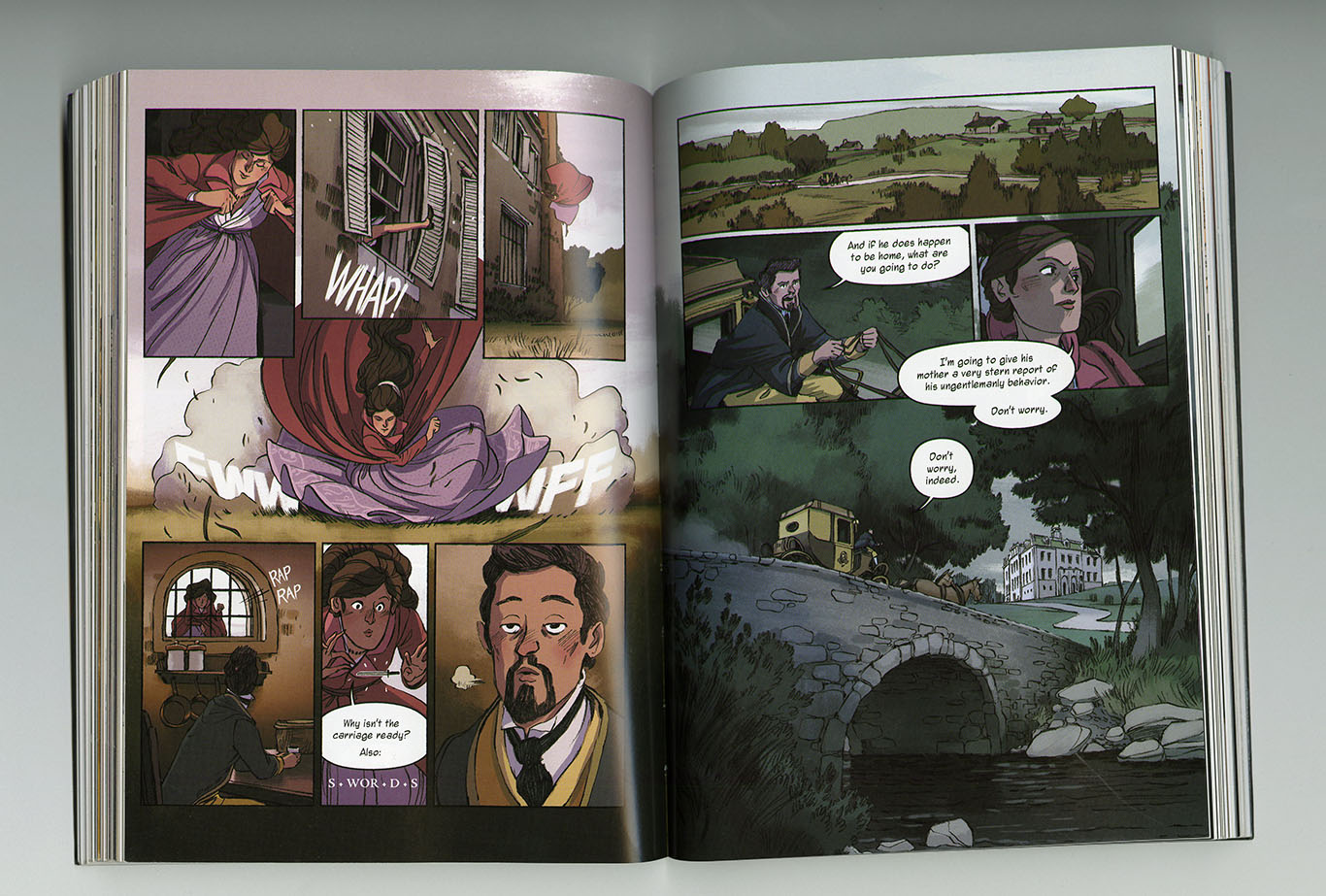
“Delilah Dirk and the King’s Shilling” Graphic Novel by Tony Cliff. ISBN 978-1-6267-155-5 Published by First Second in 2016. Page 134-135

Closure can take many forms, some complex and some simple. It is the process where the medium and an audience come together and the audience becomes a willing and conscious collaborator with the medium. Closure is the agent of change, time, and motion. Closure allows the audience to connect moments and mentally construct a continuous unified reality even though the visuals aren’t an exact reality and allows for the participation of a person’s imagination within the creation/medium.

I chose the transition action to action or a single subject as shown in distinct progressions. The first panel depicts a woman running down a hallway, only to kick out a window, jump, and then land. Each section shows a different part of the action but your brain fills in the missing motions and actions. You don’t see the motion of the woman actually falling just her initial leap and her landing. Your brain fills in the rest due to its ability to logically fill in the blank of what actions have occurred based on experiences.

“Delilah Dirk and the King’s Shilling” Graphic Novel by Tony Cliff. ISBN 978-1-6267-155-5 Published by First Second in 2016. Page 156-157

The graphic novel I chose did not have very many examples of nonlinear or obvious chronology/continuity. One of the less rigidly formed pages was page 157 where a background Image is used to tie together the entire panel and is not contained by a border and seems to suggest that these actions happen in rapid succession or at the same time. The way I think it is to be interpreted and read would be by starting in the first box on the left-hand side only to move down words and follow the movement of the rock that is thrown finish the two smaller boxes on the right and then follow a more chronological path the rest of the page. While it is not an extreme example of the manipulation of time and continuity and doesn’t require a reader to intensely interpret or participate in its organization it was one of the few examples from the graphic novel I chose that showed a more atypical organization.

Posted in 201 Blog, Closure & Time Frames | Leave a comment

Closure and Time Frames: Yanir Govrin

Page 69 of the first volume of the comic Slam Dunk by Takehiko Inoue

For My Graphic Novel I chose the first volume of the comic Slam Dunk by Takehiko Inoue.

1) For my example of closure I chose the top two panels from the image. This is an example of subject-to-subject as one character in the same team grabs the attention of the other character with the panel changing from one of the characters to the other. They are both different subjects within the scene.

Page 8 of the first volume of the comic Slasdasdam Dunk by Takehiko Inoue

2) I thought that the page to the right was a great example of time frames in comics. I though this was a good example because it goes from a waist up shot of the character to a panel of just his eyes. This causes the reader to pause a little before the action that happens in the next panel as the detailed eye shot keeps your attention for a little bit with no motion pictured making it feel drawn out.

Posted in 201 Blog, Closure & Time Frames | Leave a comment

Closure and Time Frames: Edison Soliman

The graphic novel that I chose to read for was Amulet by Kazu Kibuishi. This book was a read that I first discovered back in my elementary days. I remember seeing this book at book fairs and such but never got around to reading it to this day. I was always so curious to know what it was about but now I finally get the chance.

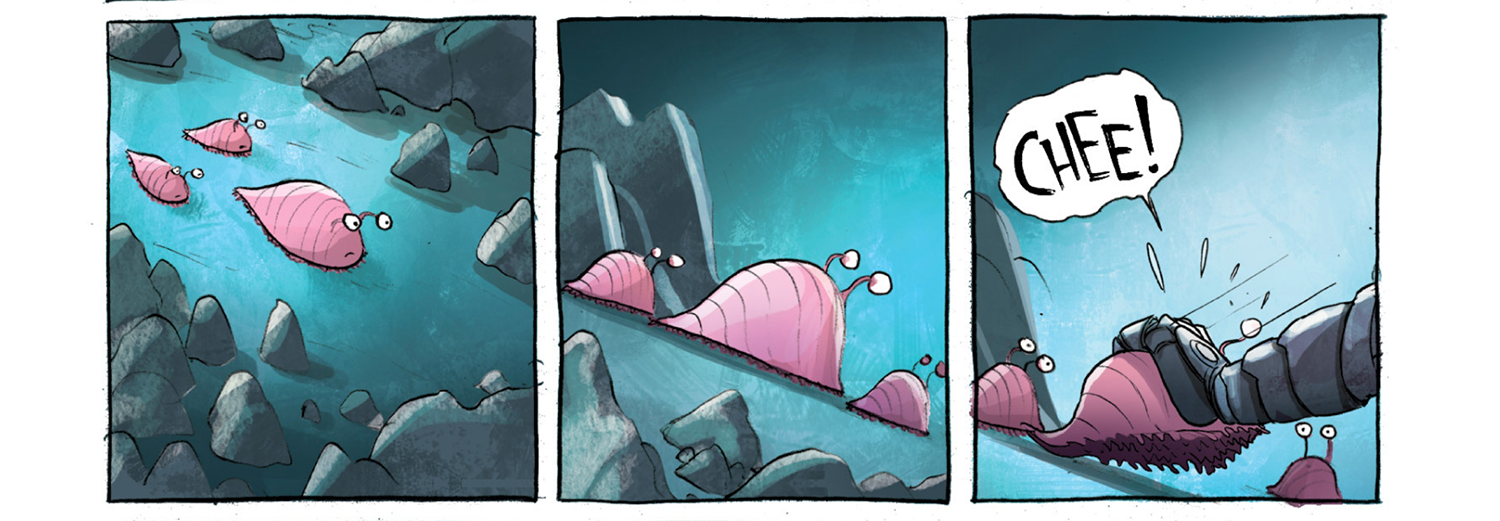
Three little pink leeches crawling through the ground when all of a sudden an arm grabs one of them. Amulet, Kazu Kibuishi (pg. 76)

While skimming through the graphic novel I found multiple examples of closure, especially ones with action to action. The example that I chose was when the panels panned to these three innocent looking slugs in a group. There isn’t much that goes on in this scene but the final panel is what really makes it interesting. The first two panels just show them going about their day. But once it switched to the third panel, there is an arm that come out and quickly grabs one of the slugs. This type of closure really adds a sense of worry due to the calming nature that the first two panels presented. The atmosphere is completely shifted from the swiftness of the arm in the third panel.

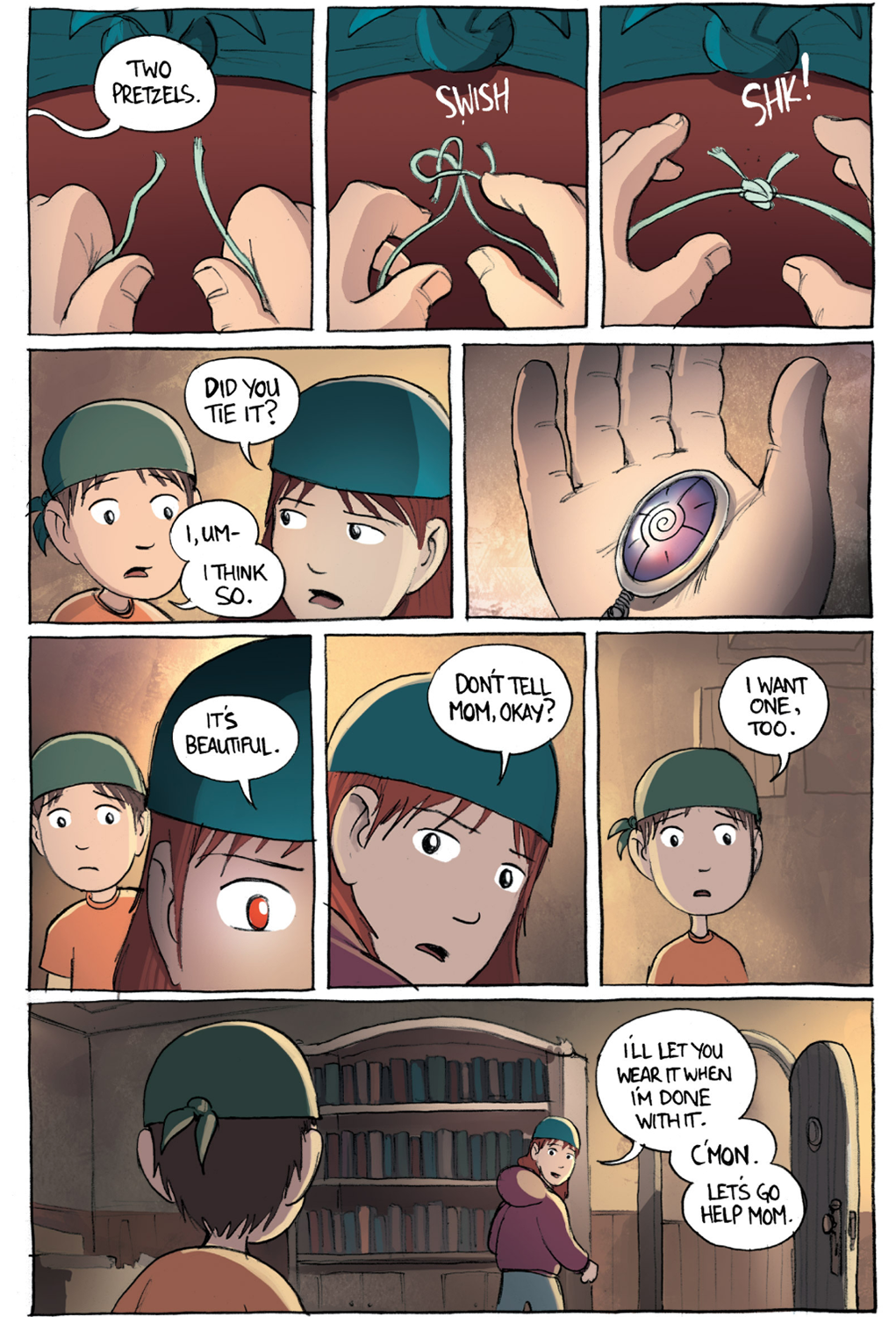
A brother and sister find a mysterious amulet while cleaning. Amulet by Kazu Kibuishi (pg. 33)

For time frames I decided to go with this scene where the two main characters find the mysterious amulet in the room that they were cleaning. The reason why I chose this scene was due to the mystery it presents when the girl handles the amulet in her hands. From the fourth to the sixth panel there is a distinct change in her eye color that causes the reader to make their own assumptions or interpretation to why this is occurring. Throughout the rest of the page she also seems to have completely changed her attitude and the subject which adds to the mystery of the story. My interpretation of this scene was that the amulet had taken possession of her.

Posted in Closure & Time Frames, Physical to Virtual | Leave a comment

Closure and Time Frames: Dean Janikowski

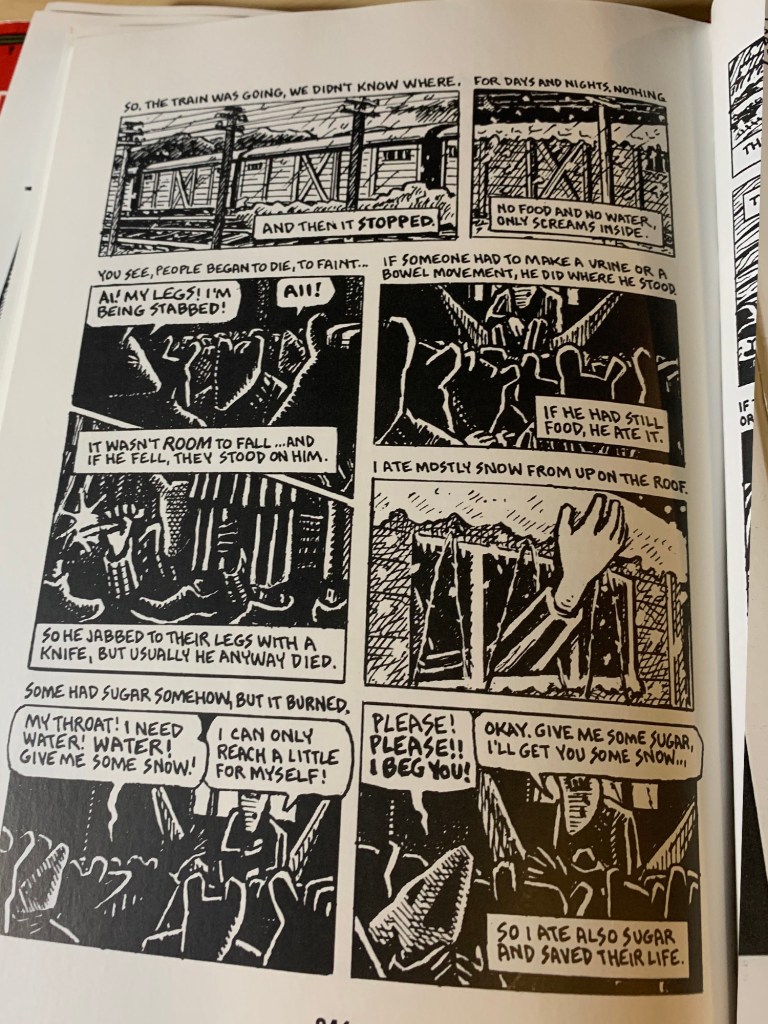
I am choosing to read the graphic novel Maus by Art Spiegelman. This book depicts the story of the lives of Jewish men and women during the Holocaust of WWII exept in this story, mice represent the characters who play those who are Jewish, and cats represent the Nazis. For the first interesting example, I found a scene where mice prisoners are being carted away in a train, forced to stand days on end, eat what little food they had, and eat the water on the train roof for water. These moments almost go scene to scene or aspect to aspect as there is no one movement showed in two frames, but rather different moments happening over time. The Nazis every few days would open the train, and then the next frame would be them traveling again in the train. These scenes are interesting because it definitely leaves room for interpretation as there is so much time that happens between each frame, and violence and death, that it almost seems the author wanted the reader to let the imagination take control. 

Maus by: Art Spiegelman

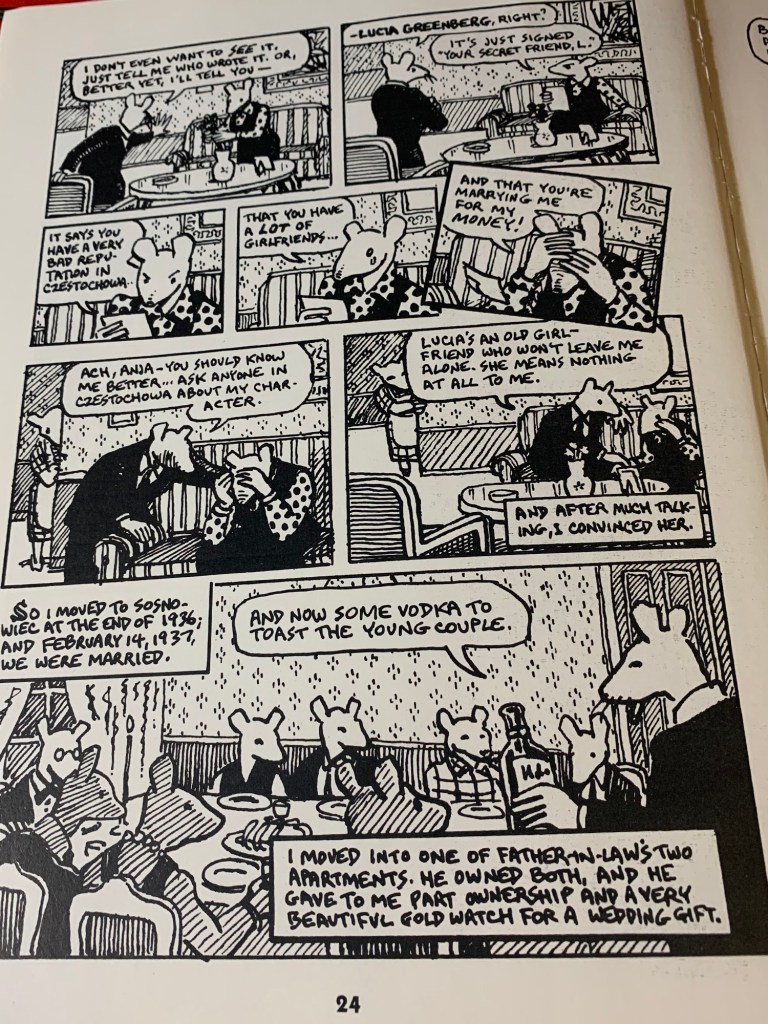
The second image I chose to depict an interesting example of time frames was closer to the beginning, when the main character is hoping to win back his love interest who believes he is not the man he claims to be, the page at first shows him talking with her, and then skips to them being celebrated for their marriage. These two separate panels are separated by years of time, which means the reader has to fill in that time gap with how they imagined their lives had gone. Their love story seems rather sudden, but because of the narrators input of time, each image carries a lot more weight as it is the substance the reader has to carry on the story in their mind. 

Maus by: Art Spiegelman
Posted in 201 Blog, Closure & Time Frames | Leave a comment

Closure and Time Frames: Ruby Hopkins

The graphic novel I am choosing to read is Persepolis, which tells the story of a young girl growing up in Iran during the Islamic Revolution. The first scene I chose to depict an example of closure is a scene towards the end, pictured below showing a moment to moment action. Why this stuck out to me in particular is because of the panel layout, leading the reader to imagine more between each image, adding in our own interpretation to what happened. Adding the black image at the end especially leads to our own minds having to draw a conclusion of what is going on. Because of the violence this specific scene is leading to, it makes sense why the author would want to leave parts out. From having images zoomed out, then zoomed in, it shows the passage of time moment to moment, with senses of suspense as the character reaches down to look at the bracelet, then realizing the horror at her feet. All of these separate images leave for seconds of time between each action, almost acting as breaths, as we yearn to know what the character sees. 

Persepolis p. 142 by Marjane Satrapi

When looking for an interesting example of time frames, I found one page that shows the passage of time in an interesting, jumbled manner. The photo below shows moments of panic, as the characters frantically run for cover away from the bombs. The first panel on the left shows movement, as the characters run for cover, but not on the same staircase, different staircases, different people, all doing the same action in different location. Then on the right side of the page, a black background with a bunch of floating heads makes for another moment of time where the other shows the lives of multiple people while they are at different locations. It definitely calls to the readers imagination, and is an excellent way to show movement and time through still imagery. 

Persepolis p. 104 by Marjane Satrapi

Posted in 201 Blog, Closure & Time Frames | Leave a comment

Closure and Time Frames: Anna Davenport

The graphic novel that I am choosing to write about is A Wrinkle in Time. The reason that I chose this because I really enjoyed the way that the characters were drawn and I enjoyed watching the movie about this story.

Screenshot from A Wrinkle in Time by Hope Larson 2012

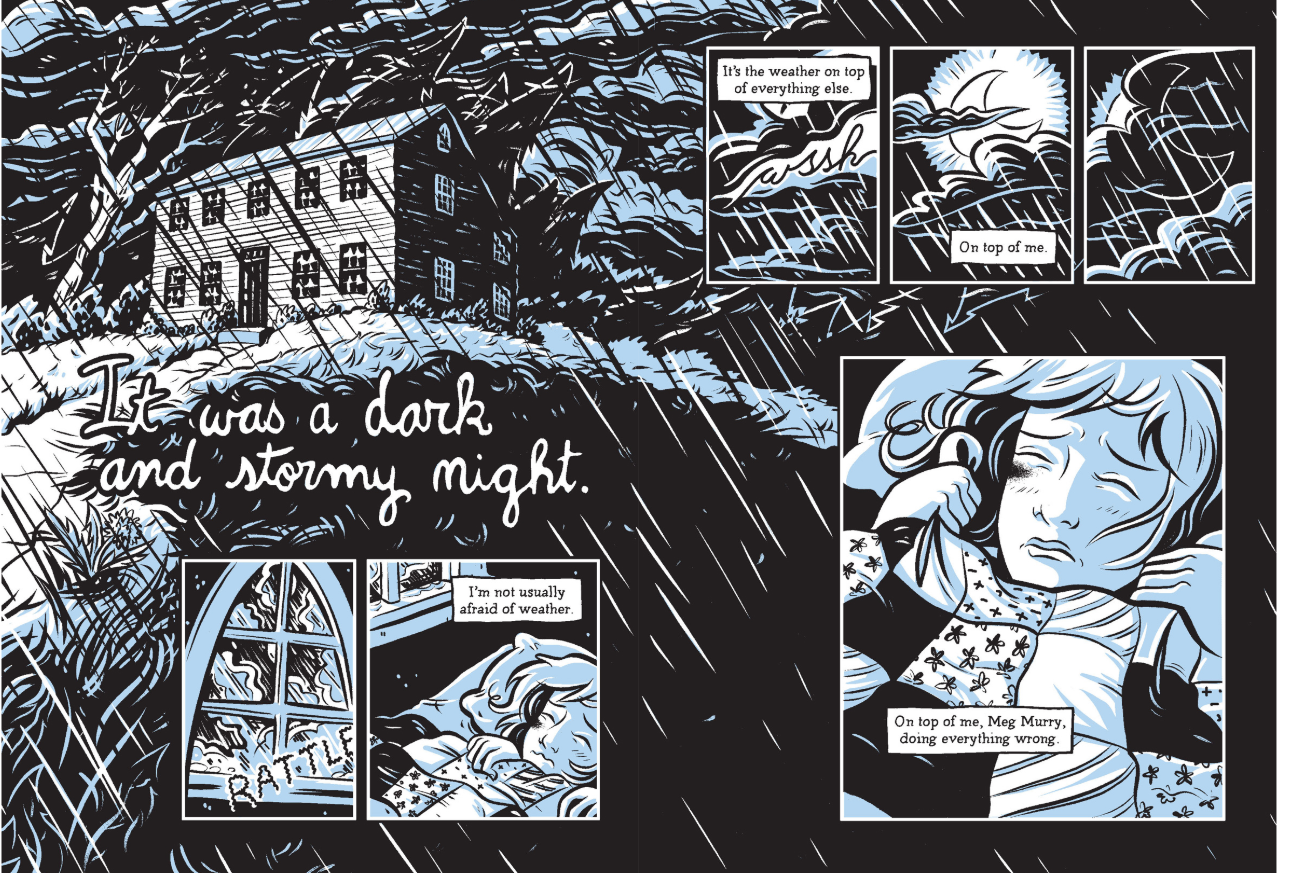
One example of closure in the graphic novel is when the author has the house, wind, and moon up close and then after it goes to the panel with the word rattle, we can finally see that it is the girl in the bed scared in the house. The reason that I think that this is an example of closure is that McCloud defines closure as a “phenomenon of observing the parts but perceiving the whole” (p. 63). Before we see the girl we are no sure why there are such dark and scary pannels and then we can see more of the whole picture of the girl in bed. I think that it is also important for closure when there is more text to explain how you perceive the whole. I believe that this example is a scene to scene type of sequence because the amount of time in each panel jumps between short wording and illustrations and two that feel like you need to spend more time on them.

Screenshot from A Wrinkle in Time by Hope Larson 2012

An example of time frames in this novel so far is when the main character has a flashback. In McCloud’s book Understanding comics, he explains that there is past present and future in comics and the way that the panel is shown and drawn and placed helps the reader understand this. In this novel, A Wrinkle in Time, the author shows that the character is flashing back by making a more cloudy drawing that has more muted dark colors.

Posted in 201 Blog, Closure & Time Frames | Leave a comment