Closure and Time Frames: Edgar S. Martinez

Daytripper by Fabio Moon

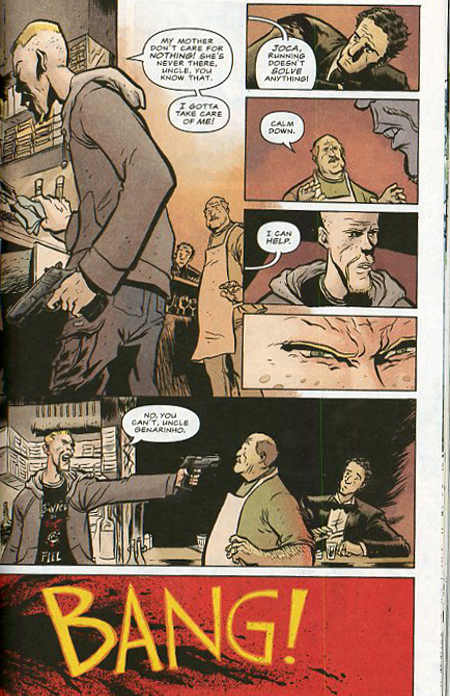
When I was deciding on a graphic novel I decided to look online. The graphic novel that I found was Daytripper by Fabio Moon which is about a author who’s job is to write Eulogies however the graphic novel is about different times about his life and what would have happened if he wrote his own eulogy. This first image showcases action to action as the first panel sets the situation and the last panel is a BANG and the action happens. This is a form of closure it is obvious that the bartender has died but it is up to us to picture the image. It serves as a dramatic ending to the first chapter and sets the tone to the type of action that can be expected from this graphic novel.

Daytripper by Fabio Moon

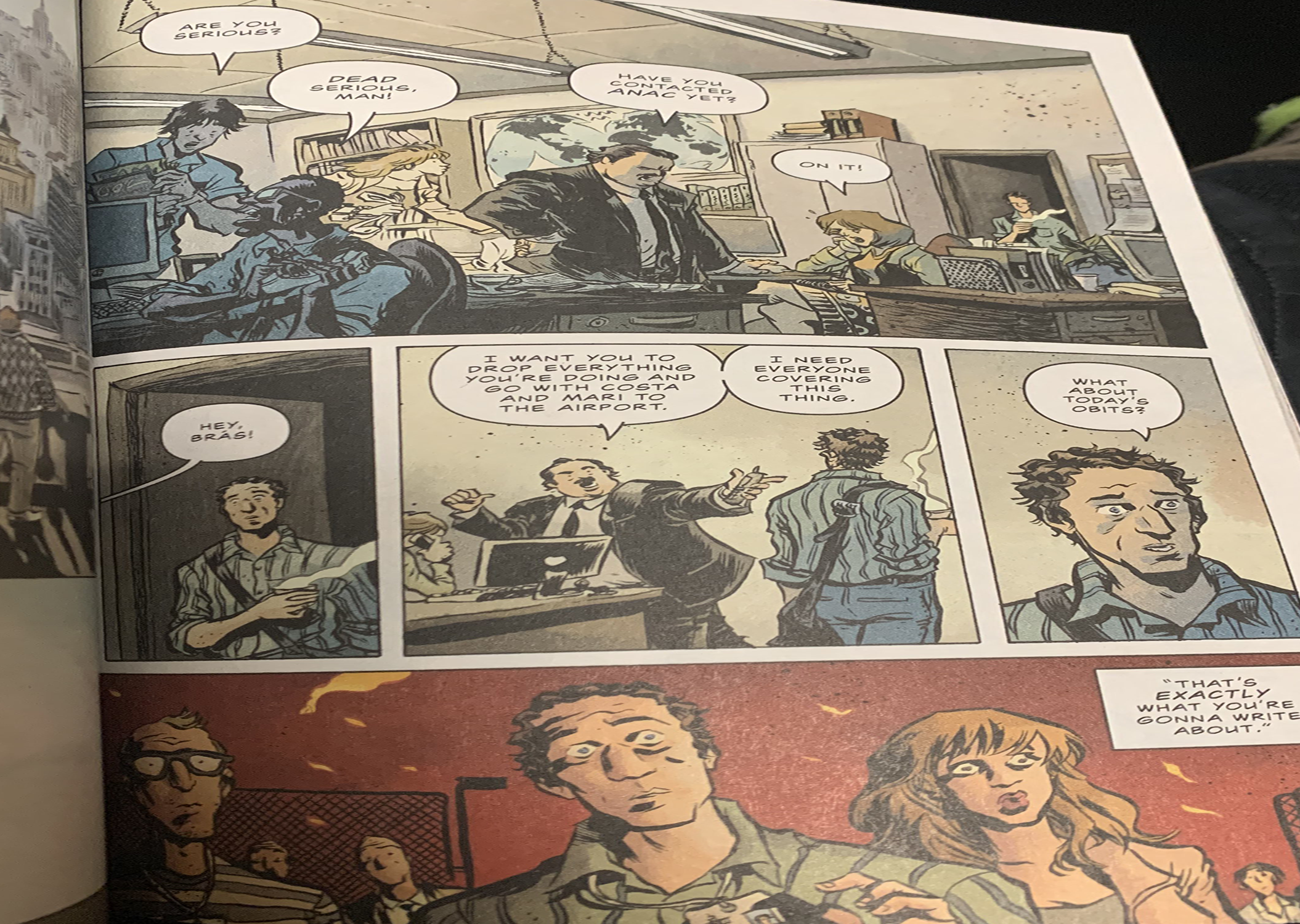
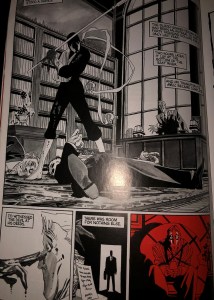
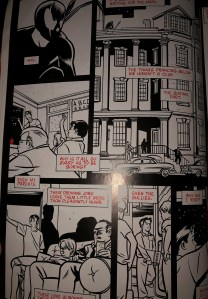
I found this panel while i was skimming the graphic novel and it caught my attention. The panel shows the main character in what seems to be a office environment and then it quickly switches to a intense red panel in a completely different environment. This huge time frame gap really demands that the reader engages with the comic. It is a very extreme cut almost like a movie. One I saw this I stopped flipping and wanted to find out more about the context of it. Its up to the reader to piece together how the two scenes fit together. There is a piece of text that provides some information as how we got the point but the closure is amazing. It feels like I am watching a film and the transition was like a sudden jump cut. That scene engages me and makes me want to read more to find out how we reached this point.

Posted in 201 Blog, Closure & Time Frames | Leave a comment

Closure and Time Frames: Brady Davis

For my graphic novel, I chose Here by Richard McGuire. I found out about this novel on the internet when browsing for ideas what to read. Here caught my eye because the central narrative of the comic is showing a scene, then showing mini frames within the scene that play as little time machine windows to the same spot in the past or future. It often uses scenery of the interior of a house to show little juxtaposed time lapses from the beginning of time to when it was written. This is something that hit home because it’s something I often wonder about. Places all around us such as houses, classrooms, etc, have such rich amounts of history and yet a lot of it goes without recognition.

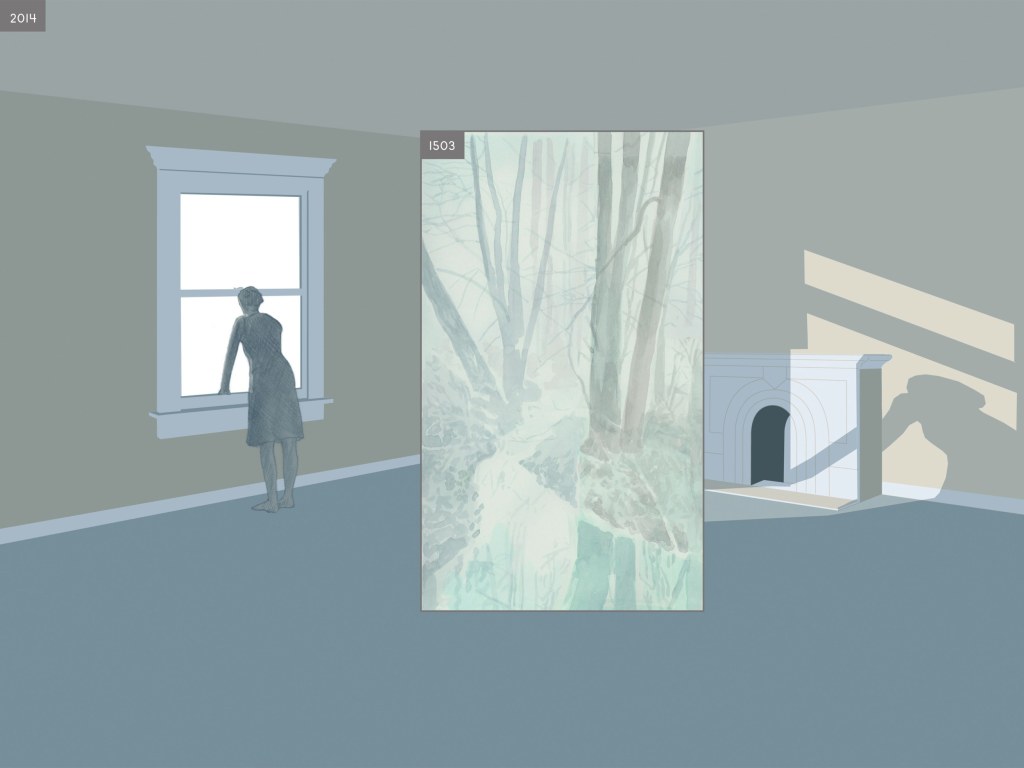
This scene uses aspect to aspect as well as non sequitur transitions. This is pretty unique in that almost all of the imagery in this graphic novel falls under these categories. While the different time periods in the shots aren’t really related to one another, they are the same place just at a different place in history. It makes for an interesting juxtaposition of the elements. It’s one scene as a whole, but the base layer / canvas is used as the 2014 set while the inner frame represents the same shot in 1503 and shows the nature that was there before the house. I found this particularly interesting because I grew up on 6 acres in a house that was built by my great-grandpa Jones. I often wonder what the scenery was like back when he was building it. Since we’ve lived there, we’ve cut quite a few hazardous trees down as well as built a greenhouse, shop, barn, fence, etc. Reading this novel makes me wish I had old pictures of my house so I could do modern comparisons like this.

I found this scene particularly interesting as it shows past, present(ish) and future. It shows a somewhat dark looking scene of the early 1600s that appears to be some sort of trade between the Native Americans and pilgrims presumably during the early colonial american time period. The base scene itself is a 2005 still of the room with two elderly men talking to each other. One of them is in bed in what appears to be a hospice care situation where he’s starting to diminish in health quickly. This is conveyed in the fact that he can’t hear the other guy in the room. The last image shown within this frame is a picture of a whale swimming in the ocean or some large body of water. This is interesting foreshadowing from McGuire as he seems to think there will be some sort of flood or chaotic event that leads to the world flooding.

Posted in 201 Blog, Closure & Time Frames | Leave a comment

Closure and Time Frames: Jasper Contreras

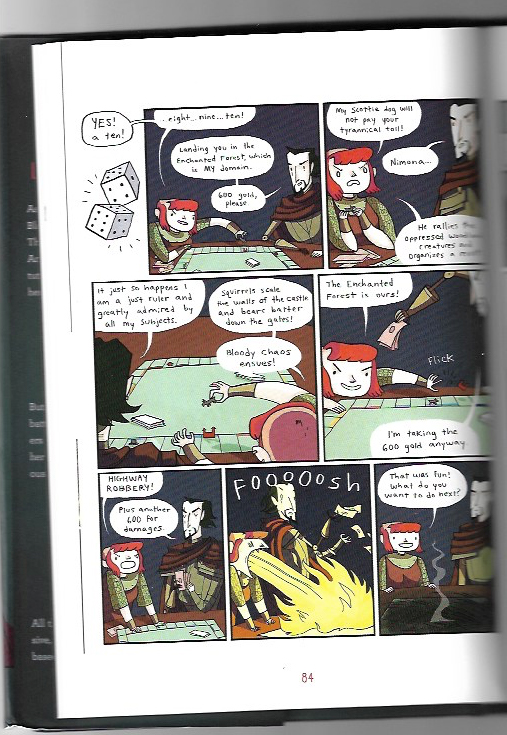
from Nimona by Noelle Stevenson. 2015, pg. 84

The graphic novel I picked is Nimona by Noelle Stevenson. I’ve actually owned it for a long time, but I’ve never gotten around to reading it. What I find interesting about this is it’s art style, it’s a bit different than most other graphic novels and comics I’ve read, I’d say the style is a bit more simple and more about vibrant colors than others I’ve read. There’s a fantasy element to the story that I really like and appreciate as well. 

from Nimona by Noelle Stevenson. 2015, pg. 172

The first page I picked for closure was this scene where two of the characters appear to be playing a board game and then suddenly one of the characters is spewing fire on the game board. I had a little trouble identifying what kind of closure this was at first, just because I thought it was more than just moment-to-moment. But looking at the page and the scene more, I think that that’s the kind of closure this scene has. This scene doesn’t exactly require a much closure because it’s all within the same moment really, maybe only a few minutes pass but even from moment to moment, the reader doesn’t really have to interpret anything to know what’s happening.

As I was just skimming and looking over the content of the book, it was hard for me to find something that seemed like it was showing time. I picked this part because, while it does require some more interpretation from the reader, all of these panels are moments through the course of someone unknown amount of time. From the third panel at least, it seems like it could be over the course of hours if we’re thinking about it rationally and realistically when some sort of science is involved. At least, that was how I saw this page, it was the one of the more obvious forms of time I could find when skimming. 

Posted in 201 Blog, Closure & Time Frames | Leave a comment

Closure and Time Frames: Sophie Dimry

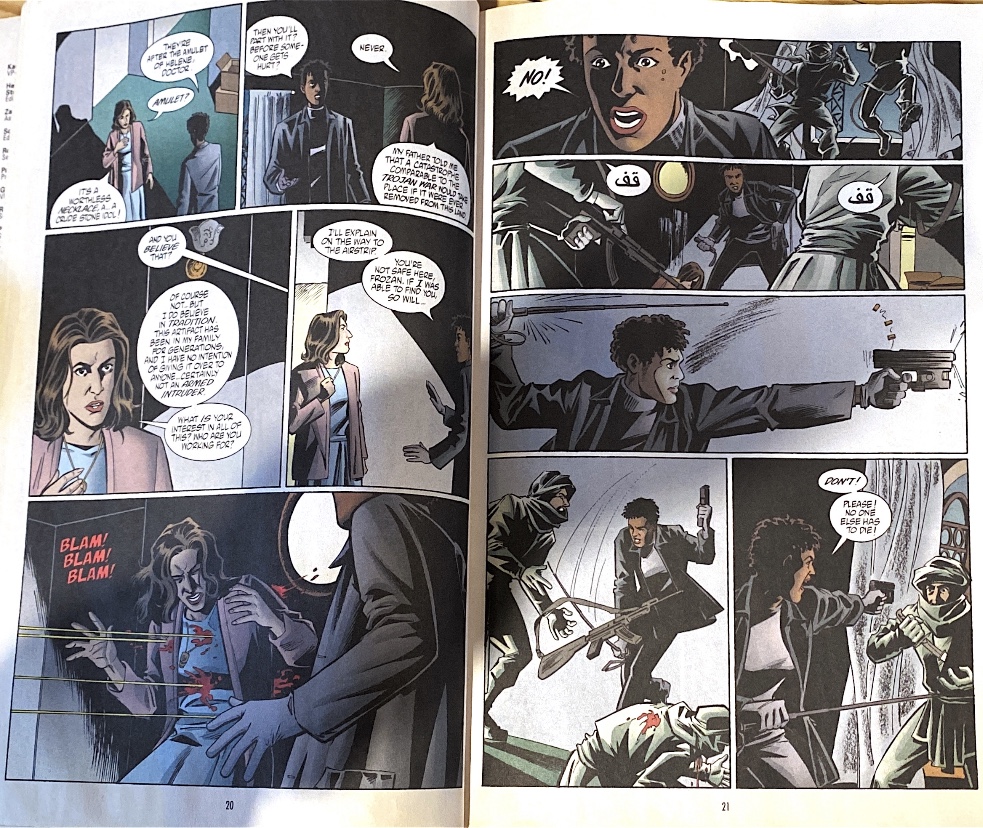
An example of action-to-action from The Last Man by Brian K. Vaughan, Pia Guerra, and Jose Marzan Jr., pg 20-21

For my graphic novel I chose to read The Last Man by Brian K. Vaughan, Pia Guerra, and Jose Marzan Jr. I checked out this book from the Holland/Terrell Library after skimming through many graphic novels. I found this one to be the most intriguing because of its classic comic book style of drawings and the action depicted in the novel. This novel is about an unknown plague that hits the entire world, killing every man on the planet unexpectedly. Only one man survives the apocalypse and no one knows why it is that man in particular.

I chose a scene from the novel that has one of the most exciting action-packed scenes in it. The story varies from viewpoints and tells multiple stories at once, each from different places in the world. This example of closure demonstrates the action-to-action aspect because it shows the progression of an attack taking place. This page is a fight scene where a secret government agent takes on two men as they surprise attack her and another woman. I thought this scene was interesting because it reminded me of an action movie scene. The panels on the first page are easy to follow and very straight forward, while on the second page they are spread horizontally to fit the page. This style shows more of a sudden transition and makes the actions taking place seem very abrupt and intense. The use of lines to indicate motion also add to the dramatic actions as well as the sounds effects and speech bubbles.

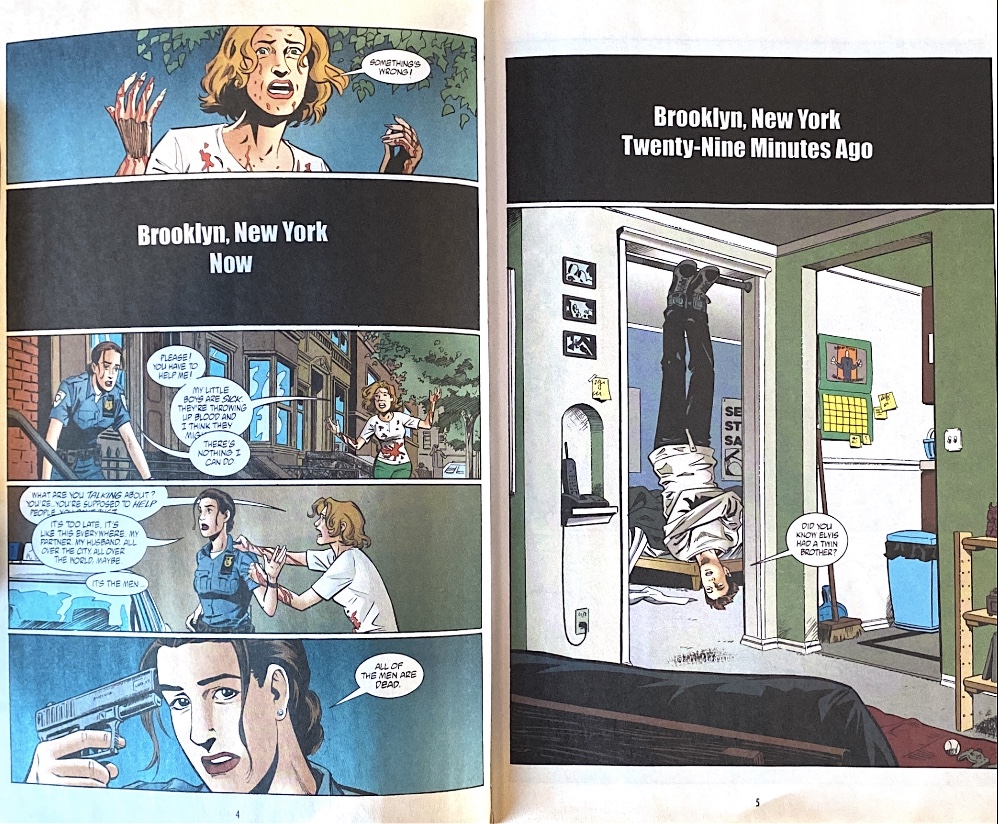
An example of time frames from The Last Man by Brian K. Vaughan, Pia Guerra, and Jose Marzan Jr., pg 4-5

The next scene I chose depicts time by explicitly labeling the time and place of where the story is taking place. This is crucial to the story because it is meant to be hectic since there are so many crazy and unusual things happening around the world. These two pages are the beginning pages of the novel that I chose because they give a glimpse into the story and fill the reader with suspense. By putting a time stamp on the pages, it lets the reader know what is going on in that moment so that they can keep track of the story and timeline in this sequence of events. It also works as the exposition for the story because it shows where the main character is at the beginning of the sequence of events.

Posted in 201 Blog, Closure & Time Frames | Leave a comment

Closure and Time Frames: Ivan Franco

Watchmen Chapter 3, Alan Moore

This image is form the Watchmen graphic novel. I chose this book as my graphic novel to follow. I have been interested in reading it for a while. This scene is from chapter 3, it displays the technique of scene to scene closure. In the novel the page jumps from a scene of the omniscient character Dr. Manhattan during an interview, and a fight scene that Night Owl and Silk Spectre are fighting. in the large picture the scenes contrast each other in their importance and raised stakes. The fight is violent and vicious but in the large scheme relatively unimportant. The interview however, appears calm and concise but what is being discussed holds large implications on the rest of the story.

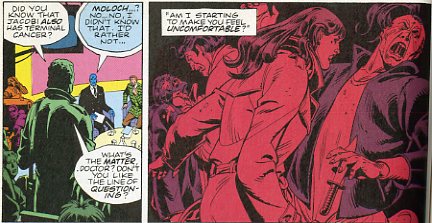
Watchmen Chapter 2, Alan Moore

This image of four panels displays a shift of time occurring in the novel. It is quite simple, Rorschach (the one in the hat) is narrating over the events that surround the mysterious murder of the Comedian. The comedian panels are of events that happened at the start of the story, but helps set up this common habit in the novel to use flashbacks to the past. The two environments are contrasted by their color scheme. The present day panel is in base colors and diverse. The panels with the Comedian is drenched in a rosy red to signify the morbidness of his death.

Posted in 201 Blog, Closure & Time Frames | Leave a comment

Closure & Time Frames: Haydyn Wallender

Hello friends! For this blog post and for inspiration for our next project, I decided to pick up something related to my English major at the library (which is also my happy place, if you didn’t know). After browsing some of the sections of comic books at the Holland & Terrell Library, I stumbled across Matt Wagner’s Grendel. If you don’t have any context, PLEASE allow me to explain: Grendel is the demon from Hell that a character long ago, known as Beowulf, slays to save townspeople and their king. It’s an unbelievably old epic poem with known author and no one really knows how it survived except for in a single manuscript known as the Nowell Codex. Really, that’s all the information you need. I could go into deep detail about this book, but let’s face it: no one really wants to know more about Beowulf than they have to.
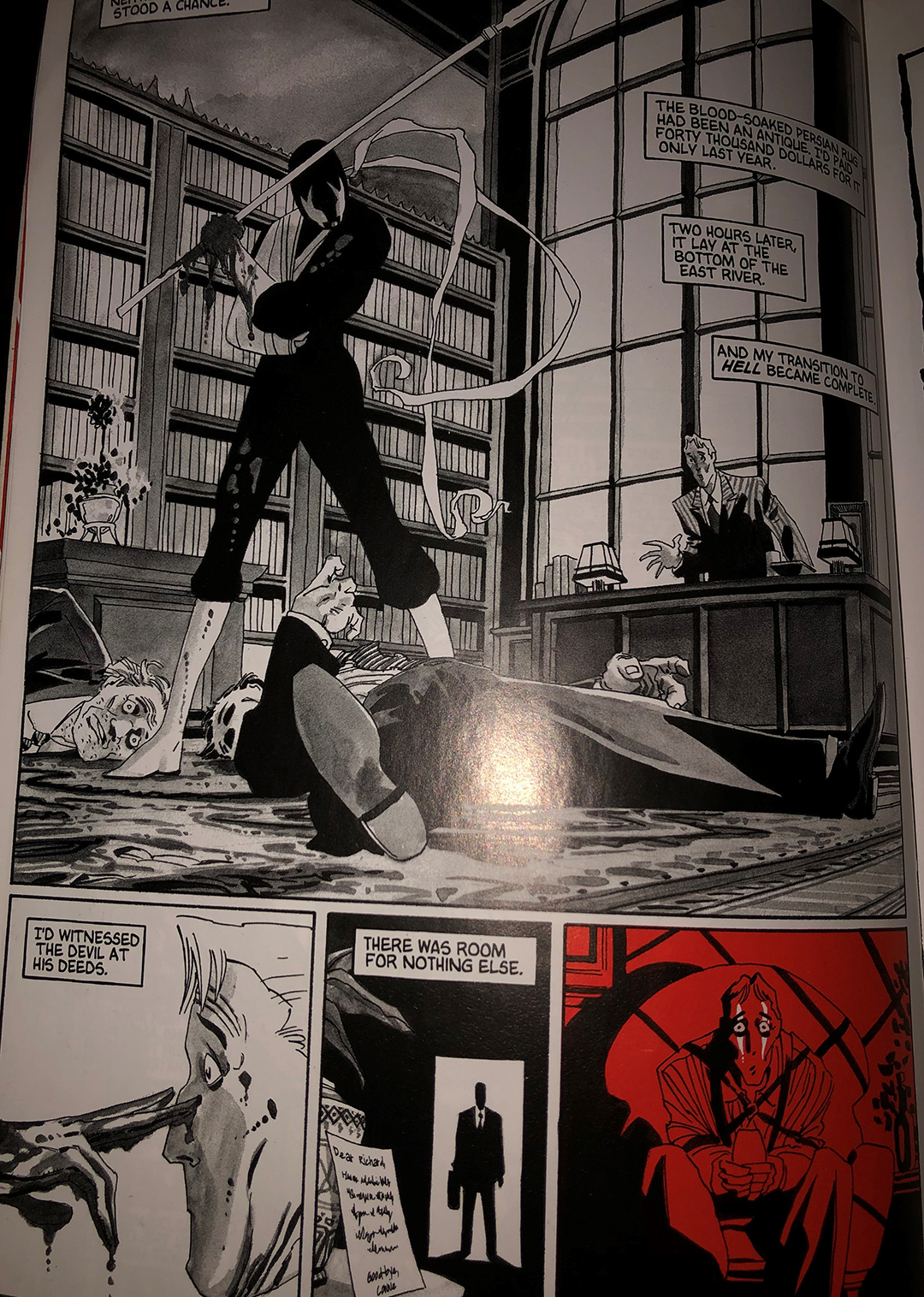
Matt Wagner’s Grendel, Dark Horse Comics Inc., 2000, pp. 11.

So, to save everyone the trouble, we’ll talk about Scott McCloud’s idea of “closure” and “time frames” instead! According to McCloud, closure is “the phenomenon of observing the parts but perceiving the whole” (63). In this version of a twisted Beowulf, Wagner does exactly this, with a bit of layout help. On page 11 of the novel, Wagner shows a scene of the main character, who happens to be Grendel’s lawyer, being attacked by mob men who he has prosecuted. Grendel then appears as either a well-timed hero or by being summoned by this character, and in the split second of a page-turn and two panels, Grendel has attacked the mob men and killed them, and the scene shows the men lying on the expensive Persian rug in the lawyer’s house.
Matt Wagner’s Grendel, Dark Horse Comics Inc., 2000, pp. 12.

Now, how is this considered closure? Because the phenomenon of the scene happened not only in two panels, but in two frames separated by a page turn, Wagner uses closure to place in the reader’s mind exactly what will play out in the scene, but not include the gory details of the killing. This way, it saves some mystery and active engagement for the audience, and saves Wager some drawing time. I would, like McCloud’s example of the man and the axe, consider this scene a subject-to-subject transition. The scene stays the same, and adds some action of the same character. Readers, as I mentioned before, have to put in some effort to understand how to read the panels and come to a logical conclusion that the author set up for them to figure out. For these reasons, the panel information and the reading of it has to be meaningful.
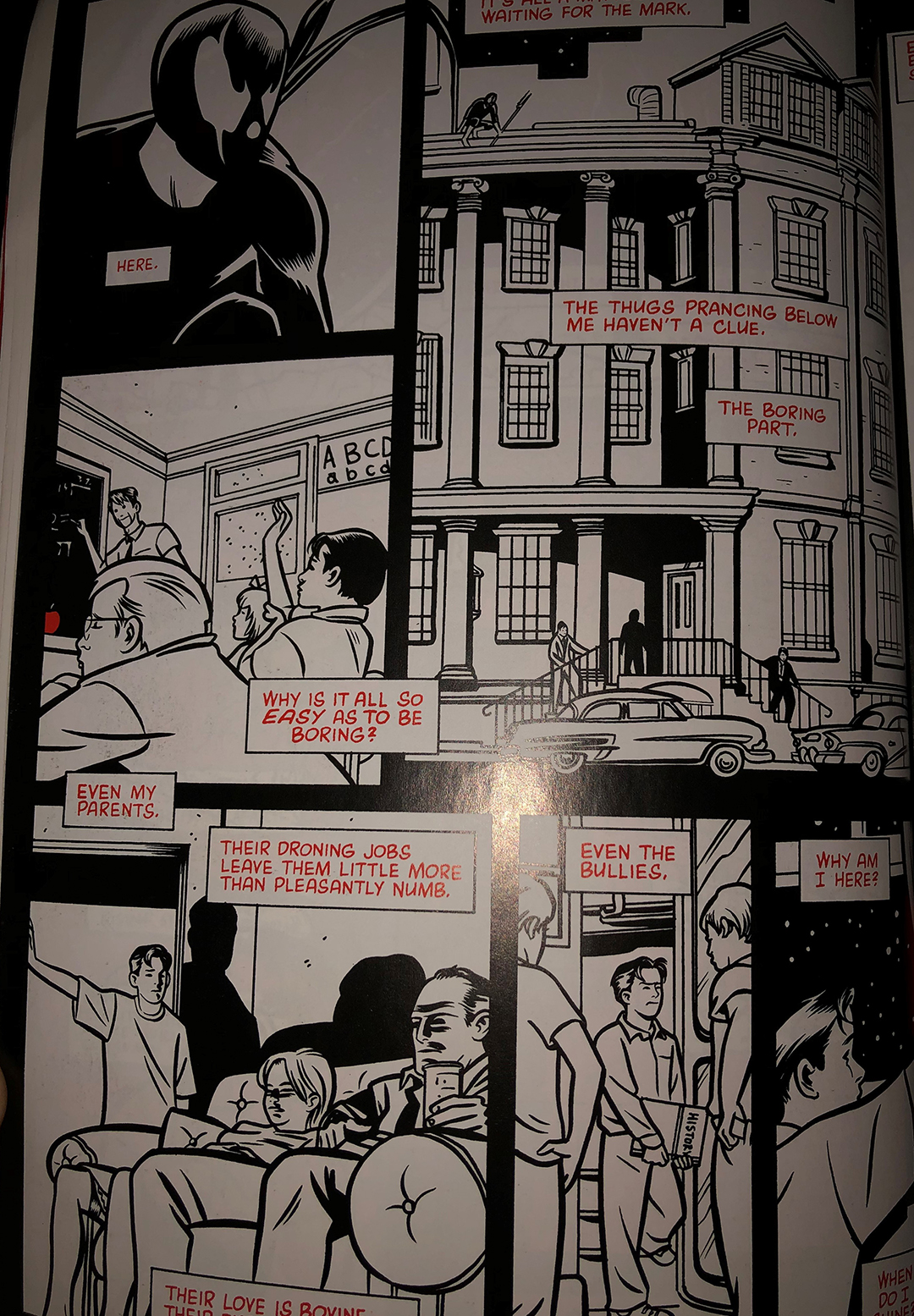
Matt Wagner’s Grendel, Dark Horse Comics Inc., 2000, pp. 22.

The second idea that McCloud mentions in his book are known as “time frames”. Time frames, according to McCloud, are a mixture of panel size and shape, as well as the faces and words in a panel that are linked in relation to action and time (96). The best way I can explain this is by looking at an example from Wagner. On one page, 22, Wagner manages to bounce from a close up of Grendel to a extremely tall building he is perched on in the panel next to it. This difference, though the shape of the panels are the same, are different in size, which makes me, as the audience, see that the right panel is a close up compared to the zoomed-out version of the building and Grendel’s perch. Similarly, this page goes from the present moment of Grendel’s life to a flashback of how he got there in the first place. Grendel, perched on the building, reflects as he looks at the night sky of his childhood and the events that lead to his career as “the devil”. Wagner does an excellent job of using one page with similar panel ideas to communicate this idea. Grendel goes from on top of a building that could either be taken as a business, a hotel, or a school in the imagination because of lack of identification factors and zooms into the inside of the “building”, where young Grendel is in school questioning his life. That is the brilliance of Matt Wagner’s art.

Thank you for coming to my baby TED talk on Wagner’s comic. I’m so excited to read the whole book. I hope you enjoyed learning about it as much as I did.

Posted in 201 Blog, Closure & Time Frames, Uncategorized | Leave a comment

Closure and Time Frames: Rachel Fox

“Zen Comics.” Zen Comics, by Ioanna Salajan, C.E. Tuttle Co., 1978, pp. 15–17.

The comic book that I selected for this project is called Zen comics. It’s entirely composed of four panel comics about meditation and restfulness. The panels that I selected for closure are the monk reaching into the other panel to grab a stick and then in the next panel he has the stick hitting the apprentices head with the exclamation whack! I think this panel is an action to action progression because you see the monk grab the stick then in the next frame the same monk is depicting the next motion of hitting the apprentice this makes the viewer use closure to understand the sequence of events between these two actions. Much like the example of the man hitting a baseball on page 70 of Scott McClouds book. 

“Zen Comics.” Zen Comics, by Ioanna Salajan, C.E. Tuttle Co., 1978, pp. 15–17.

The time frame that I selected is the apprentice exclaiming that the flag is moving, the eye then slides to the flag blowing in a connection to the next panel of the monk telling him the wind is moving finally you move down and the master is stating that the mind is moving. These are all in one connected sequence rather than panels with gutters and yet they exist at different moments of time that can only pass as the reader’s eye moves over it. The panels feature a unique juxtaposition to maintain the flow of this comic, in order to keep the panels connected the last panel is in the bottom right corner rather than the center bottom or the bottom left. This was done to keep the reader in the same moment that there was not a long period of time between these events occurring. The word feature in the bottom left panel took me a while to understand but just says Zen comics which is the title of the book and was most likely placed there to balance out the unique panel lay out. 

Posted in 201 Blog, Closure & Time Frames | Leave a comment

Closure and Time Frames: Korie Cedre

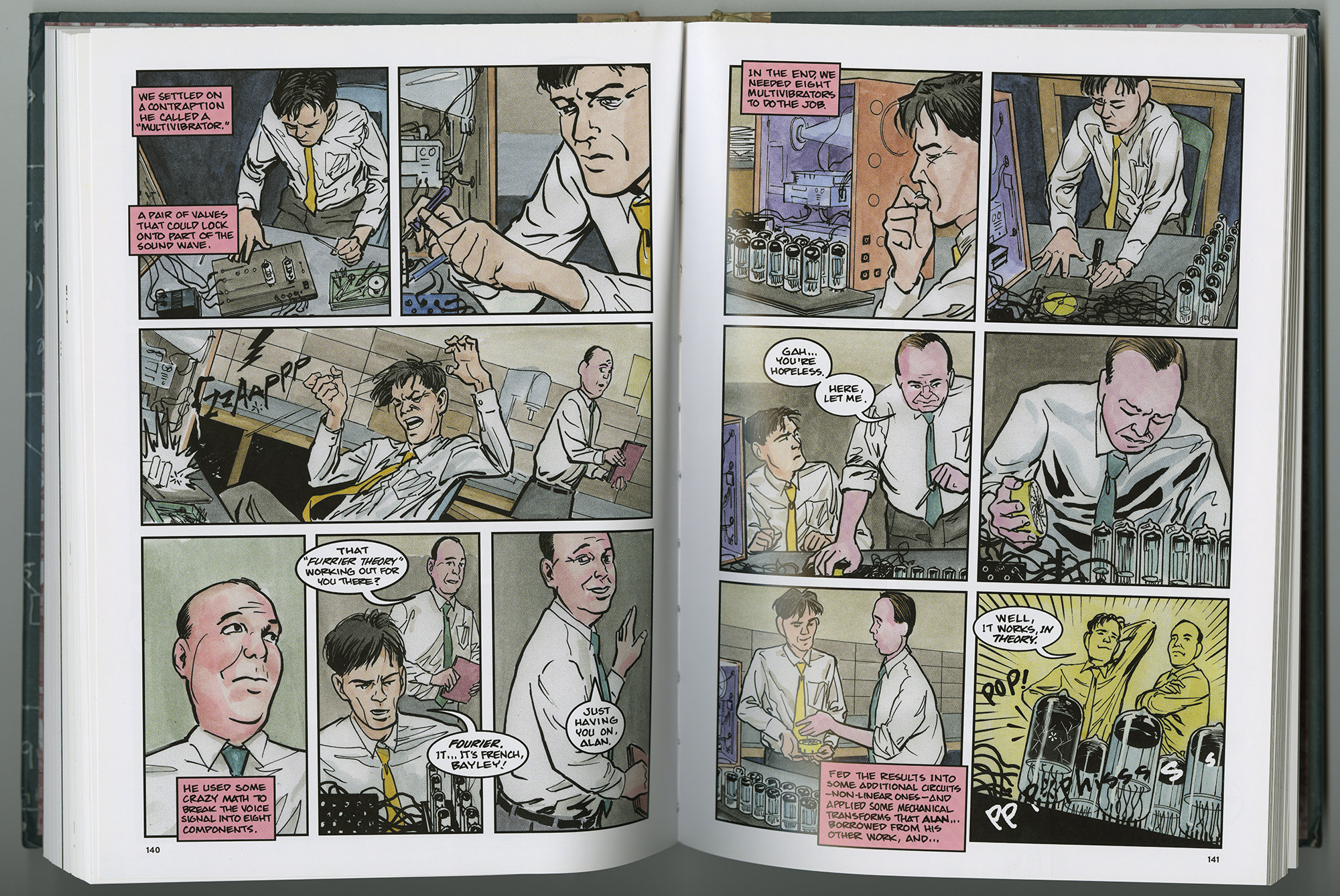
For our fourth blog post, I found a graphic novel to check out from the Owen Science Library. The graphic novel I decided upon was one in which I recognized the title, intriguing me as it was something I was familiar with already. Below are scans from the graphic novel, “The Imitation Game, Alan Turing Decoded,” by Jim Ottaviani and illustrated by Leland Purvis. After skimming it in the library, I noticed that it appealed to me by using a variety of bright and pastel colors, and how the comic seemed to be hand-drawn with a pen. The story revolves around Turing, an extremely bright man and the difficulties that come with it.

Following this, the first example of closure I recognized was towards the middle of the graphic novel. As one can see on the left hand side of the graphic novel, page 140, there are a total of 6 frames, the middle frame being the longer one. Previous to this specific frame, the readers can see, and read linguistically, that Turing is working on a contraption that requires sound waves and electricity. The second frame shows him up close with a concerned look as he takes tools to the lightbulbs. The frame right after is Turing, in the same scene, jumping back as there is a flash in which readers can assume that he was zapped while working with the lightbulbs. This becomes an action-to-action example of closure as readers can see Turing make transitions in the frames due to his actions, and as well transitions in a single subject/scene. This becomes a distinct series of actions, becoming an action-to-action scene as Turing is working on a contraption involving electricity, thus shocking himself.

“The Imitation Game,” a graphic novel by Jim Ottaviani and illustrated by Leland Purvis, about the life of Alan Turing (Ottaviani and Purvis, The Imitation Game, Abrams Comic Arts, 2016, pgs 140-141).

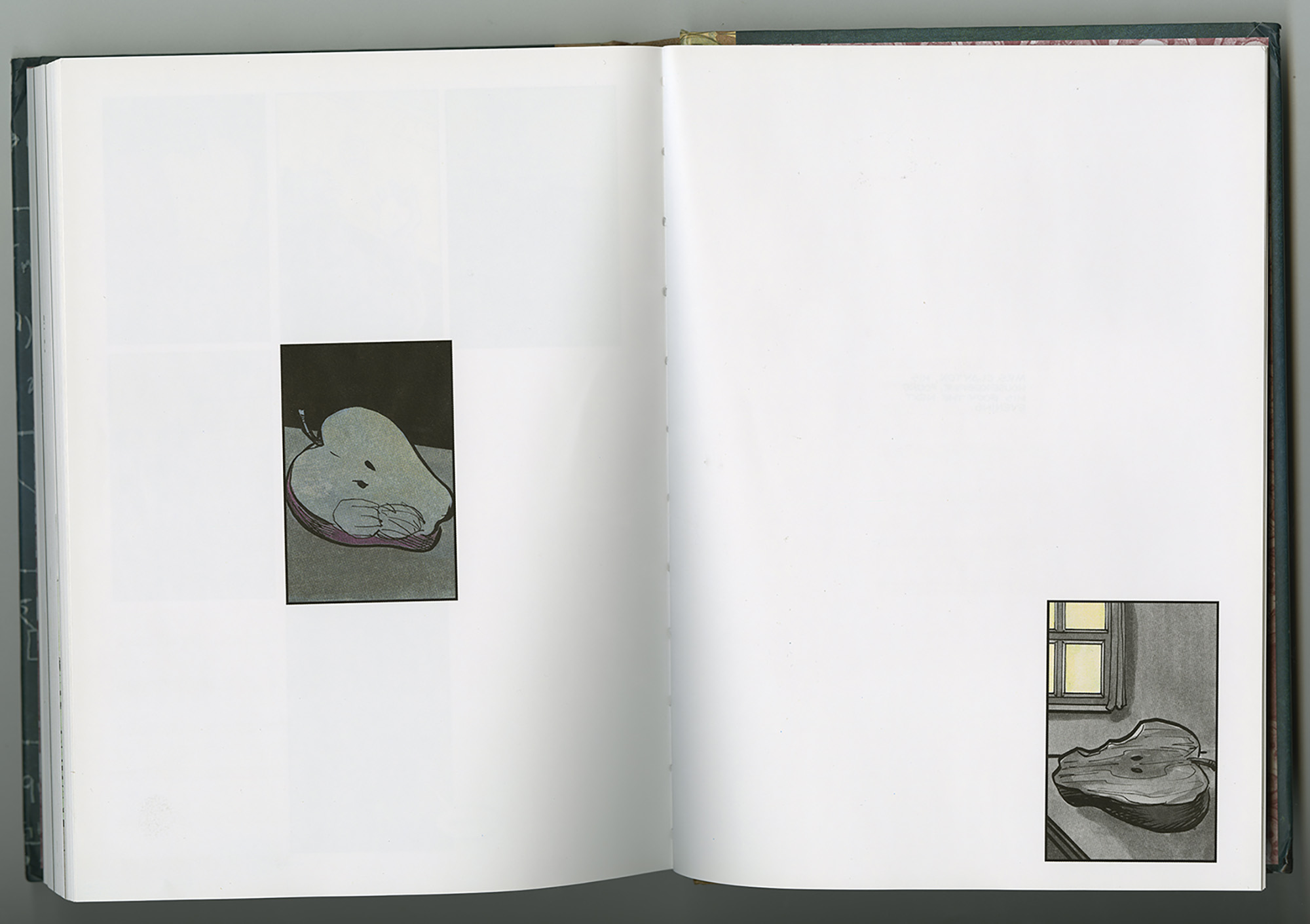
Another example asked to find was a scene in which the reader needs to be engaged; needs to participate or interpret the scene specifically. A scene I found that requires the reader to read the images closely is on page 220 and 221; the end of the graphic novel. As one can see, the two pages only show two frames, an apple that was cut in half, and another apple that is also cut in half, but aged. The reason I chose this scene is because in the pages beforehand, we see Turing cutting an apple to eat before falling asleep. However, these frames, pictured below, come right after in which it is left for the reader to interpret what happens afterwards. One can question if these two differently aged apples are even the same apple, and if they are, how long has time passed? The reader can also interpret if the apple represents the passing of Turing, or if it was simply forgotten about. Similar to the scene mentioned in McCloud’s graphic novel, the readers are the actual killers. As readers, we do not officially see Turing die, but assume by the aging of this apple that he has and remains in bed, deceased. In a sense, the readers are who kill Turing officially just by acknowledging the suggested meaning of the aged apple. In no way does the graphic novel state he is dead linguistically, thus, being time frames that ask for serious viewer participation.

“The Imitation Game,” a graphic novel by Jim Ottaviani and illustrated by Leland Purvis, about the life of Alan Turing (Ottaviani and Purvis, The Imitation Game, Abrams Comic Arts, 2016, pgs 220-221).

Posted in 201 Blog, Closure & Time Frames | Leave a comment

Closure and Time Frames: Daylon Hicks

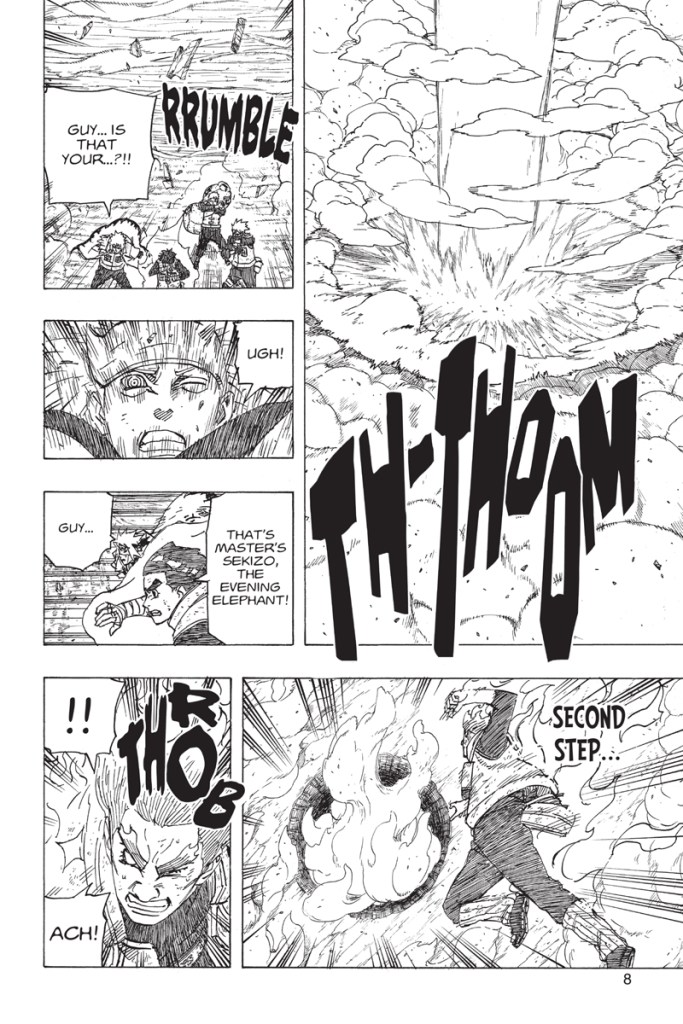
For my blog post #4, I chose to read about Naruto. Naruto is mainly known as an anime tv show, but they also release manga. Manga are comics or graphic novels created in Japan or using the Japanese language and conforming to a style developed in Japan in the late 19th century. The first image that I have shows the example of action-to-action. The reason that it shows action-to-action is because it shows Might Guy (bottom right) punching Madara Uchiha (middle left). The “TH-THOOM” action shows how this is action-to-action closure. 

Naruto Manga: Page 8

The next photo shows an example of aspect-to-aspect. The bottom panels show the box trying to get complete balance. The next slide shows Naruto balancing the box as he is sitting on it. The reader can be left wondering the flames represent. The reader can just assume that it represents Naruto balancing the box in the middle to obtain balance from his mind mentality and physical.  

Naruto Manga

I have not currently picked a Naruto manga because there is no Naruto manga here in Pullman, but I know I have Naruto manga at my house. Manga is different because you have top left to bottom right to fully understand the story. I wanted to do manga because I have a deep love for anime and I’m excited to learn more about Naruto manga and how it correlates with this class.

Posted in 201 Blog, Closure & Time Frames | Leave a comment

Closure and Time Frames: Feifan Li

I decided to read a graphic novel by Ben Katchor called Cheap Novelties: The Pleasures of Urban Decay. This novel is very famous in my hometown of China, so I decided to read it. The story is a novel collection of pictures from various publishers-Ben Katchor tells the story of real estate photographer Julius Knipl for decades.

From this comic, we can also see the change and movement of the character’s position. The cameraman saw a distant person falling down with a heavy object on his back. He walked over to help us. We can know this from the change in the distance of the scene. Because I watched it for a long time and I forgot which page it is (Friday), it should be more than 50 to 60 pages. The far and near environment of this picture, the cameraman first looked around and then prepared his own camera, and then found that someone lifting a heavy object is a distant view at this time, everyone can see the scene from a particularly distant place, and then a focused lens, Similar to let the reader understand that the focus is on that place. Then the picture came closer, and a positive close-up began to tell a new event. Then he also explained that he did it. Then use the change of the telephoto lens to explain the event. I think this is a great example of closure, and noting them in a graphic novel can help you think more deeply about what you are reading and what each scene means.

Cheap Novelties: The Pleasures of Urban Decay. pg.60
“Cheap Novelties: The Pleasures of Urban Decay”的图片搜索结果
Cheap Novelties: The Pleasures of Urban Decay. pg.32

In this picture, there are obvious clocks to prove the change of time. You can also grind the change of time from the background color and background change. The protagonist has seen various things passing by various places, and the background color has gradually become darker. You know it’s getting late. This example is what I think is best understood. Because the title requires us to look for an example of time, this screen has a clock on the surface to record the time, and the use of color on the side to tell you the change of time.

Posted in 201 Blog, Closure & Time Frames | Leave a comment