Closure and Time Frames: Jon Preng

The graphic novel that I chose was, “Poppies of Iraq” by Brigitte Findakly and Lewis Trondhein. I found this comic interesting because it is an autobiography in a comic form. Also, it is unique since there aren’t any panels throughout the book. Instead, the scenes are separated by a white space. The artwork is detailed but no too complex, which is a style that I enjoy.
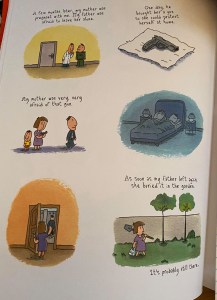
Findakly’s father purchases a
gun to protect his family

The first visual that I’ve included represents closure. In Scott McCloud’s “Understanding Comics,” he defines closure as, “motion in comics is produced between panels by the mental process.” (pg. 107). In the picture from Poppies of Iraq, the closure is scene-to-scene. In each “panel” there is a different setting and it is obvious that the actions were not back to back, as if it was moment-to-moment or action-to-action. Although the panels revolve around the same idea, it is not subject-to-subject because there is a significant amount of time in between frames. For example, one panel is during the mother’s pregnancy and two frames later, the child looks a bit older.

The second picture relates to time frames. The panels engage the viewer by having them interpret what is going on. Towards the middle, the authors finally add the words, “In Iraq, it’s the men who do the groceries.” Instead of adding the phrase at the beginning, it is inserted at the bottom half of the page. I believe this what done on purpose as a strategy to have the viewer analyze the scenes.
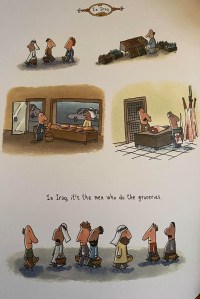
The social norm in Iraq

Posted in 201 Blog, Closure & Time Frames | Leave a comment

Northwest Alternative Comics: Jennifer Engelke

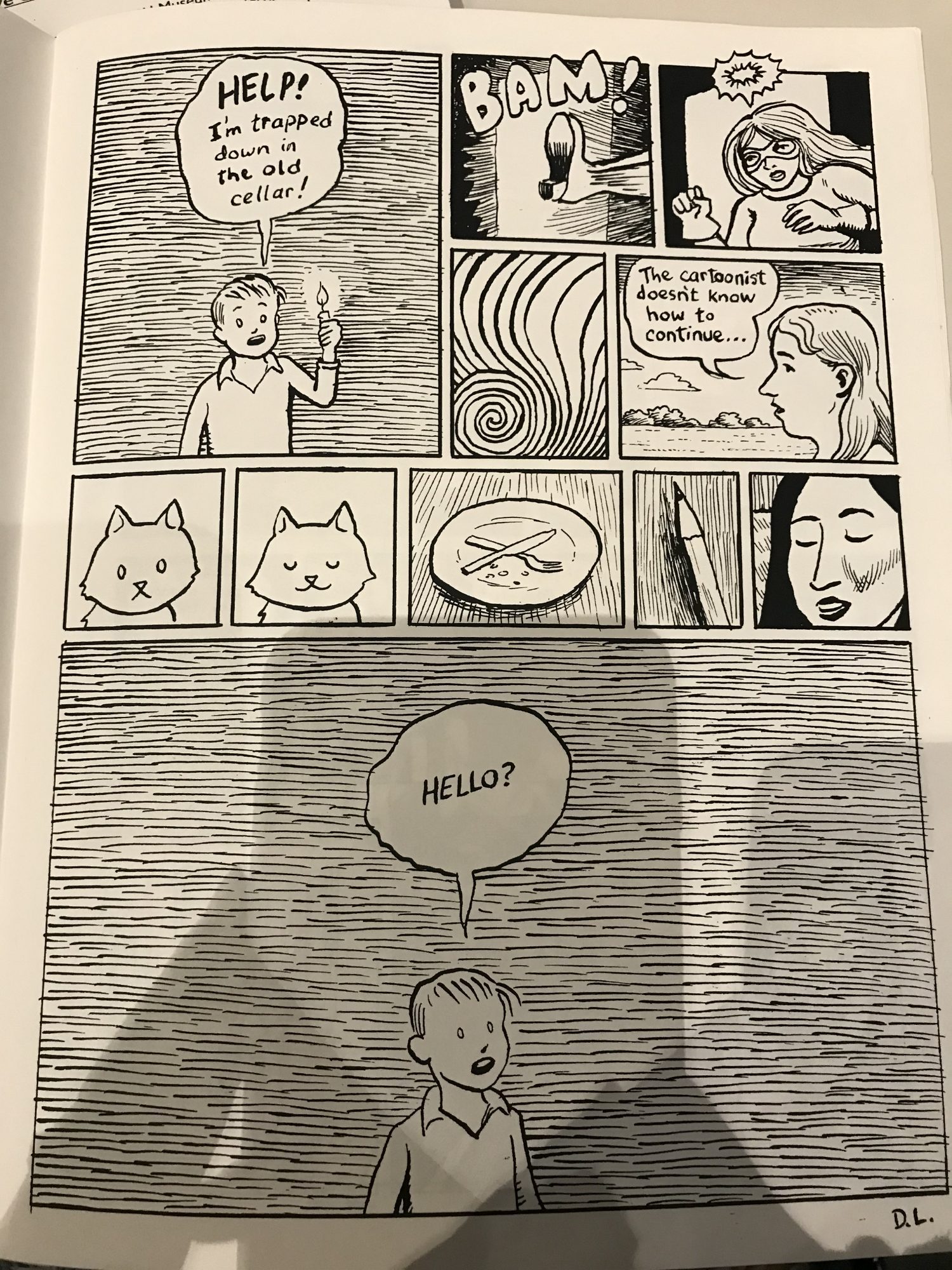
Untitled Comic by David Lasky from Manifesto Items no. 5 which includes many different elements of design.

The comic I chose to observe was from David Lasky’s Manifesto Items no. 5. This specific comic I chose does not have a name as this book is composed of the artist’s pieces of work throughout the year. This was my favorite book to look at because it simply had a lot of different visual arrangements and complexities. The comic uses Non-sequitur panels as the cat, plate, and pencil do not fit in. Non-sequitur is when the panels do not always seem to go together, except they do to create a sequence. Most of the comic does not seem to fit together in one piece however it is still defined as a comic by Scott McCloud’s definition. It applies sequence as the reader reads it left to right, and applies to juxtaposition. It is up to the reader to visualize and conceptualize why the cat, plate, pencil, and other panels are included within the comic. In addition to this, David Lasky’s comic includes demonstrations of many types of design elements within its panels. The comic demonstrates the importance of size. The first panel has a character yelling for help as he is “trapped down in the old cellar.” The final frame is much larger and the character believes he is alone. With the bigger size, it makes the character in the foreground seem much more alone in this big empty panel, and that he is not receiving much help. Using more design elements there are many lines involved in the illustration of this comic. While the main character has lines behind him to create a visual as if it is dark, yet the artist does not color in the background completely. However, as seen in a different panel (the one towards the middle) there are lines in which are guiding direction in a spiral. The lines guide the reader’s eye to the center of the panel. Balance can also be seen within the comic. There are two darker panels in the top right, and lighter ones in the middle left. Having these panels creates a balance within the panels that have lines across the entire panel.

Posted in 201 Blog, Northwest Alternative Comics | Leave a comment

Closure and Time Frames: Chloe Brusseau

The graphic novel that I am interested in reading is Breakfast After Noon by Andi Watson. I am interested in reading this graphic novel because it appeals to me and what I would look for in a novel. I am not as interested in sci-fi or superhero genres which are more common in graphic novels. This novel explores the life of a young couple named Rob and Louise, and their struggles and triumphs as they walk through life together.

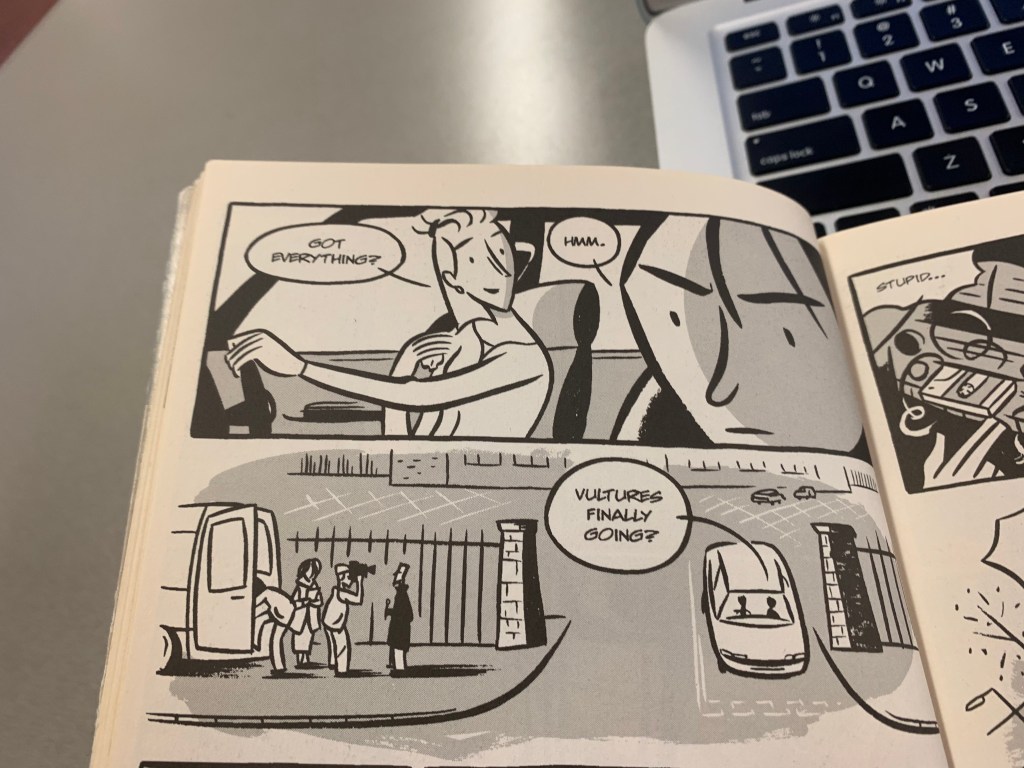
One example of closure shows a shot of subject- to- subject closure. The top or first panel shows a shot of Rob and Louise in their car getting ready to drive somewhere. Louise asks Rob if he’s got everything he needs, and he says yes. The very next panel shows a wider shot of the outside of a car driving away. One thing the reader might assume is that it is indeed Rob and Louise in the car. There are two completely different subjects but though closure, the reader will most likely assume that it is the same car shown in the previous panel of Rob and Louise conversing.

Subject-to- subject scene in Breakfast After Noon by Andi Watson.

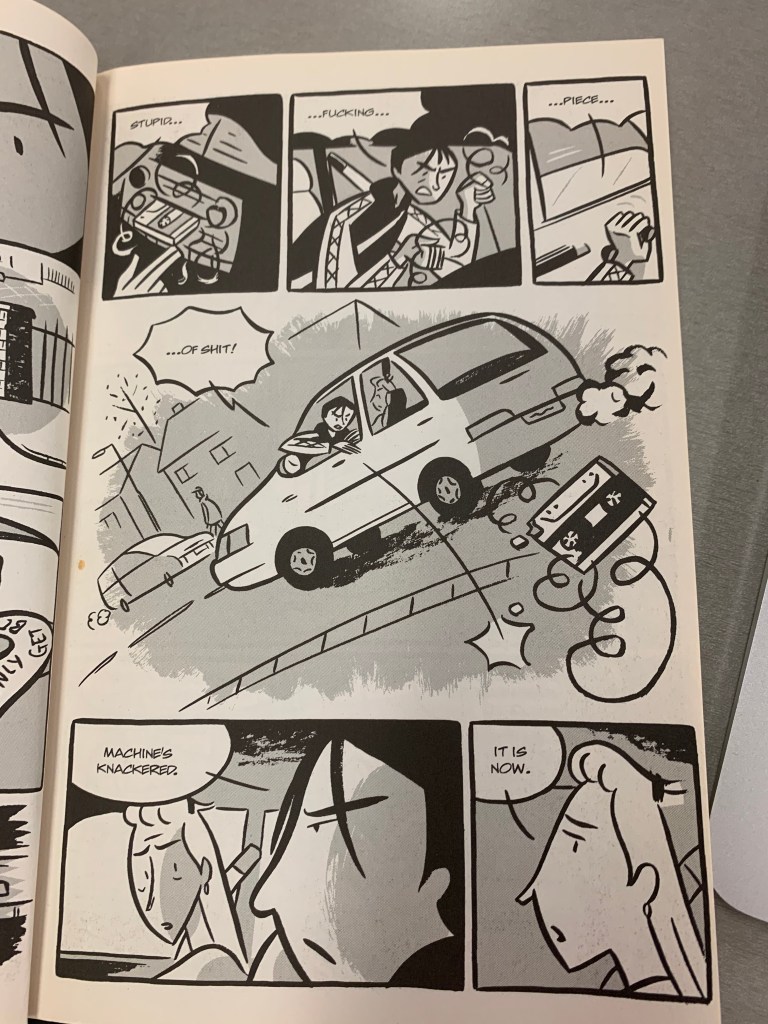
An interesting example of time frames is actually the following page in Breakfast After Noon. There is a shot of Rob throwing a tape out the car window in frustration. Even though there are 3 panels that represent the same moment. While Scott McCloud touches on time frames not being linear left to right, this page somewhat has that. However it then skips to one big panel, the climax one the heated moment, and back down to the bottom where the moment ends. I found this interesting because in some comics, that moment might have been portrayed all in one panel; Andi Watson’s breakage of the moment adds tension and emphasizes the importance, possibly suggesting foreshadowing.

Interesting time frame example from Andi Watson’s Breakfast After Noon.
Posted in 201 Blog, Closure & Time Frames, Uncategorized | Leave a comment

Closure and Time Frames: Diana Alonso

The comic book that I have chosen to read for the semester is called “Monster”, written by Walter Dean Myers. I found this book to be interesting compared to others because, of the topic, as well as the cover, which was what attracted me the most, especially since it is focused about a person of color, and the main cover is also person of color.

Walter Dean Myers “Monster”

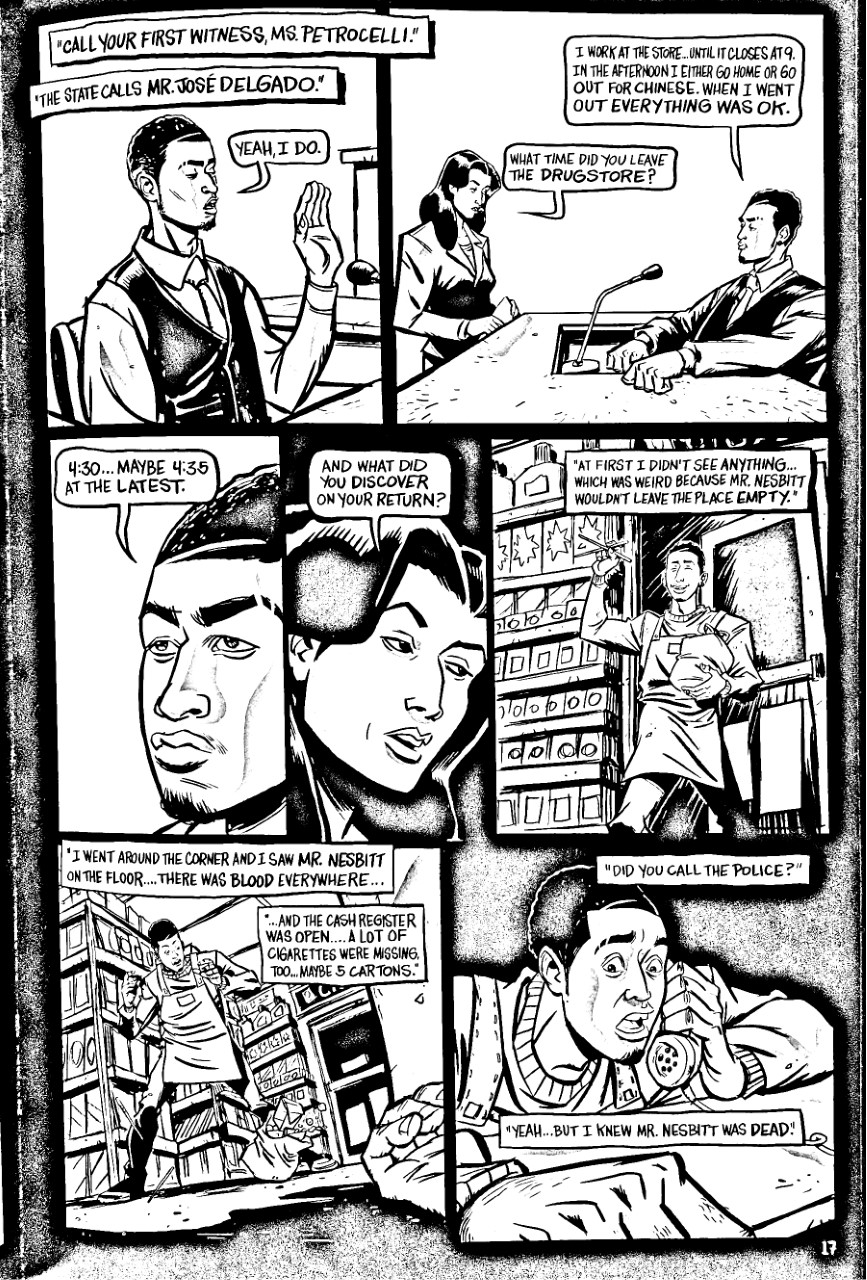
As I skimmed through the book, I was having a bit of trouble trying to find a time frame that was constant because most of the panels show time back and forth, not necessarily longer panels. This comic mostly shows panels that go from one thing to the other, which was what I found this image as. In this image it shows how the writer was going back and forth in a court case and it shows in the panels when the person is talking during the conversation. In this page, not only does it show the current time when it’s happening, but it is also showing the past of when the people are talking about, such as the topic that is being discussed in the page.

In this image from the book, when it came down to closure, I was able to find a moment-to-moment panel. This image demonstrates a moment-to-moment panel because it shows how it has very little closure, as it shows in both images below the page. As I looked for both time frames and closure, it was most difficult to find closure because there wasn’t many panels that showed very little closure. Most panels showed different scenarios according to who was talking which did not allow me to find many close panels.

Walter Dean Myers “Monster”
Posted in 201 Blog, Closure & Time Frames | Leave a comment

Closure and Time Frames: Ben Apostol

The graphic novel that I have been taking a look at is one of Scott McClouds Superman adventure books “A Big Problem”. Scott McCloud had released many Superman graphic novels that are similar in design and have the same comic style. One example of closure in one of the pages that I found was a scene created towards the beginning of the book that is the first unstructured or not uniformly framed. It shows a whole scene but still has one frame in the picture to show that something else important is happening outside of the large scene that is being shown more dominantly. Even the letters which are supposed to show sounds that are being created throughout the scene are shown to be taking up their own space on the page, giving the reader the option on when to acknowledge the different moving parts within this big scene. There is a lot of moving parts to this scene when broken down and looked at more closely, and leaves a lot of interpretation up to the reader on how they want to analyze all that is happening.

The scene that I chose to use for demonstrating how time frames are shown in graphic novels such as Scott McClouds, I chose a scene that was lighter on structure, yet still presents a lot of elements for the reader to discover at their own pace of reading and understanding. The particular page that I chose does not necessarily have an order to it which is why I thought that it fit pretty well for highlighting time frames. Time frames suggest that there is a time line that the author of the graphic novel wanted to convey, or let the reader convey for themselves. For the page that I chose, the timing of events on the page for the scene are up to the reader. Because there is so much going on at once, the author wanted the reader to take their time and look at the different elements that are making up the scene and determine your own timeline.


Posted in 201 Blog, Closure & Time Frames | Leave a comment

Closure and time frames : Mitchell Delmage

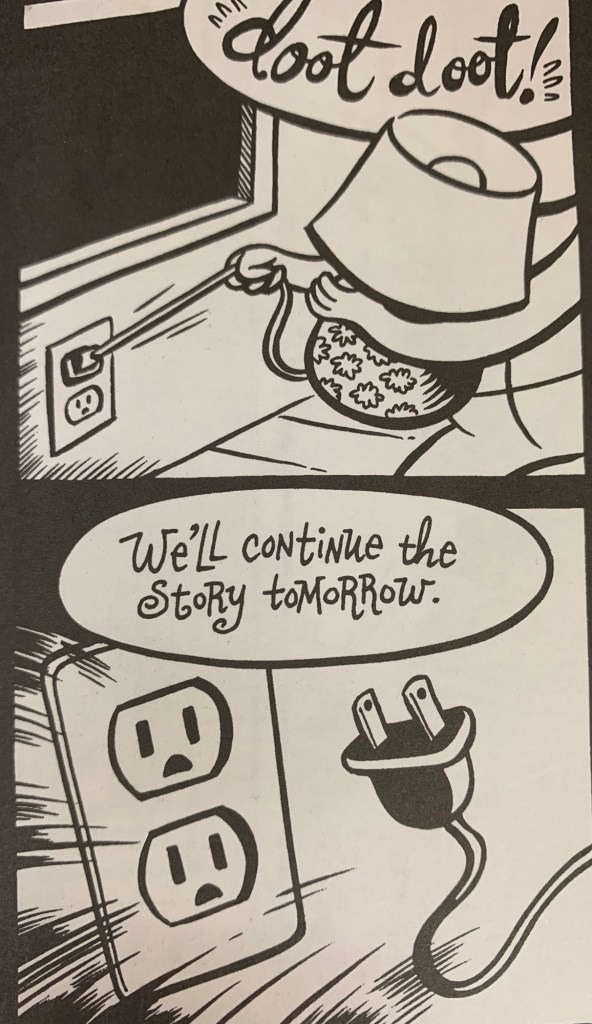
I read Good-bye Chunky Rice by Craig Thompson. An example of closure I found was when a character pulled a lamp off the shelf and the cord popped out of the socket. The comic sequence is action to action but also subject to subject. It is action to action because the first frame shows a character holding the lamp and pulling on the cord that is plugged into the wall. The next scene shows the cord popping out of the socket. This is action to action because it shows the motion of the cord going from being into the wall to being popped out. This is also subject to subject because the first frame shows a medium shot of a character’s arm, the lamp and the plug. The next scene is now a close-up of the plug popping out of the socket. 

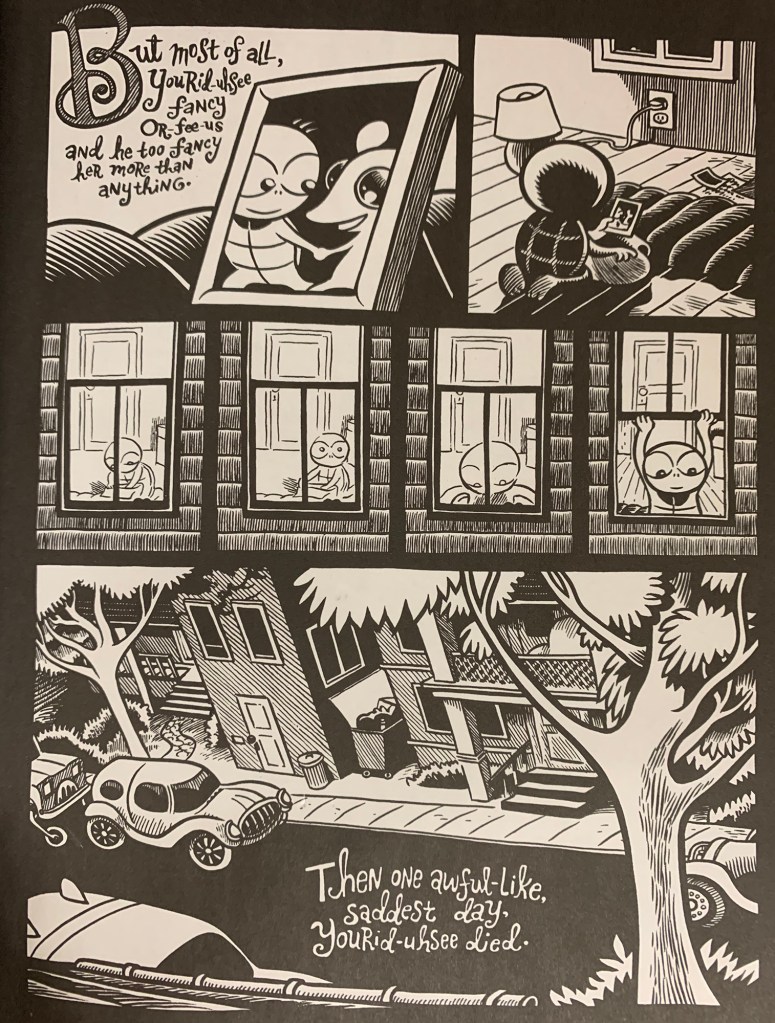
The next example demonstrates the practice of using time frames. The page starts out with a fairly big frame of a close-up, the frame is made big to show the emphasis that the picture showing the two friends is important. The next frame is zoomed out to show that the character is sitting by himself. The sequence of frames that follow convey the feeling that the character has been waiting forever. There is a sequence of four panels all showing the same scene with the character being the only thing that changes. This is done to show that time is passing. The frame also is from outside the window to show that the reader is really far away from the character to give a lonely or sad feeling. The final frame on the page is by far the biggest frame on the page. The frame is so big because it is such an important part of the story. The frame takes up half the page and says that one of the characters has died. The author made the panel so big to put emphasis on the importance and to show that sadness of it.

Posted in 201 Blog, Closure & Time Frames | Leave a comment

Closure and Time Frames: Ethan Miller

Image from Maus by Art Spiegelman

For my book, I choose to read Maus, I like books based on true stories so this seemed like a good fit. For my example of closure, I found a moment to moment style. In this scene, it zooms in closer to the character to emphasize their emotions. It’s very subtle and not a huge change in each panel, but it is enough to make the point that the author wanted to. The way Scott McCloud describes this type of closure is with very little change, which these panels are representing here as well. As the panels zoom in closer with every frame we as the audience can see more and more details, adding to the effect. Sweat pouring down her face, shadows, more detailed eyes. As the detail is increased, so is the impact of the moment.

Maus by Art Spiegelman

I found this example of what I think fits time frames pretty well. The reader has a couple of options on where to move their eyes through this page. Since the photograph on the table is enlarged to show detail, the reader could look at that first and then see that’s a character whose looking at it or they could follow the character and then notice they’re looking at a picture, and then move to the right to see the enlarged version. This isn’t a crazy example where the reader could go any which way, but I think it still fits the definition because there’s still a little bit of interpretation left up to the audience. The tilting of the enlarged photograph help the audience trace it down into the next panel. I think it provides some great direction for the reader so they know which was to go next. The reader has to move downwards and to the left, not only does it provide direction but it also helps the photo stand out greatly, making the reader realize they have to move their eyes to notice this thing first.

Posted in 201 Blog, Closure & Time Frames | Leave a comment

Closure and Time Frames: Bryce Ames

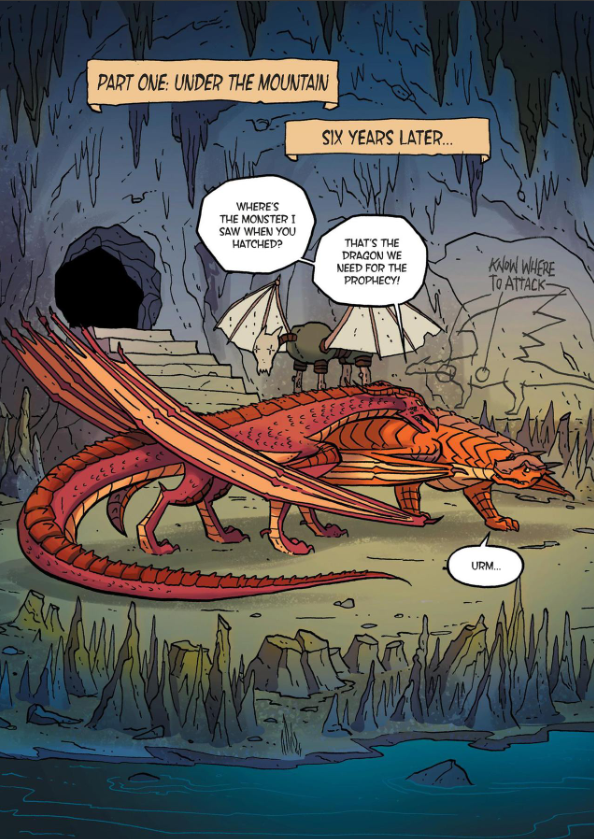
The graphic novel that I am choosing to write about is Wings of fire. Book one, The dragonet prophecy: the graphic novel. The reason that I chose this novel is that I really enjoyed the original novel but after skimming the book for a bit I realized that the graphic novel is slightly different in terms of how the reader perceives the characters and actions.

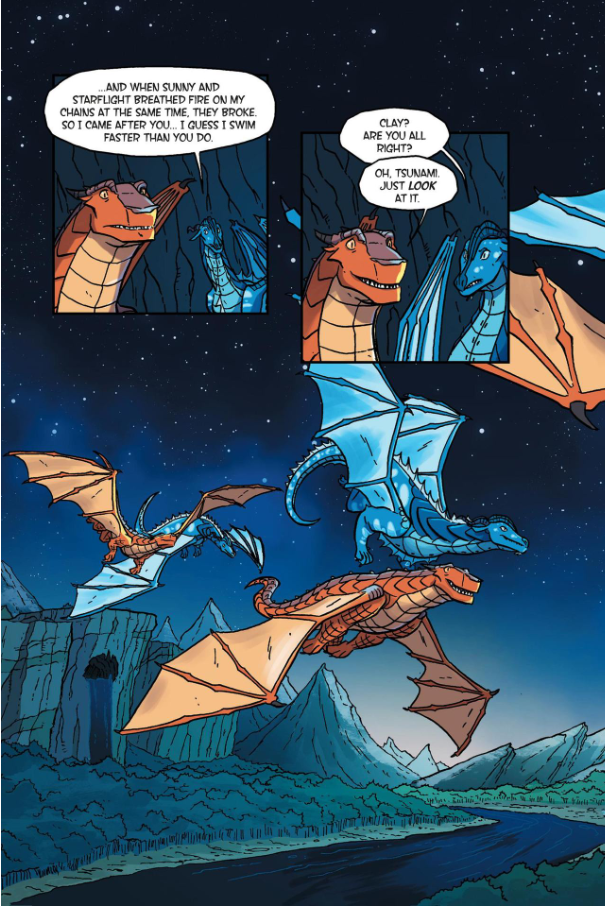
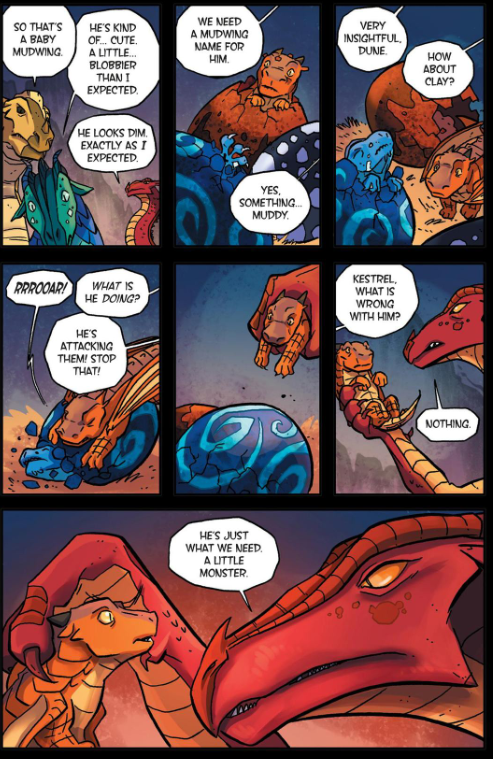
Screenshot from Wings of fire. Book one, The dragonet prophecy: the graphic novel p. 54 by Tui Sutherland

One example of closure in the graphic novel is when the author has the pair of dragons flying across the sky and off the page. This scene is an example of moment-to-moment in the sense that we can see that there are just the two dragons and that they are moving closer to the reader and that time is in the current present.

An example of time frames in this novel so far is when the story jumps into the future and we are seeing the characters when they are older. In McCloud’s book Understanding comics, he explains that there is past present and future in comics and the way that the panel is shown and drawn and placed helps the reader understand this. In this novel, the scene shifts and we can see the same two dragons but one is bigger than the other indicating to the reader that time has passed.

Posted in 201 Blog, Closure & Time Frames | Leave a comment

Closure and Time Frames: Maddy West

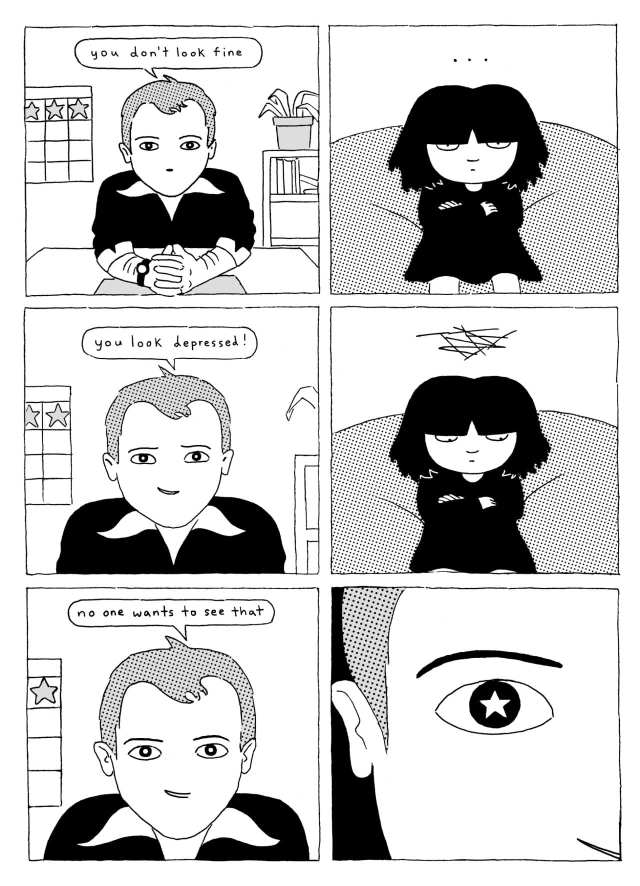
The graphic novel that really interested my was Exits by Daryl Seitchik. There were several things that drew me to this comic, but I really liked that the main focus was a girl who I could relate to. I think that the topic of mental health, and mental health struggles, is interesting especially when explored through visual and linguistic aspects. The reason I want to read this book is because of my own struggles with mental health. Seeing how someone else characterizes it will be interesting for me to explore. I read a little part of this story last semester in another DTC class and I it left me intrigued. Unfortunately, the library does not have a copy of this book, so I ordered it off of Amazon. It hasn’t arrived yet, so the pictures that follow were found online (which is why one of them is too small). Once I receive my copy of the book, I will replace this pictures with photos that I take and resize myself.

This is a JPG of panels from Exits by Daryl Seitchik, which focuses on the story of a depressed girl working out how to live in society. This scene focuses on a conversation between the girl and her boss. The JPG was published by The Comics Journal. (2016, http://www.tcj.com/reviews/exits/)

This first example showcases a subject-to-subject scene. I like this example because it goes between the boss and the main character of the book but in the last panel it breaks the subject-to-subject theme. I think that this exchange is definitely one that many people relate to and that experience makes it easy to understand the back and forth of the comic. Reading this set of panels feels like a quick “shot” in a movie, where each panel is only a few seconds long, and just briefly captures the feelings of each character. All of the panels are the same size, making everything come across the same, giving the reader the sense that the feelings in the panels are flashing across the page. This is enhanced because as this set doesn’t show how one character moves compared to themselves until the last panels. In the last panel, the zoom on the bosses face enhance his feelings. By breaking the back and forth, the last panel adds intensity on the bosses feelings.

This is a JPG of panels from Exits by Daryl Seitchik, which focuses on the story of a depressed girl working out how to live in society. This scene focuses on the passage of time. The JPG was published by Seite, a publishing group trying to sell more copies of the book. (https://d3u67r7pp2lrq5.cloudfront.net/product_photos/46934281/640_original.jpg)

This set of panels does an interesting job of showcasing the passage of time in a way that I feel like could be confusing to the reader. I know that I struggled to understand this without fully being able to see what came before and after it. Despite this, I think the passage of time is shown because every panel showcases a different moment. As Scott McCloud explains in Understanding Comics, the passage of time isn’t always a linear progression which we expect. By focusing on a location with the people and activities happening on it changing, Seitchik conveys a sense of movement through time. This change is ambiguous and is not clearly defined for the reader, meaning that they have to take a little bit of extra time to understand more deeply the development of time that is showcased in this set of panels. The reason I chose this moment is because of this ambiguity.

Posted in 201 Blog, Closure & Time Frames | Leave a comment

Closure and Timeframes: Malvin Malai-Harrison

For my graphic novel I chose the first volume of Sin City by Frank Miller. I chose this graphic novel because it’s a book that I borrowed from my dad a long time ago but never got around to reading it so I figured now would be as good of a time as any.

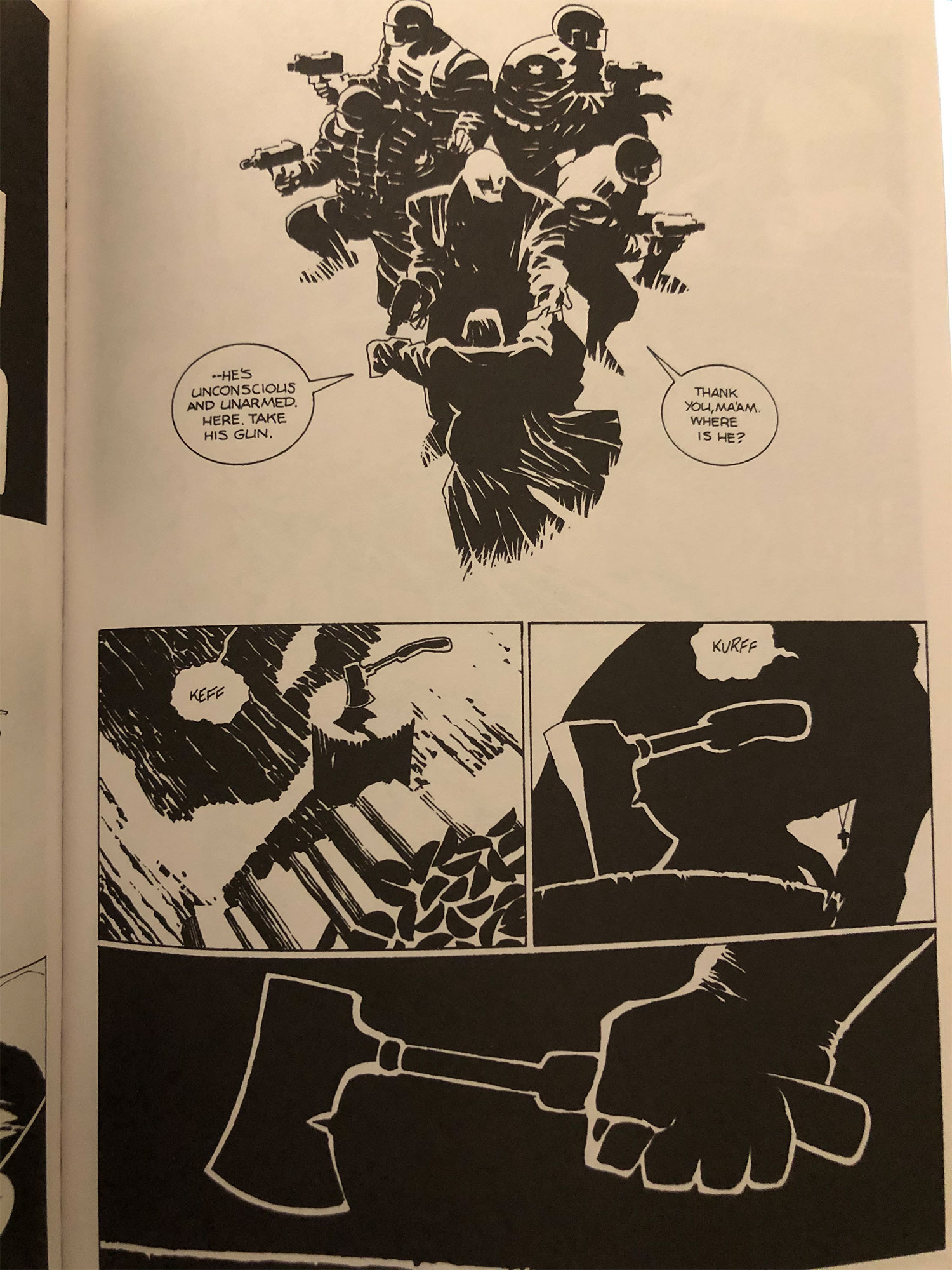
Frank Miller’s Sin City pg. 117.

My first example of closure from the book doesn’t necessarily indicate one category or another, but rather a blending of different categories. One category that it could be classified as is aspect-to-aspect.

I think that the bottom 3 panels could be considered aspect-to-aspect because it shows different perspectives of the same scene adding to the overall atmosphere.

The 3 photos showcase different viewpoints of the same subject while incorporating action as well. This is why I think that this example doesn’t necessarily fall into one of the other but rather a combination of both.

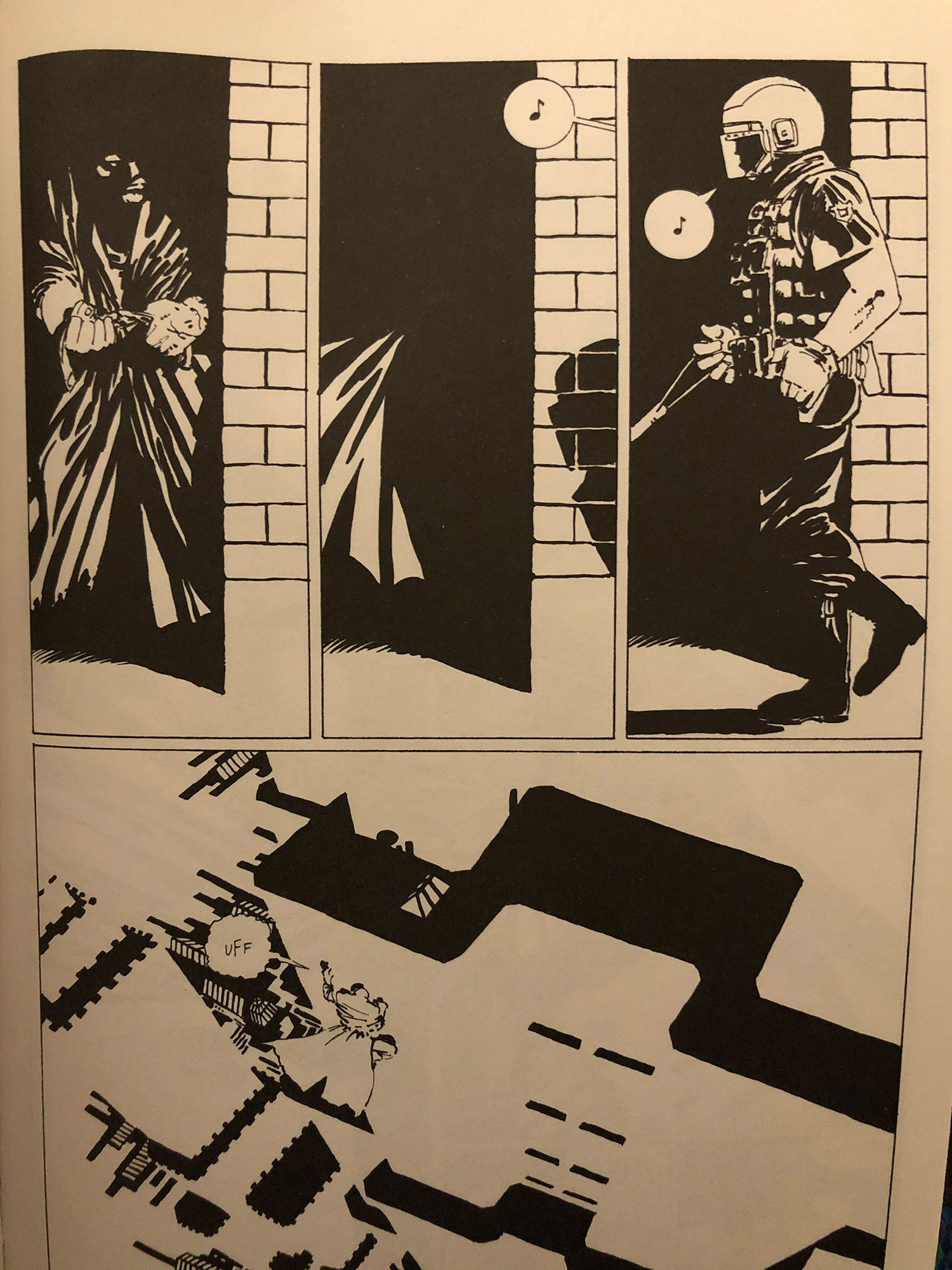
Frank Miller’s Sin City pg. 33.

For my next example, I was skimming through the book and found one that I thought illustrates the concept of Time Frames pretty well.

In this scene, the protagonist ducks behind a wall just moments before the security guard would’ve noticed him. The placement of the panels and their proximity to one another helps create this idea that these moments were happening very quickly to one another. Movies are able to showcase close-call moments pretty easily and it is very interesting to see how the artist went about designing this space.

This scene in particular was very brief because the main character was actually in the middle of running away from something and running to a different destination and he was doing it rather quickly. There are more pages that help depict this quick time change but I think this one was a great example for illustrating that.

Posted in 201 Blog, Closure & Time Frames | Leave a comment