History of Collage & Photomontage: Zachary Larson

Rosalyn Drexler was a Pop Art connoisseur of the early sixties. She took content from journals and other print forms as the foundation for her art. Drexler utilizes bright pigments in her work to transform bland images into pieces of art with a whole different context. After cutting out images from magazines, she strategically placed them onto the canvas painting over them to leave a seamless new portrait.

Drexler was limited to her resources compared to the abilities we have today. Because there really wasn’t a digital world at the time, all of her work was done by hand. This meant she had to be precise on the way she cut and placed images because there was no undo button or I think I’ll change this later. She must have been creative in her methods. The project would have to be planned out from start to finish beginning with an outline of what she wanted her piece to represent. This would make an artist much more cautious about what they laid on their canvasThe creative choices Drexler made are imperative to the message she is relaying through her art. Her whole point is to take the bland, the corrupt and the ordinary and make it into something beautiful with a completely different context. By choosing to craft with cut outs from magazines and journals Drexler is implementing a piece of society into her art. Through this connection she can take what society has to say about a topic and turn it on its head. Drexler’s specific use of tools and materials leaves me to interpret her work as passionate, eye-opening pieces of history. She was an artist who illustrated the world in a unique light and left the people thinking about the social issues they were caught up in.

https://mymodernmet.com/collage-art-collage/2/

Rosalyn Drexler, ‘The Dream’ (1963)


Posted in Uncategorized | Leave a comment

Texture: Sanna Wright

Plant life. Photo by Sanna Wright, September 2018.

I took this first photo on the WSU campus. The white leaves caught my attention as I was walking home from class. In the photo, there are many contrasting textures. First, there is the grainy cut leaves with frayed damaged edges, contrasting with the rough plant stems and the smooth red berries. Next the pokey physical texture of the sticks in the dirt.The dried corse leaf contrasts with silky spider webs and smooth concrete pavement. There is a soft uniform appearance to the plants. The colors contrast, the red from the berries sits directly across the color wheel from the sharp green of the leaves. The white scratches on the largest leaves draws attention to the rough dry texture.


The corner of a painting has a rough frayed texture. Photo by Sanna Wright, September 2018

In this photo of a screen painting in my house, you can see the frayed damaged edges, as well as the fibers of the cloth the canvas is made out of. This physical texture contrasts with the surface behind it, which is a smooth wall. The stapple’s smooth reflective texture contrasts with the bumpy grainy texture of the screen painting.


Posted in Fall 2018 Archive (336) | Leave a comment

History of Collage & Photomontage: Angela Basinger

Eugenia Loli worked as a computer programmer and technical journalist before she left the field to pursue art. Her collages combine cutouts from science fiction books and vintage magazines. The artist leaves her collages to the viewer’s interpretation but attempts to depict narrative scenes, encouraging views to create a plot. In this particular image, the artist makes specific stylistic choices that create a unique composition.

One of Eugenia Loli’s surreal collages taken from an April 2015 article by Sara Barnes for My Modern Met https://mymodernmet.com/eugenia-loli-collages

Visual texture is created with the moon in the background and, in turn, this texture is contrasted with the smooth, soft looking texture of the woman’s skin. Direction is created in the photo as line is used within black and white columns to create direction. The cone opening toward the top right center of the collage balances with the woman in the bottom left corner and the flowers in the bottom right corner. These three points of interest reinforce the vertical direction of the image. Further, harmony is made as the woman’s bathing suit, the flowers, and the sky as all contain a coordinating color scheme. Harmony is made once more with the green plants, the green landscape, and the green galaxy pattern in the stars. Value is created as these is light to dark contrast in both the top and bottom of the frame. Dominance given to sculpture in the middle as it is pasted on top of background, but this dominance is partially taken away with the dark shadow effect on the sculpture and the woman on a rock in the foreground. In this, the woman in the foreground establishes dominance as the subject of the photo. Things with life in the photo, woman, plants, and birds, have bright pink and yellow coloring. I believe that the author is working with ideas of life in her image as nearly all the aspects of the photo signify movement and growth. Because the author leaves her work somewhat open ended, I chose to take this image as alluding to the idea that life is all around us: though some life is plain to see, as the woman, flowers, and birds other forms are curious and unknown as that of space and seemingly concrete landscapes.

Posted in Fall 2018 Archive (201) | Leave a comment

Texture: Alex Allen

For this blog post on texture, I wanted to get some feedback on which image I should pick for project one. Below I have narrowed my images to my top 3.

Alex Allen’s Photograph of “Tree Bark” in Pullman Washington on the 5th of September, 2018.

When thinking about what picture I wanted to take to resemble texture, I immediately thought of  tree bark and how the fracturing of the bark splitting in every direction really makes the tree appear more live like. After reading through the chapters assigned in more depth, I started to realize that texture is used all around us. From the concrete walls you see around campus to the paint clots left on a canvas by artists to make the art work come to life. To give you a brief definition of what texture is, I think Rick Valicenti (one of the authors of the book Graphic Design The New Basics) says it best “Texture adds detail to an image, providing an overall surface quality as well as rewarding the eye when viewed up close”. This broad definition of the word texture also can be categorized in multiple different forms which include: landscapes, Code generated text, etc.

Lion Eye

Lion’s Eye I found this image on the Internet at this URL – https://www.behance.net/gallery/69990073/Material-Study-Cat-Eye

The reason I choose to pick this image as one of my texture photo’s for consideration was because on first glance, what stood out to me was the smooth and pattern like texture of the individual hairs. After looking at this detail I then noticed that this eye had little gold veins that moved throughout the eye. Comparing this image to texture I knew was going to be hard, but for that sake of wanting to design something different and unique I decided I would still incorporate this image.

Human Race - Shoes

Human Race Shoe I found this shoe on the internet at this URL- https://www.tbdress.com/Cheap-Mens-Shoes-105825/Best-Selling/

For my last texture image I choose to go with a Human Race designer shoe. This shoe uses texture in the design of the stitching, material and overall look of the shoe. After reading the “Textured Logotypes” section in our readings and I think it is directly backed by the passage said in this section “The texture makes the logo light and engaging when it is used at a large scale”. I interpreted this by the Race lettering on the top of the shoe because the yellow surrounding it makes the lettering pop and give a clear visual of what is being presented to the audience.


Posted in Fall 2018 Archive (336), Spring 2018 Archive (336) | Leave a comment

History of Collage & Photomontage: Tori Bredy

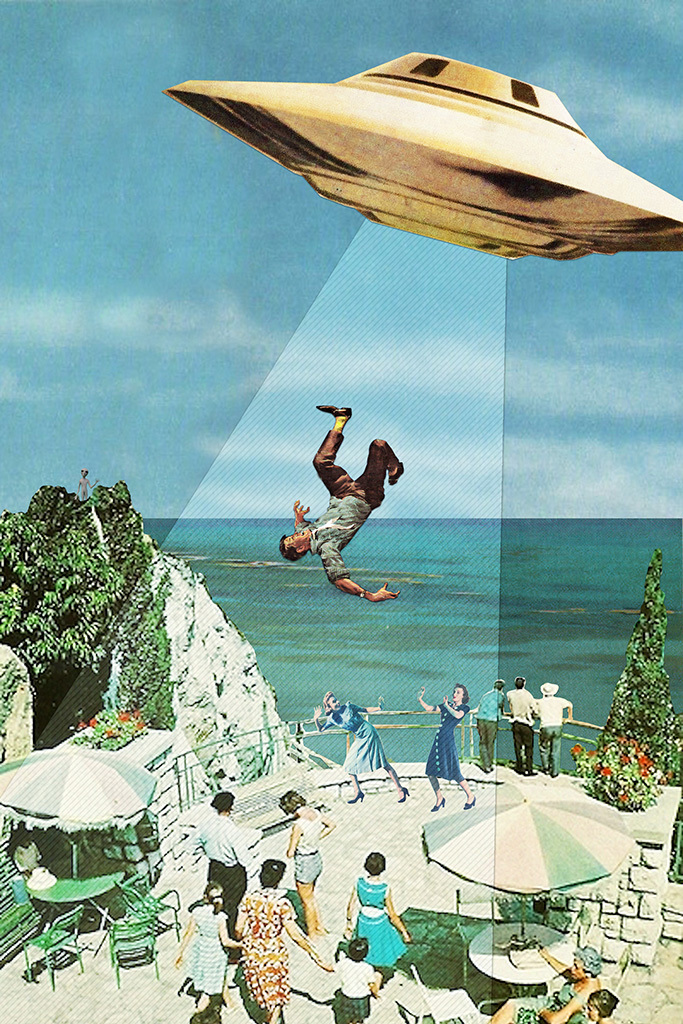
For this blog post, I chose to research the work and style of Eugenia Loli. During my search for this assignment, I found myself quite interested in all the different styles of collages done by the artists. They all have a similar theme, using forties and fifties through the present, yet each express different talents and methods by the artist. Loli is considered a contemporary artist and uses digital media and tools to craft up her pieces. Being a contemporary artist, Loli is able to continue to bring the collage to her work, just with different tools. Throughout Loli’s work, she incorporates iconic art from the fifties while using digital editing programs to create that contemporary twist to her artwork.

Time has definitely changed from when collages were being created as far

This collage demonstrates Loli’s use of science fiction along with merging it with art from the fifties. Since digital editing programs were used to create this, it would be considered a “contemporary approach” (“Stars for Breakfast” by Eugenia Loli, https://cargocollective.com/eugenialoli/)

back as Picasso. Now, in the twenty-first century, we have the accessibility to computers, tablets, Internet where artists are able to use software to create digital artwork. Loli uses contemporary advancements to create her art. With technology and digital editing programs, this accessibility has influenced their creative choices because the artists have a way to make it just right. The digital editing programs allow the artists to ‘undo’ work that they might feel just isn’t placed right. This is much different compared to the artists that created their collages by hand because work was stuck where it was placed, even if the artist wanted to change where it was placed.

This artwork demonstrates Loli’s use of modern vintage art with her twist of science fiction (“UFO Abduction” by Eugenia Loli, https://cargocollective.com/eugenialoli/)


Loli’s choice of tools and materials affect the way I interpret the composition. While observing her work, it is unique and interesting to see how Loli uses well-known celebrities of the forties and fifties or uses women and children that reflect the 50s decade and see them edited in a collage with a space themed backdrop. Loli’s artwork has a sci-fi theme along with it which makes it much more interesting to enjoy.

In “Stars for Breakfast,” there is distinct contrast between time periods. The setting of the artwork takes place in a classic fifties kitchen however the inside of the fridge is in outer space. There is contrast with colors, kitchen and family are subtle colors but outer space is a mixture of black, deep purple and tan.

In “UFO Abduction,” I see two strict vertical lines which represent the UFO grabbing the man and a contrasting horizontal line which is where the sky meets the sea. The colors used in this artwork are in harmony with the overall piece.

Posted in Fall 2018 Archive (201) | Leave a comment

History of Collage & Photomontage: Ryan Ferrell

In my class’s assigned readings this past week, my eye was caught by the Jiyen Lee contemporary collage. Jiyen has a history of creating collages of stairs stacked on top of each other with, what seems to be, pedestrians walking on the stairs. Since the point of view is from an aerial/bird’s-eye-view, your brain will want to think it’s just another trippy image of shapes and lines trying to confuse your mind. The stairs move in all directions are in

XgCm67cwj9NObwJLLk51_1082117640

This image shows a mass amount of people walking up and down stairs, although you aren’t able to depict which it is. (Image by: Jiyen Lee)

varying sizes, yet have no perception as to if the people on the stairs are going up or down, or where the stairs end and begin.

After extended research, I wasn’t able to find a website that gives much information about her and her art piece. I wasn’t able to find anything about her influences and inspirations, nor was I able to find the name of the picture (to the right and above this line) and its date of completion of creation. Although, I have a decent idea of what she may have done to create her art. I believe that she took images herself, copied the images and multiplied certain parts many times, warp them, and alter the direction using computer technology.

The way she uses her choice of stairs, the depth perception that causes your eyes to draw into the middle, and the mass amount of people makes me perceive it as society isn’t building out anymore, but rather up instead, as the world population grows. The usage of the many people causes me to perceive this image to be about our quickly-increasing population. You can clearly tell that the walking paths are stair cases that travel high and deep based on the central depth perception using shading. I believe this image perceives that our modern society is very busy and constantly going somewhere, but that they have to climb endless stairs up and down to get to just about anywhere, whether it be work, friend’s or family’s apartments (especially apartments), restaurants, and stores. This is due to our society starting to build society up as we are running out of usable land.

Posted in Uncategorized | Leave a comment

History of Collage and Photomontage: Jessica Harja

Out of the readings that we had this week, the artwork Le Cirque by artist Laurent Chehere caught my attention. This piece of artwork is a portrait-oriented collage that features a circus tent floating in the middle of the image frame with silvery-gray clouds in the background. A lone figure in a dark suit resides on the top left of the circus tent with balls and bowling pins falling from the bottom center.

2018_ChehereLaurent

This photo collage depicts a seemless collage of different styles inspired by artists like Bruce Davidson, Wim Wender, and Federico Fellini. (Artwork by: Laurent Chehere, Le Cirque, 2012).

From doing research on the artist’s website, it looks like he does a combination of digital and older-processed collages. Chehere doesn’t really go much more in depth on the actual process of his artwork but if I had to guess, making the collage is the analog part of his work and the digital part of the process comes in when he makes an artwork larger in print. As a current artist, I feel that Chehere might be influenced in knowing about the older ways of doing collage and is, like he mentions, inspired by older parts of Paris. Thereby creating larger prints from which his viewers can see the smaller intricate details that can be seen in this piece and other pieces included in his Flying Houses series.

When I looked at the artist’s inspiration for this specific piece, it made more sense as to why he chose to do things the way he did. I looked at the artists that Chehere said inspired this artwork; Bruce Davidson, Wim Wender’s Angels of Desire, and Federico Fellini’s La Strada. After studying the different technical aspects of each style of work, it was pretty recognizable in Chehere’s Le Cirque. Davidson’s dramatic lighting and mood that can be felt through the atmosphere in his photos is noticeable in the emotional feel that is exuded from Chehere’s work. Then, Chehere uses inspiration from Wender’s film by bringing a storylike quality to the way that the tent floats around in the clouds. Finally, as Chehere mentions when talking about this artwork, that Fellini’s movie theme inspired the idea of the tent itself but he twists the idea a little bit with the characters within the artwork but doesn’t give off the entire storyline. Merely a glimpse into it.

Posted in Fall 2018 Archive (201) | Leave a comment

History of Collage & Photomontage: Jaclyn Erickson

The artist I chose for this assignment was Jiyen Lee a Korean artist who specializes in  hypnotizing digital collage. The images she creates are extremely intriguing to look at, and for the most part what seems to be from a bird’s eye view. The series of images appears to be men, women, children, strollers, suitcases, and pets going up and down escalators or walkways. She arranged them in all sorts of different directions to really make your head spin around and take a good look.

There are all sorts of different sizes as you can see from the images attached below. Each image has a different sort of texture to it and this is because of how she came to arrange the walkways and escalators of people and some of these images have a sort of 3D affect to them because of the depths and angles she used when assembling each image. Within majority work it is still unknown which direction these people walking or which way the escalators are moving. Jiyen also uses line symmetry to keep people interested and their eyes moving along the image.

Through these images Jiyen has created she shows the busy world we live in and how people are always going from one place to the next. Although all her images revolving around the same concept, it opened my eyes and allowed me to see that a photo collage or a photomontage doesn’t need to be a 1000 different images all combined into one.

Here you can see men and women going up and down escalators that have been stretched and turned creating a very unique design. Image by: Jiyen Lee

Here you see walk ways rather then escalators that are filled with people walking to their next destination. Image by: Jiyen Lee

In this image there is no distinction on which direction the people are moving or whether or not the stairs are descending or ascending. Image by: Jiyen Lee

Posted in Fall 2018 Archive (201) | Leave a comment

History of Collage & Photomontage: Josue Cuevas

I’ve decided to go with this collage by John Turck as my example. The artist John Turck is know to create collages by hand and blend elements from nature, pop culture and architecture. Mr. Turck’s main goal is to design pieces that look if they were digitally created in photoshop.

A beautiful collage and my personal favorite one by John Turck

I believe that John Turck was influenced by many different types of technologies a big one being photoshop like mentioned before. I think this is a big influence because his style is trying to imitate the works of photoshop, but only he does it by hand. Another influence of John may be old school hand crafts or paintings because his process is a more traditional, all handmade style. So that makes me suppose that his creative process is influenced by traditional or old school type of art style.

Since John’s process is handmade it makes me appreciate his works that much more. He really does a great job in the Direction of his art like how his works flow in a vertical manner combining two different sites, and combining them in a way thats makes the work seem balanced. Like if the two worlds both belong together even though they are completely different. Also the way Turck uses Colour to catch the eye is another thing that makes me interpret the work differently than if he used basic Colours a basic or beginner artist would use. Another thing I noticed about his works of art are that they have huge sense of Balance. When looking at his work both parts look like they are about equal in space making the art look balanced. For the example shown above the space upper half isn’t taking anymore room than the lower lake house part in the whole overall work. So those are some things John Turck does in his creative process that make his works very pleasant to look at and admire.

Sources used: https://mymodernmet.com/john-turck-collage-art


Posted in Uncategorized | Leave a comment

History of Collage & Photomontage: Joni Cobarrubias

collage

This photo depicts different types of design elements such as repetition, shape and contrast. All of these elements work together to create this illusional collage. “A wisp of a smile,” by Matthieu Bourel, 2014. http://dojo.electrickettle.fr/collages/duplicity-serie/


The artist that I chose is Matthieu Bourel, a surreal collage artist. This piece stood out to me because of its simple, yet complex nature. The artist does several collage styles, which he separates into various series. Each series has a central theme that explores different layering style collages. He creates these collages with the juxtaposition of real photographs and digital art. His method, in his words, is a lot of playing around with old magazines and images. His own unique style of real collage layers and digital art make him standout among other collage artists.

His other pieces are clearly inspired by pop-culture, such as using Dorothy from Wizard of Oz as his subject. Bourel was quoted saying he takes in the commercialism, television, and digital era we currently have, and channels it into his own interpretation: “data-ism” (Leavitt, via Georgie publication).

6_6_mittelalter

This example showcases a different style collage that Bourel creates. “Migrant,” photo by Matthieu Bourel, 2010. http://dojo.electrickettle.fr/projects/collage-serie-ii/

According to Bourel, he loves getting the viewer to interact with his art in their own provocative thoughts and connections. Many of his works have been analyzed for their underlying messages on society, emotion, time, space, and more (The Re Art). This can be clearly seen in the image to the right. This collage consists of magazine cut outs as well as newspaper cutouts. The man’s face is covered in the words in a mask-like state. This could convey many different narratives, possibly relating to racism or being held captive. Whatever the case, Bourel clearly compiles these images to showcase an idea.

His choice materials is key to interpreting the messages he is conveying. With Bourel’s handmade paper collages, he really develops and creates a storyline with every image he cuts. This technique personally affects the way I interpret his art because of the particular placement of each piece. These layers are not just images piled into Photoshop, they are real, cut out newspaper or magazine images, and this adds authenticity.


Other sources used:

http://dojo.electrickettle.fr/about/

Matthieu Bourel: Collage and the power of images

Posted in Fall 2018 Archive (201) | Leave a comment