Past, Present, and Future Technology: Interview Ideas Juan Guzman

Play Samsung Tablet Ipad Google Internet Music

Image taken from Max Pixel  (Photographer not named) CC0 License Public Domain https://www.maxpixel.net/photo-605439

1.) In Chapter 6 Robot Construction from the book ‘Soonish’ I read about The topic of Robot Construction and its improvements from the influence of technological advancements. The direct connection to the StoryCorps project is significant in that they both are inferring past and present events that can affect the future. In this chapter, the author explains the effects that past architecture concepts that have impacted the world. Specifically targeting one HUGE factor that can limit the outcome of a structure: Time. In the past we have seen various attempts at condensing the time it took to build a structure. Thomas Edison’s concept of configurable molds was overlooked in 1917, then came Ernst Neufert concept to put the whole process on train tracks in 1943 came to no avail and numerous after that I assume. Although those ideas at the time didn’t catch on, many  years later sparked a conversation that lead to a new era of computerization and architecture. In the process is much more difficult as you look more deeper into the issue because of how many factors, just as a detailed story can be. We really don’t know what experiences that comes from within someone until they are revealed just like new concepts for robotics aren’t just randomly perfected.

2.)  At this time I don’t know exactly who I plan to interview, but I have a technology in mind. Throughout history, we seen so much advancement in music and in what ways they are projected. An idea for my technology, is the creation of music applications on mobile devices. The idea that now hundreds of songs and media can be stored on one single device in the 21st century was a huge step in media tech and seemingly improving its convenience. It would be interesting to know, the thoughts and experiences from someone who isn’t well aware of music applications but could have interesting memories on how music was played/stored or certain instances of music projection within innovations in their own generation. The concept of music and media technologies in general can vary and the correlation in the evolution of it can be possibly be closely linked in some ways through different generations.
Posted in Fall 2018 Archive (201), Uncategorized | Leave a comment

Comics: Ryan Ferrell

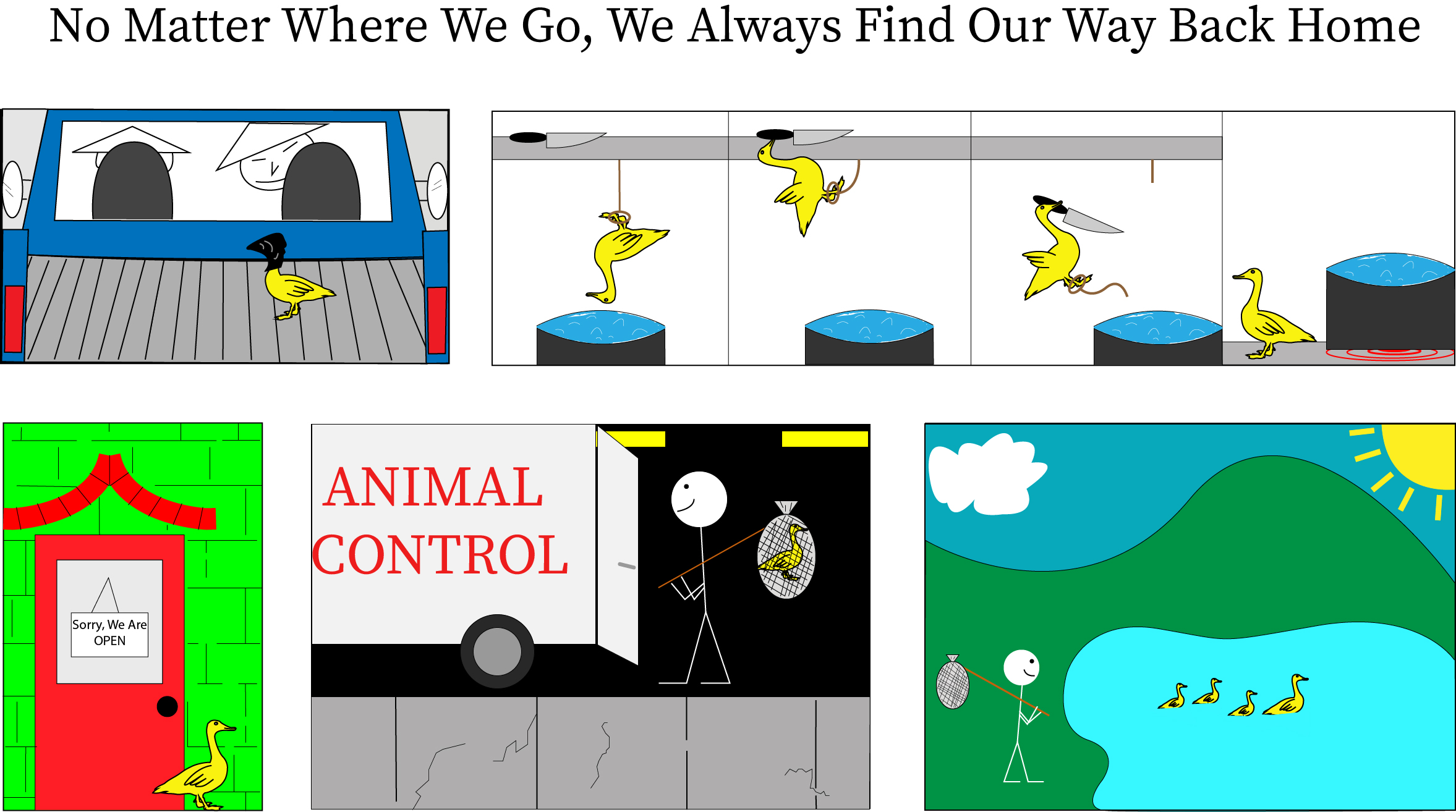
“No Matter Where We Go, We Always Find Our Way Back Home” Comic by: Ryan Ferrell. Title Credit/Inspiration: “Back Home” by: Andy Grammer

Scott McCloud defines comics as “juxtaposed pictorial and other images in deliberate sequence” in his book, Understanding Comics: The Invisible Art. The comic I created, No Matter Where We Go, We Always Find Our Way Back Home, fits the definition perfectly. The comic is made of pictorial images (frames) that are separated from each other to indicate the change of the scene and setting to show contrast between each other. In the second frame, lines are used to separate the sub-frames to indicate that the scene setting is the same, and to show more detail of the duck’s escape to help the reader be able to understand he’s escaping by seeing the step-by-step process he used to swing himself, grab the knife, and cut himself down to avoid falling into the boiling pot of water. The “other” images that were used are textual character images used in the third and fourth frames to help the reader understand the setting of the scene and what is happening exactly. Without these words, we wouldn’t know the kind of building the duck is standing outside of, nor the purpose of the truck. I intentionally created the comic to be read from left-to-right and top-to-bottom, and it is obvious that the comic should be read as so.

Some of the concepts from McCloud’s book that the comic follows are using color to paint the picture and help interpretation of each scene, different sizes of frames in which I fit the frame to the scene, not the scene to the frame to make it easier to define the setting, and keeping it simple and not over complicating it with too many lines or unnecessary background detail.

I believe the ideal reading environment for my comic to be read digitally on a screen, being read from left-to-right and top-to-bottom. I would like the comic to fit whole on a screen with no need to scroll, being read from left-to-right and top-to-bottom. It then gives the reader the option to zoom in to see more specific detail to understand each frame better, such as the lines on the bag indicating that the duck is captured in a safe netted trap that doesn’t harm the duck.

I understand that the comic could be seen as insensitive, offensive, and stereotypically racist due to the use of Asian hunters capturing a duck and trying to cook it at their Chinese restaurant, especially with the squinted eyes and the rice hats. Although, I don’t intend for it to be taken that way. I used the eyes and the rice hats because those are common ways for people to identify the hunters as Asian, making it easier to understand the context. Duck is one of the more eaten meats in the Chinese culture. I used the bag over the duck’s head to make it less gory and safe for most ages to read without discretion. Also, I have a Chinese friend whom owns his own restaurant, and that’s what I designed the exterior of the restaurant in frame 3 after. I understand that I could’ve used normal stick figures with dots-for-eyes, but I wanted to add more detail and culture into the comic, especially since I help my friend hunt duck for his restaurant (and personal use). It relates more to personal experiences, and not to mock the Asian/Chinese population. I want the readers to read in with a basic understanding and without thinking in an abstract way which could understandably result in someone seeing it as offensive. The point of the comic is that even though the duck is taken away from his family, he goes through a rough adventure, and eventually makes his way back to his family and his home. The duck is accepted back into the family even after coming into human contact, which indicates the love his family has for him. He goes through the adventure and the struggles to show that with true desire and resilience, one can make it home back to their family and cherished ones.

Posted in Fall 2018 Archive (201) | Leave a comment

Comics: Chandhni Jayakanth


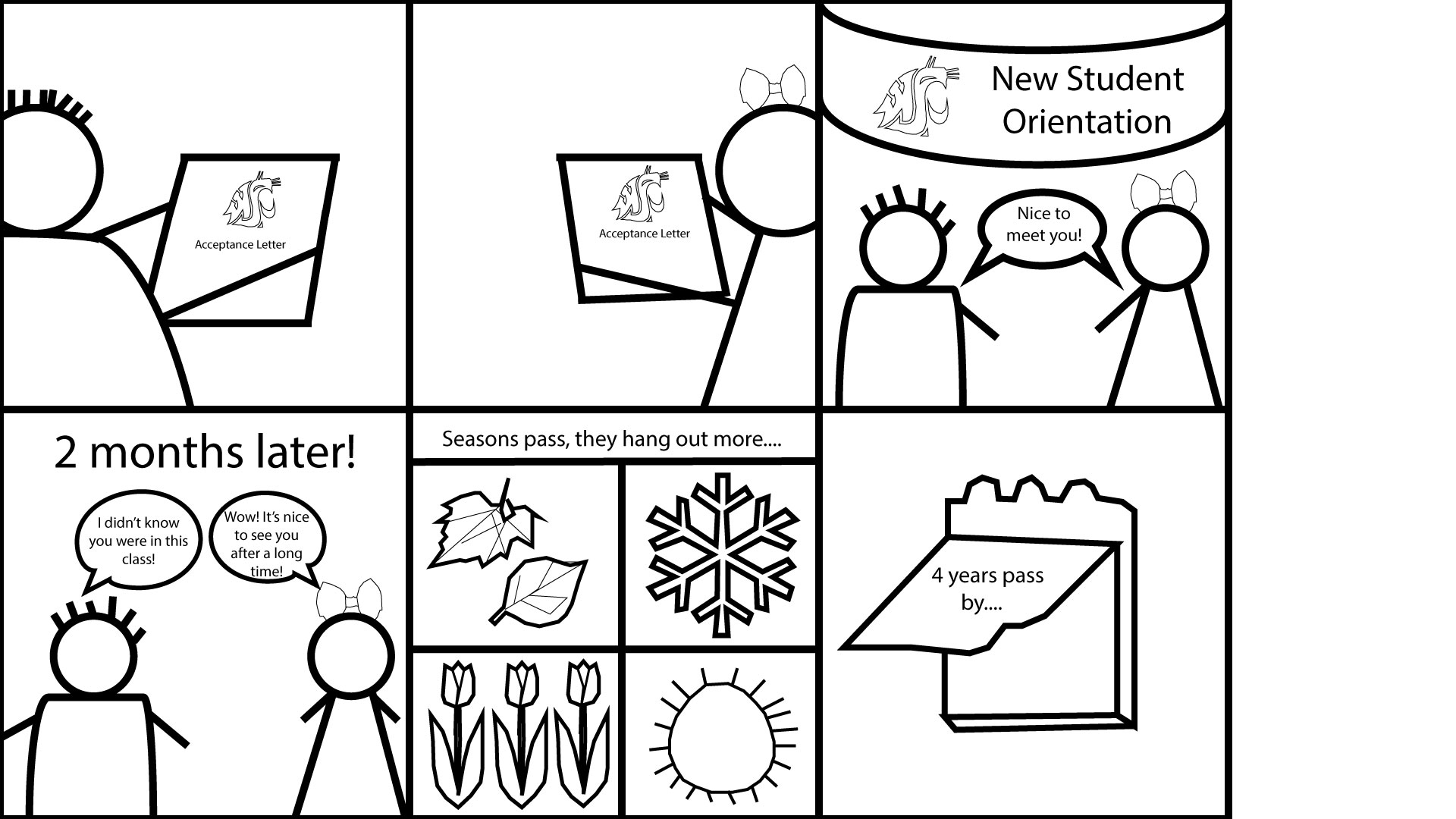
This is a comic created using Adobe Illustrator for DTC 201: Tools and Methods of Digital Technology.

This is a comic created using Adobe Illustrator for DTC 201: Tools and Methods of Digital Technology.

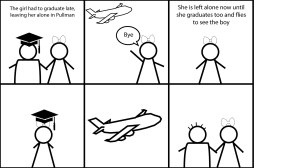
With comparison to the book ‘Understanding Comics’ by Scott McCloud, my comic is definitely a high juxtaposition of pictures and other images in a deliberate sequence. My sequence is that of a usual comic, from top to bottom, left to right. But for this assignment, I really wanted to play with a lot of things Scott McCloud mentioned such as the gestalt theory and the power of lines and the emotions it could convey. My comic is black and white for that very reason because I wanted to see how well it still conveys emotions, without the use of color. As far as gestalt theory is concerned, I did not add eyes or mouth or other significant details into my characters.This shows how just the human figure can convey meaning. Also for other detailed differences, I added the bow to the top of the head, making the girl character stand out from the boy character. Another major thing that I wanted to incorporate into my comics were the aspect of time and how it could be portrayed without words. I used images of leaves for fall, snowflake for winter, flowers for spring, and the sun for summer. This shows that the seasons have changed and time has flown by.

This is a comic created using Adobe Illustrator for DTC 201: Tools and Methods of Digital Technology.

This is a comic created using Adobe Illustrator for DTC 201: Tools and Methods of Digital Technology.

The ideal reading environment for this comic could be both print or digital because of how this is more of a single page comic rather than multiple page comics. My inspiration for this single page comic was definitely the Peanut comics that would appear on newspapers. I wanted to create something similar that people

could view over phone, tablet, iPad, laptop, or any other medium that they wish to without having to change the whole layout. One thing I feel like I could’ve improved with is maybe adding more slides to show the activities they did while their time at WSU. To show the concept of time, I had to not include those but maybe including those details could have given the comic a different twist.

Posted in Fall 2018 Archive (201) | Leave a comment

Blog #5 – Comics

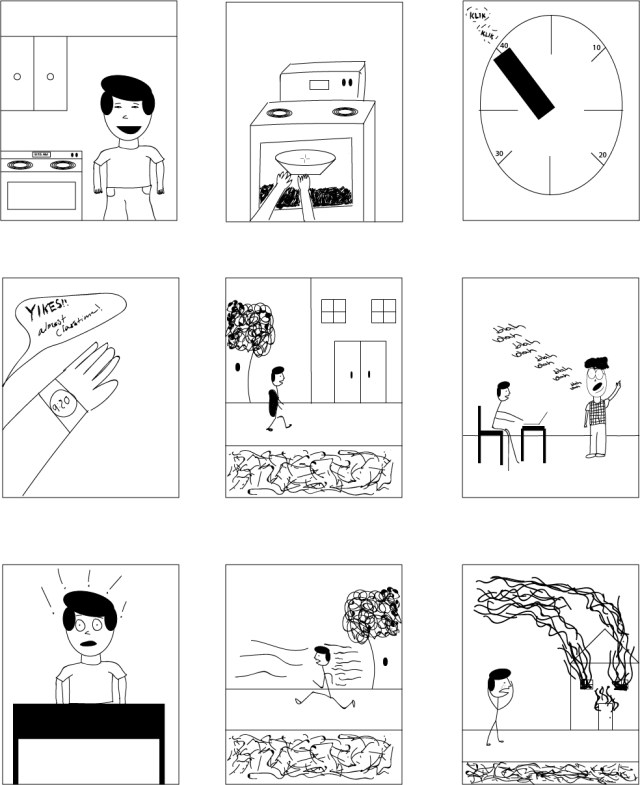
From what I understood by reading Understanding Comics by Scott McCloud, a comic refers to the medium itself. In that, comics could be about any subject as long as there is a sequence. After I read that, I started to get ideas about what I was going to do. Firstly, I brainstormed a few scenarios that I could expand on, but that also didn’t require too much background knowledge. At the time, my roommates and I were actually making a pie for a potluck dinner. I thought about how I could make this situation into the worst case scenario, and I came up with a student leaving a pie in the oven which would, in turn, cause the character’s house to be burning down when he returned. Another key concept I wanted to adopt from McCloud was the use of the “gutter.” I wanted there to be some room for imagination that would be left up to the reader. After all, comics rely on how they are created but more so, how it will be read. In that sense, I tried to keep the panels down to only the essentials that were required to create meaning and I think I did a pretty good job doing so. Another thing I tried to do was to use as little text as possible as well as abstracting the character to be someone that readers could relate to or imagine in real life, which are both concepts that McCloud talked about in his book. McCloud said that “the more cartoony a face is, the more people it could be said to describe, with the example of the rendition of his own self in the book. With that, the teacher scene was meant to have a slightly more described character than the main character. My intention for the teacher was mainly to add to the comedic factor. After all, who wants to look at a boring comic?

Bliesner-Brandon-project-02

“Sad Day” by Brandon Bliesner (November 2018)

I feel that my comic could be viewed in both print and digital media. However, I think that I would prefer it to be read online. I could see my comic being centrally placed on a website so that the reader could see the entire scenario on one central page. I believe that being on one page would simply make it easier to understand. Plus, being that it was done with Illustrator, it could be blown up or sized down with no loss of quality or understanding. My hopes are that the viewers will read my comic from left to right, top to bottom, as this is how I was taught to read, and almost anything we read nowadays is in this format. Basically, I didn’t want to confuse the readers by having a complex way that the comic was read. McCloud talks about many different formats of comics but I felt this was the easiest to read without the need of directions.

Posted in Fall 2018 Archive (201) | Leave a comment

Comics: Shawn Stephens

The biggest concept from Understanding Comics that inspired my comic was closure. Closure was the most interesting concept from the book to me, since it’s such a complex topic. Closure is present in every form of media we consume, and good media producers know exactly how to manipulate it and use it to grab the viewer’s attention.

If the consumers of media knew everything about the media to begin with, there would be no suspense, no conflict, no interest, and above everything else no personal interpretation. The consumer’s expectation, and subversion of expectation is such an important part of keeping the consumer’s interest piqued. Closure is a storytelling tool that is a constant push and pull of how much the consumer expects, how much they know, and how much they want to know. Giving the consumer too much or too little is really easy to do, and finding the perfect balance can make the difference between good media and bad media.

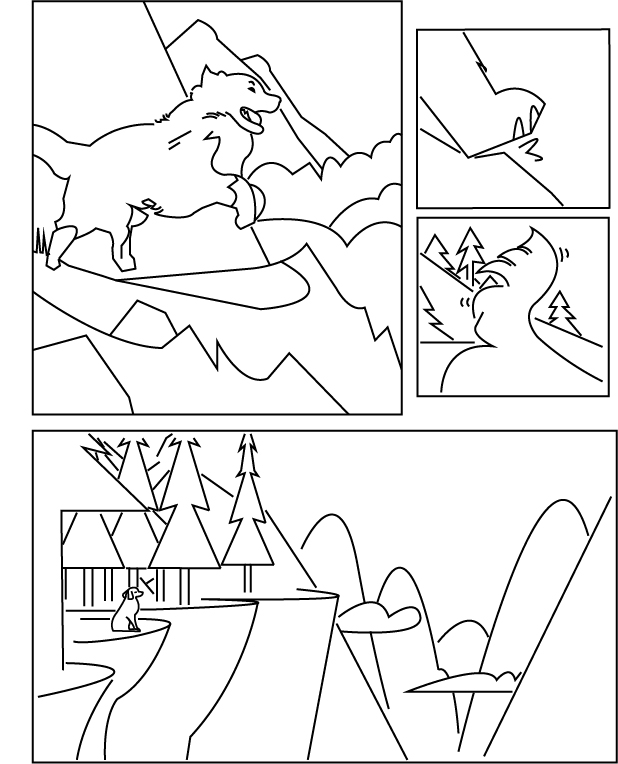
In my comic, I tried to leave the comic mostly up to interpretation. I didn’t want to explicitly tell the readers what the comic means, or throw my own personal meaning onto it. That’s actually what I love especially about music; my favorite songs don’t explicitly tell a specific story, but they deal with concepts that I can relate to in my daily life in an indirect way. I think that’s the case with popular songs too, people like songs they can relate to. My own personal meaning the comic originated from was just a starting point.

I wanted to make my comic easy to read both in a digital and physical medium, but I think it definitely lends itself more to be read physically printed on a piece of paper. The portrait orientation definitely makes the comic harder to read in a digital medium, but I wanted to keep the authentic feel of a physical page, like you might read in a comic book.

In retrospect, I definitely could’ve made the message clearer. I wanted people to be able to paint their own meaning onto my comic, but I think some people were just confused by it and wished there was text. Overall though, I’m happy with how it turned out and I learned a lot about seeing my own work from other people’s perspectives.

Posted in Fall 2018 Archive (201) | Leave a comment

Comics: Jenna Walker

Screen Shot 2018-11-01 at 3.06.06 PM

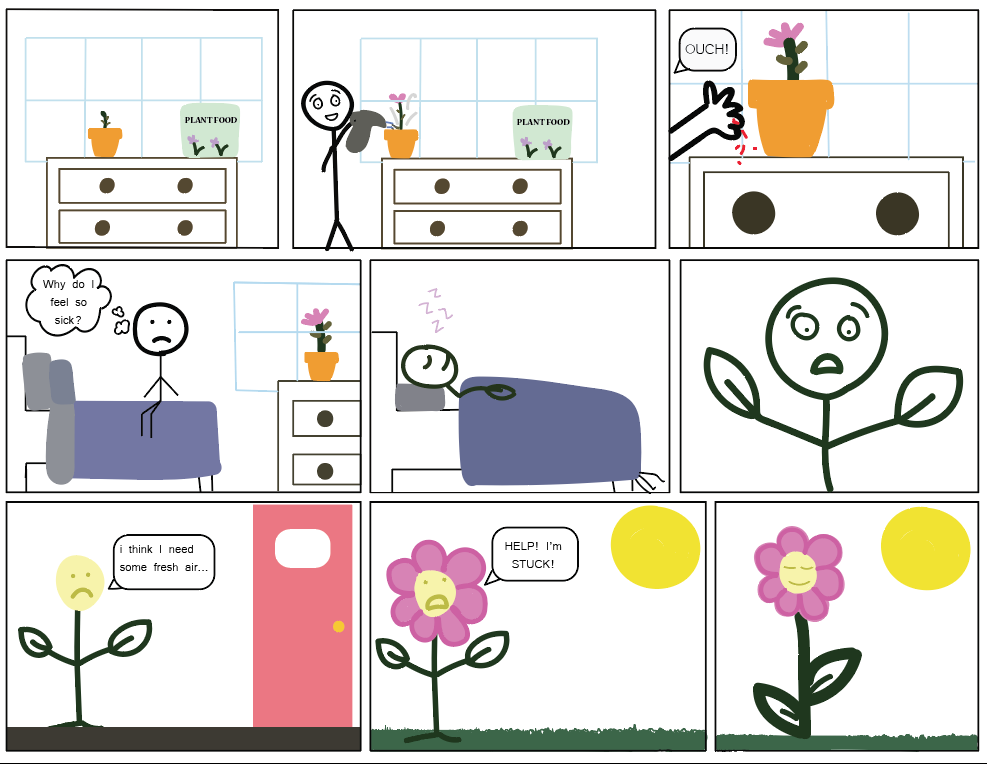
“A Boy and His Flower” by Jenna Walker

My blog, “A Boy and His Flower”, was inspired by Spiderman. I took the the concept of Spiderman and gave it a floral spin. Similarly in Spiderman, he is bit by a spider and turns in to Spiderman, but my character gets pricked by the thorns and then turns in to a flower. This relates to Scott McCloud’s book because I feel like I had a lot of good use of color, I kept it very simple yet still got my point across. The comic itself is very easy to follow, and with little dialogue it’s clear what’s going on. It fits the idea of, “juxtaposed pictorial and other images in deliberate sequence”, because my comic flows very nicely I think. In each frame, from the beginning, it’s obvious that everything that soon happens after is a reaction from the previous frame just before. I liked my usage of the different widths of the lines because it shows that it’s not all the same. My character when he is a human is used with small lines, but when he turns in to a flower, he becomes thicker like a stem and grows leaves and roots. I also had good use of color because when he is a human, he is used only in black so it really shows the difference when he turns green and his face turns yellow with pink petals. I wanted this comic to be very simple and not over the top with designs or anything like that because I feel like when there is a lot going on in a comic, it’s hard to really understand what’s going on because there is so much to look at; which can get confusing, too. I believe the environment for my blog could be anywhere, it’s a goofy comic with no underlying meaning so, it could be read anywhere at any time. I hope my readers see it and just smile, it’s a quirky little comic which I truthfully enjoyed creating.

Posted in Fall 2018 Archive (201), Uncategorized | Leave a comment

Comics: Brianna Esqueda

I believe that comics have the power to take a story and synthesis all that is is trying to say into a few panels. It combines some of the best elements of both reading and visual art. Comics turn a reader into a viewer, someone trying to form meaning out of an image. It is with this and Scott McCloud’s definition of comics that makes me feel that my piece is a comic. My piece works with the reader in disrupting the normal pattern the human eye follows when reading.

Esqueda-Brianna

The White Hole. An original comic by Brianna Esqueda.


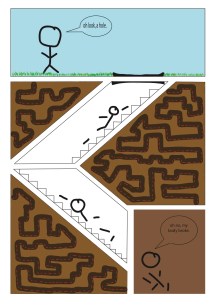
For me, one of the larges things I took away from Understanding Comics that I implemented in my work was the idea of movement. McCloud talks a lot about movement and how a character enters a panel. that was the main focus of my comic, having my subject fall down a hole. This was actually a main reason I chose to create a comic in the from of print media. Had my comic appeared on a screen that required scrolling, there would be a pause destroying the smoothness of how the eye moves down the page.

I would imaging that my comic would best be read in a book or magazine. i think that comics are best enjoyed when you are holding them. it makes the reader/viewer more aware of the fact that they are holding a piece of art.

I hope that when someone reads my comic they are initially confused. I want them to have to take a minute to figure out what happened.Then, once they do, the smirk to  themselves. Maybe they find it funny or a bit ironic. Ultimately, I just hope that people enjoy it for the moment that they are looking at it. Or that they have as much fun looking at it as Idid creating it.

Posted in Fall 2018 Archive (201), Uncategorized | Leave a comment

Comics: Timmy Huynh

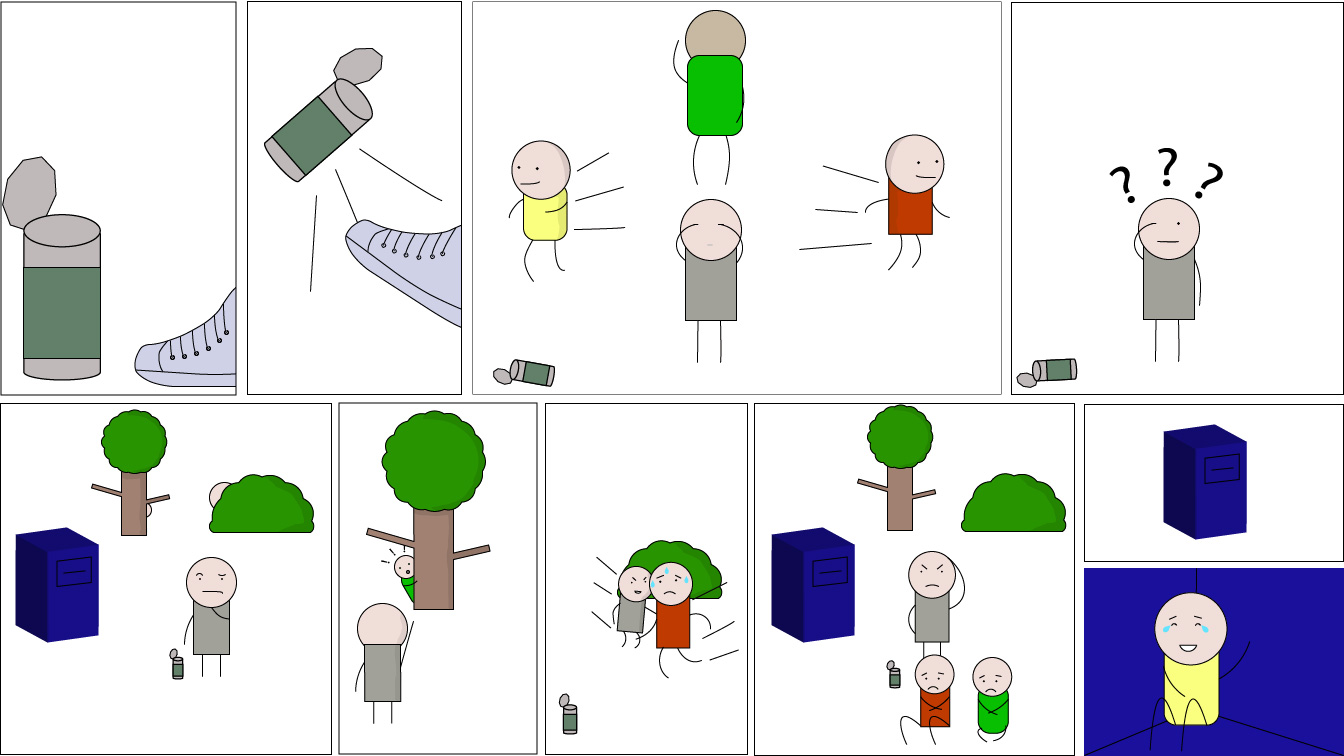
I believe my comic fits Scott’s definition because all of the relevant images are in a position and next to each other in a deliberate way. When I first heard that we were making comics I decided I wanted to do something with dialogue and text but after reading the book and read the part on which text and image balancing were so important, I decided that I no longer wanted text in my comic because I wanted something that the anyone could see easily and without the need of explaining anything with text. Another thing was the fact that images that are slightly changed and next to each other can explain movement or a story. The first two images show someone going from a neutral position to kicking the can and that tells the reader that it is in fact deliberate for the kick and that it was premeditated rather than just showing the can being kicked. The last two images also do something similar in that it imitates a camera panning into the bin. With the isolation of the bin at first you can see that it is important to the story and explains the next image of the kid in the bin much better than just simply showing the kid in the bin which could confuse viewers. I decided that I would like this piece to be digital because of how short and simple it is and that the images could be split up for better story telling through animations or clicking. The comic in my opinion is to short for print and some of the details might be lost if it is too small. What I wanted people to see when they saw this comic was something a lot of people can relate to. Kids just running around and playing and having fun with each other. I remember when I was a kid I would go outside and play until it was way too dark. My friends and I would play any game that we thought was fun that day or just run around and pretend to be some kind of character. I wanted other that read this comic to be reminded of that innocence and that fun they had when they were young and that having fun with friends can be as simple as kicking a can and chasing after each other.

Timmy-Huynh-Comic-Kick-The-Can

Comic by Timmy Huynh, October 2018. “Kick the Can” a comic about 4 kids playing the hide and go seek spin off called kick the can.

Posted in Fall 2018 Archive (201) | Leave a comment

Comics: Emily Bruckner

Death’s Plight manga. Emily Bruckner, 2018

My comic “Death’s Plight”, I believe fits well into the criteria of a comic. The comic as a whole, is made up of a series of depictions that make up a cohesive story line. While I was trying to decide on what type of comic I would like to make, I considered a very simple and cartoonish design at first, but looking at some of my early ideas of it I didn’t like how simple it was, and the dialog and content of it was lack luster. I changed my perspective when I remembered that a manga is technically a comic in form. I had an idea of a more somber and hard hitting storyline that would work well in a manga style. This style runs higher on the realism spectrum than most comics, making it easier to identify with a more human looking character. When reading through McCloud’s book, I took the idea of using very few words of dialog in the story and focused mainly on the visuals to help convey meaning to the reader. In McCloud’s book silent characters are often more physically expressive and they are able to convey so much meaning without “saying” a single word. The abject silence of most of the moments in my comic give it a more serious undertone appropriate for the subject matter. In using the fewest amount of words possible, I wanted them to be able to stand out as much as they could in the mostly silent story. I chose to use a black and white color scheme mainly because it is utilized traditionally in most manga. I wanted a lack of color to also add to the sense of dread, sadness, and foreboding in the comic; happy cheerful colors would have taken away and distracted from the narrative. In all, the story is purposefully a little vague to leave interpretation up to the reader. In the end, I did cut out a large portion of the prolog story part, chiefly because I ran out of time to complete all of it. The story still retains its core meaning however, those first few frames functioned merely as added context. This comic I would think would be best suited to print, in a sort of traditional manga style booklet, perhaps, if the story ever carried on past what I have written so far.         

Posted in Fall 2018 Archive (201) | Leave a comment

Comics: Melissa Urueta

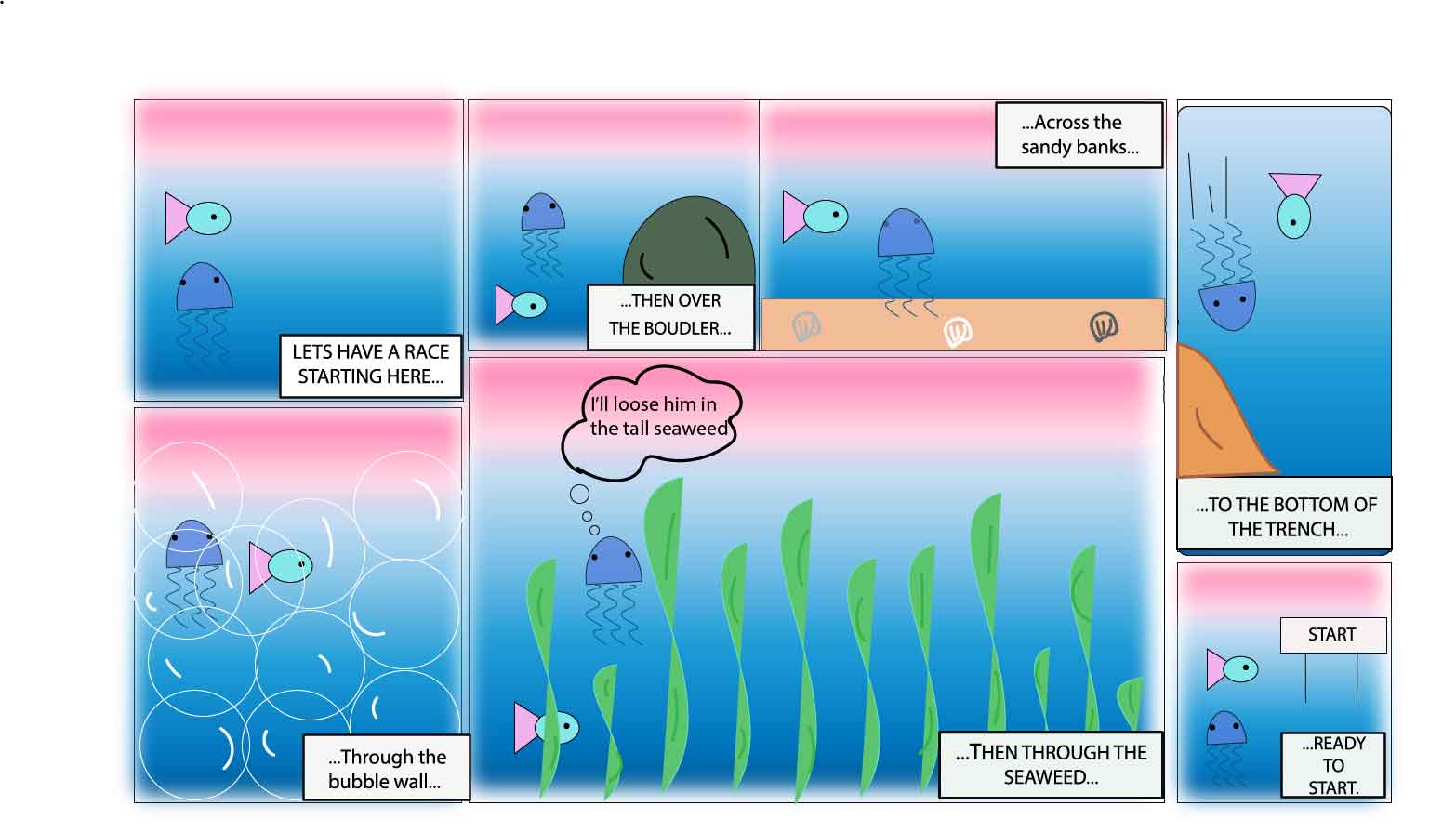
The great fish race by Melissa Urueta for DTC 201

My comic is a very traditional take on a comic. It fits into Scott McCloud’s definition because it is a bunch  of images in a sequencing order that is deliberate and mine tells a story. It is formatted in a traditional way in boxes and it is red from left to right and the story is then explained and easily understandable. Before I read Understanding Comics I first decided that I was not going to make my comic look like a comic I wanted mine to stand out. Then after I read it, I realized that the formatting should go along with the story the comic is trying to portray. The book made me understand that the comic is full of the symbols that help tell the story so the format does not matter. So when I decided to start my comic I had to come up with the story first in order to figure out the over display of my comic. I wanted to make something simple, a story about a race that takes place underwater. So I chose a simple format for a simple story. I then decided that I wanted it to be a normal comic strip that can be available for both print and digital media.

My comic can be understood in both and having the comic in either print or digital media will not affect the understanding or the comic itself at all. That being said, the best form to view the comic is print, more specifically like poster. It has two rows and there is no need for different pages. I hope when readers read my comic they will think that it’s cute and that the colors are pretty. I really wanted it to be a simple story line with beautiful colors. I wanted the vibe of the comic to be cute and colorful.

Posted in Fall 2018 Archive (201) | Leave a comment