DTC 206:Digital Reflection #1


Digital Reflection 1

Internet Service Providers’ Role in the Digital Divide

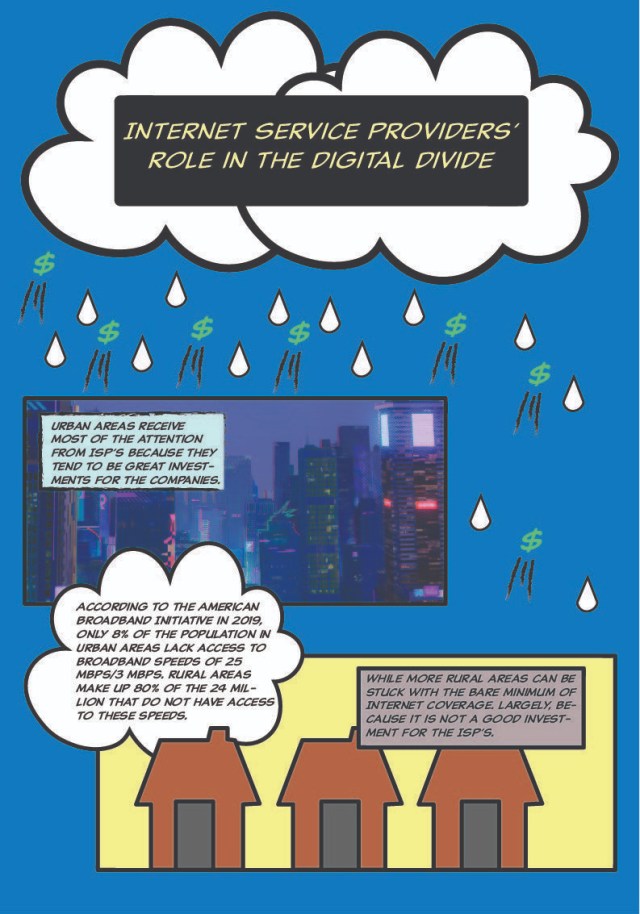
Reflecting on the first-half DTC 206: Digital Inclusion, there were a few concepts that stood out to me and seem to fit together well. In this poster comic, I attempt to demonstrate how the concepts of the Digital Divide, net neutrality, and the geopolitics of the physical internet all connect and relate to each other. At the top of the poster, there are clouds which serve to represent the Internet Service Providers (ISPs). The raindrops falling from the clouds are there to represent how ISPs choose to distribute their resources. Similarly, the dollar sign paired with a few motions lines visualizes the companies’ monetary yield from their resource input.


The Digital Divide is being visualized here through the juxtaposition of two types of areas in order to show to how type of area affects its connectedness. This is meant to show that the large cities and more urban areas will receive many of the resources ISPs have to offer. Whereas rural areas are not as fortunate as urban areas and are often left with the bare minimum of internet (Burrington). This is where the Digital Divide starts to connect to the geopolitics of the issue. You see the large, modern city taking up much of the ISPs resources, while yielding a sizable profit in return. On the other hand, rural areas are receiving less attention, while also producing small amounts of profit. Large ISPs like AT&T, Comcast, and Verizon understand that these rural areas are not helping them make money, so they see no point in providing coverage and wasting resources that could otherwise be profitable. Unfortunately, rural areas often fall behind urban areas because of corporate greed.


The geopolitics of the physical internet are concerning to me as we move further into the digital age without net neutrality. If ISPs are already able to choose which areas do or do not get the fastest internet, it seems probable that they could also throttle the connection speeds of their users in order to make them pay more. Similarly, the Digital Divide and net neutrality connect because the post-net neutrality internet seems to be entirely motivated by profits, contributing to a deeper divide. Each of these three concepts connect to one another and help explain each other. One of the most interesting things that I am noticing is that the Digital Divide, net neutrality, and the geopolitics of the internet are all connected by one thing: The Internet Service Providers. Each of these issues or concepts all come from the fact that ISPs have the power to decided to who has access to the internet, how fast the connection is, and maybe even what users see on the internet. It seems to me that a possible solution to these current issues lies in limiting the power of the ISPs.


American Broadband Initiative. “Milestones Report: February 2019.” pg. 11.

Burrington, Ingrid. “Where the Cloud Rises from the Sea.” The Atlantic, 12 November 2015.
https://imgur.com/eGDUZvJ


Posted in Uncategorized | Leave a comment

Final Digital Comic Collage: Zach Morgan

Digital Comics Collage

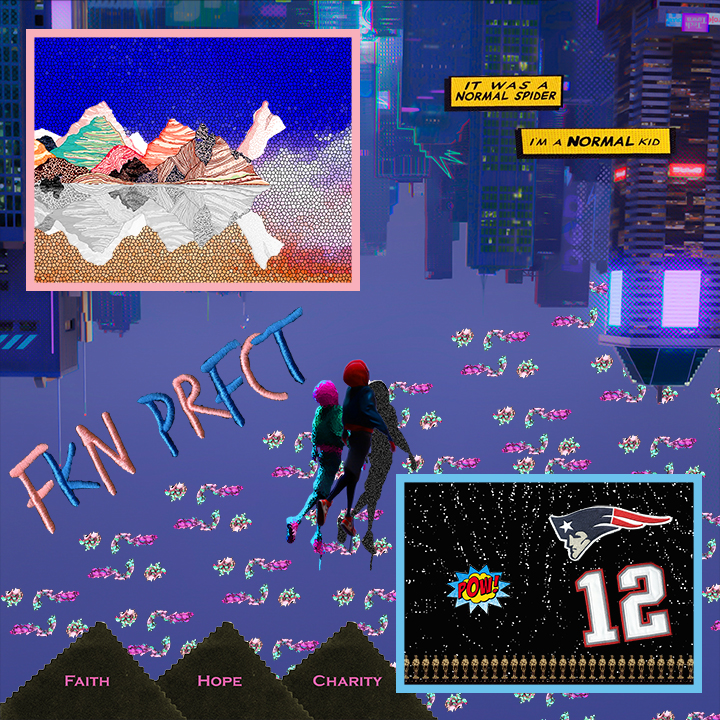
In this post, I pay homage to my inspirations through digitizing physical materials and curating graphic art in a Digital Comics Collage. Clothing brands, sports teams, musicians, and movies are all inspirations of mine that are present in this collage. The images of these influences are not alone, however, as they are all connected to each other and to words to create one coherent product. I think that Scott McCloud would agree that this collage fits under his definition of comics, as the two panels are juxtaposed not only to each other, but the city skyline background as well. In addition, this fits the definition because these graphics are all intended to “produce an aesthetic response in the viewer.” Utilizing concepts like balance, color contrast, and direction from John Lovett’s Design Overview helps to keep the comic visually interesting and to define layers and flow. Balancing this collage are the two panels boarded by pink and blue in the top left and bottom right, respectively. This allows the viewer to give their attention to the comic in a way they naturally would, rather than having their attention be pulled to the blue panel if the pink panel wasn’t there.

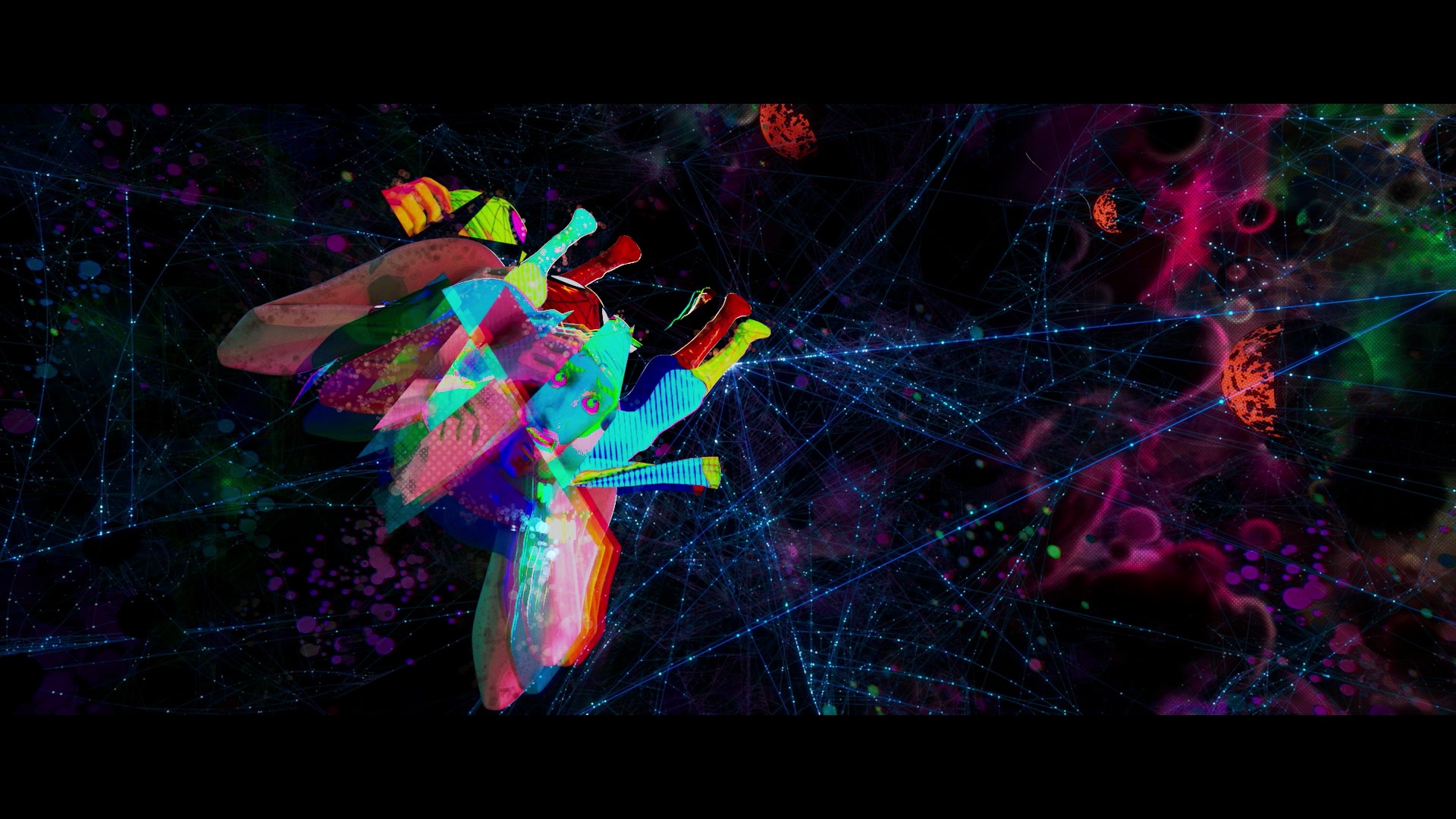
As far as making the composition of these materials and images mean something, they each in someway inspire or have inspired me. One of the heavy influences for this collage is the movie Spider-Man: Into the Spider-Verse, which I talked about briefly before in my digital comic. It contributes to the comic collage through a couple quotes, the background, the character at the center of the page, and the colorful “glitched” clouds. In addition, at the bottom of the blue panel, there is a row of small Oscar Award-like figures. That figure is from the cover of the album DiCaprio 2 by JID, which is what I listened to for most of the time I created this project. The words in this comic that stand out to me are the two yellow dialogue boxes because of how they feel to me as a viewer. Because these boxes are not constrained to a panel, it allows the words to live in the city skyline and take up more “space” in the viewer. The words feel alive this way, like the character is yelling as they are falling up the page.

Screenshot from Spider-Man: Into the Spider-Verse showing Spider-Man “glitching”

Creating this Digital Comics Collage was the first time that I had sued Adobe Photoshop since about 2012 when I was in 6th grade, but I feel as though I have been able to adapt to it quickly. The tutorials in general were a big help because it took things very step-by-step and it was east to follow. As expected, I had to make many selections, but I think one of things that was more important than I thought was being able to layer things effectively. Fortunately, I think I did a good job of figuring out the nuances of those mechanics. Overall, I really enjoyed creating this poster, especially in a digital environment. One of the main advantages of creating in a digital environment is that you have more freedom to try things that may otherwise seems too hard or too risky to try with physical creations. For example, I was able to adjust the hue and saturation of the clouds in the background to make an Into the Spider-Verse reference. That reference is that the “glitched” clouds are influenced by when Spider-Man “glitches” in the movie creating a similar feel. All in all, I am very please with the finished product of my Digital Comics Collage.

Posted in Fall 2019 Archive (201 Blog) | Leave a comment

Final Digital Comic Collage: Joseph Alonso

Created by Joseph Alonso, September 2019

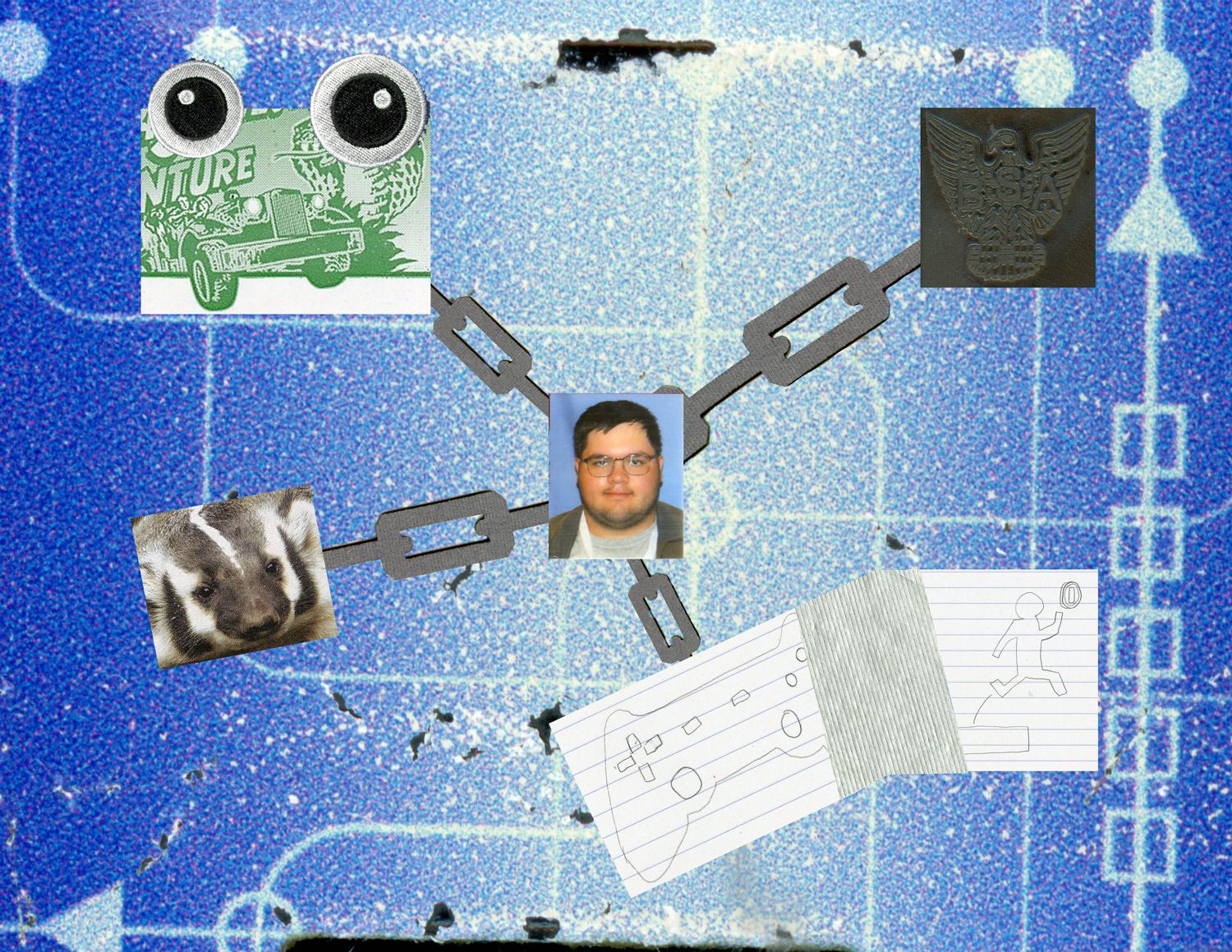
The first thing that I scanned when preparing for this project was a piece of duct-tape.  I didn’t even know what I was going to go for in my final project.  The second thing I scanned was the chain on a Chain Chomp plushie that I keep in my dorm.  I started thinking about what makes these things special and why I should use them, then it hit me.  I would make my collage based on things that are important to me.  I first decided to use the chain and duct-tape to reference connections between different images, one of the images being of myself.  I would have the chains connecting images to me to show that they are important to me, and the duct-tape to connect similar things.

The first thing I connected to myself was my BSA wallet emblem, to show my connection to Scouting.  I have been a Boy Scout since I was in middle school, starting in the Bear rank, and working my way up to Eagle.  The next item I connected to myself was the green jeep and snake that I got off an Indiana Jones FastPass ticket.  I also stuck two googly eyes from my Chain Chomp plushie to it.  This represents my love for adventure stories, along with a healthy dose of comedy.  The googly eyes are also supposed to be a subtle nod to the Banjo-Kazooie series, which fits the description of a comedic adventure.

The next thing I connected to myself was an image of a badger that I got from a Northwest Trek ticket.  This represents my love for animals and going to the zoo, though my favorite zoo to visit is Point Defiance.  The final images that I connected to myself was a simple drawing of a game controller and a person doing some platforming, held together by duct-tape to represent my love for games that have a basis in platforming.  The background of the collage is a small section taken from my phone case to represent my affinity for technology.

This was my first time ever using Photoshop.  The most important tool that I used was the background eraser tool, which helped me isolate the chains from their white backgrounds, along with the Chain Chomp eyes from their surrounding colors. Learning how layers worked was also important in making sure the chains did not cover up the images connected to mine, as well as me.

Posted in Fall 2019 Archive (201 Blog) | Leave a comment

Final Digital Comic Collage Arron Borja

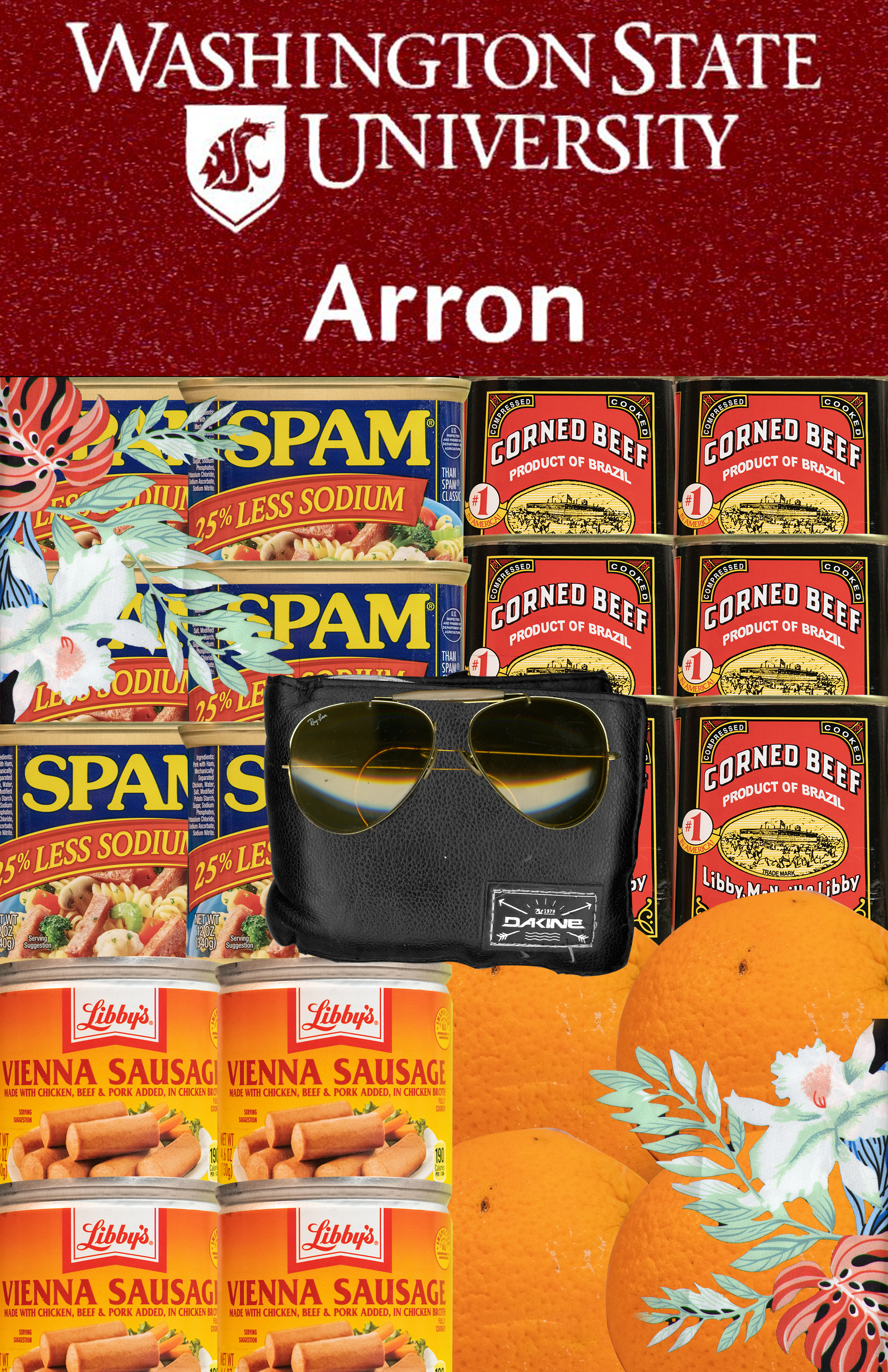
I believe that my comic does fit into McCloud’s definition: “Juxtaposed pictorial and other images in deliberate sequence, intended to convey information and/or to produce an aesthetic response in the viewer”. I believe this because my comic is a sequence of items close to me and that conveys information about me to the viewer. John Lovett’s Design Overview helped me by helping me to understand terms like repetition and harmony. I feel like my comic is a good example of repetition considering that I have a comfortable amount of the food in the background to admire. Regarding harmony, the items in the background are all foods/related elements. The only linguistic elements that i’d highlight in my comic is my name tag at the top. I feel like that stands out really well and is effective in letting the viewer know my name and what school I attend.

The reason for my wallet being in the middle is because it resembles my money and the items in the back are what most of my money goes to, which is food. The shades on top of my wallet is just a touch of me to add my character to the comic. It is one of my most favorite pieces of eyewear. The floral items on the corners of my comic resembles where I come from, which is Hawaii. This piece comes from one of my floral collared shirts.

This is not my first time using Photoshop. I have been using Photoshop for about a year. I have learned more about layer masks like how to select certain parts of a photo and using the brush tool to make those certain parts disappear. I’d say that the most useful technique is layer masking. I actually love composing in a digital environment because all the tools I need is literally in the program that I am using.

Posted in Fall 2019 Archive (201 Blog), Uncategorized | Leave a comment

Final Digital Comic Collage: Brayden Jacobs

The Adventures of a Lifetime – Brayden Jacobs

“Juxtaposed pictorial and other images in deliberate sequence, intended to convey information and/or produce an aesthetic response in the viewer”. Scott McCloud’s definition of a comic in his book, Understanding Comics: The Invisible Art can fit a wide variety of artistic work and personally broadened my understanding of what a comic is, and what a comic could be. When beginning this project, I instantly knew what I wanted to make based on McCloud’s definition of a comic. I decided to make a collage comic to summarize the experiences and adventures me and my girlfriend, Tabby, have made over the last 3.5 years. Most of these items are very specific to the experiences we had together, and the audience is the two of us and those where were there along the way. This comic is something that I would post on a blog or print out and hang on my wall, and not something that would go into a newspaper as a conventional ‘comic’.

Scott McCloud's Book
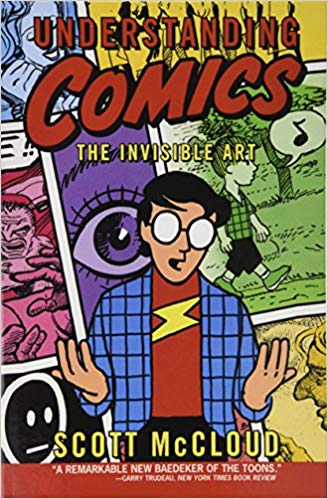
Scott McCloud’s Understanding Comics: The Invisible Art

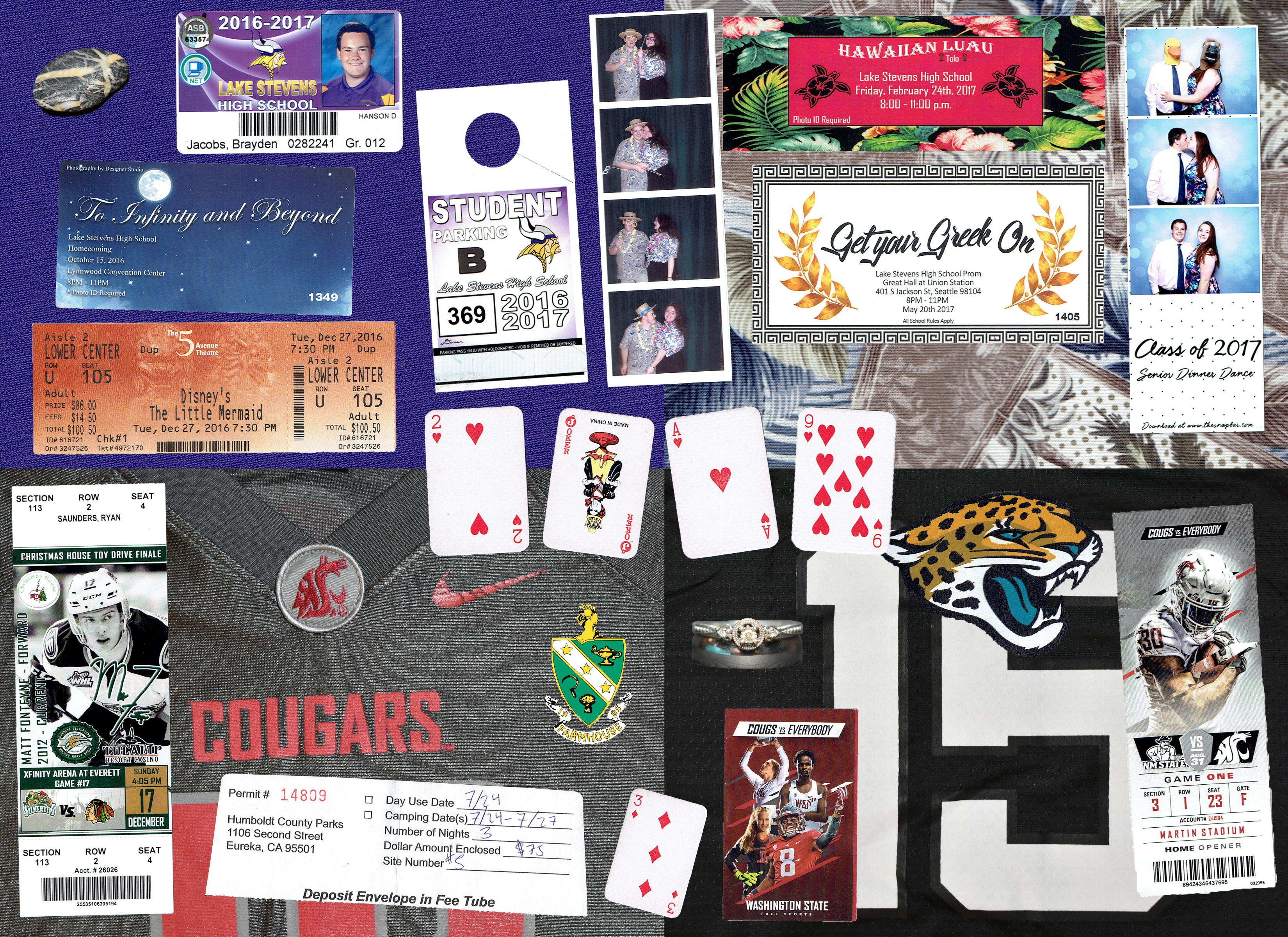
Each item in the comic portrays our relationships’ journey through the years, from high school sweethearts to our junior year at university. The comic is split up in four sections, each representing a year of our relationship. The first (top left) quadrant depicts our fall semester of our senior year (2016) at Lake Stevens High School. The second quadrant (top right) is our final semester of high school and the senior dinner dance and prom that are some of the peaks of our high school years, as well as the first semester of school at WSU (2017). The bottom left quadrant is our first ‘real’ year at WSU, 2018, when we started making college friends, I joined a fraternity and we still had money to spare. The bottom right quadrant (2019) is a bit more ‘controlled’ than the rest of the quadrants, as we are entering our junior year of college and becoming adults. The black jersey as the backdrop is Gardner Minshew II’s Jaguars jersey that we both purchased after his performances last year at WSU and his journey to a starting QB in the NFL. The playing cards were a fun way to show what year the comic was made, spelling out ‘2019’ with the joker as the 0. The card ‘3’ at the bottom is meant to depict how many years we’ve been together. While there are 4 quadrants, we haven’t yet celebrated our 4th anniversary. These playing cards, along with everything else in the comic, were little parts from our biggest adventures that I’ve kept in a memory box.

This comic is amazing to me; being able to put these items together and tell our story with snapshots of our past. The separate quadrants, each with their own aura, show the juxtaposition under McCloud’s definition of a comic and are ordered by year, a deliberate sequence. To follow some of John Lovett’s Design Overview information, I made sure to keep the colors different, but also avoided keeping all of one color within a single quadrant. The WSU jersey is the background for quadrant 3 but the ticket stub and the pamphlet are in quadrant 4, to keep a flow to the comic. I did not add a linguistic mode to my comic, but within most of the pieces are written information giving context to when, where and what each item describes.

As for my experience in Photoshop, I have taken a photography class and a digital technology class where we primarily used Photoshop for editing. The tutorials taught me new ways to make selections that allowed me to alter pictures in a more realistic fashion. I thought about using masks and shadowing but decided not to, as the comic is supposed to have a more realistic feel, as if this could be pinned on a wall. I love the wide variety of uses that a digital landscape has to offer and creating this on bulletin board would have been far more difficult and not as polished as my digital final product.

Posted in Fall 2019 Archive (201 Blog) | Leave a comment

Final Digital Comic Collage: Dane Graves

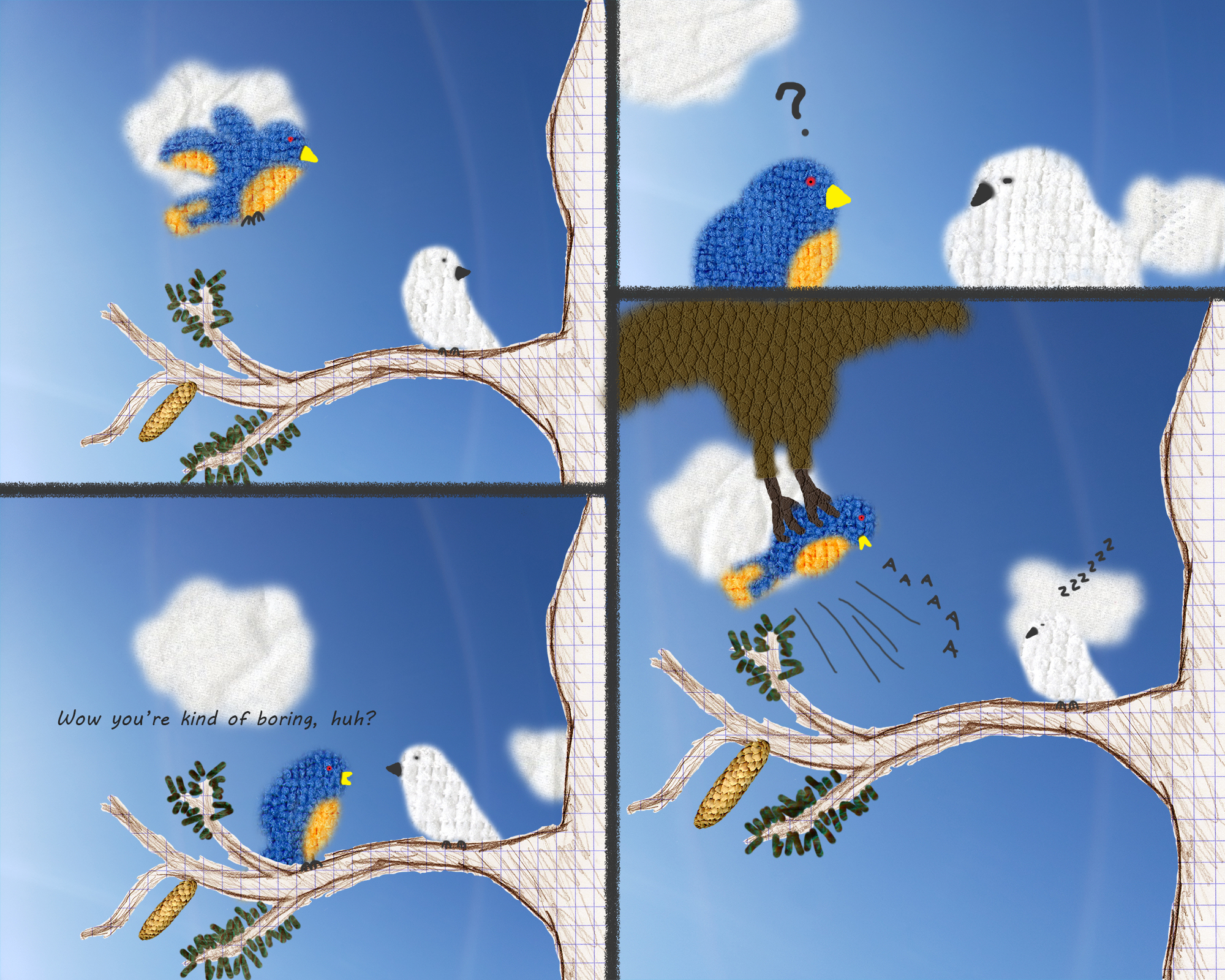
My Comic Collage is definitely more traditional comic made out of real life materials to create the collage part of its name. In termsCollage Comic 72ppi of fitting McCloud’s definition of a comic, “Juxtaposed pictorial and other images in a deliberate sequence, intended to convey information and/or to produce and aesthetic response in the viewer.” I feel as though I fit his description perfectly. My comic uses panels (being the different images) in a sequence close together to convey a story aesthetically. I feel McCloud’s definition was pretty broad in and of itself so It was pretty likely that most projects will fit his definition, mine might just be a little more obvious than some of the more abstract collages. When I was working on the panels I was thinking about some of John Lovett’s Design Overview to think about the composition. I thought about elements such as lines, texture, color, and direction. The two smaller birds both use the same textures the different colored washcloths I bought in a pack, while the large bird uses a rougher texture I acquired from the cover of a book. I tweaked the color of the book cover on different parts of the large bird for a more varied look, and I tweaked the color of the drawn tree to be brown rather than black.  For lines and direction I used oblique lines to show the movement of the colorful bird being taken by the larger bird.  For principles I thought about the balance of the panels to try and draw the reader through the correct reading sequence like keeping the two main birds near the center of the panels to try and not draw attention to the wrong panels on accident. When it comes to why I made a more traditional comic for this Comic Collage, it’s simply because I had difficulty finding more that just simple colored textures to scan. I finally settled on using the color and textures from the collected materials I could acquire to create objects using them rather than straight up use the scanned objects themselves, exceptions being the pine cone and tree I drew on graph paper. When it came to the text I tried to make something lighthearted and have the font fit my intentions. The colorful birds font for speech is clean and easy to understand, but doesn’t look formal. While the question mark, the scream, and the zzz’s are all drawn by the mouse to keep them loose and (hopefully) fun. This is my first project using Photoshop so learning how to use the tools was enjoyable particularly mixing clipping masks and layer masks for the colorful bird. I used a lot of clipping masks for the clouds, birds, and pine needles.  I enjoyed working digitally and I want to get better at it.

Posted in Fall 2019 Archive (201 Blog), Sample Posts by Students | Leave a comment

Final Digital Comic Collage: Patrick Istvan

I made my collage with items that I find dear to me and convey stories and information about me. Each item says something about my background even though

A collage telling my interests and stories about me. (Edward Bernays, 1923) (Gesta Hungarorum, by: Anonymous,~1200AD)

the meaning may not be obvious. I hope that my collage can be an interesting piece for viewers to grow their curiosity about me and possibly draw their own judgement and stories about me, before having them dispelled or reaffirmed from reading this blog post.


I purposely put each item in its position next to more relevant items to achieve harmony and follow an overall message of introducing myself through showing different aspects of myself. The top is politics related which shows my love of studying politics. It shows my background with the Romanian revolutionary flag from 1989 anti-Ceausescu protests which my family fled to the America to avoid. I replaced the normally hollow center with the mechanism from a watch to reflect that the overthrow of Ceausescu still impacts Romania and its people today. I also have a page from Gesta Hungarorum, that chronicles the Hungarian history by an anonymous writer which I am very proud of as I am related to the Arpad Dynasty. I am Hungarian from my fathers side, and Romanian from my mothers side of the family. While I was born In the USA. I put a book in the political upper section on the left side as my Hungarian side of the family was always more analytical while the Romanian side was more emotional. The book “Crystallizing Public Opinion” is very valuable for me as it not only opened my view on politics but gave me the inspiration to go back to college and pursue my Marketing bachelors.

The Lower Section I used a leather passport case as the background. This was a gift from my girlfriend and I especially use it in this collage not only because it has a more sentimental value but because I use to do leather work as a meditative hobby. It was very relaxing for me, which is why I chose to use it to be the background for another interest of mine which is world religions. The icon in the bottom left is a gift from my mother who would often go to different churches and try to bring back icons for my brother and I. The Buddha also reflects my explorations of other religions, although i do not have any symbols from other religions that I could have put into my collage.

Tying all these things together is my passport along with some Thai coins (which are oriented to the bottom of the collage as it is more sentimental). The Thai 10 baht coins are from my recent trip to Thailand with my girlfriend. The passports center orientation is to reflect my love of studying and experiencing cultures, politics, religion and business of different countries.

I also put the watch mechanism and the icon on separate corners of the collage so that they do not seem like they are 1 item at a quick glance. Their contrast to the colors around them keeps them meaning something quite separate, where as if they where near viewers might associate them easily because of their similar color. I followed John Lovett’s “Design Overview” in terms of size as I aimed to make the coins seem more “real” as they are pretty accurately proportional to an US passport.

This was my first time using Photoshop. I have used a free equivalent called “Gimp” before, and some of that know-how transferred over. I am still very new to image editing as I don’t even use filters for any social media. I had very many Geometric shapes that could be easily selected using the Marquee selection tool so that was by far the most useful tool. Despite the simplicity I still had to go back and re watch tutorials and do many quick google searches to find how to do things. Since I feel I am still not skilled enough I do not really enjoy nor dislike using Photoshop. I am neutral but probably will not delve into it much on my own.

Posted in Fall 2019 Archive (201 Blog) | Leave a comment

Final Digital Comics Collage: Peter Dowell

Digital Comics Collage, Peter Dowell, 2019

I didn’t really know how to go about making this comic when I first heard about the project, actually I was kind of intimidated by it. I have used Photoshop before and I do have a basic understanding of it, but I didn’t know how to express my creativity for the project by making it a comic. Another part of the project that I was nervous about was the scanning part of it. I had to test a couple of different materials and items before I knew what I was going to create until I came up with my final idea. I wanted the reader to see the randomness can be put in an order to look like something else.

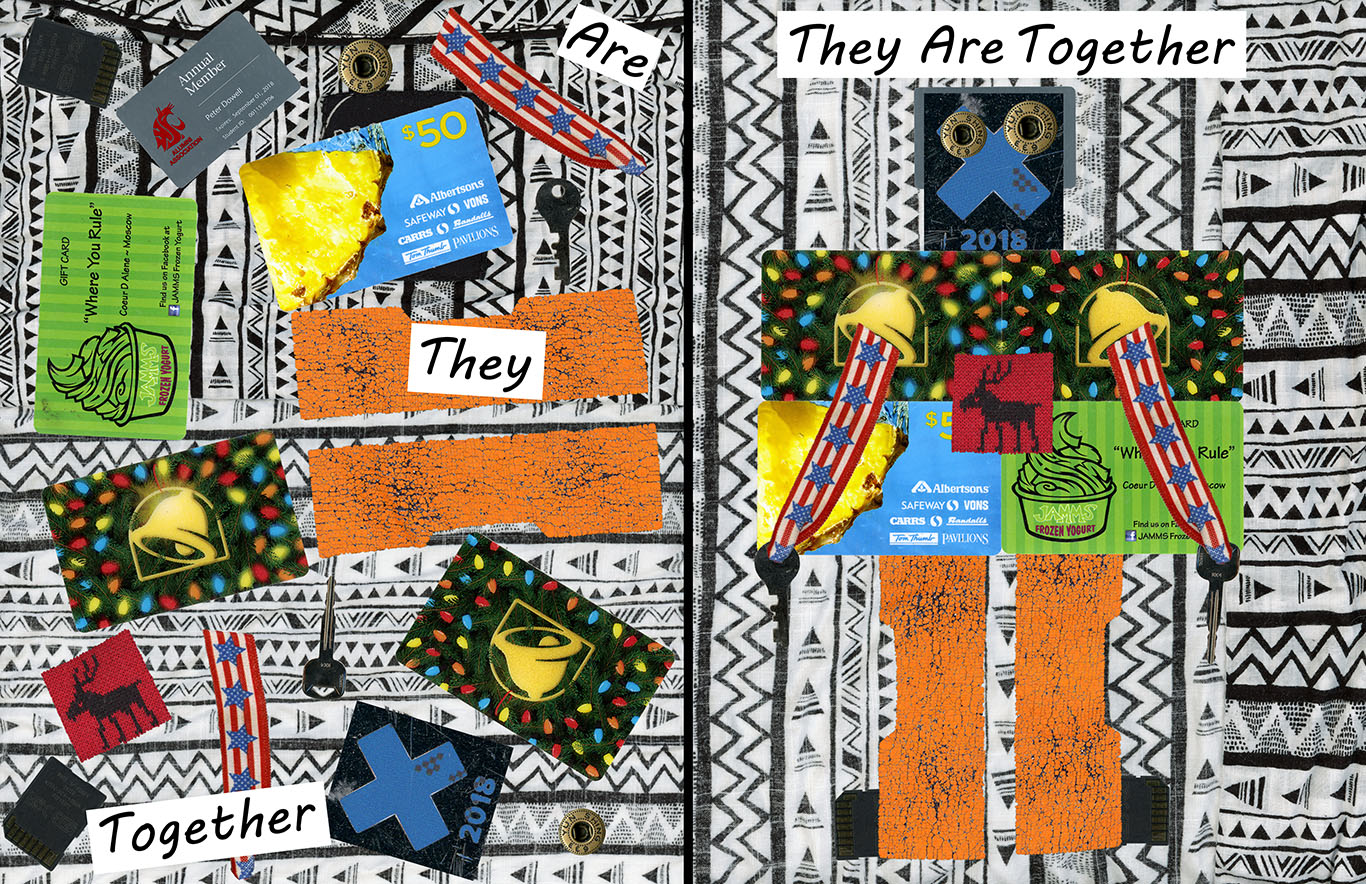
I wanted to relate to Scott McCloud’s idea that people are selfish and they see themselves in most things, such as cars, wall outlets and two dots and a line. I wanted to convey that there are a bunch of random materials that I could scan and then put together to make a sort of human looking character. The idea that I can take a bunch of random things and put them in a particular order to show a human looking character is really interesting to me. That is why I put the text as “Are They Together” vs “They Are Together” to show that when they are together and all connected they can convey a human-like thing just as two dots and a line can convey a human like thing as well, but only when they are placed in a certain order. My comic fits Scott McCloud’s definition by the juxtaposition of the two images. On the left image we can see a bunch of images put in random order in random directions with the text saying “Are They Together” which in comparison the the next page when “They Are Together” it gives a direct image to compare to the first image when the random images are no longer random, but are connected deliberately. John Lovett’s reading helped me out because I wanted to express direction of the images. I made the images random directions on the left page so that it seems chaotic while the images put together on the right are more stable being put together and horizontal and vertical. I was looking at the shape of things when I was creating my collage because I wanted to see how the shapes would fit together. I made some shapes bigger and some shapes smaller, but in the end they all fit together and the images I used really just made it interesting to look at and made it random as well. If I were to take a bunch of completely different images and textures I would get a completely different character. Thinking of the character and fitting the pieces together helped me manage the process for my collage. I had the spatial mode in my comic because it was all about how the images looked when they were put together and how much space they took up and you can really compare the two spaces between the left and the right side to see what they actually look like in the space that they take up. The text also takes up space and is really interesting because it is in a kind of wrong order on the left, but on the right it is more deliberate and normal to someone that would read it.

I have used some Photoshop in the past, but it was a while back so I had to remember a lot of things. I really like the quick select tool and that is how I made most of my selections. Even though I used quick select I still had to soften up some of the selections I made with feathering and stroke, so that was interesting to see how I could manage my selections. The tutorials helped me remember a lot of stuff from the past such as layer masking and messing with the colors for the project. I found it difficult to figure out how much I wanted to change from the original image in the project when I was making my selections. I wanted the images to be just how I scanned them and did not want to change it because if I edited the image too much from the original it would not really be random enough for my idea. I would mostly take the selections and then transform them to certain shapes and sizes. It wasn’t really confusing. I feel like Photoshop is such a diverse tool and the thing that limits me is my creativity and not Photoshop.

I definitely enjoy working on a digital environment rather than using a pencil and paper for making a drawing. I like the extensive tools that the digital environment provides to use and it can even enhance stuff that is done in the real world. Overall digital environments are more diverse in the stuff that they can do and they are even coming to a point where it doesn’t look different from the real world drawings.


Posted in Fall 2019 Archive (201 Blog), Sample Posts by Students | Leave a comment

Final digital comic collage: Dawson Bolen

This is my final comic collage converted to web resolution.

Going into this project, I was not sure at all what I was going to create. However, I just kept playing around in Photoshop and by scanning  some items in my room. I had a bunch of pop tart boxes as I do eat them on a daily basis so I thought, why not make this collage about them. I sort of created a landscape using different scans and made it into a strawberry farm. Then I added a few panels to create the story and added various other elements to make it into a collage. If anything, I would hope that I make readers of my project laugh. The story is fictional and doesn’t make any sense. I didn’t intend to make the story line some deep or philosophical message. I took a less serious approach, but I think the nonsensical nature of this makes it kind of funny. 

My comic does fit the criteria for Scott MCcloud’s definition of a comic. It uses images in a deliberate sequence to tell a story while also creating an aesthetic response in the viewer. While I was creating the project, I took John Lovett’s design principles into consideration. I considered concepts such as contrast and tone to make my project visually pleasing.

This is not my first time using Photoshop, however, it had been a while since I last used it. I took a digital media class my junior and senior year of high school and worked with it quite a bit. But it’s been a while and I needed to watch most of the tutorials for review. I found layer masks most useful in this project because I needed to hide certain parts of layers pretty frequently. I used many layer masks to hide parts and combine layers. I like creating in the digital environment like I did in this project because I can create content on my own computer from my room. I also just enjoy playing around in Photoshop and changing images.


Posted in Uncategorized | Leave a comment

Final Digital Comic Collage: Eddie Abellar

Digital Comic Collage by Eddie Abellar, Fall 2019.

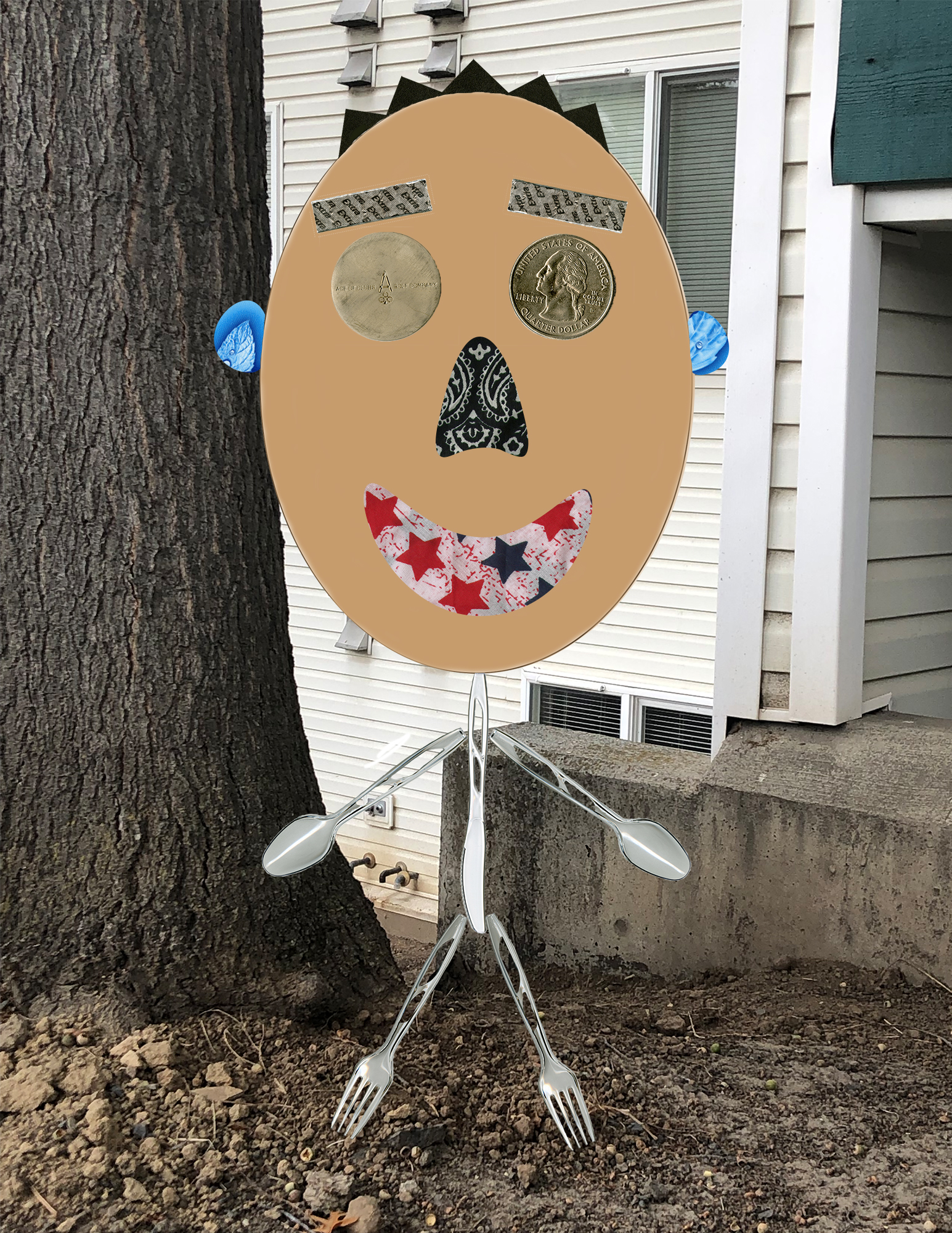
My digital comic collage fits Scott McCloud’s definition of a comic because it produces an aesthetic for the viewer to respond to. Although there is no specific sequence to view the collage, the images that were used work together to form a comprehensible work of art. While I was creating this comic collage the principles and elements of design I made sure to focus on were shape, contrast, and repetition with variation. The images that were used to create the collage were random things that I found in my room and kitchen. I juxtaposed these images to create a person out of them. The idea behind creating a person out of random objects that I scanned is to help the viewer relate to the collage by using certain objects that the viewer may have used in the past such as a fork or a quarter.

This was not my first time using Photoshop but I would still consider myself a beginner because this was my first big project done using Photoshop. I learned a lot from watching the tutorials in class. One new thing that I learned in photoshop was the select and mask space when making selections. This space was really good for fine tuning selections in the overlay view. I used the select and mask space a lot when creating this collage. Other tools I used to create this collage were the quick selection tool, lasso tool, magnifier tool, brush tool, elliptical marquee and rectangular marquee tools. All of these tools were essential to creating the necessary body parts to create a person out of the random objects I scanned. I really enjoyed working on this project and working in Photoshop. Working in Photoshop felt like digital arts and crafts which was a lot of fun.

Posted in Fall 2019 Archive (201 Blog) | Leave a comment