

Photo of the many textures in one of my abstract acrylic paintings.
I am a painter, so the chapter on texture in “Graphic Designs: The New Basics” broke down and explained concepts I use regularly in my art. In painting texture has always been my obsession. I love experimenting with different mediums and tools that can be used to achieve different physical and optical textures. With paint you use color and contrast to optically add texture. This invites your viewer to imagine the object as it is in reality. The same thing is done in virtual and computer designed art. However, the aspect I enjoy most about painting is physical texture. In this acrylic painting you can see several ways I applied and manipulated texture. First, there is the base texture of the canvas that is consistent throughout the entire piece. On top of this I added globs of paint with a palette knife and achieved two types of texture: a physical texture with the dimension of the body of the paint, and a visual texture with the variation and blending of color. Once I established this background, I changed mediums to a metallic paint and used a brush to add a splash of contrast. This silver line and the silver splatters I feel enhance the base texture by adding a contrast of color and shine. Unfortunately, I was unable to capture how glossy and metallic the silver appears in real life compared to the semi-gloss/matte of the varied blue background. I prefer manipulating metallic paint with a brush so I am able to create more smooth and flowing textures that mimic how real metal objects look.
These next two images are from one of my oil paintings. Oil paint is a much thicker medium than acrylic and I enjoy the textures it can make. The following two images show two different textures I created with oil paint using a brush vs using a palette knife. As you can see from the images, using the palette knife I was able to make a much thicker physical texture. However, while the brush didn’t add as much body to the texture it did add a unique and interesting pattern to the texture in the many fine lines.
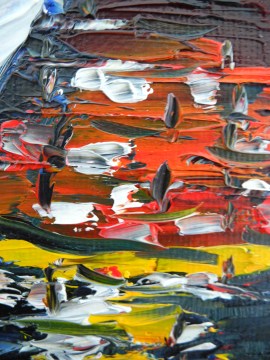
Photo of the texture achieved with a palette knife in my oil painting.
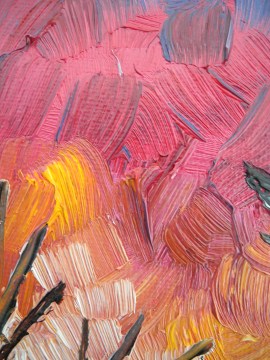
Photo of the texture achieved with a brush in my oil painting.



 palette, this is a nice element because it ties the image and text together in another way. Using similar artistic style and color is something that I will use in my poster so that the elements in my poster appear more cohesive and not just cut and pasted on. Another thing that this example has made me think about in my poster in the use of layering, Layering will be important for me because the image I am creating has depth and dimension that layering is essential too. Aside from what I will use in my poster I also simply appreciate the craftsmanship of this book. It’s amazing the level of detail that was captured in this 14th century book and how it continues to inspire mine and others work today.

 Kristin Becker's DTC Classes at WSU