Formstorming: Tre Bobo

On page 43 in What It Is, Lynda Barry asks the question “What is a story made of?” and the way the page was laid out along with the images she used could be seen as a form of formstorming. The book Graphic Design: The New Basics by Jennifer Cole Phillips describes formstoming as making visual examples to gain a deeper meaning or understanding of a subject. I believe that the illustration given above is a great example of the formstorming collage process because it shows many ideas that make a story, a passage taken from a book or drawings or photographs for example are seen on this page which can both be seen as important elements in a story. Formstorming is very beneficial when trying to communicate an idea or understand it better as seen in the example, while most people would believe that a story is made solely from the linguistic aspect of communication, the collage showed that a story could have many other modes of communication like visual or spatial which are both seen in this picture.

blog1.JPG

Pg 43 of “What It Is” by Lynda Barry

Posted in Spring 2017 Archive (336) | Leave a comment

Formstorming: Sophia Price

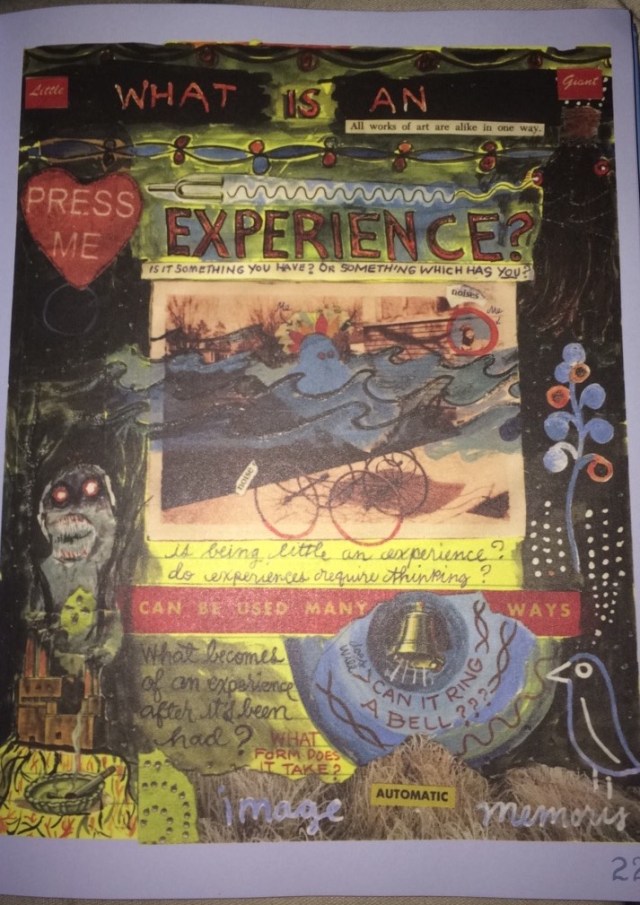
I would argue that do to her exploration of the way images or ideas are different things (memories, experiences, stories, etc) Lynda Barry’s book What It Is is, in itself, an example of formstorming. She explores different ideas based on images in new ways. By brainstorming in this way, she is using her novel as a template to discover what she feels images are. She explores her own memories in this way. By taking her readers from the feeling of knowing a stuffed animal blinked at her, to the way she remembers the novel Heidi being so real, she explores feelings in an unusual journal entry form. I found one of the stronger pages of formstorming Barry uses is on page 22, where she shows different forms of what experience is. By scanning the page you find specific experiences, such as bike riding and working in a factory, to more abstract ideas of experience; “can it ring a bell” and what I would call a smoke monster rising out from the factory (Barry, 22). Her use of dark blues and black mixed with yellow give a point of confusion to her artwork. This adds to her formstorming, identifying images and experience as something that need to hold more discovery. Barry continues to use this on other pages, such as 48 where she explores different forms of wandering, or on page 16 where images are explored through other forms of images. Barry’s use of formstorming images as images works well within her novel exploring her past as she identifies where ideas originate.


what-it-is-page-22

From Lynda Barry’s book What It Is, page 22. Published in May 2008, by Drawn & Quartley.

Citation: Barry, Lynda. What It Is. Sigamore: Drawn & Quality, 2008. Print.

Posted in Spring 2017 Archive (336) | Leave a comment

Firestorming: Cora Kline

firestorming-2

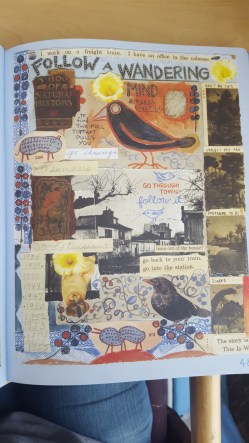
Pg 48 of “What It Is” by Lynda Barry

The image I chose is page 48 of “What It Is”. I believe it represents firestorming because of the content discusses the wandering mind. In order to properly brainstorm/firestorm, you need to be able to allow your mind to wander into possibly unfamiliar places.  One word is repeated four times; “go.”  When it comes to firestorming, you can’t hesitate, you just need to go.  Often people are worried about bad or stupid ideas.  The word “go” means just go for it, even if it fails.  I remember watching a documentary where a team was firestorming ideas on redesigning shopping carts. They said they put every idea on the wall, no matter how ridiculous because that idea might inspire another idea that could solve their problems.


On the image, there’s a sentence “Don’t do this unless you are prepared to be scared.” This is important because in firestorming, you may come across ideas that are out of your comfort zone and challenge social norms.  This is scary to many people, because challenging social norms might get them ostracized or damage a reputation.  However, if you can handle the fear of being different, you can make real changes and create new ideas.


In the image there are also different types of birds; there’s one that looks like it was drawn by a child, there’s several that are simple outline drawings, there’s a photo-realistic bird, and there’s one that looks like it came from a renaissance-era tapestry. Each image is a bird but shown in a different style.  Firestorming is all about creating the same idea in different ways.


Posted in Spring 2017 Archive (336), Uncategorized | Leave a comment

Broadsides

Class of 1918 Broadside - MASC Collection

Class of 1918 Broadside – MASC Collection

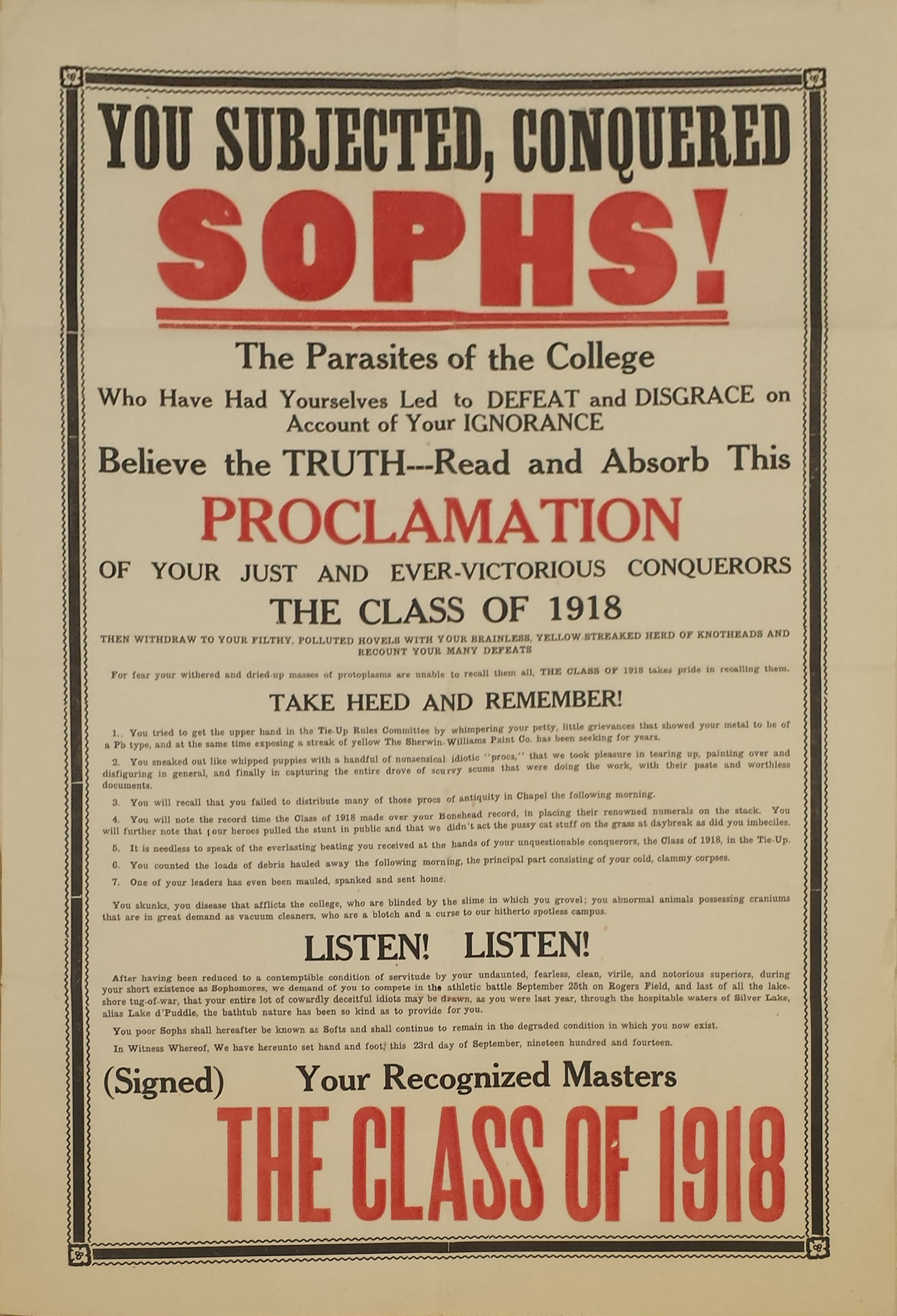
The piece from the MASC Collection I chose was a broadside written by the class of 1918 to that year’s sophomores.  It integrates display type well, creating a visual hierarchy within the text.  The most important information is printed in large display type.  The type that stands out the most would be “SOPHS!” “PROCLAMATION” and “THE CLASS OF 1918.”  They stand out most because they are the largest type and are also printed in red.  These three bits of information give away the purpose, audience and author of the text to people passing by, and draw the reader in to learn more.

The next biggest text is in black, and tells the reader to “listen!” “Believe the TRUTH” and “Read and absorb this.” Towards the end of the broadside is black text of the same size that tells the reader that the upperclassmen are their masters, and that they need to recognize that.

The majority of the large text is in all capital letters, suggesting importance and urgency.  The red color of the largest text suggests this as well.

The closer one gets to the page, the more information they can read as the type gets smaller and smaller.  The reader starts to learn that this poster is setting rules for the underclassmen, and that the text is there to make fun of those younger students.  It is an early, innocent form of hazing in college.

The biggest text stands out the most, creating visual hierarchy and gives the most important information first.  This is why the display type on this broadside is so effective.

Posted in Fall 2014 Archive (338), Sample Posts by Students | Tagged | Leave a comment

Menu Design

The New York restaurant Pera Soho uses a menu that has been designed to have a strong hierarchical structure.  The name and logo of the restaurant is at the very top of the page, suggesting readers should look at that first. It is also the largest font size used on the page, surrounded by the most white space of any other element on the page, which signals its importance. Having so much white space around the title pulls the eye into point on the page where the title takes up space because it stands out so much more than the other blocks of text that are not contrasted as much with white space. Additionally, it is a very dynamic element on the page because the line of text is curved, which contrasts with the very straight and square blocks of text on the rest of the menu. Moving down into the food items, Pera Soho’s menu shows section titles with larger, bolder font sizes such as the “dips and chips” section or the “salads” section. Although these sections are near the top of the page, signaling that they should be read first, the section that is most important on the hierarchical arrangement is the “main plates” section. This menu is interesting because they clearly arrange the menu sections to be read in a hierarchy of what items should be ordered first, but at the same time use font and style choices that show a hierarchy of importance of the sections, as well. Although all of the section headings are much larger and bolder than the menu items listed in their section, the difference in scale is much larger between the main plates and its items in comparison to the salad section and its items. This menu also uses design elements to make the entire menu more visually dynamic. A large geometric star shape is in the ground of the page, emphasizing the textual elements as the figure of the page. Supporting the argument that the main plates section is the most important section, there is a black banner shape surrounding the title to capture the reader’s attention as well as a black outline in a box shape around the entire section. Black outlines were also used around the two drink sections to emphasize the importance of these sections, but contrast them to the food items as separate choices. Finally, the menu is laid out as a 3 column grid for all of the menu items except for the main plates. Once your eyes reach the main plates section, you notice there are only 2 columns. This, again, supports the hierarchy of the menu options. Overall, this menu used hierarchy extremely well.


food-1

Paradise Creek Brewery menu

In Paradise Creek’s menu, the design of the menu is not quite as obvious a hierarchy as the Pera Soho menu. In Paradise Creek’s menu, we see the same scale contrast between the food items and their descriptions as are seen on the Pera Soho menu. However, there is not as obvious a scale contrast between the section headings and the food items, which makes the hierarchy confusing and makes the section headings easy to skip over. In addition, some of the food items are very bold and dark, pulling the eye away from everything else to look at that particular menu item. This almost suggests a hierarchy of food items within each section, which may confuse patrons into thinking they are a specialty or popular item. The number of different fonts on this menu also makes the page almost too dynamic to the point where it’s overwhelming. Similarly, the grid style used on this menu is less obvious because there are some entries that appear to be on a 1 column grid, some on a 2 column grid, and some on a 3 column grid. These are all mixed together and make it confusing to read the menu because it suggests certain items are grouped together for some reason. Overall, their menu would be much more effective if the columns were more uniform, having only emphasized items in a different grid style, less font styles that are more hierarchically uniform, and contrasting the section headings from the menu items a bit more.


Posted in Sample Posts by Students, Spring 2016 Archive (336) | Leave a comment

Broadsides

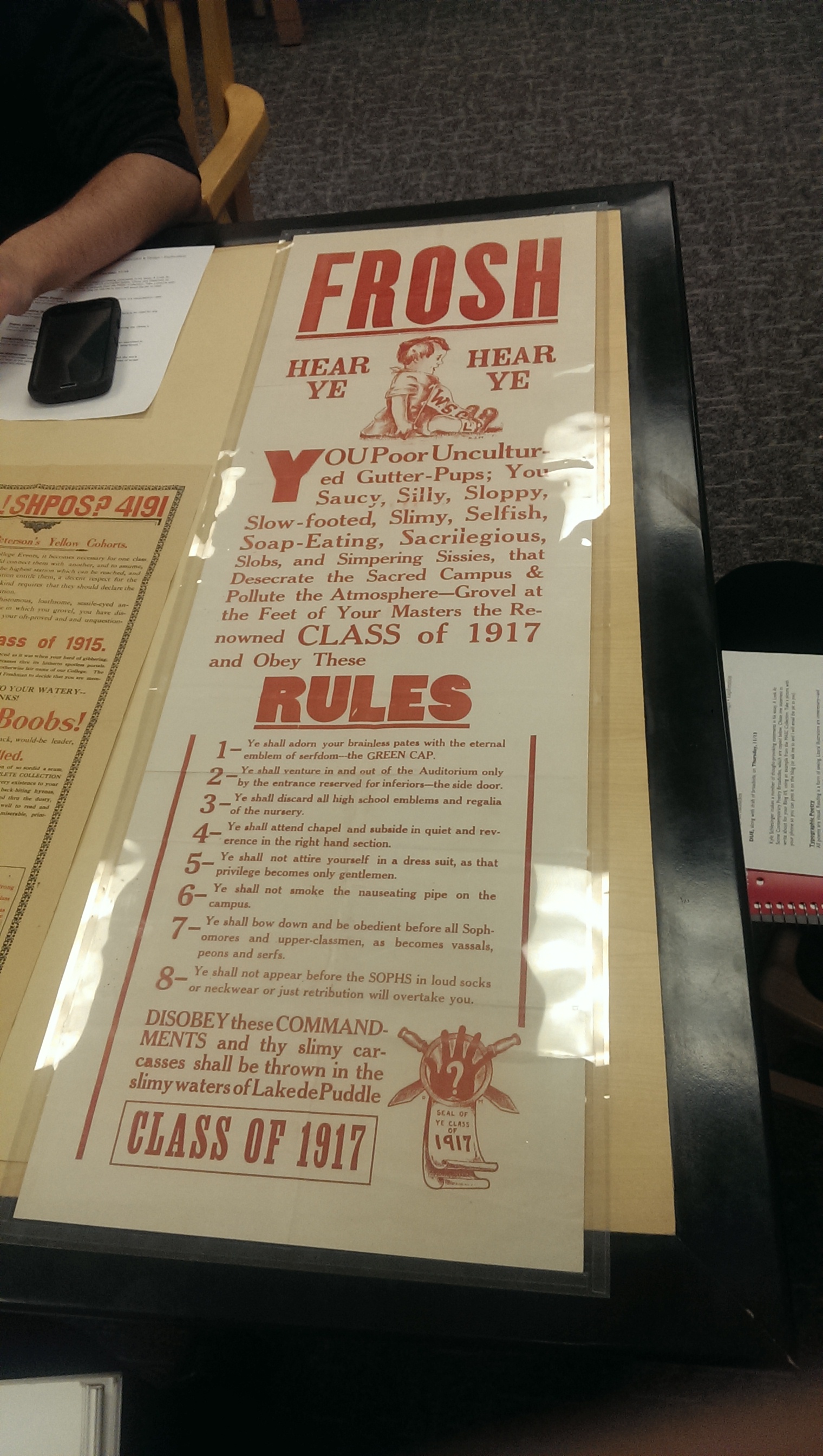
According to Kyle Schlesinger, some people would categorize broadsides as “a single, unfolded sheet printed on one side only” which my example falls in line with. The size of this broadside is actually what drew my attention to it. It was a lot longer than all the others and seemed to be in the best condition. The length of this broadside immediately made me think of a long letter from a long time ago when they were longer and on parchment (instead of our 11 x 8 ½). I believe that this is what it is suggesting at with their jesting letter/announcement to freshmen designating rules that they need to obey. Not only does the size of the paper feel like a letter but the format does as well. There is a larger title FROSH that is who is being addressed, along with Class of 1917 in a square at the bottom resembling a signature. All these elements typography, placement, and paper size all come into play when deciding what this broadside is suggesting at or what it is trying to say.

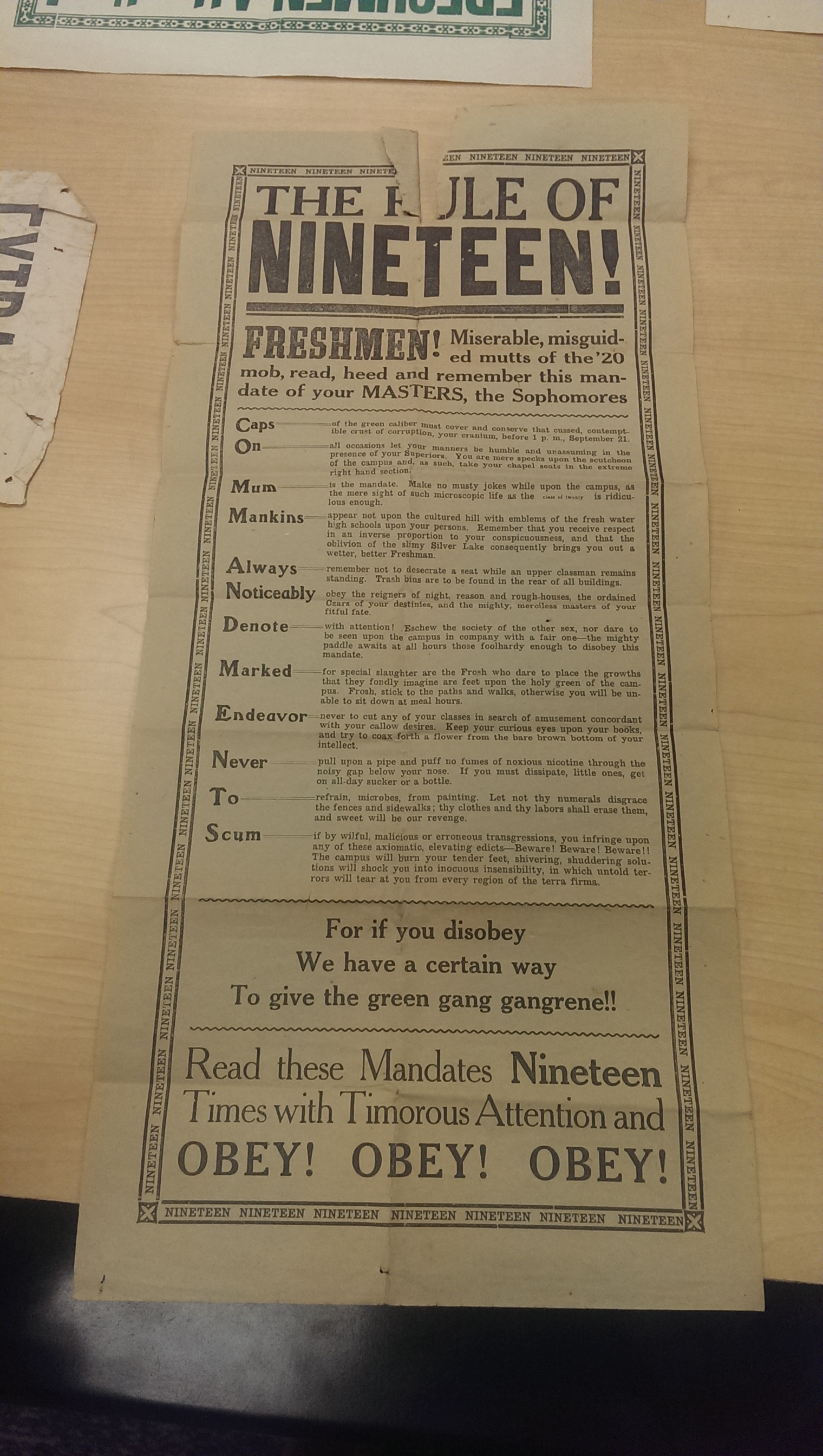
In order to emphasize how the paper size and the type work together to create the letter feeling I wanted to show a broadside of a similar size and compare. The second broadside does not have any visual cues that would evoke images of letter writing. FRESHMAN! is not the largest piece of information and The Rule of Nineteen! is the heading which signals at more of a list than a letter. The title and singular bolded words are almost like bullet points, again creating a feeling of a list type structure. Instead of a signature it just ends with OBEY OBEY OBEY. The paragraph of writing at the beginning is smaller, suggesting less importance whereas my original broadside has a much larger font and the paragraph of writing stands out contributing to the letter feeling.

Just these few differences in type can create a whole new feeling. The type and the images they create that come together to make a typical list or letter are ingrained in our minds and we transfer that into our interpretation of these broadsides. “Translating words into space, feelings into letterforms, is a significant part of book design” and is how I look at these broadsides. The letter forms transform into a larger image (of a letter) because of the way they are arranged and the way our mind is trained to read things.

Posted in Fall 2014 Archive (338), Sample Posts by Students | Tagged | Leave a comment

Framing the Girl With Frames

framing

Image Taken From Hadi Girl by Miyabi Akino,  Publisher Manga Time Kirara Forward

When thinking about modern framing I’d like to use this modern Manga page as an example as it has very good examples of techniques that modern comic artists use in japan. Because we are talking about a physical comic book page, reading it would cause the page it is printed on to become an innate frame. The next super obvious frames are the thin black lines that act as individual panels for the right side of the page. The frames for the left side of the page are the tones in the background and and for the bottom panel left panel the edge of Sae-Chan’s hair acts as a boarder. The most interesting thing about this panel is that in the middle frame Sae-Chan completely ignores the lines and comes out of her panel bringing emphasis to her pose and allowing her to act as a frame for the other panels. Which allow us to know that the egg comes next because it is on top of her deeming it the next thing we read as our eyes flow through out the panel. Another interesting thing to consider is that the way she is facing would lead us to the next page too find out more, because the Japanese read from right to left.

Posted in Fall 2016 Archive (336) | Leave a comment

Pattern Design and Color Interaction

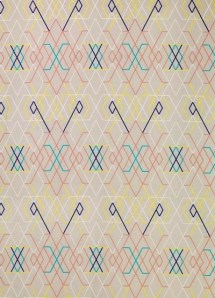
http://2.bp.blogspot.com/-Jrv8dU2_qJE/U96Z6GQ1o_I/AAAAAAACUDo/5FT2tqNnCys/s1600/IKEA+Margrethe+Odgaard.jpg

Geometric: Margrethe Odgaard for Ikea

The first pattern is geometric because there is an obvious pattern that repeats itself throughout the frame. A person does not have to deeply search to find the pattern because it is made up with simple lines forming shapes. There are lines made by the pattern but overall the pattern creates a grid structure. Because this pattern is on a grid it appears to be tiled and not repeated. The use of contrasting hues helps us see the grid. There are both warm and cool hues used throughout the pattern. The dark blue hue stands out from the rest of the hues because it is a dark shade as do the yellow and green-blue because of there high values. We compare these to the orange, tan, and white with their low values and lack of color and notice that they enhance the other hues. The dark blue comes forward as the yellow, orange, and white recede.

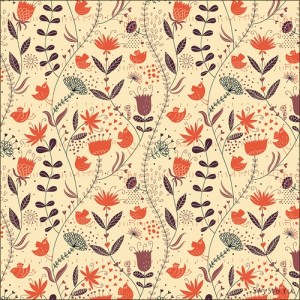
Organic: flicker photo by Julia

Organic: flicker photo by Julia

This pattern is organic and could be said to have stripes or dots but they appear in a more random way. This pattern is very intriguing and makes the viewer really search for the individual repeating parts. At first I thought this pattern looked more repeated than tiled but taking a closer look I realized that this pattern is tiled, but definitely irregular. The hues interact very well together as many of them have the same value. However, the orange has a much higher value than the other hues and therefore stands out from the other elements. The purple with the slightly higher value than the other dark hues is the next hue that catches our eye. Having all of the “dots” and “lines” placed on such a saturated, low valued, yellow background enhances the individual pieces. The yellow hue is also seen as its own element in the pattern as it becomes broken up throughout.

Posted in Fall 2014 Archive (338), Sample Posts by Students | Tagged , | Leave a comment

Black Lives In Media

black-lives-matter

The Black Lives Matter Campaign Poster

When I looked at the black lives matter campaign poster I thought that the talks would be on heavy handed topics that are often hard for us to talk about. Due to the serious intense look of the poster with the grungy textures and black and white color schemes. For the most part the talk I attended actually did talked about heavy handed topics that made me uncomfortable talking about. For example the stereotype of the bad black mother figure that was represented in the Precious movie. When she talked about people  that she knew that lead lives like that I was really shocked. The blurry out of focus face in this picture makes this poster shocking and carries with it a sense of heavy shaking. Thankfully the message ends more hopefully when we ended on a still heavy but lighter topics of the way minorities are represented in videogames and online. What is more disturbing to me looking back on it is that as a minority I have never really thought of the way I was represented in games or online. But that’s because I’m finding it harder and harder to identify what I am. When I use things like MMOs and character creators I never make them look like myself and I’m not sure if that’s because I don’t like myself and when I think of why I don’t like myself. I really can’t come up with a good reason. Is it because throughout my whole life in the games I loved to play none of the heros I was ever playing looked like me. The same thing occurred with the movies that I watched as a kid didn’t have anyone who looked like me in them. This is really the first time I really thought about my race as represented in the media, but I honestly think it would be a bad thing if I thought too much about race while making posts on social media. I don’t feel as I personally feel misrepresented in the media. But this is sort of a gray area that is very unclear and I feel like this lack of clarity is what makes this poster perfectly represent the topic.

Posted in Fall 2016 Archive (336), Sample Posts by Students | Leave a comment

Transparency!

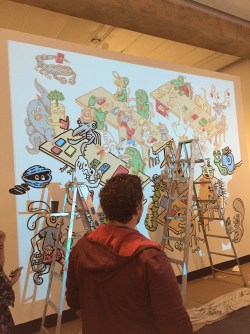
img_1547

Art Mural

As observed in the picture, the transparent layer projected on to the wall serves as a base for the drawings. Although the transparent layer appears to be at about 80 percent opacity level, the outlines created by the artist make the colors more vibrant than they actually are. Also the outlined parts of the mural that are been hit by shadows are creating the illusion that the drawings are part of the wall and not the projection.

Posted in Uncategorized | Leave a comment