Point, Line, Plane: Jon Williams

Graphic novels are extremely engaging when done correctly. If the images being shown can engage the reader on a basic level, helping draw the eye across the image in a reasonably paced fashion without being too busy, the entire page can feel alive and full. Each image follows the same basic rules in terms of how someone looks at it. Our eyes are drawn to large objects, follow lines, but always move top to bottom. Each place your eyes start registering part of the image, are points.they can be large and prominent, but also can be a lack there of in a space. Similar to how your eye is drawn to the face of the red headed girl on the left page, center frame. Her eyes and the blank space around her act as a point to engage the viewer, while the boarders of the comic lead one’s eyes down the page toward the main focus, our main character. These lines not only guide the reader to the focus, but help keep the page organized and set up well. Each image is separate, but the images still flow. On the right side of the image, the focus on the plane has shifted to sort of emphasize a scale of the scene. Again, the unique red hair of the main character works as another set of points in order to lead the reader carefully down the page, indicating where to stop. The floorboards also act as the lines in this segment, keeping the focus down and to the left of the page. This scene is more hectic, but the scale along with the points and lines help keep the reader engaged and interested without getting lost. it’s amazing what good design can do for graphic novels.


Posted in Spring 2017 Archive (336) | Leave a comment

Point, Line, Plane: Eva Guillen

real-cost-of-prisons

Page 10 of graphic novel Prison Town Paying the Price by Kevin Pyle & Craig Gilmore

In this novel, Prison Town Paying the Price, the author makes each of his pages different in how they should be read; in this page there is a left to right form of reading. Point, line and plane are used to form the different platforms for the images on this page. It makes it so that a reader or viewer knows where the text starts and ends. It also makes the pictures easier to follow and know there order as well. Point is specifically and more prominently used in the form of a period, this is a simple and tell-tale sign of the end of a sentence. Lines help separate one part of the story to another, making it again easier to tell what is going on in the story. I notice that there are multiple points that make up the shadows in the images. Then the plane of each box allows for a way to tell what is important in the story or not. Certain planes were larger than others, emphasizing that it’s a main point in the story. The image on the top left is a great example of the use of a plane because of how much space is used. It tells me that this is the start of the story and has a much larger emphasis, this is especially shown because the image was not restricted by any lines surrounding it. In the end, I can tell that with this story the eye moves from left to right; also that there is an emphasis on images that have larger planes than others.

Posted in Spring 2017 Archive (336) | Leave a comment

Point, Line, Plane: Elise Detloff

The graphic novel Fun Home: A Family Tragicomic by Alison Bechdel is a memoir of the author’s life, focusing primarily on the familial relations, self-discovery, loss that Bechdel experienced throughout her life.

Since the story focusing primarily on the author and her family members, each panel places the various family members at the forefront of the drawing making them points, focal points in this sense. A point, according to Graphic Design: The New Basics by Ellen Lupton and Jennifer Cole Phillips, marks a position in space. In a more literal and graphic sense, most of the points used in this comic are used to form lines in order to create the curves and thicknesses needed to illustrate the family members and surroundings. Lines, after all, are an infinite series of points and geometrically are the connections between two points or the path of a moving point.

The individual panels are typically very centered, with the action occurring in the

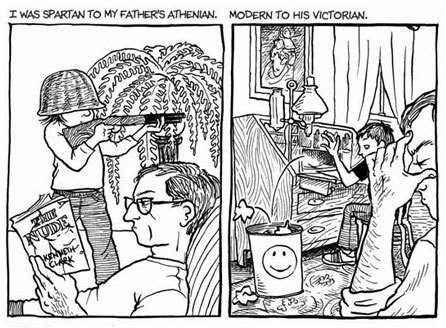
fun-home

Page 15 of Alison Bechdel’s Fun Home: A Family Tragicomic. Image from Institute for Doctoral Studies In the Visual Arts. Bechdel, Alison. Fun Home: A Family Tragicomic. New York, NY: First Mariner Books, 2007.

center of the image, drawing your eyes to that point. This creates a flowing feeling to reading this comic, there is this overarching theme and common element to each panel, making it feel like it all fits together without the similarity feeling boring or lifeless.


Lines are also used to create the different panels that separate scenes within the comic. This separation gives flow to the comic, allowing the reader to know the order of the scenes and when an idea ends and when a new one begins. When the lines connect in this way to create the panels, bounded planes are created, a bounded plane is essentially a closed shape. Planes are flat surfaces extending in height and width. It is on these planes that the lines and points come to together to create the images that create the cohesive narrative of the author’s story.

The planes utilize quite a bit of negative space, or white space, as can be seen in the example image. While the comic occasionally features more ornate backgrounds, the use of negative space helps to enhance the focus on the main characters and their actions. I also feel that this simple, clean, and somewhat rigid design choice is reflective of the father’s need for perfection and orderliness as described throughout the story and in the example.


Posted in Sample Posts by Students, Spring 2017 Archive (336) | Leave a comment

Point, Line, Plane: Tia Caton

Page 3 of Raina Telgemeier’s graphic novel Smile

Points, lines and planes are the building blocks of design. They create images, icons, textures, patterns, diagrams, animations and typographic systems. Points are defined as marks that define a position in place. They can be insignificant flecks of matter or a concentrated locus of power. When there are infinite points a Line is then created. Lines can be a positive mark or negative gap and when multiplied can describe volumes, planes and textures. Lines also appear at the edges of objects or where two planes meet. Once a certain thickness of a line is reached, it becomes a plane. A plane is a flat surface extending in height and width and can be considered a line with breadth. Shapes are created when a line closes and can be considered a plane with edges. Each of these elements are portrayed and used in comics to help direct the viewer’s eye.

The graphic novel I read in class was called Smile, by Raina Telgemeier, and followed the story of young author Raina in her troubled journey of dental disaster. The story begins with Raina on her way home from a Girl Scouts meeting when she trips and falls, knocking out her two front teeth. Following this event the reader follows Raina as she encounters more dental problems, braces and the cruelty of other children. Eventually, the story explains how she got into graphic art and why she started drawing.

In this comic you can see evidence of the use of a point in each frame where the main character sits. For example, in the image I provided the main character Raina sits in the center of the page in almost all of the frames. Because of this, she acts as a point in which the eye is drawn. There is also slight use of points in the middle frame to create detailing of glitter on the table the Girls Scouts are working at. Of the three building block, lines are the most used in this comic I believe. In these frames for example lines are use to show the person in which a name belongs, where each speech bubble is coming from and also to indicate various movements or emotions. For example on the last two frames there are little lines near Raina’s hands and the other girl’s head to indicate movements. Looking at the comic as a whole you can also see negative gaps which help distinguish where each frame begins and ends. Lastly, there are a large number of planes or shapes at work I this specific graphic novel. I think Raina is a pretty simple illustrator and relies heavily on the use of simple shapes and colors to create her work. Along with this I think she uses axonometric projections in order to depict volume in a lot of her elements. She gives each of her characters depth and volume which helps make them seem three dimensional.

Posted in Spring 2017 Archive (336) | Leave a comment

Point, Line, Plane: Hak Do

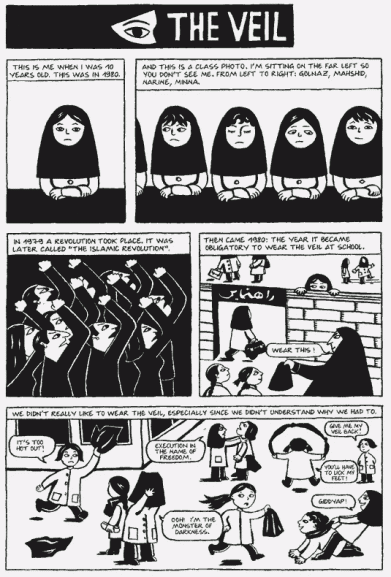
the-veil-jpg

Page 1 of Marjane Satrapi’s “Persepolis”.

This whole graphic novel is based around positive and negative space. Because there is no detailing in this novel and no other color in this novel it’s essentially a black and white novel which means that it’s based on positive and negative space. What I noticed about this novel is that this novel is one smooth flowing story that leads the readers eye from point to point and line to line. Since there is no detailing or other colors it makes it easy for the reader to follow along with the story instead of getting lost in the visuals.

There are a multitude of points and lines within the comic pages itself. For example, the first frame the point is obvious the girl. The next frame there are multiple points as there are multiple subjects, however they are arranged in such a way where the reader looks at them as though they were in a line. Planes on the other hand are used to show a wall, floor, entrance, etc. They are not exactly used on the subjects itself. Frames such as the third one have subjects arranged in such a way where it creates a line towards where the subjects are looking. Frames such as the third and the sixth one do not exactly have a line, however multiple points indicating the multiple activities going on within the frame. One important combination of plane and line to note are the narrative rectangles and speech bubbles. They are also an important markers that guides the readers eye through the story fluently and in the order the author intended.

As stated before there are no detailing or colors in this novel. That makes it strong because that way the reader actually follows the story like the author intended instead of getting stuck looking at a visual and not really knowing where they are at in the story.

Posted in Spring 2017 Archive (336), Uncategorized | Leave a comment

Point, Line, Plane: Alexandra Borders

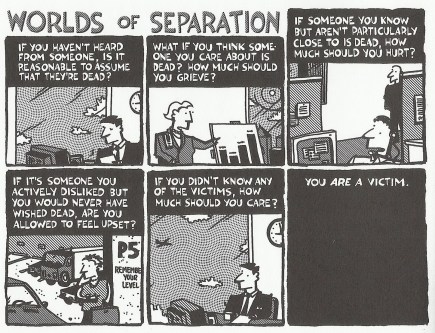
rall23a

This comic strip appears in Ted Rall’s “To Afghanistan and Back,” meant to convey what occurred following 9/11. Rall, Ted. To Afghanistan and Back: A Graphic Travelogue. New York: Nantier, Beall, Minoustchine, 2002. Print.

I didn’t realize we were going to be referencing the books we looked at in the library, but I did find a strip online of the book I briefly looked over: To Afghanistan and Back by Ted Rall. His travelogue is comprised of several different comic strips and this is one I found powerful.

Point, line, and plane are more important than they seem, being the basis of images, and allowing depth through patterns and textures. Points are the beginning, standing alone or being clustered to further create lines and planes and shapes, and being the natural shading of varying grays, seen in this comic strip.

For example, the lines drawn across the sky indicates the movement of the clouds, as well as the progression of time. This also conveys different planes, inside the office and outside the office, by different points being used together to create a solid place in time and space for the reader to follow. And the progression of the story being told remains clear.

The lines in this comic are clean and clearly guide the reader, including the edges of text boxes, making text plainly distinct. Lines used in crosshatching for the sky, something clothing, and office equipment give texture to nearly every panel, also drawing focus to each individual one without being distracting. This is important due to only a grayscale being used to shade the comic. The grayscale is overall cohesive and balanced, save for the last panel, which could act as a point of the strip as a whole, being what first draws my focus. This goes back to adding depth to the image. The white text contrasting against the black not only compels attention but gives more meaning to the panel, as if screaming, “This is important!”

Posted in Spring 2017 Archive (336) | Leave a comment

Points Lines and Planes: Emma Garcia

page-2-of-harvey-pekar-american-splendid

American Splendid By Harvey Pekar Page 2

Points, Lines, and Planes create an image and builds the image into a story. During class, I looked at the graphic novel, American Splendid: The life and Times of Harvey Pekar by Harvey Pekar. This novel was in all black and white was drawn in great detail. It told Pekar’s life story and his switch from collecting records to writing graphic novels. In every page of the comic the account for detail was incredible and led your eye to the central aspect of the frames.

I found that the central details in the images were the points because they centralized the focus to your eyes. For each of the frames, a man was the main focus along with the words coming from the speech bubble. The points marked the positions in the space and made the surrounding images capture more meaning. Harvey Pekar chose to write his graphic novel in black and white, this showed the details of points and planes, that color would have lost.

In this strip of the comic, they are set up as individual frames. By incorporating lines in the background he made them a large part of the frame, which created a connection between the man and the space he filled. These lines are visible in his jacket, hair, hands and face but increase in density in areas where it is darker creating a deeper effect. The use of lines in the frames helps you visualize the details in the room giving each frame a sense of location.  As for the plane, I think the decisions that the artist made were deliberate to create a specific design. Each decision the artist chose had a specific purpose including having the novel in black and white, which creates the impression of a surface.

A plane is described to be “a flat surface extending in height and width” in the book Graphic Design: The New Basics. I think the decisions that the artist made were deliberate in order to create a specific design. This is why the artist chose to have the novel be in black and white because it creates the impression of more depth within the frame and adds the aspect of Plane to his novel. The frame is expanded into something more through the use of Plane. Not only did the frames use plane but the text bubbles also create a sense of plane by expanding the text into something more than just a speech bubble.


Posted in Spring 2017 Archive (336) | Leave a comment

Point, Line, Plane: Toree Boutz


fullsizerender

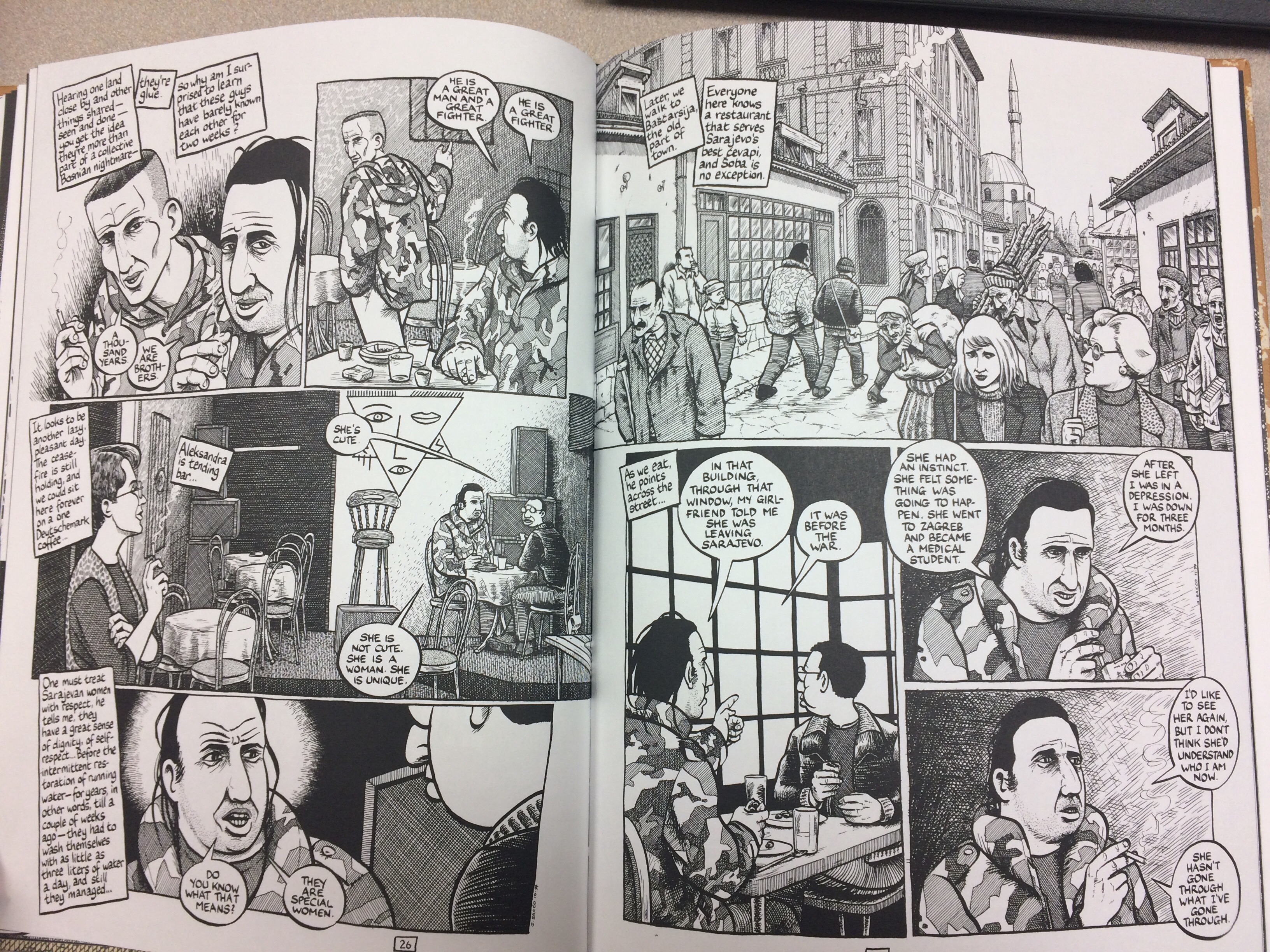
Pages 26 and 27 of Joe Sacco’s graphic novel, War’s End: Profiles from Bosnia 1995-96.

Ellen Lupton and Jennifer Cole Phillips outline the definitions of point, line, and plane and describe their uses and examples in the book, Graphic Design: The New Basics. While these elements seem like simplistic concepts, they are integrated in every part of the design world. Lipton and Phillips define a point as a marker of a position in space (page 34), a line is defined as “an infinite series of points,” (page 36), and a plane is a flat surface that may be expanded (page 38).

Examples of point, line, and plane can be found throughout Joe Sacco’s graphic novel, War’s End: Profiles from Bosnia 1995-96. Sacco’s uses a familiar comic-book type style to tell several short stories in his novel. Lipton and Phillips describe the way points and lines can be used to create images, along with shading. Something I immediately noticed about Sacco’s book was that it is entirely black and white in color, and many images were especially dark. Not only does Sacco use shading to create textures and patterns, but he also uses points and lines to shade the backgrounds of his images. This, paired with the emotionally dark nature of the stories, made Sacco’s stories especially powerful, because we see, and thus feel, the deep, painful, mysterious emotions of the novel.

Also using points and lines, Sacco creates shapes (usually squares and rectangles) to fill with individual images. These are examples of panes. Sacco creates flat spaces that vary in size and shape to tell his story with.

Posted in Spring 2017 Archive (336) | Leave a comment

Point, Line, Plane: Logan Quaranta-Rush

pointlineplane

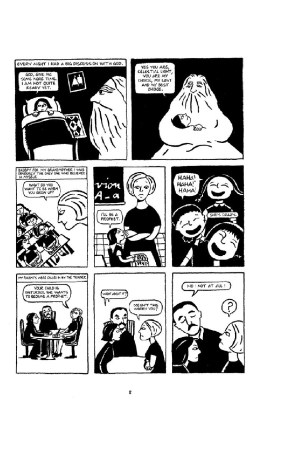
Page 8 from Marjane Satrapi’s Comic “Persepolis” 

In the comic Persepolis by Marjane Satrapi we are not distracted by large amounts of detail or color, allowing the reader to focus on the seriousness of the story being told. On page 8 the writer tells us of her dreams of being a prophet and her conversations with God. For a young child especially a female child growing up in Iran during a time of religious dominance and change this was a dangerous dream. This is made clear by the use of the implied line, a strong invisible cue that directs the reader’s eyes from character to character. While the images are in different boxes, the reader can trace a line from one character’s eyes to the next and with the low amount of detail in the image the author focuses on the expressions within the eyes, for these are the points inside the image. While not focusing on the accuracy of the plane each character or object sits on inside the frame, Marjane still uses it to give some depth to her work. The plane is most easily seen by the use of the tables or layering one character over another as seen in frames 5, 7, and 8.

Posted in Uncategorized | Leave a comment

Points, Lines and Planes: Alexa Berg

I took a look at the graphic novel Smile by Raina Telgemeier in the WSU library during Tuesdays class. The novel tells the true story of the authors awkward early years from 6th grade up to high school. The novel did a good job, style wise, at creating a teen like comical feel by using large gutters on the surrounding edges and thin clean cut gutters separating the straight-edged planes that give it its position in space. The large space surrounding the planes is symmetrical and makes it feel balanced and equal.  I thought the design choices made were appropriate to the story, especially with the use of splash pages. Each new chapter contained a full page image that introduced the scene that followed. It usually was a location, like the city, or a characters house, but succeeded at creating that acknowledgement of environment and draws your eye to it because of its surprising detail. It felt almost as if you were watching it through a television, only you can take your time soaking in each scene, which is why design choice is so important.

An interesting style choice Telgemeier made was the ridged lines around the planes during the earthquake scene. Right away your eyes are drawn to the dissonance that is occurring within the scene and its black background is capable of making the viewer feel the transition to a tense environment, as we begin to see something other than strictly arranged lines and a shift in symmetry. Another use of color was during Raina’s dental surgery, where the pages background appeared a decaying yellowish color to illustrate the characters lack of reality while she is under the anesthesia.

When significant actions occur within each plane, the words, made up of points which mark a position in space and express their own identity, are worded in bold and typically take up an unusually large portion of the comic. This immediately draws your eyes to the big letters and elaborates the importance of the action. It also ties into the “teen comedy” kind of feel that I picture the author going for based on her design choices in this particular novel. Overall I felt it was a very smooth and goofy visual read.


Posted in Uncategorized | Leave a comment