Point, Line, Plane – Cristian Gutierrez

img_2054

It’s pretty amazing to know we can move around a couple points, lines and planes, in order to create almost about anything. In this visual I chose, the layout of the design is very simple. It follows a structure that makes it easier for the viewer to digest the story. Each box enclosing the illustrations serves as the plane in which the story unfolds. The line framing the plane provides the illusion of a fixed parameter, sort of like a television. Each frame made from the interaction between the plane and line is made the same size as the others and arranged in left to right pattern that reader can follow. As for the points that make up the text in the illustrations, certain words are depicted in a darker shadow tone to emphasize its importance. The entire page, which serves as a larger plane for the illustrations to reside on, follow a symmetrical balance, that is very simple but works accordingly. Overall, the building blocks of the visual I presented interact very well to create a strong narrative.

Posted in Spring 2017 Archive (336), Uncategorized | Leave a comment

Point, Line, Plane: Tre Bobo

yossel3

From Graphic Novel “Yossel” by  Joe Kubert

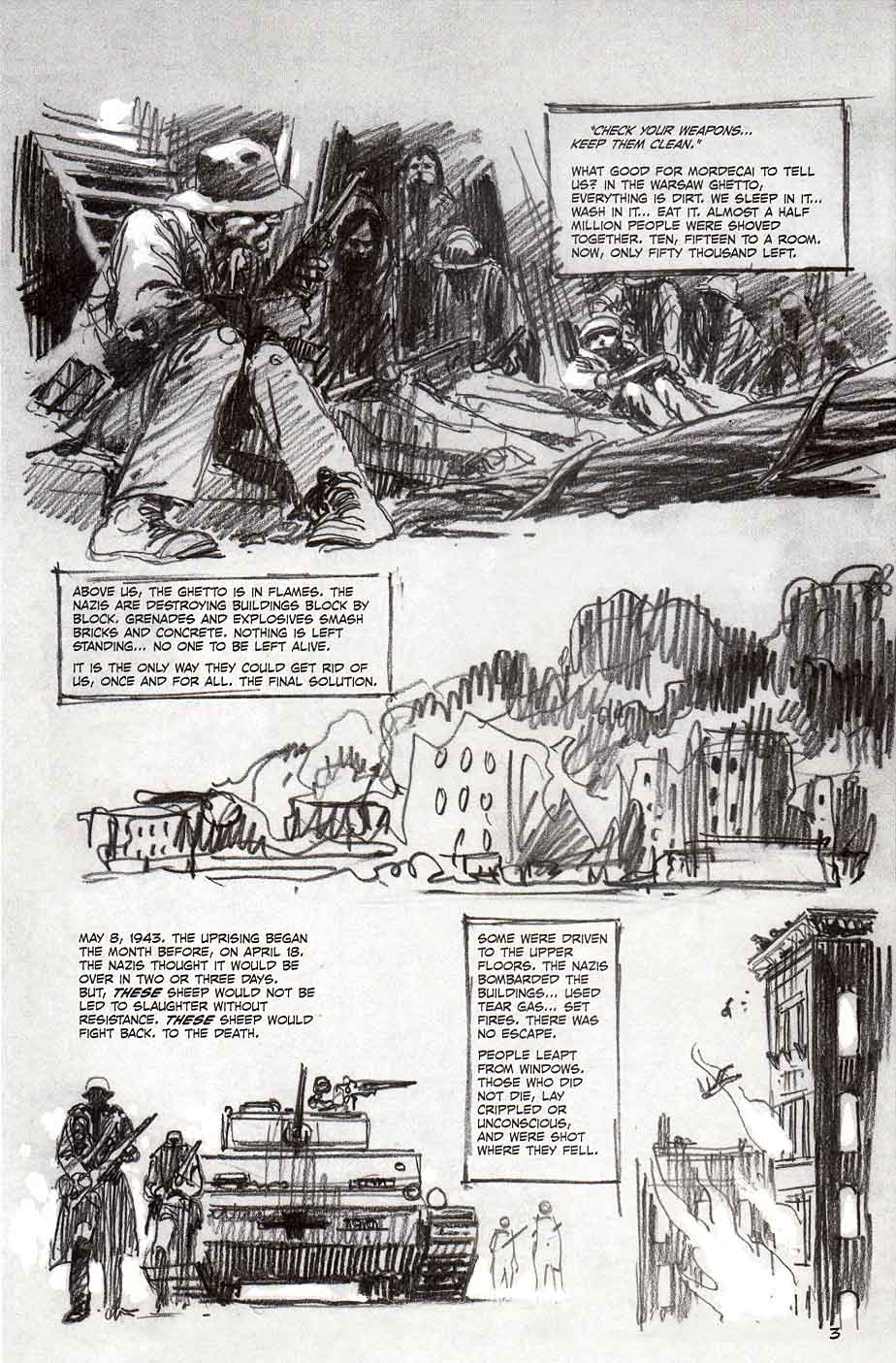
Reading the chapter “Points, Lines and Planes” in Graphic Design: The New Basics by Jennifer Cole Phillips, I was able to understand the importance of point, line and plane in the field of design and how the interaction with one another can represent anything from emotion, texture or even spatial distance. The book describes point rather simply, as a single position in space but when manipulated in its size, and positioning towards other things around, it can have many different meanings. Line was described as a series of connected points or the path between two points. Similar to a single point the way that a line is rendered can influence the perception of things like space and texture, however lines don’t always have to be physically seen as they can also be implied by the space around them. A plane is a flat surface from a closed line. Shapes are an example of planes and with the help of points and lines can create the perception of space or volume. The graphic novel that I read Yossel by Joe Kubert is about a Jewish person who enjoys drawing during WW2 at the Warsaw Ghetto Uprising. It is implied that the illustrations in the book are done by him given from the fact they all look like pencil sketches of events that happen in his life. The way he creates images as seen in the first frame above, really capture the emotion of sadness that is present in many of the Jewish people affected by this time.  In the second frame although less detailed still reminds you that this is a sketch done presumably by Yossel of the Warsaw ghetto in flames. The last frame is arguably the most detailed, in my opinion this was done intentionally to show how “clean” and “organized” the Nazis are compared to the Warsaw Ghetto Jews who are fighting back. These three frames show that without reading the story or being their firsthand you can sense the atmosphere of the situation just simple design choices like lines, shading and framing.


Posted in Spring 2017 Archive (336) | Leave a comment

Point, Line, Plane: Sophia Price

screen-shot-2017-01-18-at-1-10-47-pm

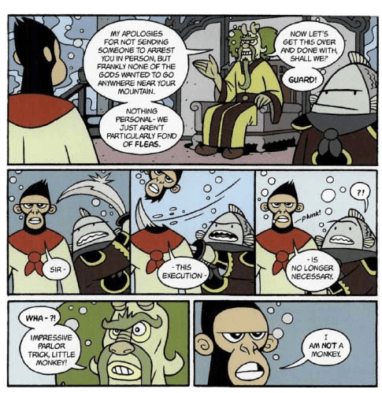
From Gene Luen Yang’s graphic novel American Born Chinese, page 146. Yang, Gene Luen. American Born Chinese. New York: Roaring Book Press, 2006. Print.

From understand what  point, line, and plane are I was able to gain a deeper understanding of how the author works as they create a graphic story. I did not know we had to grab a graphic novel from the library, so I chose one of my personal favorites for this post: An American Born Chinese. From using points and lines the artist was able to make a comic that causes the reader to know the clear focus point of the plane. This artist form of drawing mainly includes shading, where the points all come together to form a more solid coloring. The point of focus on the page is clear though the different colors used, and the way the characters are place. They cause my eye to follow through the frame to get to the main focal point of each frame. The points immediately bring my eyes to a section of each frame. For example, the first frame has the ninja king sitting on a thrown in a background of grey and black lines. His greenness causes him to be the focal point for the frame.

The lines used in this comic also help give the photo depth. The lines carry my eyes to a place, not just an empty space. You can tell from the placement of the lines under the window and the thrown that the image is set on a plane which is supposed to look more spread. The lines in this page also add motion, such as the frame where the monkey is getting his head cut off. The lines make it apparent that the sword has been swung. They also add to the shape of the curve, making it shine and curve as the fishman holds it up. Lines are also used to display emotion. The eyebrows shape, the eyes solid forms, and the changing of emotion between the characters are all depicted through lines.

The plane of this image is formed to be a room. Because of this I am able to trace my eyes as they look through the room, going left to right and then stopping on the green man. the plane adds to the way I see this because of the solidness of the coloring. The points have been brought together to give shape to each part of the comic, starting with the floor of the room and furthering to the chair the man sits on. It gives each frame a more solid way of being focused on, because the characters are not just floating in white space. They give location to the novel.

Posted in Spring 2017 Archive (336), Uncategorized | Leave a comment

2: Point, Line, Plane – Michelle Francis

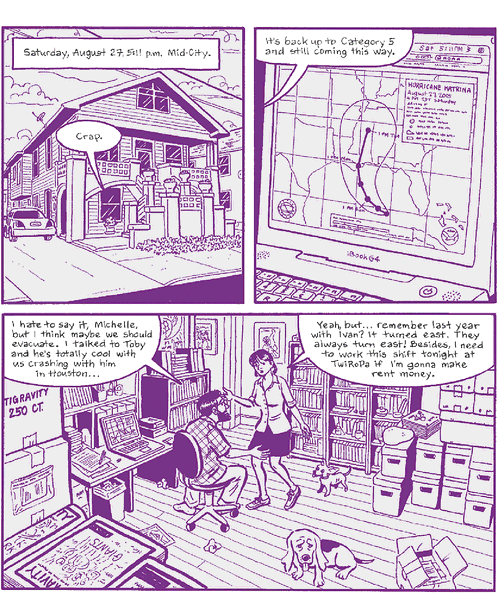
I had the opportunity to view New Orleans After the Deluge by Josh Neufeld. This graphic novel is a historical imagining of the lives of 5 (?) individuals just before and after hurricane Katrina in 2005. Neufeld uses large, sweeping shots and large, neatly aligned panels to tell personal stories in a very matter-of-fact tone. The first chapter shows us a repetition of scenery, separated by time and the tragic events which unfolded. Neufeld also gives us a very distinct rhythm and progression of time — we are clearly given dates when the scenes transition, and each individual’s story utilizes a unique color scheme. While pages contain, at most, 4-6 panels, Neufeld establishes a hierarchy by choosing to give more important scenes larger panels or even their own page (for example, page 11). Chapter 1 of New Orleans After the Deluge feels very much like Google maps snapshots of Katrina, in that Neufeld uses a birds-eye view almost exclusively. We are able to see the totality of the devastation before going into individual people’s experiences. Neufeld’s gutters are always clear, clean and even and tend to demark the passage of time and space. In chapter 2, the gutters are still crisp, but Neufeld uses people’s silhouettes to form organic borders which remove the character from their grounding in time and space.

I was emotionally affected by Neufeld’s use of the actual civil emergency message.  This added a sense of reality to the character’s situations – making the story difficult for me to read. We see this message woven into each of the character’s lives as they make their own personal choices: if they should leave, and then when, and then, horrifyingly, how…

6a00d8341c192953ef0120a58254ba970c


Posted in Spring 2017 Archive (336) | Leave a comment

Formstorming: Aaron Scofield

what-it-is-resized

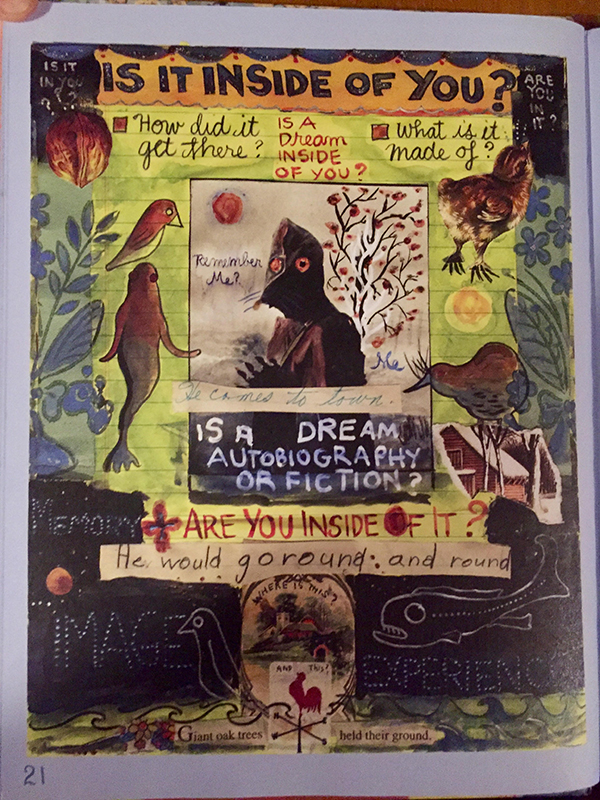
Page 21 from Lynda Barry’s graphic novel “What It Is”

Reading through the first fifty pages of Lynda Barry’s What It Is, you will notice a trend that Lynda asks several questions like, “What is an image?” and “Where do they come from?” She asks these questions many different times and in many different ways. By this, I mean that she uses different phrasing for asking the questions or she uses the same phrasing but with a different style of text. Throughout the book, she uses her creativity to find her imagination and the images and words used on each page resemble something called formstorming. Formstorming as explained in Ellen Lupton and Jennifer Cole Phillips’ Graphic Design: The New Basics, is a way that designers and artists can use one certain theme throughout a page or several pages, and they can stylize that theme and make several different variations to text or images in a creative and very unique way. There are examples of formstorming on practically every page of Lynda’s graphic novel. Shown in the picture is an example of formstorming from page 21. There are birds of different shapes, styles, and textures, as well as several questions about images and dreams and where they come from. Lynda uses a collage style of different cutouts of words and drawings that are layered over the top of each other. The lighter cutouts and the areas of the picture that are larger are what noticeably stand out when looking at the page as a whole. All of the pages are similar in collage form and the graphic novel is visually appealing from front to back.

Posted in Spring 2017 Archive (336) | Leave a comment

Formstorming: Cleana Broman

In Lynda Barry’s graphic novel, “What It Is” Lynda discusses how formstorming is basically brainstorming but in a visual and design-oriented way. The practice is more garnered towards producing variety over quality, at first, and then after a concept is picked from the wide array of variations, then the selected product can be polished in to the best possible finished product.

A good example of this would be the eggs shown in “Graphic Design, the New Basics” where the word, “egg” was showcased and put in to many different examples. Some more ways this could relate to real life is when an artist (I’ve definitely used this technique for digital art) will draw a sketch, and have several different pictures of the same sketch but with variations of colors to figure out which color scheme looks the best. I actually had to do this for a Fine Art class, and here is one of my drawings below.

colorsnew project.jpg

I utilized the formstorming technique in more of a controlled way to find my desired result, and then the students were instructed to pick their favorite color scheme.


Posted in Spring 2017 Archive (336) | Leave a comment

Formstorming: Alexa Berg

img_6840-1

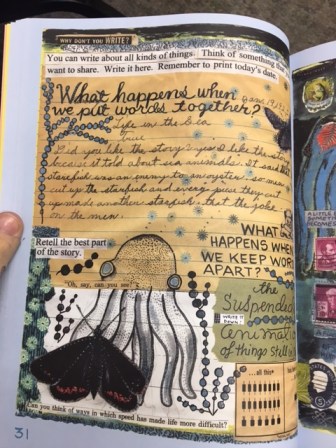
Page 31 from Lynda Barry’s graphic novel “What It Is”


Lynda Barry’s graphic novel, What It Is, features a series of images (or collages rather) that help to support the idea of formstorming, a term Ellen Lupton and Jennifer Cole Phillips describe as an “act of visual thinking” in Graphic Design: The New Basics. Formstorming is using your creative abilities to approach design solutions for problems that require more than one way of thinking. In other words, it relies on the imagination the designer beholds. It requires much endurance and exhausting iteration, but discovers originality to design dilemmas that dont often require simple solutions. On page on 31 of Lynda Barrys graphic novel, the series of images featured could be an example of formstorming for a few reasons. For one, the page explores multiple ways to produce text in graphic design by using several different fonts to create unique experiences each time. The top of the page says “Think of something you want to share. Write it here.” while below it asks the question “what happens when we put words together?”. This is Barry reiterating how different words combined together will create a different experience every time. It is the visual representation of the text in front of us that spawns the sensuality we experience. Also present on the page is the sentence “what happens when we keep words a part?” in a font that has gaps between each letter, also an example of why font style can be important. However, the most unique thing about this page for me was the re-telling of her favorite part of a story (written in cursive handwriting), about the starfish and the oyster. It made me think about how there are many different ways you could tell your favorite part of a story in a visual way, and how each one of those different ways will produce something different every time.

Posted in Spring 2016 Archive (336), Uncategorized | Leave a comment

Formstorming: Hak Do

20170117_102222

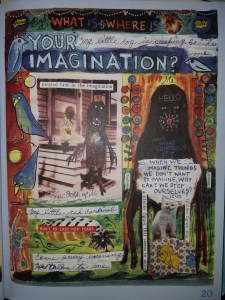
Page 20 from Lynda Barry’s “What It Is”.

In Lynda Barry’s novel called, “What It Is” she seems to use a method of formstorming in many of her pages and her pages combined in general. Formstorming is a tool for designers to unlock and deepen solutions to basic design problems, so Ellen Lupton and Jennifer Cole Phillips say in their book called “Graphic Design: The New Basics”. A basic example of formstorming would be taking a word and reiterating it in many different forms so one achieves many outcomes but in a slightly different style every time.

Lynda Barry has a more complex example of formstorming. The pages in the book can be combined to created a sort of formstorming theme. Almost all her pages include animals, or creepy figures, or words that form a sentence that turn it into a question. All her pages combined can be considered formstorming, however even just a single page can be considered formstorming. Such as in page 20 of the book. You can see that she has drawn three birds, however they are different in their own way. She has also drawn two creepy shadow like figures however they are not the same. Also she has questions and ominous quotes that have the same central theme, but don’t say the same thing.

The benefits of formstorming would be that it forces one to be creative with the subject matter. It makes one question, “What can I do to this subject to make it more interesting in many different ways?” Another benefit would be that after formstorming the producer could find something that he/she likes that they never would of thought that they would like unless they did formstorming. It adds new inventory to the producer’s skill-base and teaches more about the person itself.

Posted in Spring 2017 Archive (336), Uncategorized | Leave a comment

Formstorming: Cassidy Krahn

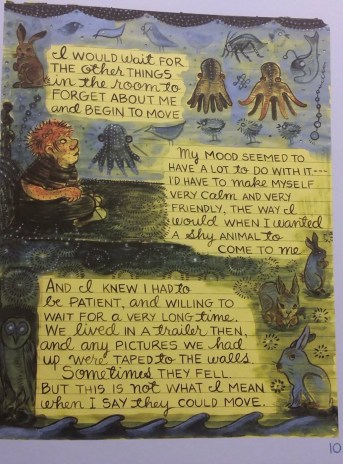
“Formstorming moves the maker thought automatic, easily conceived notions, towards recognizable yet nuanced concepts, to surprising results that compel us with their

What it is page 10.jpg

What It Is by Lynda Barry, pg 10

originality.” stated in the book Graphic Design The New Basics by Ellen Lupton and Jennifer Cole Phillips, perfectly encompasses the need and definition of Formstorming. We live in a world where there are few new ideas or concepts. The fast pace track we have it is hard to be original or new. But by practicing Formstorming we can push and challenge ourselves to come up with something from a different perspective outside of ourselves. A great example of this would be from the graphic novel What It Is by Lynda Barry on page 10. This page has many images going on, but one can see that there is different type of patterns, rabbits and octopuses. The words speak of waiting for the images to “forget about me” (Barry, pg 10). I understood the author wanted the pictures to move, and if they forgot about her maybe they would. So she drew them so many times in so many ways, I feel like it was her way of making them move, making them more or less realistic. Seeing which way would make them come alive.  There are four rabbits of each look more or less the same in different position, Formstorming could be happening to see which way they would come alive. The same could be said for the octopus and other elements on the page.


Posted in Spring 2017 Archive (336), Uncategorized | Leave a comment

Formstorming: Tristan Moran-Salgado


what-is-it-img

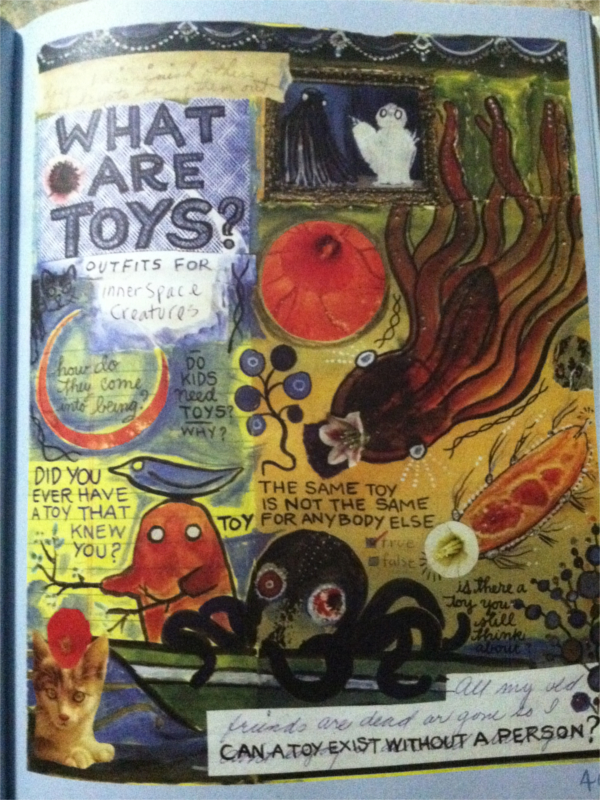
Pg 46 from Lynda Barry’s graphic novel, “What it is.”


In the first section of the graphic novel “What it is.” by Lynda Barry containing 50 pages of drawing of tons of different things from people to animals and such along with writing. During the 50 pages Lynda shows images and talks about imagination and her past as a child but doing it in a creative kind of way and a bit unorganized on each page. Each page has a bit of a grim looking with dark colors being used along with the different styles of writing but have the same inky style of drawings using repetition on each page as well.

The process Lynda shows in graphic novel would be the one stated in the book “Graphic Design the New Basics” by Ellen Lupton and Jennifer Cole Phillips, which is Formstorming. Formstorming is when trying to come up with new ways to draw and present the viewer from a basic design to bring back creativity people had troubles with. When people have, trouble thinking on what to draw that’s original they formstorm using basic shapes they know and draw it different ways to come up with new ideas and bring their imagination back. Lynda shows that in her graphic novel in her writing and pictures and Formstorming has several techniques but Lynda uses dailies. Dailies are when artists must draw a design every day for a least two weeks to help develop time management, disciplined, create a portfolio focusing on a topic aspect.

What Lynda uses in her graphic novel that shows that she uses Formstorming would be like page 46 for example where she has a bunch of things going on. The page questions “What are toys in big words and repeats the word toys in different context and different styles of text that has different meaning to the word. She has also repeated the drawings of the octopus, the bird, and the cat on the page and on other page having them be in different styles and forms whether it’s an inky drawing or a cut out of a picture and placed in the page of the book. She did those so they have different meaning for the viewer and did that as dailies.

Posted in Spring 2017 Archive (336) | Leave a comment