Formstorming: Sanaya Nordine

There is a fine line between what we call reality and “fiction”, and all these what is between resides in what we call, unconventionally, “the past”. It is a common human experience to recall something that was not there, or things we have never seen. In “What It Is”, Lynda Barry questions (and challenges us to question, in turn) “formless things which give form”, or “images”. In cut-and-glue style collages, she invites us to put together our own definitions of the following questions; what is an image? Where, and what is our imagination? And how do these things continue to live inside us despite having “passed”.
img_0228

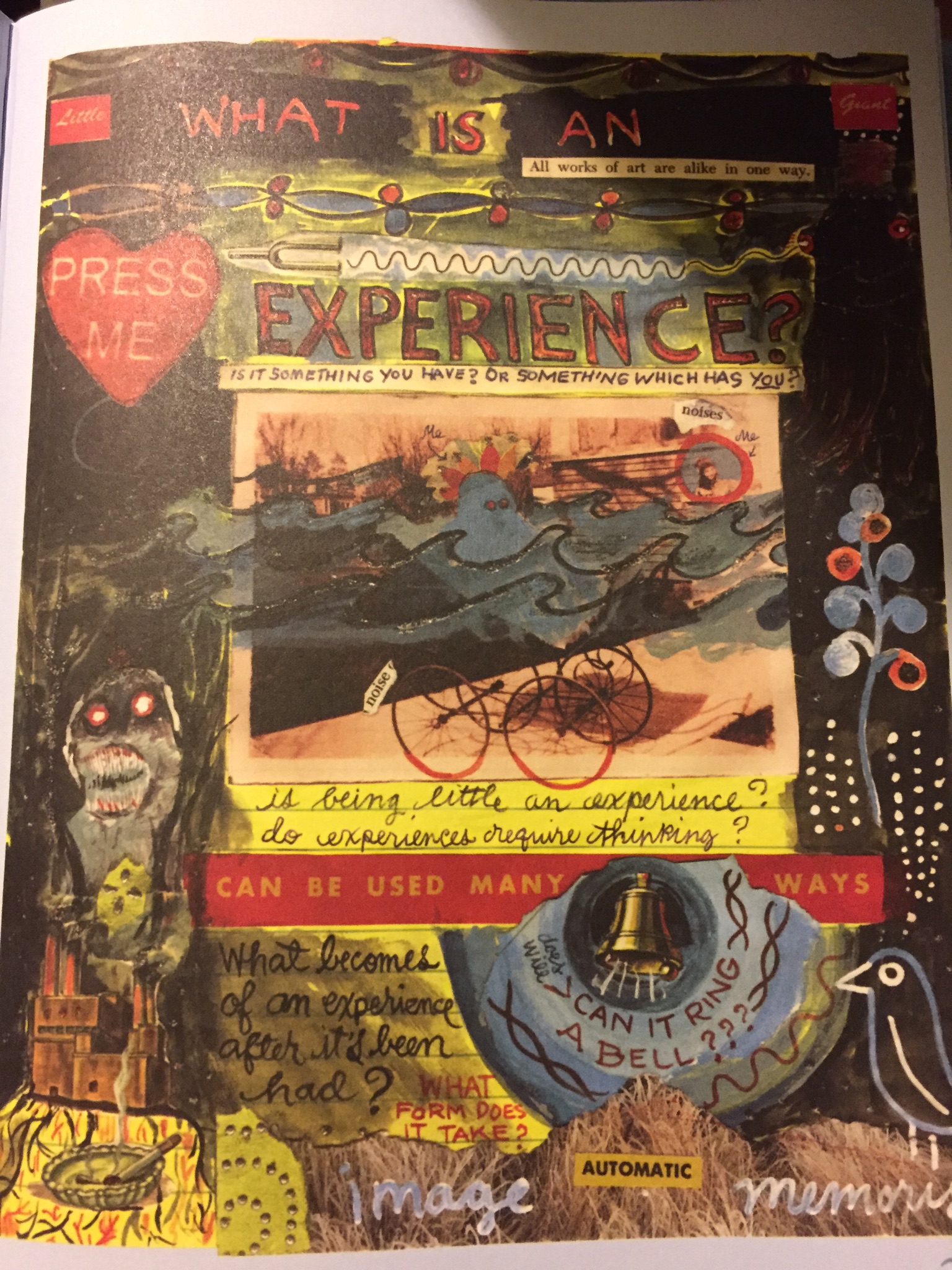
Page 22 of Lynda Barry’s “What It Is”

The artistic style of “What It Is” can be described by Ellen Upton’s and Jennifer Cole Phillips’ “Graphic Design: The New Basics”. The concept of “formstorming”-or a way of visualizing abstract concepts into different arrangements-relates to the way Barry designs her pages about concepts like image. For example, the page to the right, “What is an experience?” shows a variety of images and words. She can not tell us for sure what an experience is, so she poses different questions to guide us in creating our own meaning. Images like the creature on the left might remind us of a fearful moment, and the images of  bicycles might take us back to the time we learned how to ride one.
Posted in Uncategorized | Leave a comment

Formstorming: Eva Guillen

what-it-is-page

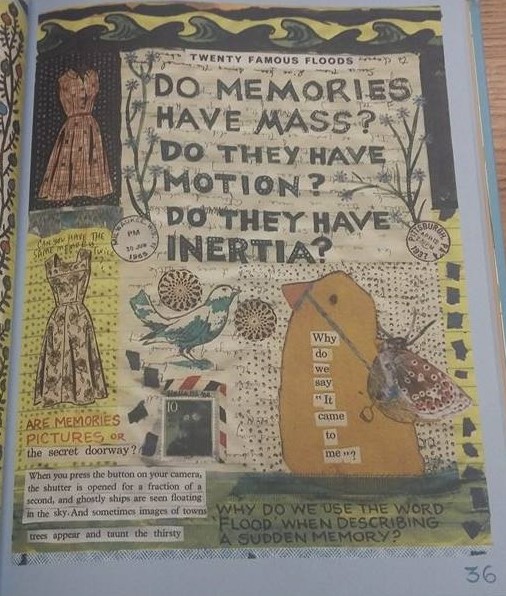
Page 36 from Lynda Barry’s graphic novel, “What it is.”

The benefits that come from engaging in the formstorming process is being able to make different arts with one strategy. Like mentioned in the book Graphic Design the New Basics by Ellen Lupton and Jennifer Cole Phillips that “Formstorming is an act of visual thinking” (13). It is a method for an artist to express themselves through the visual they make in order to compel a story. Formstorming is like a template for artist to use so that they can make what they desire. The image from the graphic novel What it is, is a great example of what the formstorming concept consists of. I wanted my example to hold a template style so as to show how the author demonstrates her story through it. The template provides the author with a template, like I mentioned before, to organize her work; and make it easier for the author to incorporate the story being told. Most, if not all, Americans tend to read from left to right, so this page in particular is organized well enough that the reader would be able to read in this form. Especially at the bottom of the page, it allows the reader/ viewer with an easy to follow graphic novel. The author of the graphic novel continuously used formstorming to organize numerous pages in the novel. Formstorming in this graphic novel allows an easier way to follow the content of the story and it also had great images to allow me into the authors’ world.

Posted in Spring 2017 Archive (336) | Leave a comment

Formstorming: Cristian Gutierrez

img_1818-1

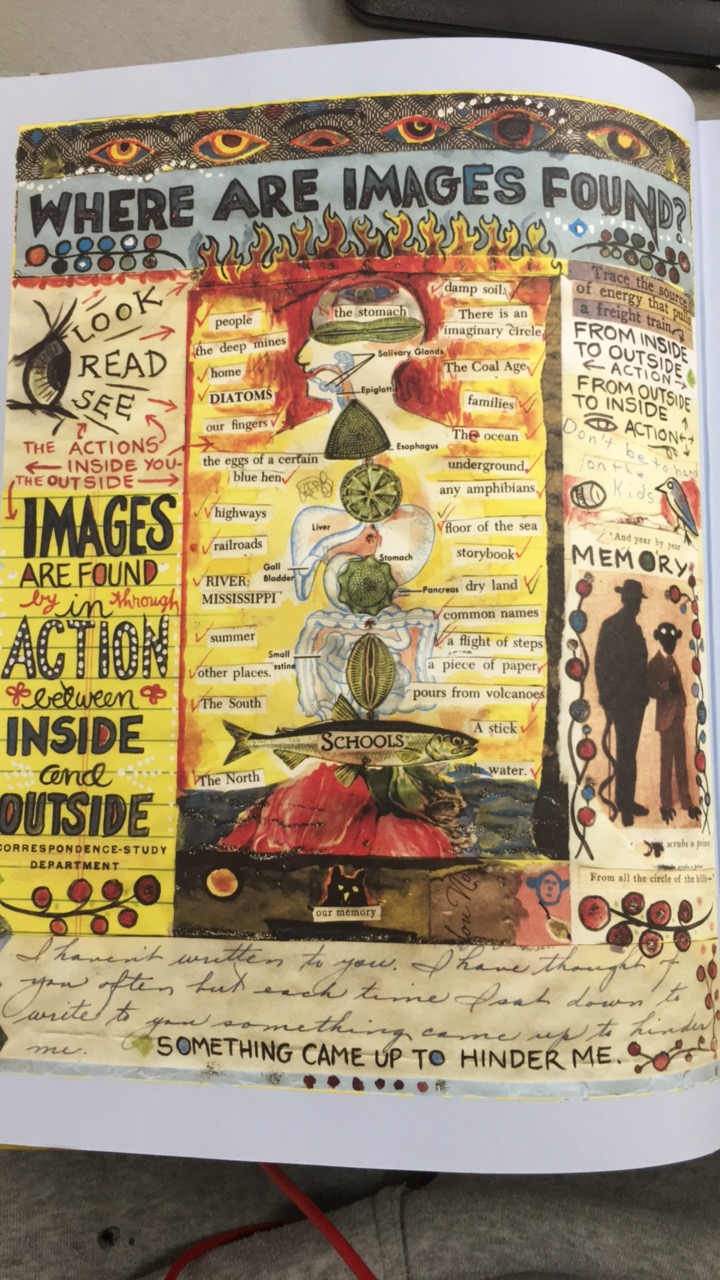
What it is! Lynda Barry (pg 15)

In the beginning of her graphic novel, Linda Barry starts out by talking about the notion of time. It seems as though; she sees time as something we can travel to back and forth. This notion is carried throughout the story. As conflicting as it may sound, she’s right. In the process of creating or designing something new, beyond pure convenience. Formstorming is a tool used to unlock greater solutions. It is, a necessary component to think outside the box. As a designer, it is very easy to get up with an idea based on what we think we know. Linda Barry in her novel talks about her mind being a landlord that doesn’t know its tenant. The idea is that our mind often finds a solution and it locks itself to just one idea. What Linda Barry is saying is that, time is irrelevant and we should let our mind roam free, pulling inspiration from past, present and possible future experiences. Sort of like the basic idea behind formstorming, which is to utilize exercises such as 100 iterations, templates, design investigation, dailies and other examples talked about in the Graphic Design book. Although Barry’s novel is not a draft we can observe various examples of the concepts talked about in the Graphic Design book. Some examples that stood out to me are found on page 15, here she uses some process verbs that also create an alterego. To her the words look, read and see might set a parameter for her to work in. This list might also have been used to create a set of actions in her chosen design. As for the alterego, it seems as though she might be putting herself in the shoes of the reader in order to help rediscover what it is that will make her design successful. She also does this by using the words look, read and see as a set of instructions to guide her readers through the chosen page layout.

Posted in Spring 2017 Archive (336), Uncategorized | Leave a comment

Formstorming: Jon Williams


Flipping through the pages of What it is? by Lynda Berry, I came across a page that really spoke to me as a person talking about memories. The images on page 33 discuss the idea of what is a memory, and what constitutes a memory. One could go literal with this idea, but rather than do that, Berry goes a different route and shows great design in how to talk about and to explain a memory in sort of a visual fashion. Memories often sit in the back of our minds and are often in the dark, but as we think more about them, they start to come into the light. The way Berry chose to format the page created an interesting proposition and discussion more about what memories are about or revolve around.

20170116_145023

Formstorming, which is a tool designers use to create more nuanced layout is shown on this page in the style of Formstorming Templates. These templates express a common core theme, but can be different art styles or composed differently than one another. The point still gets across, and there is some imagery where most would have a memory peak from the image of the duck that looks vaguely like Disney’s Donald Duck. Along with this, there are elements that may also trigger memories from people such as notebook paper and dish rag material/patchwork around the image, as well as other little things here and there. Whereas the discussion of the words should start the conversation on memories, the materials used do the work to actually bring memories forward, an interesting application of formstorming. I’d almost say that it’s perfect in attaining it’s goal.


Posted in Spring 2017 Archive (336) | Leave a comment

Formstorming-Henry Buehler


Formstorming is a creative problem solving method conducted through “visual thinking”. The primary elements of formstorming are repetition and variation, such as different fonts or kinds of eggs. These examples include different styles and different forms of the same subject matter. The first chapter of Graphic Design The New Basics properly explores formstorming. It states that, as designers, we must strive for excellence in each part of our designs and that clear visual communication is key.

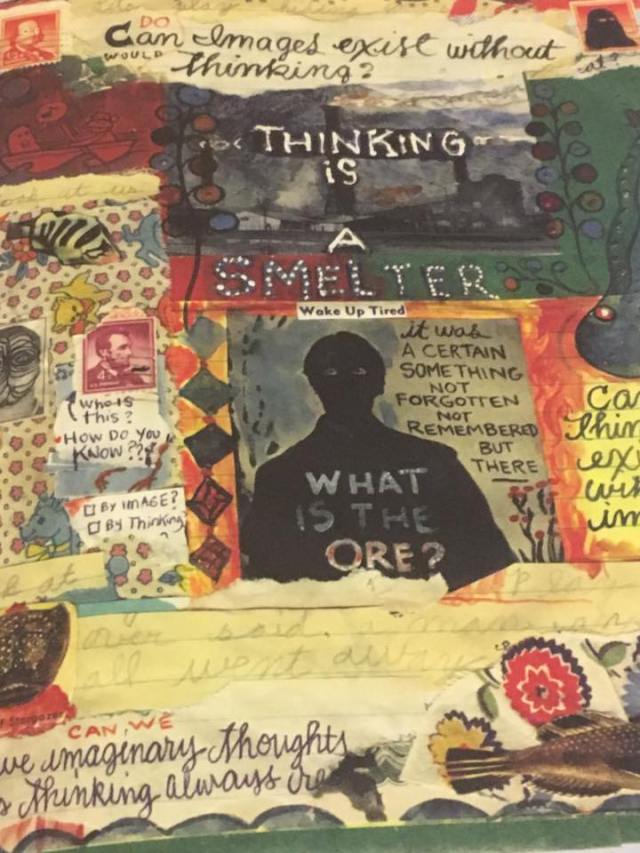
A lot of  pages of What It Is are collages and I think the page I chose represents formstorming very well: The first thing that catches my eye is the centered text that reads, “Thinking is a smelter”. There’s a dissonance in the font that is split between the beginning of the statement and the subject of that statement. The “a” is also placed unevenly between “Thinking” and “smelter”, which I believe was done to draw the viewer’s attention more towards the abstract visuals below. The collection of different images, fonts, patterns, and other visual elements such as different people, a squid, flowers, and so on add to the smelter analogy. A lot of different messages in the text also reinforce this: “Can images exist without thinking?” with “Do” and “Would” placed above and below “Can” to add to the message of the central question. There is also a stamp of Abraham Lincoln placed above the questions, “Who is this?” and “How do you know?”. Below those questions are two options, “By image?” and “By thinking?”.The text ironically helps frame the central message of the page and frames it. The author used formstorming to create this collection, choose every element down to the last detail, and express something visually through a work where everything has purpose.

16003092_738135246337174_1999538505861888656_n

(Lynda Barry, What It Is, 2008, pg 68)

Posted in Spring 2017 Archive (336) | Leave a comment

Formstorming: Jasmin Negrete

img_3288

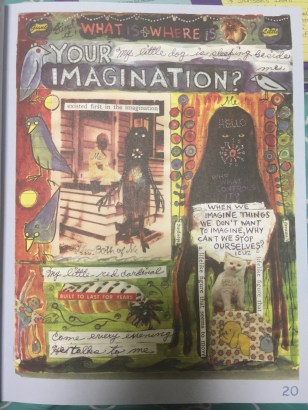
Page 20 from Lynda Barry’s graphic novel, “What It Is”

Through the first fifty pages of her novel, What It Is, Lynda Barry discusses many questions she has about images. From “Where are images found?” to “What is and Where is your imagination?”.In the first few pages of her graphic novel, Barry shares about her childhood, in which she would patiently sit and stare at the images in her house. In her story she mentions that she remembers that these images would move, blink, and breath. However, as she got older these illusions in the images began to slowly go away and now as an adult she has all these question regarding images. Throughout these fifty pages each question is stated on a single page and under or around these questions are graphics that give the reader a sense of what maybe  going through Barry’s mind when she asks these questions. Each of these pages can be seen as a form of Formstorming. Which according Graphic Design: The New Basic written  by Ellen Lupton and Jennifer C. Phillips is a template that designer can create to visually think and solve design problems. There are many forms of Formstorming, however one that I was able to notice throughout the first fifty pages of Barry’s novel  was One Hundred Iterations. In this type of Formstorming the artist creates multiple ways (or images) in which a certain idea can be expressed. A specific page in Barry’s novel that represents this was page 20, in which Barry sates her question “What is and Where is your imagination?” and under this question are various images. Throughout these various images Barry expresses what a persons imagination may look like or where it may come from. These images are all scattered across the page and  vary from birds to a kitty to dark shadows with creepy eyes. At first glance none of these images have anything in common, however with the question that Barry ask in this page one can see the multiple ways a person imagination may be. All these images are connected through one idea, which is a persons imagination, that is why this is a form of Formstorming.


Posted in Spring 2017 Archive (336) | Leave a comment

Formstorming – Mikah Chan

Formstorming , is a term used to explain “the act of visual thinking”or practicing brainstorming in the physical world outside of your head. As discussed in Graphic Design: The New Basics this method is used to investigate an idea. To analyze and critique, reiterate and perform, this is what formstorming is when thinking creatively. This method of thinking and experimenting is meant to work around basic ways of thinking about design or style, and skip past designs that look like many others’ work. Formstorming gives an individual a way to experiment with original ideas and then rework them until it is complete and sound. An example of reiterating ideas creatively can be found on page 14 of New Basics… in which one artist gives the representation of an egg through one hundred different iterations. By doing this, you can see that dozens of images and text can be used to represent an egg (i.e a image of Benedict Arnold), and that by experimenting and exploring an idea quite far, that the results bring you many original and creative products.

Another type of formstorming is also seen throughout the pages of Lynda Barry’s graphic work titled What It Is… Within its first fifty pages, this book explores the idea of what makes an image and how it is empowered and remembered by us. Looking past technical terms for thinking, Barry explores the psyche of our minds to help explain why images are important to us. Written on her pages are many philosophical questions, “What happens when we put words together?”, “What happens when we keep words apart”, “How do we recognize something?”, “Are there images inside us?”and so on. These questions help to build the somewhat loose narrative of Barry’s work, though also are the pages’ illustrations and images Barry gives us to accompany her questions.

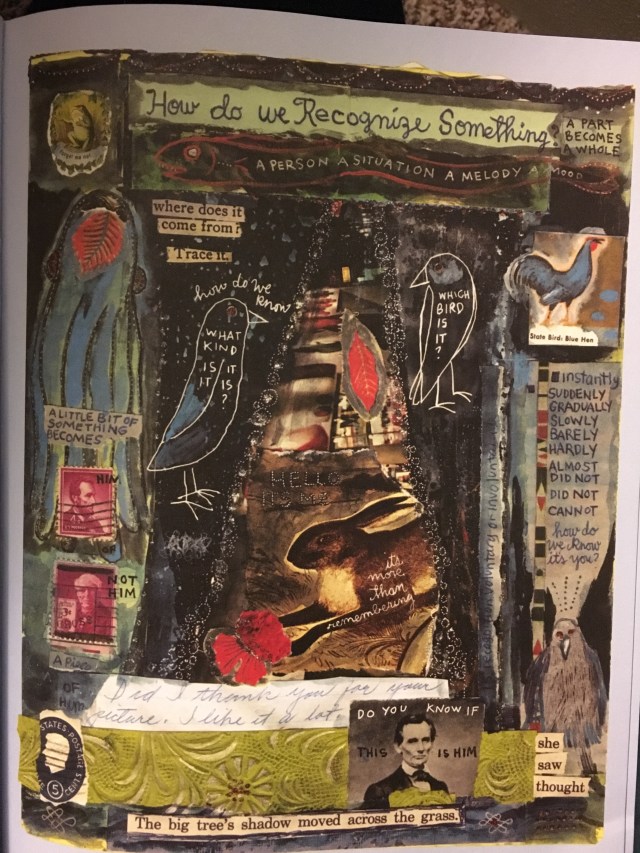
These pages including the featured image of this post (page 32 of What It Is…), shows us Barry’s own way of formstorming within her work. Though we see the final versions of each page, one could imagine the artist creating and recreating these pages until she was done. This page alone could represent an example of formstorming with the use of collage. A popular formstorming method, collage enables you to take cut out images, written text, original illustrations, and other materials to piece together and create an idea or vision. On Barry’s pages she uses collage to represent the images she refers to when addressing the text and questions on the page. The cutouts of Lincoln and stamps along with animals such as birds and rabbits giving an answer to how Barry herself recognizes something.

barry

Page 32 of Lynda Barry’s work titled “What It Is…”

Posted in Spring 2017 Archive (336) | Leave a comment

Formstorming: Tia Caton

336-pic

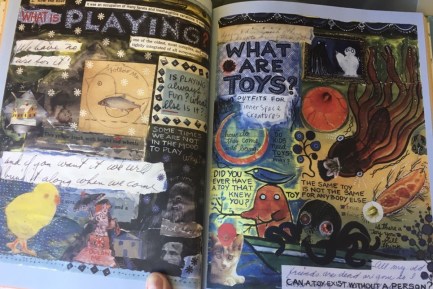
Pages 45 and 46 of What It Is by Lynda Barry

In the graphic novel, What It Is by Lynda Barry, we are exposed to a variety of different illustrations and collage like images that help depict parts of her childhood. Throughout the pages the reader learns of her dysfunctional family growing up and the small comforts she was able to find in her imagination and later, books. As a child she relied on the realness that she found in so many of her imaginations and later reflects on how she has lost that ability in her adulthood.  Imagination is a key component in the use of formstorming which is a major concept incorporated into this novel.

In Graphic Design: The New Basics, by Ellen Lupton and Jennifer Cole Phillips, formstorming is defined as an act of visual thinking and as a tool for designers to unlock and deepen solutions to basic design problems. Formstorming is focused on the idea of exhausting easily conceived notions in order to yield unexpected and profound results in return(13). Ultimately it forces designers to stretch their imagination and really immerse themselves into the art of creating. Barry uses multiple forms of formstorming but the one that jumped out to me in particular was her use of alterego.

An alterego is a tool used by designers to create a fictitious persona that amplifies, undermines or rediscovers an element of themselves (27). By illustrating herself as a child Lynda Barry is able to create an alterego of herself and revisit so many of the ideas, memories and imaginative ways of looking at things that she was able to have while she was younger. A good example of this is on pages 45 and 46 where Barry looks back on the idea of children needing to play and have toys. Each of these pages have depictions of what I believe to be some of her memories of her old toys. I feel as though all of her illustrations give off a feeling of childlike creativity and chaos that is seen in young children’s drawings. There are ideas and questions thrown about each of the pages in a scattered array, but by doing so I feel as though Barry has successfully captured the ideals of her alterego and is able to rediscover the imagination that she had as a child.

Posted in Spring 2017 Archive (336) | Leave a comment

Formstorming: Alex Gutzwiller

20170116_194831

Page 17 from Lynda Barry’s book “What It Is.”

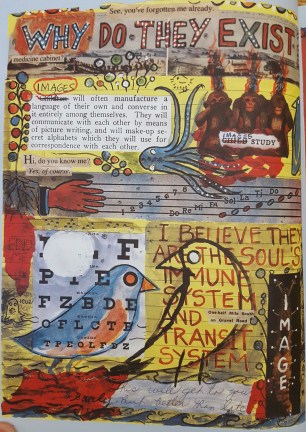
In the graphic novel, What It Is, Lynda Barry explores the ideas of what are images and how are they created. Throughout the novel, Barry seems to illustrate the difficulties a designer faces while developing the concepts for an image. Barry asks questions that are repeated throughout the novel such as “What is an idea” and “Where do they come from”, which seems to reflect the dilemma of how to assemble all the thoughts together for a design image. Barry responds with looking into the “past” or the “imagination” to gather ideas for the completion of an image.  The illustrations and ideas used by Barry describe several processes of formstorming as discussed by Ellen Lupton and Jennifer Cole in Graphic Design: The New Basics. Formstorming is the use of visual exercises by designers to promote creativity and develop richer feelings for the subject matter.  Through the use of formstorming tools such as repetition, revising and analyzing, as described by Lupton and Cole often leads the designer to the unexpected creative discovery for their design. One of the tools used in formstorming is alterego, which calls for the designers to explore themselves by creating himself or herself into a different person and looking through the eyes of that character to develop new and fresh design concepts. On page 15 from What It Is, I feel is an example of alterego as Barry asks questions such as “Hi, do you know me?” as if she is a different person.  Barry further states, “Children will often manufacture a language of their own . . .” however, crossing out the word children and replacing it with images.  This seems to me that Barry is reflecting on thinking about the thoughts of a child and not of an adult, allowing for new images to appear. This illustrates the formstorming idea of looking into the ideas of another character, in this case a child’s mind. Additionally, this alterego tool seems to be highlighted with the image of a bird within what appears to be an eye chart with the letter O for the bird’s eye. Further emphasizing the idea of looking through the eyes of a different character to experiment for new forms of creativity. Lastly, the images within this page also reflect the senses, as seen with the hand and touch, musical notes and sound, and with the monkeys that represent hearing, seeing and speaking.  It seems to me that Barry’s use of sensory images also reflects the concept of the alterego tool of formstorming because one can gain creativity through feeling the senses of a “fictitious” person the designer develops to rediscover new and different concepts for a design.


Posted in Spring 2017 Archive (336) | Leave a comment

1: Formstorming – Michelle Francis

Graphic Design the New Basics walks us through style of conceptualization called “formstorming”. I would describe formstorming as repeatedly re-conceptualizing a familiar subject in numerous ways while retaining the functional integrity of the symbol. My favorite example of formstorming, shared in Graphic Design the New Basics, shows us several illustrative iterations of an egg. What formstorming allows us to do is get the most obvious and mundane versions of an idea out of the way, clearing a path for more creative design solutions. In Lynda Barry’s What It Is, Barry starts by exploring the fundamental nature of images and where they come from. Images have been employed by humans for as long as our species has had the cognitive ability to think abstractly — a really long time. Humans are symbol using animals, and this is the basis for much of human communication, especially so in the digital age. The mere ability we have to formstorm shows us that our ability to think abstractly, to communicate clearly and creatively, is boundless. Barry’s artwork in What It Is lends itself well to this boundlessness. By combining and layering stylistically distinct images, Barry is almost using a type of formstorming. We are able to visually see the depth and range of symbols, laid out on a single page.

Posted in Spring 2017 Archive (336), Uncategorized | Leave a comment