Points, Lines and Planes : Gilian Fejes

POINT, LINE, PLANE:

Point, Line and Plane the fundamental building blocks for design.  All three of these factors together combine as a perfect synergy that builds relationships to each other to form visually enticing textures and patterns. These three aspects, together can depict light, shadow and volume which ultimately makes the enticing images we recognize today. With only one aspect, the image wouldn’t be as dynamic as if there was depth or created shadows from these manipulating aspects. With a simple line, which crates depth makes an image go from 2-dimensional to 3 dimensional in just a glance.

A point marks a position in space, a visible dot. Dots can be from one of the most irrelevant shapes but can create a whole image. For example, in photographs there are many tiny points all working together to make up an image, when you zoom out a little, the image looks pixilated and grainy. The point can play some perceptual jokes on the mind. The points can work together to make out an image. Or be a focal point of one, on a bigger scale.

A line is an infinite series of points, a connection between two points. It can be used as a positive mark or in a negative gap or shadowing. Lines occur in many weights of thick, thin and texture. Lines in typographic sense are implied and sometimes drawn.  The white space beneath this sentence is considered an implied line. The space between it senses a form of organization and direction. Lines can be applied to almost every object, organic and not. With curved and straight lines, it is the biggest necessity while creating visually enticing work.

A plane is lines closing to form a flat surface extending in height and width. Planes can be parallel to a picture source or skew into space. Overall it is a space where lines close and are filled with dimension and shadow.

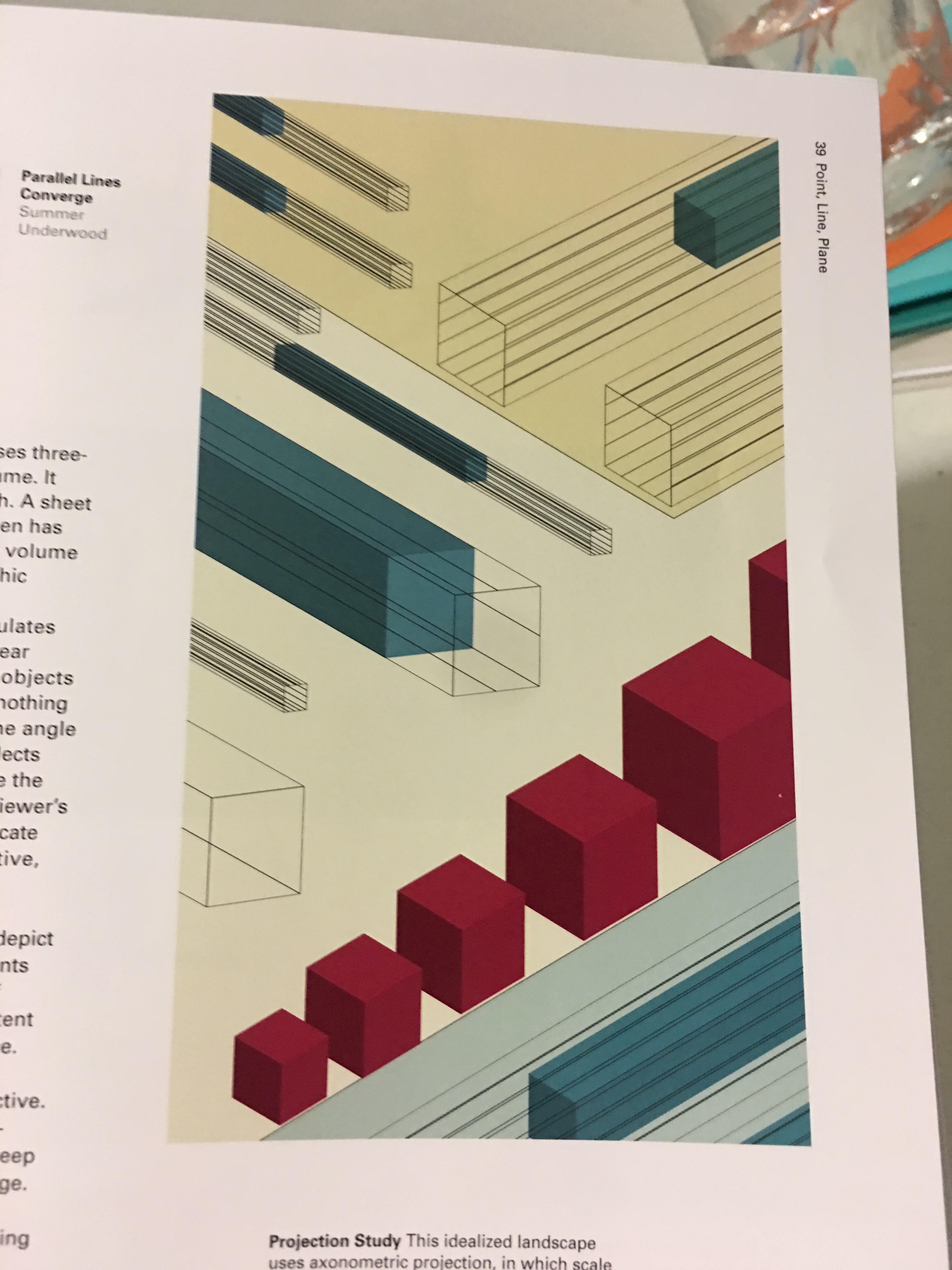
The photo I chose below has all three aspects of point, line and plane. Every ‘box’ corner has a point that connects each other into lines, that eventually gets filled into planes. Some of these boxes have more dimension and textures than the others because of the line usage and the thickness of the planes that are being exemplified.

photo:  Graphic Design The New Basics by Ellen Lupton and JIMG_6194.JPGennifer Cole Phillips
Posted in Uncategorized | Leave a comment

Scale: Logan Quaranta-Rush

scale

Page 15 from Marjane Satrapi comic, Persepolis

With the amount of information that a person gathers every moment an author must use different design techniques to focus the viewer’s attention to what is happening on a single piece of paper or screen. One of these ways is by scaling larger, relative information, that is information that the author wishes the viewer to understand. Using an example from the Comic Persepolis by Marjane Satrapi, on page 15 we are introduced to a new format of frames. Much different from the three by three as we have been seeing previously, instead we are given only two pictures. The first, a short but wide image zoomed out showing the chaos outside the movie theater. The second, a large image taking up almost the entire page, a closer image bringing the viewer in and showing them the fear and destruction happening. With these images we see the contrast of something that is scaled up and made to seem even larger when it is next to something smaller, even though the smaller image is still 3 times the size of the normal frames.

Posted in Spring 2017 Archive (336), Uncategorized | Leave a comment

Nikki Aviles: Point, Line, Plane

I believe the photo I chose for this assignment best represents point, line, plane, because thats all this photo is made up of; points and lines. The word “Mexico” is made out of a bunch of lines that have been bent and manipulated so it would spell out the word “Mexico”. By doing this, the lines also created some sort of texture, or “plane” and keep your eyes busy by following the continuous lines. The points in this photo are the circles at the end of the word. These circles remind me of the Olympic Games symbol. This photo looks like it was taken on the street and somebody either gratified the word on the wall, or its a big sticker someone designed and printed out. Either way, the people in the foreground in motion walking past the sign also gives it another layer of depth. The people help give a sense of where you might be, like I assumed, on the street somewhere. I found this photo off of a graphic design blog created by Jennifer Gordon.

https://jgordonumd.wordpress.com/2014/01/23/point-line-plane-texture-scale-3/

The 1968 Olympics logo. Jennifer Gordon.


Posted in Spring 2017 Archive (336), Uncategorized | Leave a comment

Scale: Cassidy Krahn

Our book Graphic Design: The New Basics by Ellen Lupton and Jennifer Cole Phillips talk about how scale is relative and a motion, among the others as well. I feel this comic from

action-comics-no1

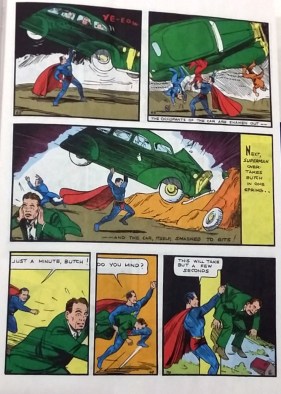
Action Comics No. 1 June 1938, Superman!

Superman, found in Action Comics No. 1 June 1938, utilizes these two ideas well.

 
Let us start with motion. Looking at the placement of the car we can infer its moving. In fact, our eyes might just move between the top three photos rather quickly, due to the lack of words. But this allows us to see the scale in which superman is exerting his strength of the massive car and moving it in the photos. It helps we are familiar with the build of man and typical size of cars, making it easier for the reader to interpret the story.

In the second frame the car looks relatively larger because the cropping of this does not let us see the whole far but frames most of it. Leading us to think it is closer to us and larger. This can also be said for when we compare the car to Superman himself, he is a slightly above average male size, and the car is much larger than himself. We are also left guessing in the bottom right frame, where the barn is very small and Superman and Butch and “normal” sized as they climb up the power line pole.

Posted in Spring 2017 Archive (336) | Leave a comment

Framing: Conor Reich


I found the short comic above while researching the importance of framing in comics. I absolutely love this comic as it highlights the importance and significance frames add to an image. The frames in the comic above are fairly standard until the last panel in which their are actually two frames. The comic is illustrated to portray the message that no matter what lies inside the frame, the simple act of framing emboldens whatever is housed within. I like this comic because it also emphasis the dedication illustrators put in to their work. No frame is wasted or unnecessary as each one should serve to capture a moment.

While researching I came across the notion of rhetorical frames which is a technique of framing which scales the image to the frame. Rhetorical framing allows the reader to see exactly what the illustrator wants them too. If the comic were to end without the last panel we may not even notice the broken frame lying at the bottom right hand corner of panel two. Rhetorical framing allows the reader the opportunity to witness each every important action in a sequence of events from start to finish.

Posted in Spring 2017 Archive (336) | Leave a comment

Point, Line, Plane: Conor Reich

killing-joke

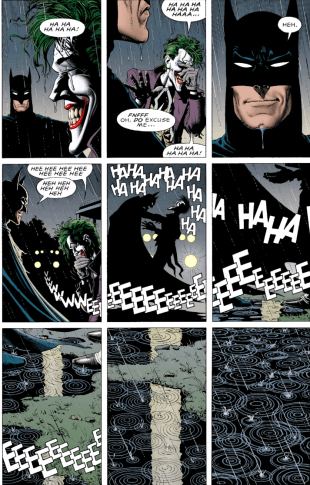
The last page of, The Killing Joke, written by Alan Moore and Illustrated by Brian Bolland

The last page of Alan Moore’s, The Killing Joke is an excellent portrayal of how points and lines can serve to not only add to the depth of field, but they can also demonstrate volume, sound, and mood. The last three panels demonstrate the complex images simple point and lines can create.

The lines angling downward are an indication of rain. As readers, we know the rain is falling downwards because the artist intentionally added a heavier point to the end of the line. Concentric circles roll out from these points to indicate the splatter of rain upon the city’s streets. These concentric circles appear to be larger and more concentrated near the bottom of the page as opposed to the circles near the top. This technique places the falling rain on a plane which further adds to the image’s depth of field. 

The circles also indicate the volume of the rain and the coinciding sounds and moods which accompany it. For example, rather than adding more lines to panels to indicate more rain, the illustrator clever portrayed the water as pooling up enough to make visible drips further adding to this story’s poignant ending.


Posted in Spring 2017 Archive (336) | Leave a comment

Scale: Dave Herman

img_0694

“Slippery Eall” (Nov. 30, 1947) by Will Eisner and Jerry Grandenetti.

This page from Slippery Eall was drawn mostly by Will Eisner with the backgrounds drawn by Jerry Grandenetti. I thought that this page is an excellent example of scale in a graphic novel. The newspaper was positioned in the forefront so that it appears larger and so that the text on it can be read. Also the street lights, equal in size, appear to shrink as they grow farther away; eventually growing shorter than the man. I would argue that due to the size of the sewer drain, this should be considered the focal point of the page. The text on the newspaper confirms that the sewer is a metaphor for the trap of crime. Also the amount of trash in the foreground might indicate a dreary and gloomy industrial atmosphere. It seems that Eisner took great care in detailing larger images in comparison to smaller or further away images. The man walking along the stream could indicate him following this stream of crime; like a detective.

Posted in Spring 2017 Archive (336), Uncategorized | Leave a comment

Framing-Miguel Bustos

iron-man

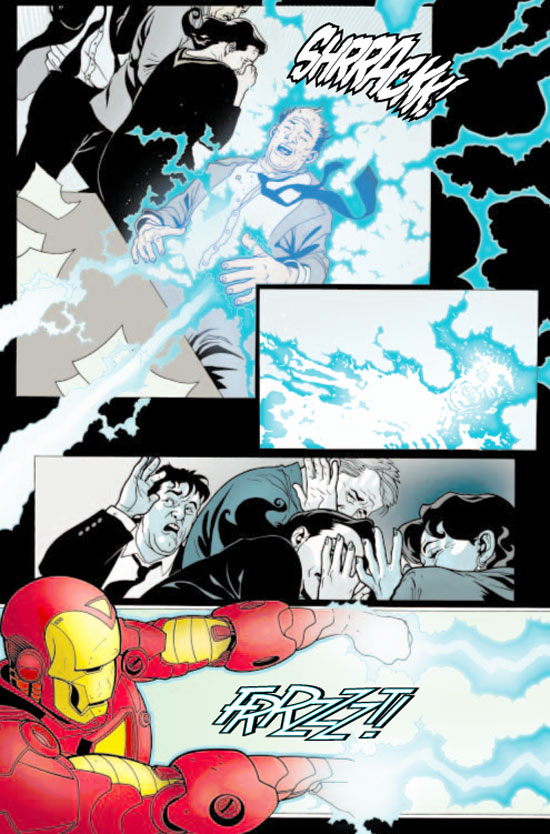
Iron Man #86, Page 12,Written by Mark Ricketts and Pat Lee

In this page of Iron Man, the artist does not use a full page bleed.  He uses the negative space to imply the different frames.  The two frames with the board members are different sizes to portray different things.  In the top frame we can see the entire body so that the full effect of the lighting is seen.  The middle frame zoomed into the board’s faces.  The scaled up and enlarged so that they emotions on the faces is more visible.  Ironman and his lighting break the frames to help show that they are involved in and affecting all of them.

Posted in Spring 2017 Archive (336) | Leave a comment

Point, Line, Plane-Miguel Bustos

cover

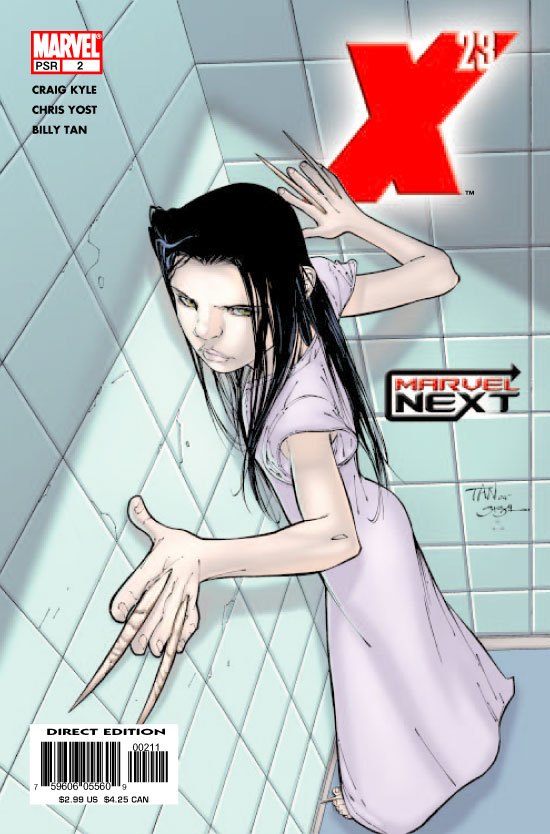
X-23,Craig Kyle & Christopher Yost, Billy Tam, Marvel Comics, Cover Page.

In this picture, we have several parallel and perpendicular lines. Because the lines are arrayed in a pattern we are able to tell that this grid formation represents the grout between tiles. These lines all seem to be converging on a vanishing point. The point itself is not visible but implied. This allows for the background of the picture to have depth. The lines also create a sense of plane which the reader can interpret as a wall. This cover has three planes that converge so it is evident that the girl is in a corner. The artist then uses these as a reference point to draw the girl in proportion to the room. He also places her directly on top of the vanishing point so that even though she isn’t perfectly centered on the page, our eyes are still naturally drawn to her. The character’s pupils are points that are also used to draw in our focus so that we can not only see her face, but the expression and emotion on it.

Posted in Spring 2017 Archive (336), Uncategorized | Leave a comment

Scale: Makenna Coxey

scale

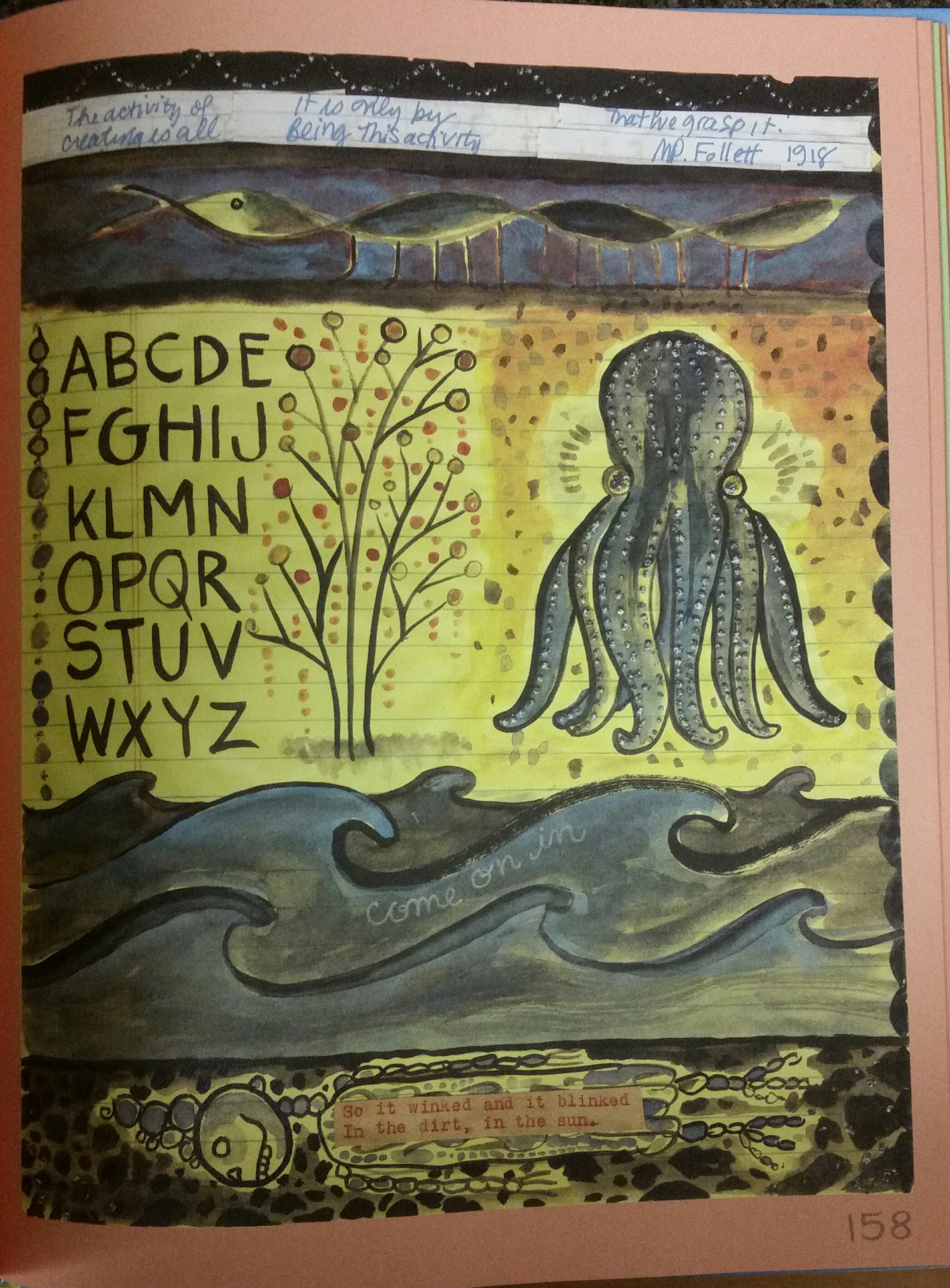
Lynda Barry’s book What it is. Page 158

the I chose this Image from Lynda Barry’s What It Is, is because the use of scale here is interesting, with the octopus figure to the tree is clearly not proportional. In real life the tree is usually larger than an octopus. Referring back to Graphic design: The New Basics talks about objective and subjective scale. in this particular page I believe that this would categorize under subjective scale because we understand that usually letters are not supposed to be as big as a tree or a tree is not supposed to be smaller then a octopus. I think that the point of this type of scale is supposed to create emphasis on certain parts of the piece and create a path that your eye follows. in this piece first my eye looks at the two brightest things on the page, which is the yellow block that contains the letters, tree, and octopus. and from there the choice of scale draws you to look at the waves and the person figure beneath them, then finally the small letters that inside this person or at the top of the page. it is intended to make you look at the images and then the text. in this particular image there is not a lot of objective scale, because nothing is really the size that it is supposed to be, the only thing that might be considered objective scale is the words at the top of the page inside what looks like to be lined paper. something else that I notice in this image is that there are words inside the waves, with the choice of these words to be small and in the shape of the wave it suggests that the author wants you to engage in the image behind the words because they are shaped like a wave.

Posted in Spring 2017 Archive (336) | Leave a comment