Figure/Ground: Lauren Campanella

Famous rabbit-duck illusion dates back to 1892. (Salisbury, 2015)

All things exist and interact with other things. This is very broad and can mean a lot of things, but when it comes to figure and ground relationships they shape a visual insight. Known as positive and negative space, imagine a Rubik’s Cube with only black and white squares and then mix it up a bit. This is what figure/ground relationships look like in art. The book says “a stable figure/ground relationship exists when a form or figure stands clearly apart from its background.”

There are a few categories within figure and background – stable, reversible and ambiguous. Out of the three, ambiguous is the most complex because it challenges the audience to find a focal point. In this famous image, one look and a person might see a duck. Take another look and you’ll see a rabbit. I chose this image because these types of images have one obvious pattern and another that you have to adjust the eye to catch. It’s only a bunch of black and white lines that make two different images in one. Our brains are responsible for creating visual impressions and choosing what a person sees in images like this one.


Posted in Spring 2018 Archive (336) | Leave a comment

Figure/Ground: Daniel Kim

Image is based of the Figure/Ground principles. Characters in the yellow/black: Penguin and Batman. Characters in red/blue/black: Spiderman and Green Goblin. Image taken from Smash Magazine.

Figure can be defined as solid in a void, focus point, or positive. Figure’s functioning partner is ground, which is the void around a solid, background, or negative.

The image on the left, represents DC Comic’s superhero characters and their arch-nemesis. I found this image to be a great representation for the figure/ground concept because of the balance between negative and positive space usage. The balance of space creates an image where the focus point can be either Batman or Penguin, for the black/yellow image, and Spider-man or Green Goblin, for the red/blue image. Due to the colors having such heavy contrast, one may find it difficult to keep their attention on one of the areas.  This ambiguity is based off the concept called reverse figure/ground, the equal attraction to negative and positive components. I believe people who are familiar to these specific characters may have more trouble focusing on a point because they already recognize the two figures by shape. By recognizing the shapes before viewing this image a person will be able to point them out. On the other hand, one who does not know about DC heroes/villains will only be able to recognize one major figure and ground. In comparison to one another, the blue/red image is a little more unique because of it uses the black space a special way. If I were to put myself in the shoes of a person who has never heard of DC in general, I would’ve seen an image of a man with light shining on him creating a blue shadow on his back. The black space created even more ambiguity by creating this illusion that the focus point was the silhouette figure and the colors were for depth. Due to the ambiguity, I believe the image of Batman/Penguin and Spider-man/Green Goblin are not a good way grab the attentions of new people. On the flip-side, people who recognize the characters may use the images for ornamental functions.

Posted in Spring 2018 Archive (336) | Leave a comment

Figure/Ground: Abby Larson

Makrina Oikonomidou’s design for Bone-A-Pet-Treat

The positive space is the subject of this image, yet the cut out from the easily recognized bone shape gives the background more meaning. The background cuts into the foreground to create a second subject. This second subject is the ‘invisible’ dog that is holding the bone up. The iconography seen in this design is essential to its understanding. The shapes that create the logo are easily recognized as a dog and bone, which informs the audience that the function of this design is practical, since the design tells the viewer that this business is for pets.

Makrina Oikonomidou’s design for Bone-A-Pet-Treat on a storefront

I found this company’s logo to be a perfect example of ground and space ambiguity. Instead of additionally adding a second subject and color to the logo, the designer simply used negative space so that the viewer can see the dog despite there not actually being a dog here. This logo is more interesting to look at due to the negative space since the background becomes the foreground. If you look closely at the second image, the logo is used at the top of the windows in a pattern. Each version of the logo is slightly different however, because the dog that is created from the background color is given a hair-do that is unique to each repetition.

Posted in Spring 2018 Archive (336) | Leave a comment

Pattern and Texture – Robert T. Hartley

Pattern when something or a structure is organized in a way that is consistent creating a visually pleasing balanced aspect where the design is repeated in a repetitive unit, shape, or form. Pattern can exist almost everywhere in various forms. From a microscopic level to an almost infinite level patterns can be observed. Many artist use patterns in their artwork to grab the attention of viewers and to give their art a visually interesting factor. Some can be very subtle patterns while others can be exaggerated. Within a pattern the elements do not have to be consistent, but is required to be consistent in design. The history of patterns date back to ancient times or even the beginning of human kind. From walls in the cave to drawings found in Egypt. Architecture has been heavily influenced from patterns as well. Not just being a design aspect, it has also been found to be useful within structure in order to enforce stability.Processed with VSCO with b5 preset

As you can see her, there are multiple patterns in this image. From the bricks in the wall that serve as an element is placed in an organized, structured, matter that is consistent and visually pleasing to the eye. Or the windows that are placed equally from one another, repeating it’s design over and over again.


Texture can exist in two dimensional art as well as three dimensional art, being either visual or physical. One can make you feel that you are touching the piece through relation to the object. For example if you see that an image creates a visual aspect of a sand paper, people who have touched a sand paper before can imagine the texture.

These two images both use two-dimensional texture in order to create highlights or contrast between the images to better attract the eyes or make the object feel more real even though it’s not physical.

Posted in Uncategorized | Leave a comment

Pattern and Texture – Samuel Jonsson


A quality photo of the ocean taken by Phil Davis. It’s on flickr as a public domain.

Texture is a natural part of the environment and because of this, design. Textures co-align with whatever subject it is that that texture is applied to. Textures can even be found in different fonts, for example: wether something is italicized, bolded or normal. Textures, unlike patterns, are not reliant on any sort of rhythm or repetition but rather are random and consistently shown across the entire subject. Texture is what gives a surface it’s identity through use of lines and dots. I chose this example of the ocean because water is something super difficult to replicate digitally and yet the ocean maintains an iconic and signature texture unlike anything other.

A classic tessellation made by the infamous M.C. Escher. Using pattern and negative space this piece is well knit and cohesive for seeing a fish turn into a bird. Found through tes teach.


Pattern is not something that defines the look of anything but rather only defines the position it’s and it’s relation to other objects within that piece. Patterns are also a representation of a lot of cultural identities. Something non-western may consist of intricate details while something modern and western may be simple and plain. Patterns can be broken into categories of dots, stripes or grids but is not limited to only these groups. Complex, overlapping patterns can be made when introducing colors, a change in size or details points. I chose this piece of M.C. Escher because he’s always been one of my favorite artist’s and when the assignment asked for something pattern related he was the first thing to pop up in my head.

This as a frame from the music video Robot Stop by King Gizzard and the Lizard Wizard, one of my personal favorites! It’s such a wonderful blend of textures, effects and gritty attitudes. Worth checking out on their VEVO.

Graphic design, at its most basic, can be broken down into three things: point, line and plane. A point is a focus of something, it doesn’t necessarily have to be a dot but rather an object or identity with a given position within the piece. A line is a continuation of dots to establish a certain distance from one point to another. A direction is given to the line if there is a focus on one end of it because it carries the viewers eye to that other focus. A plane is at least three lines connected to create a limited space or shape. When planes are connected to other planes with the same lines it creates a volume or 3Dimensional shape. For this example I decided to with this music video made by the legendary Jason Galea due to videos intense and varied use of all these aspects of digital design, pattern and texture included.


Posted in Spring 2018 Archive (336) | Leave a comment

Pattern and Texture- Aaché Howard-McDaniel

This is a photo of a table mat we have on our kitchen table. I took this image myself.

Pattern to me can be a repeated design, symbol, picture, sequence etc. An example of pattern could be polka dots, photos on like wrapping paper, a pattern of numbers, or other designs. While the texture is the appearance of how something might feel. It could also give you a sense of consistency. Texture is something you can feel and also see (physical and virtual). In the photo of the table mat, you can see that there are two different styles of the pattern. There are big, small, white, yellow, and hot pink flowers all repeated throughout this design. The shading of the leaves around the flowers gives the image a sense of texture in my opinion. Aside from the contrasting colors, the shading also shows the difference between the flower petals and the leaves. In the middle of the flowers, there are points, these points bring volume to the image. The border lines make two separate planes. You have the outside of the border which is one plane, and designs on the inside that makes the second. The border also gives the table mat direction of how the mat should be set on the table. I tested this by turning the table mat vertical, and it did not give me the same image, it looked out of place. Emphasis was added to the design with the flowers being all different colors and sizes. The bigger, hot pink flowers stand out more than the smaller hot pink flowers, the smaller yellow flowers stand out more than the small white ones, and so on. When I looked at the image after realizing the emphasis, it seemed as if the bigger flowers were popping out of the image, how the flowers were spaced also added to that effect. The spacing also gives the image volume.

Posted in Spring 2018 Archive (336) | Leave a comment

Pattern and Texture: Alex Hagen

This is a photo of colored hexagons with a CC0 Public Domain license from Public Domain Pictures

Pattern: a pattern is a recurring design formed from points, lines, or planes that form a graphic or image. It can be a subtle design or enhance the overall power of the image with bright colors or textures. In order to demonstrate pattern, I decided to use this photo of a hexagon wallpaper. Points and lines come together to create a cohesive shape (hexagon), which when duplicated many times forms this pattern. When color is added, a beautiful pattern can be replicated to form seamless images such as this one.

This is a rope photo taken from Pixabay


Texture:  the tactile grain of surfaces and substances in both the physical and virtual world. In images, texture is often made up of planes and depths, which can be viewed by the observer as an ocular 3D representation despite being viewed in a 2D medium. Texture can often give an indication of traits of the object in question; hardness, sharpness, softness, and more. For my image, I used this photo of a rope texture. Users who look at this picture can tell without a doubt that the ropes have a coarse rope texture, despite not being able to physically feel the rope between their fingers. Despite being viewed in a 2D medium, people can see that depth is created by texture in this image.

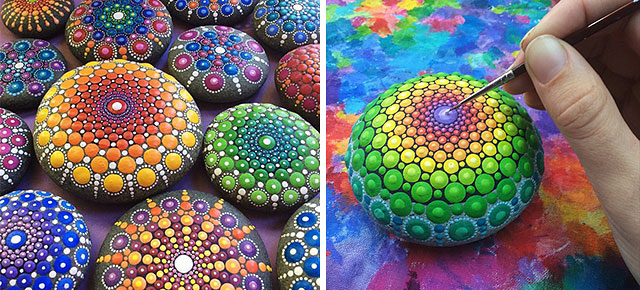
This is an image of rock mandala art taken from deMilked.com

Lastly, I found this image of mandala art painted on rocks to illustrate a combination of all these factors. The image is composed of bright patterns of color, replicated over and over while changing size and color. Points of bright color spiral down into a focal point in the center, creating these beautiful mandala shapes. The texture of the rock gives the photo a semblance of depth, further accentuating the effects given by the spiraling color patterns. Both texture and pattern are combined in this image to give a stunning mandala effect.

Posted in Spring 2018 Archive (336) | Leave a comment

Pattern and Texture: Bryan Duran

images

A painting by Artist Pollyanna Pickering.https://goo.gl/images/WVMShu

The term pattern can be defined in many different ways. Depending on the situation, a pattern can be defined as repetition of different or same components that come together to make a whole piece. A repeated decorative design can be used to describe the definition. Components such as dots, stripes, and grids provide designs to provide different elements to help make the component come together as a whole. The picture I included is an painting by an Artist about a zebra. The artist used the pattern that the zebras have on their stripes to make the piece stand out. I liked this photo because you could say that there are two patterns, the black stripes and the white stripes.

tree-bark-5_medium

A picture of tree bark that I found on the internet.

Texture can be used to describe the elements and feeling of the piece. Different components can make a piece have different kinds of texture. In art two types of texture exist, tactile and implied. Tactile texture is the way a surface actually feels, such as sandpaper or tree bark. Implied texture is the way the surface of an object “looks” like it feels. This is created with different pencil and brush or other drawing media techniques. After doing the reading, I was surprised to know just how much goes into texture and different kinds of qualities that count as texture too. With texture you are looking at physical trait, as well as what you would expect to feel through a picture. Texture can be shown in different sort of ways, other than just physically real or apparent. In the photo that I picked you can clearly see how the texture of tree looks like. You can literally picture placing your hand on the tree and knowing the texture.


Posted in Uncategorized | Leave a comment

Pattern and Texture – Jennifer Wenning

Taken by me on my phone.

Frozen Fog on Weeds in Pullman, Washington

Texture is the grain of surfaces that can be felt, or seen.  It adds emphasis and detail to images or physical objects, so it is both physical and virtual.  Texture utilizes juxtaposition or contrast for affect.  Examples of juxtaposition are sticky/dry, or fuzzy/smooth.

I used this picture of frozen fog I took a couple weeks ago because I thought it was cool how you can see the ice crystals build up and stick to the smooth stalk of the grass.


Found through creative commons: https://c2.staticflickr.com/4/3384/3627948860_63005064d8_b.jpg

Japanese Lotus Flower and Water Tattoo. Found here.

Pattern is composed of stripes, dots, and grids.  Patterns have three basic forms: isolated, linear, and criss-crossing elements.  A dot is in individual form while a line is a linear path.  Dots and stripes compose grids and when these components are used, a pattern arises.  Changing the color, orientation, or scale of a pattern can change the perception of an image, which can create motion and depth.

There is a pattern of semi-circles and loops that form the waves of this tattoo as well as as the background shading that is shown in this image.


Found through creative commons: https://commons.wikimedia.org/wiki/File:Bryce_Canyon_Swamp_Canyon_Trail_topography.jpg

Bryce Canyon Topographic Map. Found here.

Point, line, and plane are what makes design possible in the first place.  A point or dot is a visible mark, and a series of marks makes a line.   Lines are an infinite number of points with length but no breadth.  A plane exists because a line has reached a thickness or breadth to make it a flat surface.  Planes can be solid, opaque, transparent, perforated, textured or smooth.

The lines of this topographic map give information of land contours of Bryce Canyon.  Topographic maps can also have texture because the different elements of them are raised or indented, and in the case of these lines, they provide information about elevation changes in Bryce Canyon.

Posted in Spring 2018 Archive (336) | Leave a comment

Pattern and Texture: Lexi Day

erol-ahmed-296514

This is a photo of leaves placed together by Erol Ahmed taken from Unsplash

A pattern is something that is repeating, while also being made of shapes, lines, and other planes. It usually isn’t a “loud” photo, as the pattern needs to be able to be understood by the person looking at it. To demonstrate this, I chose a photo of some leaves that have a clear pattern of cured lines around the edges, and straight lines in the middle of the leaves. Each leaf is a shape, and with repetition it becomes a pattern together with the curved lines going over each other, and the leaves all being roughly the same. The color pattern adds as well, since there is a distinct pattern of that deep green in all of the leaves.


A texture is something that can be both in an image or in the psychical world. The image of it is made up of a plane and depth, that the person looking can understand what it

patrick-tomasso-208114

Blue painted brick wall by Patrick Tomasso, downloaded from Unsplash

would feel like, and whether it would be something soft and light, or hard and rough. For my image, I chose this  photo of a painted brick wall. It should convey the knowledge that if the image were in front of a person in real life, it would be hard and rough and probably cold, as the brick is located outside. The paint also conveys another, more flaky texture over the uneven brick. You can easily see the grooves, adding a more 3-dimensional look to the texture photo of brick.


This last photo is a mix between both texture and pattern, and how they work together

steve-huntington-378974

Colorful soap sitting together by Steve Huntington, downloaded from Unsplash

to help the viewer perceive the image better.  The image is made of lines from the soap all put together, and those lines come together to have the image create a patterned design. The change of color in the photo add to the pattern as well, as it is a clean line straight through the focal point of the soap. The texture is very apparent as well, as the image gives off a chalky appearance because of the loose powder included in the image. Both the pattern and texture here come together to inform the reader that the psychical attributes of the image are a rounded star design, and that it would leave a powdery finish.


Posted in Spring 2018 Archive (336) | Leave a comment