Geometric Versus Organic: Joshua Perez

Jeb!.svg.png

I think that this design is pretty in cool in and of itself. The name Jeb is really organic while the year 2016 is much more geometric. I also really like the contrast between the red and blue. The red is also more lighter in weight than the blue . One thing that really stood out to me was how friendly this logo seems it seems as if Jeb the presidential candidate is giving the impression that he is a friendly presidential candidate  which to me translates to someone who can relate to you. I think the design in this logo is more representational because it is a clear translation, in my opinion of what Jeb Bush is trying to portray. And it’s simplistic nature is really appealing to me that’s the main reason why I chose this logo because I really like how simplistic yet effective it really is. And out of all the presidential logos that were an option I think this is one of the better ones.


Posted in Uncategorized | Leave a comment

Geometric Versus Organic: Feifei Zhong

下载.jpegThis is a campaign logo for JimWebb in 2016. The logo is designed in a simple way with no picture on the logo. There is no organic form in this logo because there is no any nature shape. The way is geometric because all words are solid edges in the logo. Moreover, the logo is more representation because we can be easy to know the signification of all meanings of words in the logo. Words “JimWebb’16” and “Leadership You Can Trust” are easy to make audience understand meanings. The logo is no abstract because there is no any unknowing shapes in a logo. The words with leadership you can trust represent the logo’s meaning: choose JimWebb, he can lead you win.  I think the design of the logo is simple but very easy to get people’s attention. The logo has it’s own representational quality to it.

The word JimWebb on the logo is clearly to tell the logo is designed for whom. Although the logo is designed in a simple way, I think overall the logo works well together when  the word appeared together on it.

Posted in Uncategorized | Leave a comment

Geometric Versus Organic

TED

This Ted Cruz 2016 campaign logo was featured in section on Politico.com, a website primarily consisting of political news, reports, and information. (Re-uploaded by Politico Magazine, 07/21/15) http://www.politico.com/magazine/gallery/2015/07/the-best-and-worst-campaign-logos-of-2016-000171?slide=5)

This campaign sign was used for 2016 Republican candidate Ted Cruz.  When analyzing the logo a little more closely, one might identify it as more geometric than organic.  The shapes in the logo are very similar in angle, size, and form, and lack in significant details, making for a simple and clear image.  In other words, this design is the opposite of complex and differentiated, moving away from organic aspects.  The star shape that is created towards the bottom of the logo also adds to the geometrical aspect of this logo due to the hard-edged lines.  I believe this logo is more abstract than representation because of the simplicity and 2-demensional portrayal of the shapes.  Through the repetitious and uniformity of the lines that were created to make this logo, one can clearly see the abstract approach to this design.  Although this logo is more on the abstract side, the colors that are being used help convey a message to the viewer that this is a depiction of fire, or a single flame.  These qualities affect the message that is offered by this candidate in several, yet confusing, ways.  For example, when first looking at this image and ignoring the color scheme, one might identify this logo to represent a tear drop.  Although the colors red, white, and blue represent the american flag, this logo and color scheme combination can result in a lot of backfire.  For example, when looking up more information on this logo, I came across numerous websites that disliked this particular logo because it can be seen as an idea of the burning of an american flag.  In more positive light, this fiery logo can be seen to maybe represent the passion that Ted Cruz has for politics and his beliefs to make this country better.  Fire can be represented in many different aspects, however, I believe this logo is not very effective in portraying a clear message to it’s audience.

Posted in Sample Posts by Students, Spring 2016 Archive (336) | Leave a comment

Poster Remix Critique: Feifei Zhong

IMG_0567I choose this poster as my favorite draft to hang on the wall. The purpose of my poster was to effectively present the event is coming. I try to keep the poster balance so I mainly placed the words about the authors in the same size, same font. I put the place and the event name on left and right size so it looks alignment in the right way. As my primary goal is trying to get people come to the evert, I place the event name and held place to catch someone’s eye. Positive Points:

Title is and obvious from the names, everything is simple and place in an organize way. There are also some negative points: text is laid out horizontally, making it hard to read. The sheets could have been arranged more effectively. Visually, it only contained one font and one color, and some rather bland headings, so it was not appealing in its presentational techniques. Over all I like it because is my first design of the poster.


Posted in Uncategorized | Leave a comment

Poster Remix Critique: Joshua Perez

IMG_3319.jpg

Created by: Joshua Perez; Hung up in my living room apartment. 

You might ask why would you hang it up in your living room apartment of all places? Well first of all it’s my design I like it and second I honestly needed some decorations in my apartment. No, the real reason is that I figured sticking the poster somewhere where I would always see it would make me and my roommate appreciate it more and it would really help remember the information flyer because we see it everyday.

So what makes the poster stand out from the rest, well it has a combination of black and white that adds a lot of contrast to the whole flyer. My intention for this flyer was to make the top text stand out and from there one’s eyes can diverge to the rest of the flyer. I tried to make this poster as artistic as possible without losing much information and I tried to use white text whenever I could, in order to do just that I simply duplicated multiple layers of the same text on top of each other to create a a black box and laid the white text on top. This is exactly what I did with the Washington State University I duplicated the text layer enough to create a black box in which I could then lay the date and time in white. The poet’s names was a little tricker to arrange. I obviously wanted to make the poet’s name stand out but making the text big didn’t really help because the date and time stood out more so I decided to do something similar with the poet’s names but not quite the same. I made a black box area with their information but I gave each poet a sort of drop shadow (with the same poet’s name but in black) to make their name stand out even more than it already did. Once this was done I was satisfied with how everything stood out.

In conclusion, what makes my flyer stands out from the rest is that it provides a lot of contrast and the title and poets name stand out in a unique way. When working on my revisions I plan to make the text behind the poet’s names stand out more and figure out if there is a way to make Museum of Art stand out more as well.


Posted in Uncategorized | Leave a comment

Poster Remix Critique: Pei-Chi Chu

For my poster design, I would like to choose this one to pursue for my final portfolio because I think it stood out from other posters. I hung it on the door at my apartment because it is a clear place I can see easily when I leave home and come back every time every day. It is a great manner to remind me to think about how I can do better for my final portfolio every time I see it. I believe I can get more inspiration when viewing my poster design frequently.

One of reasons I think the design stood out from others because the arc words in the center of the paper is a little different from the traditional style. From the traditional style, we can see posters mostly present horizontal lines. It is rare to see other shapes of words. Therefore, through contrasting the traditional style, I believe this way can catch more of the audience’s attention on the time of the event, and notice the title in the middle, “Experimental Poetry in Action.”  Another reason is my vertical words, which are “Presented by WSU Visiting Writer Series 2015-2016”. In my design, I want to present different styles of words to make my project more plentiful. I hope it does not look boring.

For my design, when looking at scale, we can see my letters in the poster are mostly the same size. There is not much contrast to compare different sizes. For this case, I will revise it to make some important words or letters I want to catch audiences’ eyes bigger than others. For figure/ground, I tried to balance my positive space and negative space. I tried to put black texts (positive space) surrounded with white background (negative space). For the entire framing, I kept a little bit of space in the margins because I do not want the poster to look crowded. Additionally, I not only bolded and italicized the title, but bolded the time and the university’s name with an arc shape in caption to catch audiences’ eyes.

To improve this design for the final portfolio, one is to revise some letters’ size and change to different type to make it contrast in scale. Another is for authors’ information, I would bold authors’ names or make them bigger in authors’ information to catch audiences’ attention. These ideas are so far I figured out, I will think more about how to improve my design to make the poster look better.

Posted in Uncategorized | Leave a comment

Point, Line, Plane, and Balance

ENG336_img

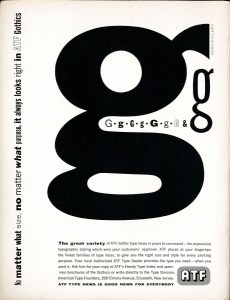
This advertisement for American Type Founders appeared in a 1958 edition of Print magazine.

The very first point the eyes are drawn to on this page is the massive “g” that covers the majority of the page. This element of type functions as point, line, and plane, since it is the focal point on the page, created from a line that has been curved and shaped to create a plane. As the eye moves around on this plane, it then notices a line created by a series of points. Each “g” functions as a separate point, but they are arranged next to each other to create that line. At the end of the line is a separate point, another “g” of a different size that appears more as a line curved into a shape, almost creating an echo of the larger “g,” but it is just different enough to separate it as its own shape. From this point on the far right side of the page, the eyes are pulled to the far left by the long line of text along the entire edge of the page. Each word appears as a separate point, especially due to the fact that each is in a separate style, such as condensed, italic, bold, etc. This is similar to the style used to create the line of “g” mentioned previously. Finally, attention falls on the block of text at the bottom of the page. This block consists of 8 lines and a point. The first and last lines draw the most attention since they are bolder than the rest of the text. Within the first line, it could be argued that the bold section of line creates a point since it stands out from the text and white space around it. Altogether, the lines form a square shape to appear as a plane. The final element to note is the “ATF” that is in the bottom right section of text. With the help of gray space around it, the white text outlined in black stands out in the corner as a final point on the page, serving as an end to the read. Overall, there is strong visual balance, despite the work being asymmetrical. It appears that the designer wanted to create rhythm through not only using the same letter multiple times, but also in using similar styles of displaying the points in both the line on the left edge of the page and in the middle extending right. Through this rhythm, they created a balance between each side of the page. The designer also eliminated awkward white space by adding the second larger “g,” that helps complete the balance by eliminating the opportunity for the eyes to get stuck on that section of the page. Despite the different weights of the typographical elements, the designer filled each section of the page with enough black to eliminate the unnecessary white space. By using strong contrast, the designer made the advertisement more visually interesting while simultaneously forcing the focal point to be exactly where they wanted it to be.

Posted in Sample Posts by Students, Spring 2016 Archive (336) | Leave a comment

Point, Line, Plane, and Balance

FSG_neruda3

Elena Giavaldi is a book cover designer and illustrator based out of Brooklyn, New York. Giavaldi designed a book cover for the novel All the Odes by Pablo Neruda in 2012. This particular version of the cover was not selected for the final cover; however, ultimately one of her designs was chosen.

Visit Elena Giavaldi’s Website.

Visually, when I first looked at this book cover, my eyes were first drawn to all of the lines that extend from the corners and edges of the larger font size letters. These edges and corners create lines vertically, diagonally, and horizontally without being overly distracting. It was still clear to me the order in which I should read the words. I also think that these lines create different planes of text within the book cover with the first plane of text being in the upper-right section of the cover and the second being the lower-right section. When I look at the cover I see two distinguishable planes that seem to extend off the edge of the page because of the lines. Without these lines, the cover would have felt out of balance, with too much blank space existing. A third and much smaller plane is created using the smaller text on the left side of the cover, the small text signify points within a plane of blank space created by the lines extending from the larger text, which act almost like borders. The placement of the points created by text also help balance out the cover and help fill the blank space.

While, the cover does seem somewhat balanced, it is asymmetrical in design with more blank space on the left side of the cover than the right. Because the right side of the cover is so busy, if the design attempted to be symmetrical by filling more blank space on the left side, the cover would become cluttered. The lines create contrasting elements that extend beyond the points of text that create the planes and force me to move my eyes in all different directions, which creates a sense of balance rather than having my eyes focus on one small section of the cover.

In this case, scale was used to emphasize the importance of some text over others. Even though, traditionally people read left to right, my eyes were instantly drawn to the title and the author’s name because of the size of text in relation to the smaller text on the let that notes that it is a bilingual edition and who the editor is. And, while the information in the smaller text is important it is not necessarily what will draw readers in. Overall, the diverse use of typography and font size to create lines, points, and planes creates a visually dynamic book cover without being overly cluttered or confusing.

Visually, when I first looked at this book cover, my eyes were first drawn to all of the lines that extend from the corners and edges of the larger font size letters. These edges and corners create lines vertically, diagonally, and horizontally without being overly distracting. It was still clear to me the order in which I should read the words. I also think that these lines create different planes of text within the book cover with the first plane of text being in the upper-right section of the cover and the second being the lower-right section. When I look at the cover I see two distinguishable planes that seem to extend off the edge of the page because of the lines. Without these lines, the cover would have felt out of balance, with too much blank space existing. A third and much smaller plane is created using the smaller text on the left side of the cover, the small text signify points within a plane of blank space created by the lines extending from the larger text, which act almost like borders. The placement of the points created by text also help balance out the cover and help fill the blank space.

While, the cover does seem somewhat balanced, it is asymmetrical in design with more blank space on the left side of the cover than the right. Because the right side of the cover is so busy, if the design attempted to be symmetrical by filling more blank space on the left side, the cover would become cluttered. The lines create contrasting elements that extend beyond the points of text that create the planes and force me to move my eyes in all different directions, which creates a sense of balance rather than having my eyes focus on one small section of the cover.

In this case, scale was used to emphasize the importance of some text over others. Even though, traditionally people read left to right, my eyes were instantly drawn to the title and the author’s name because of the size of text in relation to the smaller text on the let that notes that it is a bilingual edition and who the editor is. And, while the information in the smaller text is important it is not necessarily what will draw readers in. Overall, the diverse use of typography and font size to create lines, points, and planes creates a visually dynamic book cover without being overly cluttered or confusing.


Posted in Sample Posts by Students, Spring 2016 Archive (336) | Leave a comment

Point, Line, Plane, and Balance : Joshua Perez

f5c4213858410-56014c3580b081

This is a typographic poster by Mauro Hernandez (web designer , typographer), founder of Mahebo a company which specializes in web, typography and branding. 

The main part of the text is located right it the middle. Right where there is a transition of colors (orange to red orange). This acts as a focal point because it’s the first thing one looks at when glancing at the typographic quote. I would even argue that the focal point of this typographic quote is even a line. The line acts as a way to transition between colors and shades and this is exactly what happens at the focal point; The colors transitions as well as the weight the weight of the typographic quote is heavier on the bottom than at the top and that makes it feel balanced. Everything about this quote leads one eye to the center of the page. Mainly because everything around the quote is negative space. And really there isn’t much to see, when looking at the negative space around the quote your eye wanders until one either hits a yellow line or red line which then leads you back up to the focal point where the quote is carefully placed at. I love how well the post is asymmetrical and how detailed it is. Even though most of the quote is in the center of the overall artwork Hernández makes sure that regardless of where you look your eyes will always lead up to the center of the artwork. Even though the quote isn’t symmetrical it feels balanced because of the weight of the colors. The quote obviously has the larger scale and it’s the most important typographic material that is on this artwork. Again, even though the artwork isn’t symmetrical it surely does feel that way because of the contrast and transition between the colors. In other words the artwork is active (transition of colors) and it also has asymmetrical balance because of the weight of the different hues (gold to magenta).


Posted in Uncategorized | Leave a comment

Point, Line, Plane and Blance: Pei-Chi Chu

DTC 336

The Starbucks advertisement is posted by Jessica Hische. Assoc. Creative Director: Rachel Frederick, Jr. Art Director: Alia Roberts, Jr. Art Director: Laura Duncan, Exec. Creative Director: Dennis Lim; Photographer: John Clang

In the image of the Starbucks advertisement, we can see many words are filling in the space with a Starbucks logo. To assume each word is a point, they connect with each other to present many lines. Each word is written with lines, each character is an important element to be each line. From the image, there are not only straight lines, but also a line which defines an arc-shape along the Starbucks logo. Meanwhile, these lines are full in the object to become a plane. Moreover, these lines and edges also create a rhythm that leads viewers’ eyes to focus on the image. For the balance, it is asymmetrical, regardless of viewing from left to right or from top to bottom. When viewing from left to right, merely for the Starbucks logo, we can know the balance is asymmetrical. The reason is that the logo is placed along the edge of the object. If the logo is placed in the middle, it can be symmetrical when only viewing the logo. Further, for letters, the word “extrafoam” and “vanilla latte” are not symmetrical although the top of the lines are symmetrical. The word “extrafoam” is an arc-shape so that it can not be symmetrical when viewing from left to right. Additionally, for the word “vanilla latte,” it is a little bit inclined upwards from left to right. Therefore, it is also asymmetrical. However, if we only view the cup of the shape without letters and the logo, it is symmetrical. When viewing from top to bottom, although the logo looks symmetrical, all lines of letters are asymmetrical. For the arc-shaped word “extrafoam,” it is located a little top from the middle, so it is asymmetrical. Nevertheless, if the letter “a” moves to the middle of the object, then it is symmetrical. Besides, the top of the lines to the bottom of the lines is also asymmetrical because the bottom of the lines are a little bit inclined upwards from left to right. Overall, based on this image, point, line, plane and rhythm and balance are really important to present a designer’s idea for a image, and these elements are related to each other. Even though the image is asymmetrical, it connects all elements to present an image to make an impression on viewers. This practice is a great opportunity for us to observe the shape and how elements are presented deeply.

Posted in Uncategorized | Leave a comment