Broadsides- Megan Thompson

From reading Kyle Schlesinger’s essay about broadside the image below is an example of the earliest versions of a broadside. A broadside one large one sided page. It just so happen that broadsides are used to inform others of what they are conveying as well as let society know what is happening. During the 1950’s and 60’s broadside became very popular within poetry.

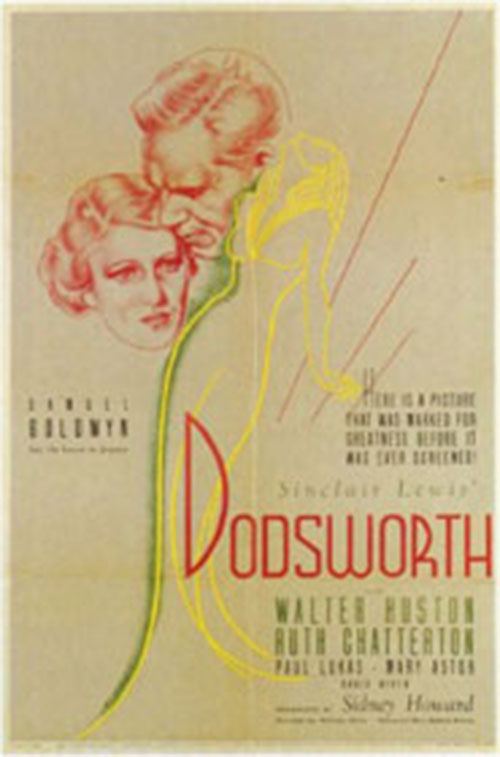
Below, is an example of a broadside that expresses total immersion, overlap, layering and much more that demonstrates a broadside. To begin, this piece shows total immersion by creating an image through text and text as an image. By the use of words that describe the movie, it also displays a picture that demonstrates the movie actors and how they expresses what the words have to say about the movie. The title of the movie “Dodsworth” stands out much different from the other texts as it is in color red and a much larger scale than the other words. This is defined as display type as the letters are larger in scale than anything else on the page. The moving to the sides where other text is located each text type is different. The fonts for each attribute of the poster are different to create more of an overall effect on the page. Not much text is at the baseline of the page but in this case the spacing between the different font scales stays consistent. The only out of place text is the text far to the left. This text that stands alone signifies much more importance and is place by the images for effect. This also goes for the images, each image is a different color that matches the color of the text. This truly shows total immersion between the text and images used on the page.

Finally, the text overlap of the images is placed for a reason near one another. It creates a unity between the text and images. The layering of some images defines more the poster as it has visual going along with words. The layering allows more images and color to happen as well as keep that total immersion between the text and image.
Posted in Fall 2014 Archive (336), Uncategorized | Tagged , , , , , | Leave a comment

Broadsides – Susan Cannarella

“She Is Far From The Land” Thomas Hood http://www.vampandtramp.com/broadside/t/trystpress.html

In the article by Kyle Schlesinger, we review many different types of broadsides. This broadsides by Thomas Hood exemplifies the characteristics of a broadside discussed by Kyle Schlesinger. The poem is set on a . We can see that this printed text and image clearly utilizes a single page.  The text on the image is set on a very small scale and on an even baseline with regular letterspacing. This creates a strong visual weight of flowing down and cascading down.

The idea of total immersion is defined by Kyle as “the text is an image and the image is a text”. This can be seen that the text of She Is Far From Land by the way it emulates the motion of a waves crashing and falling down. It starts out small at the top, but continues to trickle down with wider lines of text. The title, She Is From Land acts as a divider between the land and the water and the letterspacing of the words are wider suggesting it is not part of the poem and is the title. The decision of having the images of the sea-creatures at the bottom evokes this sense of mystery that lies at the bottom of the ocean where the darkest secrets of the water lie. Also noting the fact that the image/text relationship is different since the scale between the two are different. This creates a visual hierarchy between the two and showing the dominant presence of the images over the small scaled text. One thing that we notice or rather that we don’t notice is there is no overlapping or layering in this piece so the chaos of the words and images don’t seem present. The paper looks organized and condensed into a simple vertical line falling down.

Posted in Fall 2014 Archive (336) | Tagged | Leave a comment

Broadsides – Sample Post

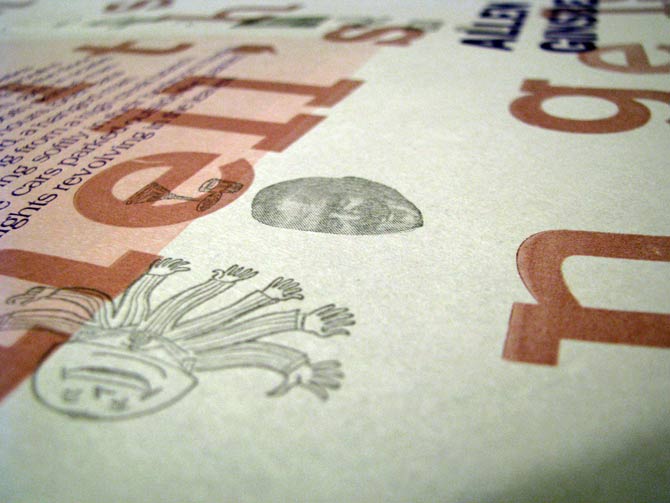
Nicholas Weidner designed this broadside for the poem "First Party At Ken Kesey's With Hell's Angels" by Allen Ginsberg. It was printed using letterpress at the Jack Sinclair Letterpress Studio at the University of Arizona using four different colors of ink.

Nicholas Weidner designed this broadside for the poem “First Party At Ken Kesey’s With Hell’s Angels” by Allen Ginsberg. It was printed using letterpress at the Jack Sinclair Letterpress Studio at the University of Arizona using four different colors of ink.

Like many of the examples in Kyle Schlesinger’s essay, this broadside by Nicholas Weidner features poetry, uses letterpress printing, and is printed on a single, large sheet of paper, suitable for hanging on a wall. It is certainly part of the literary tradition of broadsides that started in the United States in the 1960s and 70s. The size of the paper and the letters encourage communal or semi-public reading, perhaps in a space such as a gallery, or even outside. The design of the broadside uses display type (larger size type) for the poem’s title and author, as well as smaller type for continuous reading of the poem itself. Small icons or images are also used, and are very well integrated into the text: One could argue that total immersion of text and image occurs on this broadside. The display type features the title of the poem, First Party at Ken Kesey’s House with Hell’s Angels, but it also serves as a very active visual element: The words of the poem’s title are spread out to fill the vertical height of the broadside, and the letters that form each word vibrate up and down slightly, rather than sitting on a shared baseline (also note the uneven kerning between the letters). Through this nontraditional handling of type, the letters are activated so they evoke the excitement and chaos of the party in the poem: Perhaps they evoke the “beer cans bent littering the yard” or the “twenty youths dancing to the vibration through the floor.” Display type is also used in the lower right corner to show the author’s name, Allen Ginsberg. This type uses regular letterspacing and an even baseline, but it still has a strong visual function, adding visual weight to the bottom of the poster to ground the viewer’s eye.

Detail image of Nicholas Weidner's broadside "First Party At Ken Kesey's With Hell's Angels" by Allen Ginsberg.

Detail image of Nicholas Weidner’s broadside “First Party At Ken Kesey’s With Hell’s Angels” by Allen Ginsberg.

Schlesinger says that “the text is an image and the image is a text” when total immersion of verbal and visual elements take place. On Weidner’s broadside it’s important that the small images/icons are printed at the same scale as the display type. The fact that they are of similar proportions allows the viewer to see them as equal partners. They seem to tell a story just like the words do, evoking the possibility of drunken visions (the octopus-like creature shown in the detail image), toxicity (a skull and crossbones in another part of the broadside), and the specificity of individual people (photographs of people’s heads). Finally, overlap and layering of the display text and the images over the body of the poem, which is signaled by its placement in the faded red box at middle left, also works to create visual chaos that is evocative. Note that the text remains legible throughout, though the reader may have to work a bit harder to read some of the lines. This added effort seems appropriate for the subject matter and mood of the poem.

Posted in Sample Posts by Your Professor | Leave a comment

Alphabet Design – Brian Tomsovic

My text is the Artificer Infusion list from the Eberron Campaign Setting Book from Dungeons and Dragons 3.5 Edition. It is a “futuristic” setting for DnD it takes place in a world where technology has developed leaps and bounds beyond the typical fantasy setting, at times mirroring or exceeding modern technology, but at times lacking, because it is a world shaped by magic. Cars exist, but they are powered by elementals from magical planes. Things we take for granted exist in a new ways, and things such as giant airships exist that we can’t build with our modern technology. It is in a lot of ways reminiscent of Harry Potter’s universe. Artificers are like the engineers of this world, building and inventing all sorts of items by applying a scientific/engineering minded approach to magic as opposed to the more traditional fantasy approach.

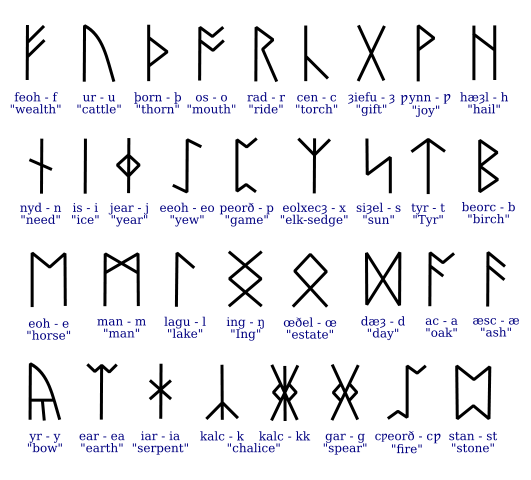
Infusions are to Artificers what Spells are to Wizards. They are magical in nature, however they are applied in a different way. I wanted to capture this feeling, so what I’m going to try is to take old norse/celtic runes and give them a modern printed feel.

531px-Anglosaxonrunes.svg

What I noticed with the runes was that nearly all have a strong vertical line. I’m going to take that idea and exaggerate it.

The Rules I’ll use as I see them now are as follows:

1) There will be a 3 wide by 4 tall grid

2) Between columns 1 and 2 will be a BOLD line as part of all capitals (if I do lowercase later I’ll have to adjust this) that stretches from the top to the bottom

3) All lines Right of the line will be thinner, (50%? 75%? I’ll have to experiment) All lines left of the line will be thinner than those to the right by the same difference (for example if I do 50% the ratio will be 1:4:2)

4) No curved lines (If this looks ugly, plan B is to allow half circles where necessary)

5) Cross bars will be at 1 square from the bottom. “Curves” (Such as P) will be half height

6) All Lines will start and end at a vertex of the grid

I had a radical change of approach late in the game, so I don’t have my sample letters done, as written I’m imagining the letter S will give me the most difficulty rules wise. So that’ll probably be the third letter I try (Get a couple to work before I tackle the hardest)


Posted in Fall 2014 Archive (338) | Tagged | 1 Comment

Alphabet Design– Jacob Oster

Typeface-design

The deaths of JP Auclair and Andreas Fransson are a painful blow to their families and friends, but also to skiing as a whole. These two skiers encompassed a large portion of what modern skiing is: an adventure, a redefinition of old rules, a mixing of styles, visual creativity and a deep, enduring love of riding.

Both perished last week in an avalanche accident when they were swept down several hunderd metres while climbing a couloir on Monte San Lorenzo, Chile.

Skier JP Auclair having fun at the Haute Route 2013
JP Auclair, Haute Route 2013© http://www.jeremy-bernard.com

JP Auclair started as a mogul skier in the Canadian team. In the mid-1990s, he was among the pioneering pack of the Canadian Air Force, trying to inject snowboard style into skiing. Frustrated by the rigid rules of the ski federation, JP was one of the first to claim freedom for his style.

Mixing mogul technique, ’70s hot-dog inspiration and a fresh snowboard attitude, JP and his friends invented freestyle skiing

JP has always been around, always at the forefront of freestyle evolution, in his soft-spoken way. He changed his haircut so many times it became a trademark… but his passion for riding never wavered.

JP won the first slopestyle of the X Games in Crested Butte in 1999, he was a star in the first Poor Boyz movies, he co-created Armada ski brand, he started ski touring with his longtime friend Julien Régnier before it became a trend, and he stunned the freestyle world with his creativity in Sherpa Cinemas films, as can be seen in the video below.

Andreas Fransson was among the new breed of radical skiers, enjoying the steepest, farthest, highest couloirs.

A soft, warm-hearted spirit, Andreas was an incredibly strong athlete who defied youth and tradition in daring alpinism feats

When Andreas moved to Chamonix in 2006, he immediately skied some of the most difficult lines. When he went to the Denali, he skied the scary south face (after two difficult couloirs and a speed ascent as a warm-up). He opened up new possibilities to steep skiing.

Andreas Fransson riding in Chamonix, France.
Andreas Fransson in Chamonix© Tero Repo

The movie Tempting Fear (below) is a moving and intimate portrait of Andreas. It’s also one of the best ski movies ever, digging deep into the psyche of these exceptional athletes, dealing with risk and death. Andreas used to write a lot, and one of his last posts on his website is particularly moving: “You can choose to see a friend’s death as something tragic or something beautiful. You can choose to believe what you like on what happens after death. You can choose to create whichever reality you like. So then create a reality that you like!”

Both influenced and changed skiing in their respective ways. Both explored new ways of moving those two tips at the end of our skis into new directions. They died together, in the Chilean snow, and they’ll both be remembered as deeply influential souls.

Read more on the Powder Magazine website, which also has a complete compilation of all of JP Auclair’s and Andreas Fransson’s videos.

If you want to help, consider donating to the Auclair Fund that’s supporting JP’s small son and his wife.

Posted in Fall 2014 Archive (338) | Tagged | 1 Comment

Alphabet Design-Jenna Hayden

For this assignment, the text that I decided to choose was a poem from Edgar Allan Poe. Edgar Allan Poe was a Poet who lived from 1809-1849. The poem I chose to use is named Dreamland. The poem is written with words and structure used during the 19th century. Because of the context, I want my alphabet to have a natural, materials-based feel to it. If I used a modular method to construct my alphabet, it would feel disconnected to the poem.  I want this font to look like it is hand written because back then, they did not have technology like now and I want the ascenders and descenders to have a slight curve. As for the exact size, I need to try out a few sizes to see what is more successful with some feed back.

Rules:-Organic feel-slightly cursive-serifs-lowercase

Posted in Fall 2014 Archive (338) | Tagged | 1 Comment

Alphabet Design, Shannon Heric

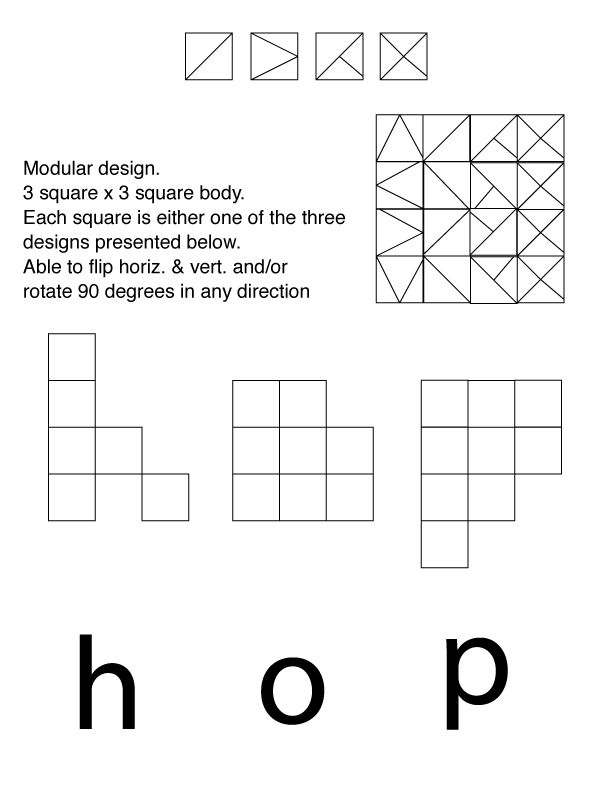
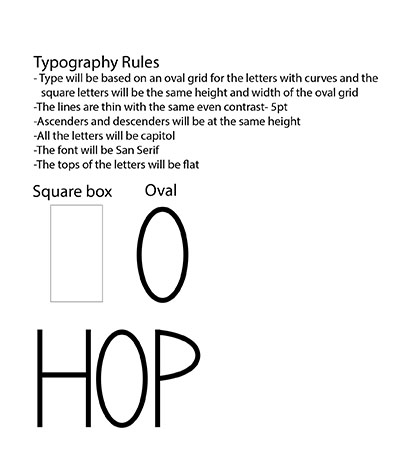
For my alphabet design I plan to use the modular method of design to define my rules for my type. I chose to do a sans serif all capitol alphabet because I am using a poem by Shel Silverstein called “No Thank You”. The rules I made to define the design of my letters are, the lines of the letters will all be the same even thickness of five point throughout with no contrast. The grid system I am basing the letter forms off will be a tall skinny oval one for the letters with curves. For the letters height and width I made a rectangle box to have the letters fit in so they are all the same size. The ascenders and descenders will be at the same height to fit in the box so there will be fluent continuity. I am choosing to make all of the letters capitol because in the sense of the poem, the feeling is slightly funny and passive aggressive. I made the font be sans serif because it will look more modern and clean so the tall skinny letters wouldn’t have any elements added onto them to make the type look different. The tops of the letters will be flat as well because I didn’t want the tops to be pointed. Overall the feeling of the font will be modern but light to go with the sarcastic poem, “No Thank You”.
Typography Rules and three letters

Posted in Fall 2014 Archive (338) | Tagged | 1 Comment

Alphabet Design – Melissa Tsitsis

blog

The text that I will be using for this project is a poem called Daffodils by William Wordsworth. The poem is very lighthearted and reminds me of the summer so my goal is also to create a font that feels light and summery. My own handwriting was kind of an influence when I started doodling options on paper. I decided to create this type using a modular method. My grid for each letter is 3/4″ x .4″ all letters will be created in lower case.

Some rules I set for my type are:

  • Letters need to have an organic feel
  • There will be subtle serifs at the bottom of every stem and descender
  • Bottom of stem needs to be wider than the top of the stem
  • Stems for letters like “b”, “d”, and “l” have to be 3/4″
  • X-height is 1/3″ or 1/3 the height of the grid

I think that these rules will fit my text because they are in lowercase and to me when I see something in lower case letters I get the message that this is more relaxed and casual. This poem is not very deep it is very descriptive. Therefore there is a lot of imagery created within the poem. When I read it I could literally picture the scene Wordsworth painting in my head. So I think that it is important that the type doesn’t take away from the poem, instead I want it to be present on the page, but not stand too strong like a type in all caps would or a thicker/bolder type.

Posted in Fall 2014 Archive (338) | Tagged | 1 Comment

Alphabet Design – Lauren Turner

Text Picture

Font

The text I chose greatly influenced the mood I wanted my typeface to omit. I wanted the font to appear somewhat handwritten, while looking simplistic and somewhat irregular and organic. I started out wanting to use a modular method, however after creating a few letters I realized that I wasn’t really following the process or system by which a modular method is made. I didn’t use a grid and because of its irregularity maybe it was a materials-based method. Upon the conclusion I realized I maybe executed this part of Project 3 incorrectly so I will probably end up changing my alphabet. However, I did create a set of rules that I want my ultimate text to have. I think these rules will pair with my text well as it is a children’s story that is still pretty heavy in philosophical discussion about selfishness and selflessness. Since the content is heavy, but the book is a children’s book, I wanted a light, condensed font to mirror the organic, simple nature of the book.

1. X height is same height as capital letter (text will be all caps)

2. Sans serif font

3. Uppercase

4. Minimal contrast, thin weight

5. Upright posture for the most part, some letters will be somewhat askew/angled to portray organic/irregular nature

6. condensed width

7. Font will appear handwritten, somewhat sloppy to imitate content of story

8. Most straight lines will be at least somewhat curved, again to demonstrate irregularity

Posted in Fall 2014 Archive (338) | Tagged | 1 Comment

Alphabet Design – Karen Marten

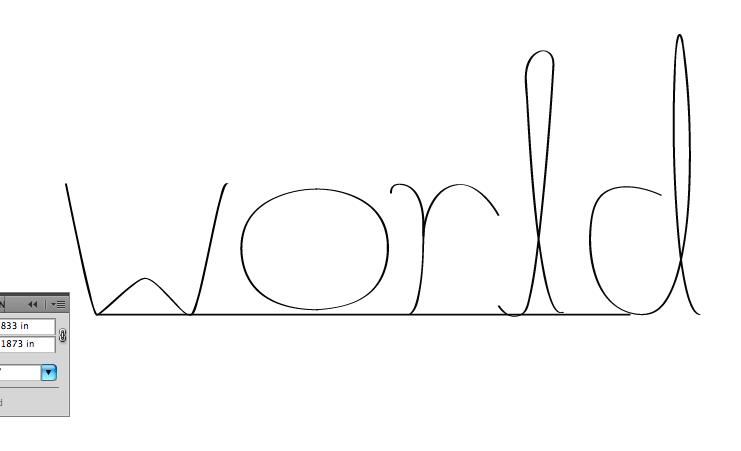
I chose the song “World Alone” by Lorde. The song is slow paced, gradually building so I want the font to portray a feeling of movement,to do so I am going to have outlines for the sizes but they will not be required to hit those measurements dead on (after some hours working like this I have decided instead to set multiple specific places for letters descenders, ascenders and bases to hit, in order to give it at least somewhat of a cohesive feel). It is a love song but not overly dramatic so I am leaving room for long ascenders and descenders to give it a romantic feel. I don’t want it overtly decorative or tacky so the ascenders and descenders will not have tons of extra loops or lines but they will avoid straight lines to keep a sense of movement and a delicate sense. It will be in lower case for now, if I chose to do upper case the uppercase letters will be more decorative than the lower ones. The lines also use an oval brush, giving it a more organic and less serious shape.

My rules:

Serifs

2×6 units(this will need to be altered)

avoid straight lines

avoid hard points, stick to curves

minimal extra decorum


Screen Shot 2014-10-23 at 11.34.41 AM

Screen Shot 2014-10-23 at 11.34.51 AM

Screen Shot 2014-10-23 at 11.34.24 AM

Posted in Fall 2014 Archive (338) | Tagged | 1 Comment