Broadsides- Andrew Sears

Wing Lau-http://www.kindofgallery.com/?portfolio=kind-of-gallery-and-bespoke-laser-present-broadside

Wing Lau-http://www.kindofgallery.com/?portfolio=kind-of-gallery-and-bespoke-laser-present-broadside

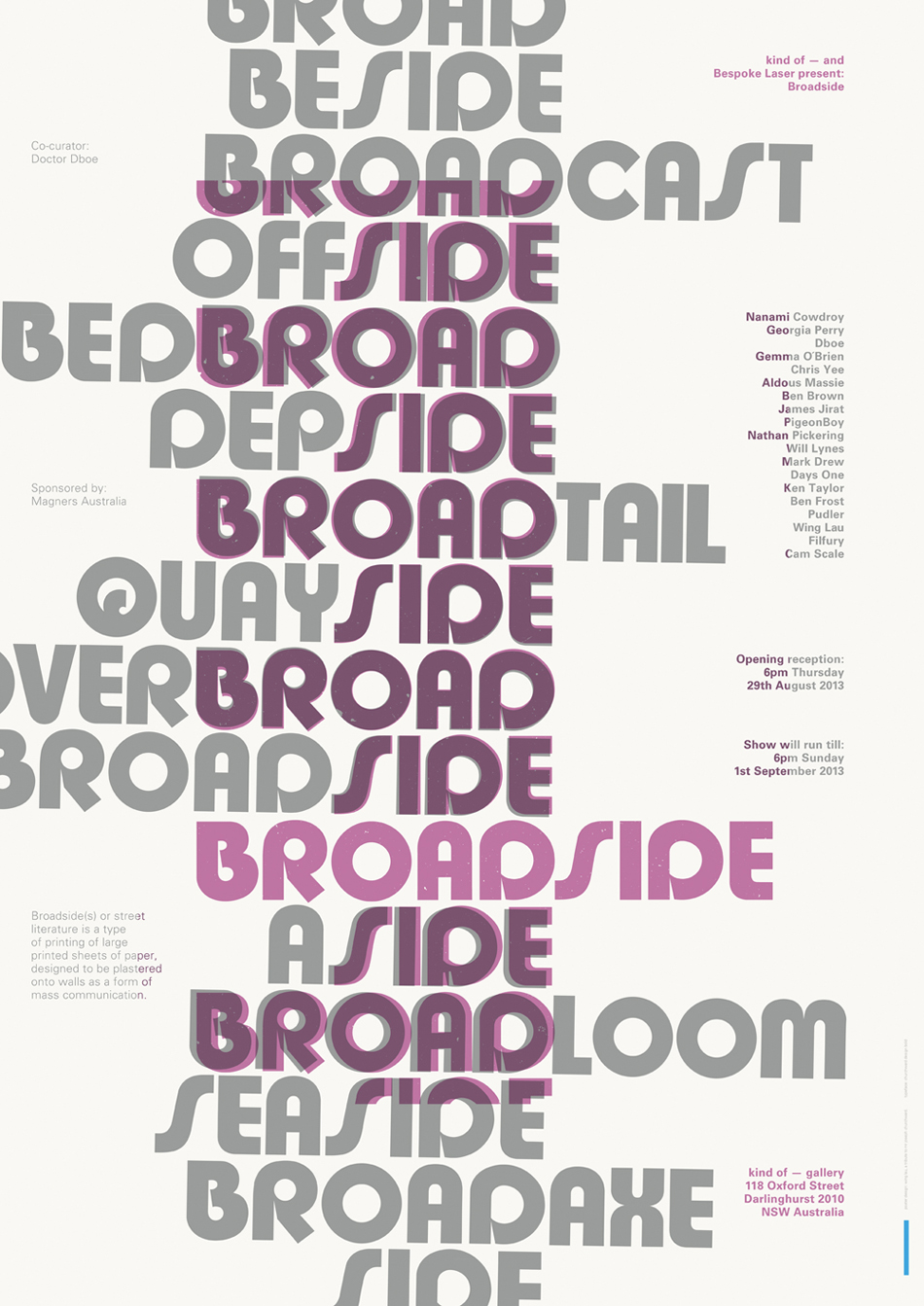
This broadside was created Wing Lau to promote a gallery showing of other broadsides by numerous artists. However I think that it itself is very good example of a broadside after reading Kyle Schlesinger’s essay. It obviously fits the criteria for being considered a broadside and even offers the definition of what a broadside is. The poster uses letterpress printing and it is put together so that the first thing the viewer reads is broad and side repeatedly. Set behind the repetitive broadsides is alternating words, which either contain the words broad or side within them. Both elements are done in display type, but the foreground lettering is done in purple, drawing the eye to it first, while the background is done in a neutral grey. The display type serves as an interesting visual element on the poster and also communicates that the events is all about broadsides. It also serves as a barrier, which divides up the page, leaving the remaining areas to be filled with the necessary information to let people know the details of the event. It appears that Wing Lau used even kerning and letterspacing throughout the design. But the purple display type appears to have been done on a flat baseline, while the grey background display types looks as if it has been slightly tilted possibly to help separate the two elements. This gives the repeating broad-sides a 3-d effect and adds further interest to the poster. Overall the overlap and layering used in the broadside creates an interesting visual design that communicates first what the event is about drawing in the viewer, and then provides the information needed to attend the event.
Posted in Fall 2014 Archive (336) | Tagged | Leave a comment

Broadsides – Brian Martinez

Author Kristin Sharp Designer: Ken Baughman

Author Kristin Sharp
Designer: Ken Baughman


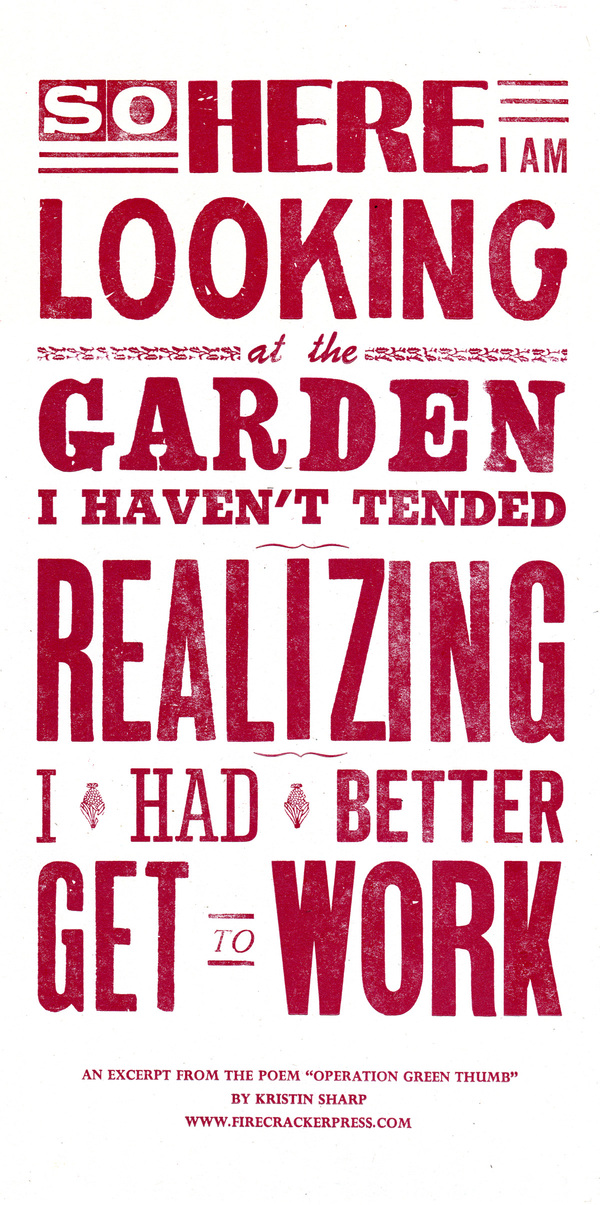
This excerpt reminded me of one of the screen plays I had been writing and how I have not been able to take the time to finish it. I am not sure this is an example of total immersion. There is a strong emphasis on the text and is lacking any visual illustration with the text. The way the text is aligned along with the design choices create one unified image.

The designer chose to use a different type face for each row of the Broadside. There are even multiple typefaces used within these rows. The text is aligned in a way that creates one shape and has no overlapping or overlaying. While there is no illustrations, much focus has been put on the presentation of the words. Letter are chipped, bold, re sized, and faded to give the broadside an older or aged look. This design is a display type.The focus is on the the poetry rather than the author or name of the poem. The large scale of the text is effective emphasizing words like “Here”, “Looking”, “Realizing”, and “Get Work”.

Posted in Fall 2014 Archive (336) | Tagged | Leave a comment

Broadsides – Colin Weickmann

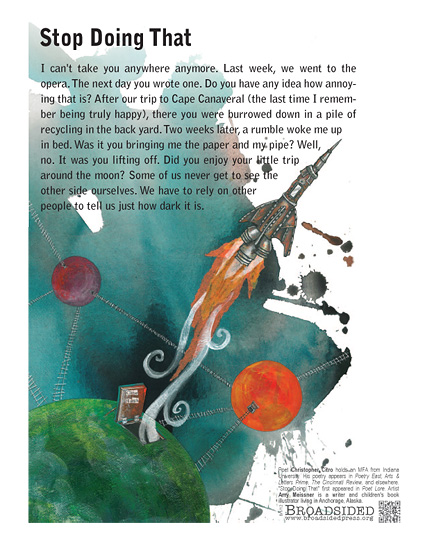
In this broadside, the designer Amy Meissner takes Christopher Citro’s poem “Stop Doing That” and creates a visual piece that complements the author’s words, demonstrating the idea of total immersion. The broadside itself is organized with the poem aligned on the top left with the visual of a rocket ship shooting from the bottom of the broadside to the top right. This organization draws the reader/viewer to read the text as their eyes meet the rocket ship that in a way borders the edge of the paragraphed text. However, the visual is not fully understood by the reader until the poem is finished as the author describes a trip to the moon at the very end. As a re

Written by Christoper Citro Illustrated by Amy Meissner

Written by Christoper Citro
Illustrated by Amy Meissner

sult, the reader/viewer must fully complete the poem before being completely immersed in the broadside.

The text chosen in this broadside is very legible and as a newspaper style typeface with the color of the text being black. While the text itself is legible, the dark painted background depicted behind the left side of the main text does make the text hard to read at times. Because of this, it is necessary for the reader/viewer to read closely so that they are able to read and understand the broadside as a whole. Yet this is not a negative aspect of he broadside, but rather a tactic to fully immerse the reader/viewer in the text and visual together at the same time. In this way, the broadside is successful in the notion of total immersion.

Posted in Fall 2014 Archive (336) | Tagged | Leave a comment

Broadsides – Becka Prater

Christina Davis Poem

“Instead of a Headstone” by Christina Davis

In this poem, “Instead of a Headstone” by Christina Davis, the author demonstrates total immersion because on the right, the image is a text and the text makes up the image. The words wind its way through the map-like image, effectively drawing the audiences’ eyes. The text in the image is retyped so that is easier to read for the audience. Another thing that makes this a broadside is the size of the paper, it is larger than just an average flyer. The display type is in the image and is much larger than the text on the left.  The poem itself on the left has a baseline and is therefore more organized and cohesive, while the image on the right has no baseline whatsoever and the uneven kerning between the letters also add to the total immersion effect as well as the different scales of the letters. Although, there is no overlayering or overlapping, the fact that it is a broadside is clear. The image on the right contrasts drastically to the poem on the left, which is uniform and much more legible so that the audience knows what the poem says. The author is praying to the Lord to more than just exist. It takes on more of a religious approach and the poem really sticks with the audience after reading.

Posted in Fall 2014 Archive (336) | Tagged | Leave a comment

Broadsides – Nathan Taylor

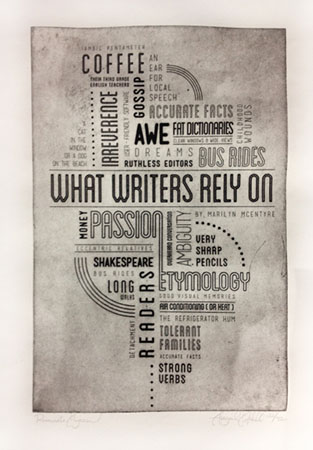
"What Writer's Rely On" by Marilyn McEntyre

What Writer’s Rely On” by Marilyn McEntyre

The broadside I have chosen for this blog is titled “What Writers Rely On” by Marilyn McEntyre. This piece is a good example of a total immersion broadside for several reasons. First, it fits the definition of broadside because it is printed on a single, large sheet of paper. Second, it fits Kyle Schlesinger’s description of total immersion as the text creates an image by the way it is arranged. Although it is not completely clear what the image is, the text still comes together to create an interesting pattern that immerses the viewer.

This broadside utilizes several different fonts and font sizes to achieve this immersion. The main text, “What Writer’s Rely On” is written in large, easily readable font directly in the middle of the page and is what the viewer sees initially. This causes the viewer to question what exactly it is that writer’s rely on, and the answer is spread throughout the rest of the broadside. The many different words and descriptions of what writer’s rely on surround this main text. They wrap around it and flow with it, creating a beautiful image. Through the use of many different fonts and sizes as well as a good use of spacing and kerning, McEntyre successfully creates a total immersion for her viewer.


Posted in Fall 2014 Archive (336) | Tagged | Leave a comment

Broadsides – Ashley Davis

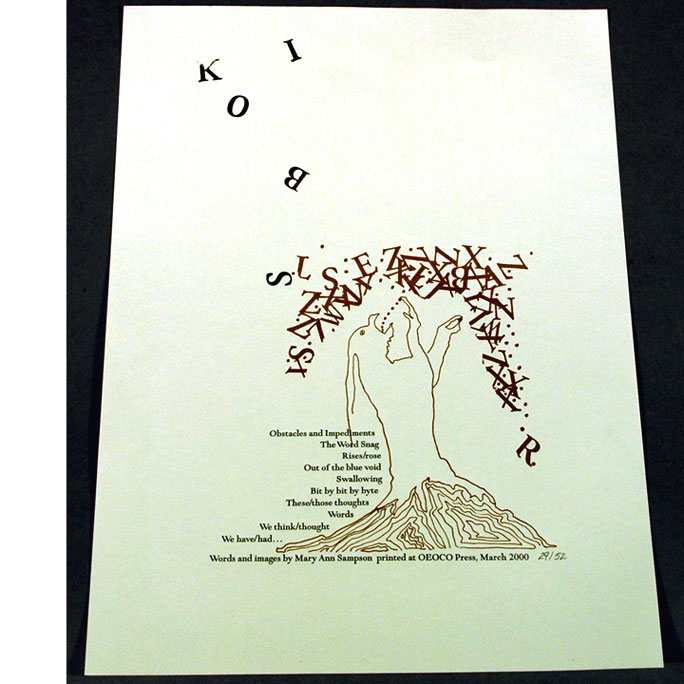
Obstacles and Impediments by Mary Ann Sampson. OEOCO Press.  http://www.vampandtramp.com/broadside/o/OEOCO.html

Obstacles and Impediments by Mary Ann Sampson. OEOCO Press. LINK

This broadside to the left is a great visual example of total immersion. It was written and designed by Mary Ann Sampson for her poem Obstacles and Impediments. It fits into the “integrating display type” category of Kyle Schlesinger’s article, as well as total immersion. It’s a visual representation of the poem itself, while the lines of it are positioned to the left of the drawing. The kerning of the text stays consistent, while the tracking varies between the lines of text. It’s especially noticeable between the last line and the line with information about the poem. There’s a much larger space used to distinguish the information from the poem itself. There’s no standard alignment either, rather a more experimental alignment that outlines the image itself.

The juxtaposition of the text is one of the reasons this is total immersion. It traces the outline of the figure, showing the comparison of the two works and how they work together. There’s a sense of belonging between the two that wouldn’t be there if the text was placed away from the figure. The total immersion is also in the whole visual context of the broadside. The poem says “the word snag / rises / out of the blue void / swallowing / bit by bit by byte / these thoughts / words / we think / we have”. And that’s exactly what the image depicts; it’s an animal (the word snag) coming out of the ground to eat various letters. So the image acts as the text of the poem; and the typographic poem acts as an image because of the way it’s positioned on the paper. Overall it also shows how the two coincide and visually belong together, and it integrates the drawing in a useful and intriguing way.

Posted in Fall 2014 Archive (336) | Tagged , , , , | Leave a comment

Broadsides – Jesse Pearson

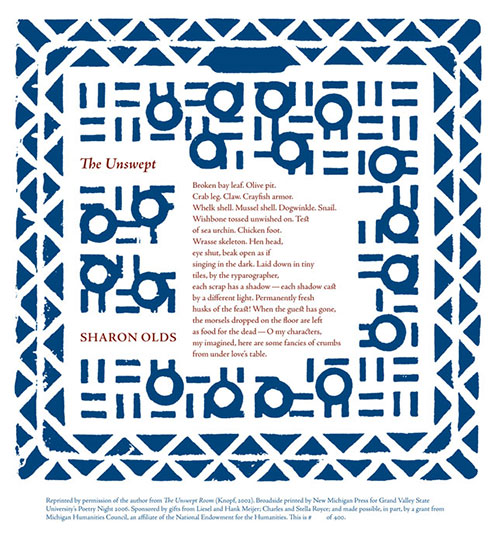
The Unswept, by Sharon Olds, from New Michigan Press

The Unswept, by Sharon Olds, from New Michigan Press

My example of a broadside is a poem, called “The Unswept”, by Sharon Olds. It puts the poem itself in the center of the page, but then uses a decorative border, along with a design in the space in between the poem and the border.

Total immersion occurs in this piece because the inside pattern occurs in the same place as the title and author of the poem. When my eye looks at this broadside, I start at the title, in the upper right hand corner. I then follow the design around the piece clockwise, and end at the author’s name, and then onto the poem. The design on the inside almost seems to create a path for my eyes to follow.

In terms of the design itself, I think it abstractly represents the poem. The piece has very natural imagery, such as crabs, mussels, skeletons, laid down in tiles- and the both the border and the interior design seem to support that. The circles on the inside and the triangles on the outside could be seen as shells, and the hatching, as well as the triangles, could represent the tiling.

Posted in Fall 2014 Archive (338) | Tagged | Leave a comment

Broadsides – Eileen Lim-Hing

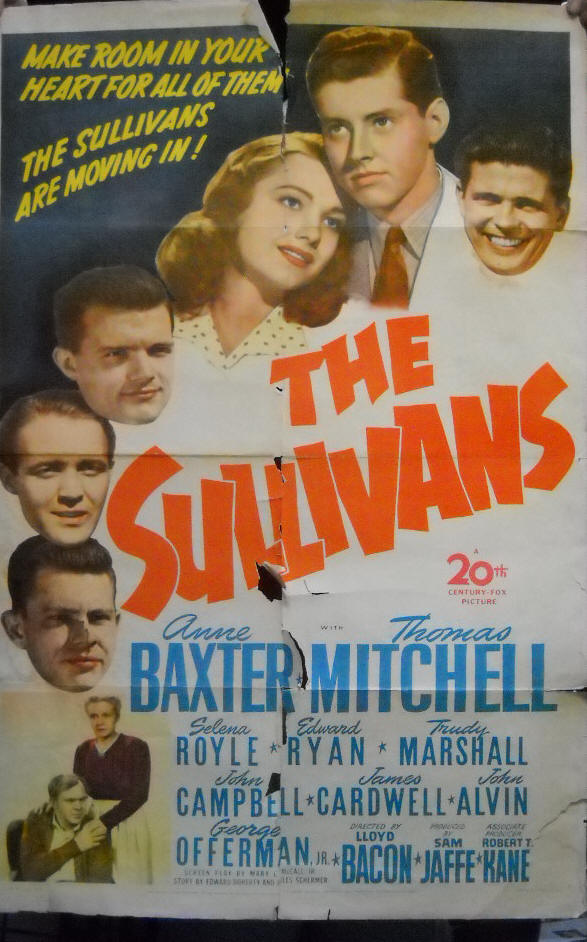
The Sullivans movie broadside.

The Sullivans movie broadside.

In Kyle Schlesinger’s reading he talks about how broadside can be seen in different ways. One of the ways is, total immersion. This is talking about how a text can be difficult to distinguish from one another. In this movie poster of The Sullivans it shows total immersion. The text is made to look more comical and not too serious. The text the author used to make this poster is different for every section of the poster. The title is the largest part and is overlapping all the letters. There is display typed used for differentiating the title from the actors. The names of all the people in the movie are unclear and hard to read because of all the different variations of fonts and how close together are put. Some names are different sizes and texts from one another. The actor’s names are condensed really closely together making it harder to distinguish all the names. The actor’s names are relatively smaller than the title. The scale between the different words vary from one another causing more awareness in the important words the author is trying to point out to the audience. The quote on the top left corner is arched and the title is slanted creating a different effect. This creates a less serious look to the movie poster. The main actors names are using a baseline by creating a smooth look and symmetry. This movie poster is advertising their movie and making it more prominent by having the title large and in a bright color, causing awareness.

Posted in Fall 2014 Archive (336) | Tagged | Leave a comment

Broadsides- Stephanie Jones

Gary Joseph boxing broadside poster

Gary Joseph boxing broadside poster

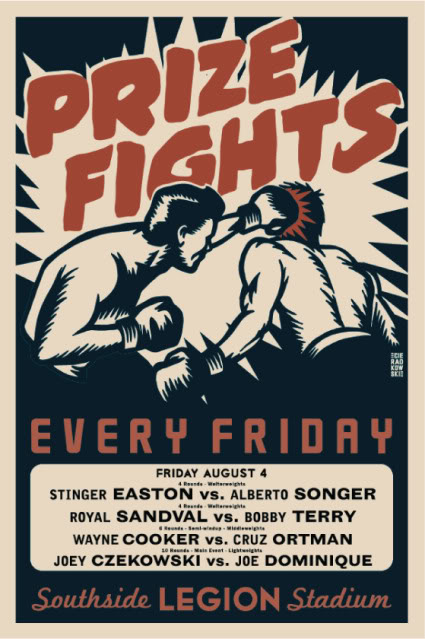
Like the Kyle Schlesinger broadside posters, this Gary Joseph post for boxing would be under the category of “everything but poetry” in the reading. This is a broadside for boxing in the 50’s, 60’s. It has bold and colorful graphics. The bright red type “Prize Fights” draws the reader into the poster because it is on a light background. The broadside uses display type, meaning larger type size for the title, as well as smaller type for the detailed information about the fights, such as the famous fighters. Images are also used on this broadside to help give more detail about these fights. The reader wouldn’t know they were boxing fights if it wasn’t for the image. This broadside could show total immersion in the text because the title “Prize Fights” is supposed to look like a comic book “pow” and demonstrate pop art. All the text at the bottom of the poster makes it bottom heavy and unbalanced because it has a lot of information causing visual weight. this allows the reader to continue to read the whole poster because the eye starts top and goes to the bottom. the type  has even letter spacing in the box, but the different red type all have different fonts and letter spacing. “Every Friday” letter spacing is more spread out then the “Southside Legion Stadium.” There is a little overlap of the image on top of the title, but the rest of the broadside does not have any overlap. The text is still legible throughout the whole poster making it easy for the reader to read.

Posted in Fall 2014 Archive (336) | Tagged | Leave a comment

Broadsides – Katie Malberg

This broadside was a “Switcheroo” for an annual Broadsided Press feature, where writers create works in response to a piece of visual art. Poet Philip Schaefer and Painter Maura Cunningham were the creators of this broadside. As can be inferred, this broadside features a poem and a painting. Though it could be viewed as a poster, this work of art is defined as a broadside for multiple reasons.

The title of the poem could be used to argue the broadside is a poster. The title, “Disappear,” uses the actual painting as a baseline. Unlike the poem, it sits on top of the painting rather than within it. The title’s scale is also larger and completely capitalized, making it stand out as a sort of title. However, its position is in the upper left-hand corner, while the poem is centered on the paper. The eye is naturally more drawn to the poem and artwork than the poems title because of this arrangement.

This broadside was a "Switcheroo" for a annual Broadsided Press feature. Poet Philip Schaefer and Painter Maura Cunningham were the creators of this broadside.

This broadside was a “Switcheroo” for a annual Broadsided Press feature. Poet Philip Schaefer and Painter Maura Cunningham were the creators of this broadside.

One could also argue that the broadside is a poster because the scale of the sheet of paper is unintelligible, and the scale of the typeface does not seem to be display type, but of a more average size. This is in itself, however, acts as a way to draw people in to look at the broadsides content.

The prime reason this acts as a broadside rather than a poster is because of the total immersion taking place between the painting and the text. The poem is titled “Disappear” and when observing the kerning, or slight leaning of the text downwards, it almost seems as if the text is going to disappear behind the painting. Additionally it mentions a bird stretching its wings in the poem, and the shape that the text makes could resemble a bird’s outstretched wing. The painting and the poem act in accord with one another to make both their ideas equally important to the artwork as a whole, thus making it a broadside.

Posted in Fall 2014 Archive (336) | Tagged , , , | Leave a comment