Type Anatomy: Daniel Kim

Image from the book Printing of Today: An Illustrated Survey of Post-war Typography in Europe and the United States by Oliver Simon.

The typography inside this image of a book cover is very clean and has a classy feel to it. The serifs on the typography is sharp and geometric and this is what creates this clean and classy mood. I believe the creator of this book cover used this form of typography to help fabricate a sense of ethos for the author of the book and book cover. Due to all of the typography being uppercase there is a lack of ascenders and descenders, but this helps create a sharper look because all of the typography are the same in height in their respective areas. If there were ascenders and descenders, it would take away from the clean look because the extra length going below or above the cap height of the uppercase letters. Also, lowercase letters x-height would make the book cover look more “ridged” due to the varying heights. The spine of the “S” in this typography is fairly thicker than the rest of the “S” and get’s thicker as it reaches either ends of the letter.

This typography being used the book title, also doesn’t have a ligature, making it look more uniform and less clustered. The space in between each letter takes away from clutter and does a good job at filling up the right amount of dead-space. The giant “O” in the center of the book cover seems to be made larger to help the balance of the piece. The color choice of the typography holds a high contrast from the orange image, inside the “O”, and the two orange lines below the title. The helps the fonts feel more heavy and solid, if they used a lighter color for the typography the mood given off would have been more light and friendly. This typography is definitely a Material-based example because one can notice there are not breaks in each individual letters. Also, this style of text is very uniformed and easy to read.

Posted in Spring 2018 Archive (336) | Leave a comment

Type anatomy: Jen Ladwig

This is the title page of “Prieres pour las messe, confessions, et communion” by William Rollinson. This book was printed sometime between 1770 and 1800.

This is the title page of the book “Prieres pour la messe, confession, et communion,” a French prayer book. The entire book is written by hand, and it shows the true artistic ability that is required to do calligraphy. The writer used a serif font, and it is very dynamic. There are thick sections of the letters and thin sections, and they are quite different in size. The writer also created several different fonts, with varied styles. The first word, “prieres,” is very decorative, with fancy embellishments on the spine. It also has a varied color, with detailed shading that give the typeform depth. With “pour,” the font has shading as well, again helping to give it more depth.

This book was written by hand. Because of the time and dedication this type of precise writing would entail, it almost certainly belonged to a wealthy person. The beauty of the text and the cover show that it would have been very labor-intensive to produce, and thus would be expensive.

Throughout the rest of the book, there is a mix of red and black text, and both italics and regular letterforms. The mix of the two distinguishes between the different types of writing in the book, such as a prayer versus a descriptive bit of text. The text is justified, for the most part, which makes the fact that it’s hand-written even more stunning. The writer had to plan out how much space the words would take up and write the lines accordingly. There were a few places where the writer seemed to misjudge the length of the line and they finished off a word with a flourish that would take it to the end of the line. This added a certain amount of flare to the text, but seemed unevenly spread throughout the book, making it stand out.

The text, although in several different styles (italics, regular, all caps, etc.) all meshed well together, making it pleasing to look at.

Posted in Spring 2018 Archive (336) | Leave a comment

Type Anatomy: Abby Larson

I have chosen to write about Bertha S. Goudy: First Lady of Printing for this blog post.

A biography about Bertha Goudy, written by Frederic William and published in 1958 by The Distaff Side, New York.

This book was published in 1958 and was written in English. The typeface changes throughout the book and among chapters. It varies between a calligraphic style and a standard serif font. I am going to focus on the calligraphic typeface. The first letter in the chapter has been stylized to match the rest of the book. In this case, it is a red ‘I’ with a flourish that appears to be a red leaf. The following black typeface appears to be handwritten or printed with a very irregular typeface. If you look closely, you can see that the letter ‘d’ is written in two different ways. This is also seen with the ‘e’. In the second line, the ‘e’s in where and the ‘e’ in begin are written differently. This is also seen in the word ‘because’ at the start of the third line. In looking for a pattern of when the different variations of these letters are used, I found that the alternate ‘d’ is used only when it is the last letter, or second to last letter in a word. The ‘d’ that looks more customary is used at the start of words and in the middle of words. I wasn’t able to identify a pattern among the variant ‘e’s.

This page gives the reader the impression of importance, prominence, and significant

A biography about Bertha Goudy, written by Frederic William and published in 1958 by The Distaff Side, New York.

meaning, especially in comparison to the page that comes before it. The font is the biggest contributor that this text comes across the way it does. The color of the first letter also plays a role in this impression.

I also found that the capital G has a descender, which is interesting since most capitals do not have descenders by convention. The lowercase letters strictly stay within the x-height line and all of the ascenders and descenders are the same height as well. The synchronic uniformity is emphasized by the comparatively short ascenders and descenders. These elements do not vary much from the x-height.

Posted in Spring 2018 Archive (336) | Leave a comment

Type Anatomy: Ana Giles


Anton Koberger Bible

German Bible printed in 1480.

I chose the German Bible copy from 1480 to analyze. This text has a very formal visual presence, with all of the paragraph text printed on a printing press, and the first letter of each chapter handwritten. The same font is used throughout the text. The only thing that is clearly different is again, the handwritten letters at the beginning of each chapter. The letters have a very old, Gothic looking style to them, which would make sense when you consider the year it was made and where it was made at (Germany). The text has serifs that accentuate each letter, but doesn’t overpower the overall text. However, I’m not sure if it’s just because the book is printed in a language that I can’t read, or if it is because the letters are so small and close together, looking at the page could be overwhelming because there is so much going on. There is the use of upper and lowercase throughout the text which does help with the differentiation. Almost all the letters sit on the baseline with the exception of some descending letters  like “g”. What is somewhat odd about this font however is there are not many acceding letters, and if there are, they are very close to the x-height of the lowercase letters. For instance, the “t” is a normal letter that ascends, however in this text, only the serif is above the x-line, which I find interesting. Letters like “l” and “h” are more obviously ascending. There is some contrast between the thick and thin parts, but not much. Most of the letters are the same width throughout. The text also follows a very geometric style, with boxy letters, even where there are letters that we are used to seeing with a smooth bowl, like “a”, “c”, or “o”, there are boxy elements to it with points in between where there would be the peak of a curve. Because of this, the “curved” parts are similar to the straight parts due to the boxy-ness of them.

Posted in Spring 2018 Archive (336) | Leave a comment

Form storming: Jocelyn Urias

The work of Gee’s bend woman are really good examples of formstorming because all the quilts have different shapes and coors that puts you to think really deep into the really meaning and background of the quilt. They kind of tease out ideas and options that go beyond the familiar. They were made in a really random way and so out of nowhere that is harder to understand and it really puts you to stare longer to the quilts. It usually takes synthesis, revision, and discipline that in this case of quilts, is not like that, this ones are unexpected and deeply into the creative investment.

H variation. “Milky Way” by Nettie Young

This quilt represents rhythm and balance because there is almost the same pattern invert side of the H, creating a balance of objects and it doesn’t seems awkward or out of place, it looks almost perfect. I can see rhythm here too, it shows in the way of repeating some figures and putting them almost in the same order. I can also see a organic and geometric pattern, because this quilt has pretty much a lot of lines and dots, even though the lines are not perfect, they seem like it, and the dots and big circles represent more into a geometric pattern.

The variation of color is pretty much dispersed but they didn’t use a lot of different ones. I can see red tones, grey, black, a little bit of brown, and a circle that is dark purple. If some of the same colors would have been together a little more, there couldn’t be a balance and we couldn’t distinguish between each shape. There is almost like another H inside of the big one, formed by thin lines and having 2 lines across instead of one. This quilt is the most better looking I have seen because of the organization and straight lines it has.

Posted in Spring 2018 Archive (336), Uncategorized | Leave a comment

Formstorming: Miranda Hansen

The Gee’s Bend Quilts are a notable example of many concepts of graphic design, in both their visual/physical form as well as in their symbolism and the preservation of values important to their creators. The quilts are a craft passed down through the community for generations, and while each quiltmaker has a unique style (such as the one individuals uneven stitching) when viewed as a whole the exhibit has discernible roots and consistency. The community teaching method helps contribute to the formstorming since the techniques are passed down but the visual solutions are unique based upon the individuals vision and reflective of their own memories.

Emma_Lee_Pettway_Campbell_Lazy_Gal_(Bars)_1621

A Gee’s Bend Quilt by Loretta Pettway.

The quilts exemplify the organic geometric reflection of the women’s surroundings. For example, the barn doors worn away panelling, or the architecture of the inside of their houses.

Quilt 1 Nellie Pettway

Quilt by Nellie Pettway.

For example, the “Bricklayer” quilts reflect what one might have seen staring up into a wood roof, and the perspective creates a sense of distance, as if you are looking into the quilt. The quilts also have abstract meaning in addition to emulating a physical picture. For example the way one of Loretta Pettway’s quilts was made from her husbands clothing so she could remember him.

Another preventing theme one can discover when examining the quilts is their balanced but not necessarily symmetrical layout. The blocky elements, fabric type and color are also indicative resources they had to work with. Despite some of the quilts dating back as far as the 1930’s, I thought it reminded me somewhat of a new age animation/music video theme in regards to the feel of the quilts. Specifically it made me think of the music video for the song Mykonos by Fleet Foxes.

Posted in Spring 2017 Archive (336) | Leave a comment

Formstorming: Samuel Jonsson

For this post I chose a work by Lucy T. Pettway called “Birds In The Air.” What really caught my attention for this piece was the patterns established throughout. I love how the quilt is made almost entirely of triangles and Lucy establishes form through the placement of key triangles that are bigger than the rest around them. You really see this in the diagonal line established from the top left to the bottom right. It really helps establish direction and helps the audience see the abstract birds. With the help of contrasting bright colors, it acts as a rhythm and as a form. This form being, of course, a bird.

This quilt named “Birds In The Air” made by Lucy T. Pettway is a dazzling display of geometric patterns to represent birds. This piece would have taken some serious formstorming to create with it’s abstract forms and colors.

The pattern is easily geometric but copies the forms of natural bodies. This makes the quilt abstract because the representation of these birds is mostly powered by our association with triangles and flight. The colors also remind the audience of feathers with its bright reds and purples and, its almost shining, whites, blacks and yellows.

I imagine the formstorming for this included looking up at the sky and seeing some birds fly through the sky or maybe even studying the colors and texture of a feather. It mentioned in her bio that she would plan out quilts by drawing initial patterns on paper and this is how she was able to develop such intricate geometric designs. It also said that she’d take inspiration from patterns in books, which might explain the bright colors of the quilt. The colors had to be a creative choice because it would be difficult to make this without planning ahead and collecting these bright pieces of cloth on a whim.

This pattern is surprisingly modern and I think it stands as a strong reason why these women deserve to be called artists.

Posted in Spring 2018 Archive (336) | Leave a comment

Formstorming: Jacob Granneman

The incredible and elaborate quilt patterns created by the women of Gee’s Bend, are most certainly an example of formstorming. Formstorming, the process of finding inspiration and creativity through iterations of design and observations of many many designs, allows creators to devise far more unique and original work. This is precisely what the quilt makers of Gee’s Bend did. Limited by there socio-economic statuses, and restricted by there geographic location, these women pulled inspiration from there simple surroundings. They also pulled physical fabrics and materials from their surroundings. The quilts made of clothing scraps, and formed into designs inspired by the patterns on the barns and roofs, is an example of observing many designs around and creating a new design with unique contrast and patterning.

“Milky Way” by Nettie Young

The quilts at right, demonstrate superb balance with geometric patterns that are more abstract in nature. The quilt design featuring circular patterns, makes great use of contrast and presents a style that lands nicely in a rhythm of toggling colors. When you look at it, yours eyes switch back and fourth between light and dark shapes, giving a positive/negative space illusion, which adds to the overall strength of the design. The more triangular pattered quilt, definitely gives a strong sense of direction and even movement. The sharp, geometric repetition, makes the eye travel diagonally down from the top left. The arrow-like geometry, also informs us where we should look and track.

“Birds in the Air” by Lucy T. Pettway

Both designs are rather abstract, as they are not clearly identifiable as representing an event, object, or person. However, the circular patterned quilt, is titled “Milky Way” and is in an “H” arrangement. Thus, it could very well be representative of the actual star-scape of our galaxy. As for the “H” design, I am not sure. Perhaps, it is representational of a name, or place. Ultimately, these examples of superb design and design concepts, shows a level of understanding equivalent to that of the technique of formstorming. To look at the field, the barn, and the stars, and extract design inspiration is exactly what these women did. That process is exactly what formstorming is all about.


Posted in Spring 2018 Archive (336) | Leave a comment

Formstorming: Ana Giles

NMA_Housetop_2006_0

“Housetop” by Nellie Mae Abrams, Gee Bend quilt

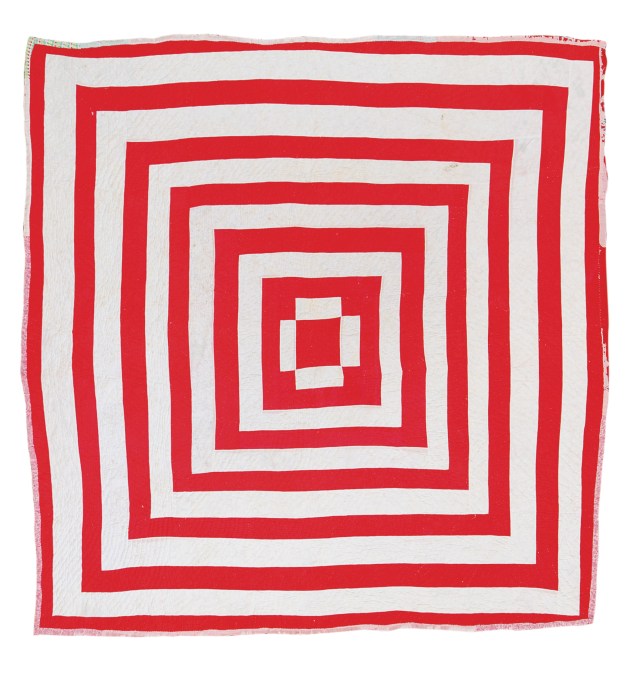
The quilts that are crafted by the women of Gee’s Bend are an excellent example of formstorming. Formstorming be definition, is “an act of visual thinking,” meaning the designs that people create tell a story or a thought process, even if not explicitly stated. The women of Gee’s Bend created these quilts because they had to. They had no means to purchase new blankets, and the tradition of making quilts for their family was an age old tradition leading back to the slave history of Gee’s Bend. Even though these women had to make these quilts for functionality, they also took the time to construct quilts that had artistic purpose. I chose Nellie Mae Abrams’ quilt “Housetop” because I was drawn to the blues and the square design. There’s balance with the first outer square where there are two sides that are blue and two that are white, creating a frame around the center squares. The center squares look like three square corners overlapping behind the frame. The whole quilt is very geometric with squares throughout. This quilt can be linked back to formstorming because although this quilt was made for a function, Abrams decided to put a design into it and keep in mind the colors she used, instead of placing random pieces wherever.

Posted in Spring 2018 Archive (336), Uncategorized | Leave a comment

Formstorming: Caleb McEnderfer

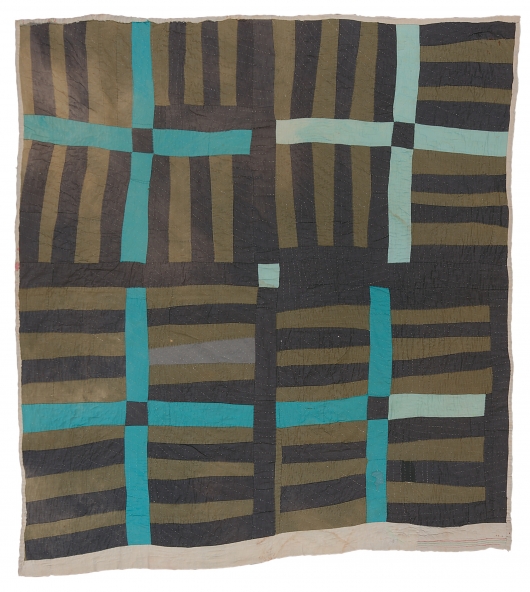
This quilt is made of cotton twill and synthetic material. The quilt was made by Loretta Pettway.

These quilts have historical value and all of the quilt display design concepts that we have learned about, but these women did not have any knowledge of these concepts, which makes these quilts quite amazing. The first quilt seems that it is a geometric pattern because the blue crosses seem like a measured length, but most of the lines do not have complete symmetry and have different thicknesses that make the quilt feel a bit unbalanced.

The four crosses that create the four boxes create balance by having an equal distribution throughout the quilt. The brown lines that surround the blue crosses create a rhythm that moves the eye in different directions. The different thicknesses of the brown lines create an ambiguity to the rhythm, but I think it makes it more intriguing and abstract.

This quilt is made out of Corduroy, denim, polyester knit, assorted synthetics. Created by Annie Mae Young.

This quilt called “bars” is a geometric pattern, but the color interaction makes it feel different. The quilt feels a bit unbalanced because the bars are different lengths for the most part and the color pattern of the bars looks random. I think this quilt is abstract because the randomness of the length of the bars and the placement of the bars do not have a natural order.

Posted in Spring 2018 Archive (336) | Leave a comment