Past, Present, and Future Technology: Interview Ideas: Ryan Ferrell

I read the first chapter of Soonish: Ten Emerging Technologies That’ll Improve and/or Ruin Everything, titled “The Universe, Soonish.” Its suggested future technology is cheap space travel. He gives multiple ideas that could lead to a great expansion of Space travel being cheaper and more readily available for regular-people millionaires rather than “crazy, nerdy billionaires.” This relates to notions of oral history about the pursuit of Space travel in the past, and how we can utilize Space Travel to preserve life on Earth. In the past, and currently, there are Orbiters and Rovers floating about the great outer space to conduct research and search for a planet that could sustain human life. This chapter relates to that notion because it is speaking ideas to begin thinking about if/when we do find a planet with the ability to sustain life. How would we get there? With affordable space travel to send people to those planet(s). There wouldn’t be a point to finding a planet with the ability to sustain human life if we can’t afford to send many humans to outer space. The concept of being able to affordably send humans to other planets should become a reality in thought soon, with engineers brainstorming possibilities, all while other scientists and engineers focus on finding a planet that can sustain human life. The notions of oral history of space travel are about the Apollo missions and the Rovers on Mars exploring and discovering new things.

I think I will be interviewing my grandpa, John Miller, about the advancement of technology with each Apollo mission. I want to specifically talk to him about Apollo 13 and the memory he has of the moments of launch and the moments of concern when the

Apollo 13

Apollo 13 of the Apollo Space Mission. In pursuit of the “Great Space Race.” Photo from NASA.

liquid oxygen tank began to leak. I want to know what the general public’s reaction was, what his reaction was, and the amount of interest he had for space travel. I would also like to bring up the failure of the Challenger Orbiter space mission that had blown up and plummeted to Earth 73 seconds after leaving the ground.  I want to know in what way the news immediately impacted the nation, if he watched the launch, and how it impacted the nation immediately following, as well as long term. My grandpa has a lot of interest and passion for space travel and technology as a whole. He was actually the person whom first nominated me for the NASA STEM Summer Camp, along with nominations from teachers the following years; I did end up receiving official invitations to the camp from NASA each year as it is an invitation-only private camp only open for the brightest young minds in the nation. Sadly, my passion for space travel doesn’t meet even half of that of my grandpa’s. I have the intelligence, but lack the passion to pursue STEM, yet alone space science/astronomical/aeronautical engineering. Enough talking about myself, I think it would bring a big smile to my grandpa’s face if I sparked interest about space travel and asked him some questions.

Posted in Fall 2018 Archive (201), Uncategorized | Leave a comment

Past, Present, and Future Technology: Interview Ideas: Aidan Aumell

The book “Soonish” relates to the notions of oral history because they do a very good job of storytelling throughout the book explain a certain topic in full detail. It talks about the future of technology in great dept but also focuses on the past and information behind the main subject. For example, when the book talks about the future of fusion power. It goes into detail on the biggest, most expensive fusion project in the world” ITER”. But prior to explaining what this is, it describes just what is fusion power is in the simplest way possible. “If you hold a lighter to a candle, but the wick doesn’t catch fire, all the heat in the wick will go away once you turn off the lighter. But if you can get the wick to catch fire, the candle will keep burning until the entire thing is gone. The fire creates more fire. In the same way, if you get the fusion reactor going fast enough…” (89 Weinersmith) This is a perfect example on how the book relates to oral history because it does a good job of explaining the oral history behind certain things.

For my project, I want to interview my mother about life as Washington State University 20 + years ago and focus on the differences from back then to now. Mostly about how the use of technology and phones changes the culture of a city. My mother always talks about Pullman when it had no phones and during that time a lot of people did a lot of thing differently. I also may want to interview my family (brother and mother) about moving to Seattle and how city life differs from Suburb life. It was a massive change for my family and I feel like we would all have a lot to talk about on this matter.


WEINERSMITH, KELLY. SOONISH: Ten Emerging Technologies That’ll Improve and/or Ruin Everything. PENGUIN BOOKS, 2019.

Posted in Fall 2018 Archive (201), Uncategorized | Leave a comment

Past, Present, and Future Technologies: Interview: Rachel Lentz

Digital cassette tape music converter. Photo by Rachel Lentz, August 2018.

Technology seems like the focus of our industrial age. Buildings get higher, devices smaller, and simple aspects of life more complex. “Soonish” describes the formula for how our world developed into what it has and explores the practicalities of advancing technology. Its main point is how the development and use of technologies is usually built on a foundation of former technology, funding, and physical infrastructure. The authors delve into how these systems might be put into place to develop the feats of science fiction we all hope and dream of.

Technology itself is defined as the application of scientific knowledge for practical purposes. However, when it comes to acquiring knowledge, it can be a little bit less “practical”. The transfer of knowledge and learning is not something that only can be confined to books or the classroom. Knowledge is passed down several ways, and one of these ways is through oral history. In applications of science, oral history can give a perspective of where we are, motivation for moving forward, and inspire creative solutions to old problems. This applies even more in the coming years as technology develops, and so should our knowledge of the world and the people in it. “Soonish” talks about how a foundation is needed for large new innovations to develop. Oral history helps provide a unique part of this foundation that is newly emerging. The collection of the stories of regular people provide the human information and drive that could make the future tech and explains for present.

To combine our discussion of technology and oral tradition I would like to interview my father. Our discussion would focus on the technology of transportation, and the theme would be change over time. I would like to discuss the surprising way that he has seen the world change from his childhood and have him discuss the implications for future technologies, especially in travel and transportation/vehicles. The picture included in this post is how an older model cars technology was adapted for current use as a cassette tape is converted for digital use. This is important as it show how the technology has changed in vehicles in just a few years and also how it can be adapted. The discourse on self-driving vehicle could be discussed as well, including issues of clean energy/electric vehicles, and how involved tech already is in vehicles. We could also discuss GPS, communication between vehicles, and much more.

This discussion would hopefully also go into the advancement and adaptation of technology we have seen. The use of old structure in the employment of new technologies and for different infrastructure is a interesting topic that could be breached. Oral history is one of the best ways to learn of this change over time from a personal perspective and develop a clearer view of what the world was and how it might change.

Posted in Fall 2018 Archive (201) | Leave a comment

Past, Present, and Future Technology: Interview Ideas: Wyatt Nevins

The bit of future technology demonstrated in Soonish that caught my interest  was the panel on page 8. It depicts a group of people with strange, sucker like contraptions attached to their heads with antenna extending. The forefront character in frame says “The bad news is that our minds are controlled by hidden rulers with direct access to our feelings. The good news is that I feel just great about it!”

This panel is dystopian in a cool, 1984 style although a tad more outlandish. What’s so interesting about it to me is not only the obvious intrigue that comes with a society who’s emotions are dictated by corporate-shadow government-illuminati types but the parallels to our world. Everyday companies convince millions to give up more and more freedoms in exchange for convenience.

I’m by no means above this. I use Facebook and Twitter and Instagram like everyone else. I give my information away to companies that sell it to advertisers and marketers and scary James Bond villains like Cambridge Analytica. I wouldn’t survive without GPS services on my phone or being able to locate my friends to meet up on campus. The convenience vs. freedom dichotomy is very real and it’s quietly taking away our privacy and autonomy without the general public noticing.

Watching Mark Zuckerberg’s Supreme Court hearing fuels this fire. He not only had a post it note over the camera on his laptop to prevent hackers from looking through, but also one over his microphone. Facebook is one of the biggest culprits of selling users information without their knowledge and the fact that the man behind it is concerned about his own information is being taken makes this feel like a coming epidemic.

If this theoretical future holds implanted devices that give those same companies access to our very thoughts we’ll be sacrificing all of our autonomy and privacy.

This is a modern concern: other generations didn’t have to worry nearly as much about their information and lives being spied on by corporate and government entities. I think it’d be interesting to interview someone who was around before the internet was so widespread and ask them what their concerns for the future were. Not only how they feel about the current and possible future state of monitoring, but problems they never foresaw or problems that faded away with time.

It won’t be terribly difficult to find an interviewee who was around before the internet which is a plus. I’d love to talk to my grandfather who worked for the military developing weapons technology shortly after the internet was invented. He also saw the birth of the World Wide Web in the 90s as well as it’s rise to modern domination. Asking him what he was concerned about throughout 20 year intervals, how those problems shook out and what he’s concerned about now would provide valuable and intriguing insight to the past as well as what’s to come.

Posted in Uncategorized | Leave a comment

Past, Present, and Future Technology: Interview Ideas: Jessica Harja

In all honesty, it is hard to draw a connection between the chapter I chose from Soonish and notions about oral history from the story corps. The chapter I chose to read was chapter two and it was talking about the ways in which space exploration (more specifically rockets) could be made more affordable if scientists explored a couple of other methods like reusing old rockets (Weinersmith, 2017, pg. 13). On the surface, there’s nothing that relates this reading to the information that talks about oral histories and how things are recorded. Maybe, in a non-connected way, these readings are connected in the way in which space technology was created and how the information scientists recorded helps future generations on how they navigate making space technology more affordable. Or even just discussing it with other scientists.

As I briefly mentioned in the previous class on Tuesday, I would like to opt out of creating an oral history project for a sound-scape project. It’s not that an oral history project is uninteresting; I’ve completed similar projects and relatively know how to create a similar project. It’s that the alternative project sounds very interesting in how someone could create a

space with sounds alone and transport the listener to that space.

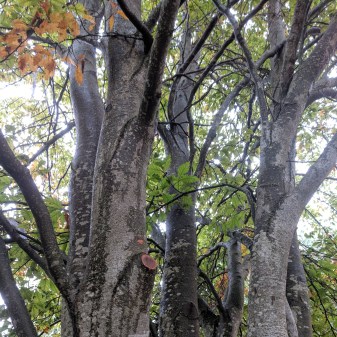
Currently, I am a double major and I am finishing my first degree next semester. I’ve been trying to think of ways I could incorporate adding a sense of space into my final exhibition and this project would be a great way to explore a sound perspective for it. Primarily what I would like to do is record sounds regarding rain, wind, rustling leaves, or other similar sounds to try and represent a forest or the arboretum over at the University of Idaho.

IMG_20181006_130727

This is a photo of a set of trees I took at the University of Idaho Arboretum for my BFA project. Created by: Jessica Harja, October 2018.


Weinersmith, Zach and Kelly. Soonish: Ten Emerging Technologies that’ll Improve and/or Ruin Everything. Penguin Press: New York, 2017.

Posted in Fall 2018 Archive (201) | Leave a comment

Past, Present, and Future Technology: Interview Ideas: Ashley Cole

For this assignment, I read the chapter of Soonish which focuses on augmented reality. When I first chose this section, I did not really even know what this meant; I just thought that it sounded like an interesting topic to learn more about. It turns out that augmented reality as well as virtual reality are ways to change what we see, hear, and smell. Virtual reality refers to a complete change of environment, virtually of course, while augmented reality is the addition of certain things to a reality in which we already exist.

This topic could relate to oral history in the sense that when people go through life using technological devices which skew their perception of reality, we have to question the authenticity of their oral histories and stories. This does not even have to specifically correlate with the idea of augmented reality but could relate to something as simple as watching television shows. When kids grow up watching a lot of TV, they may not be in tune with the reality of what is going on around them. This is something that is very interesting to think about.

For this project, I would like to interview my dad. Although he is not too much older than I am, he is obviously of a different generation and therefore I think that some of his insights could potentially be very interesting. I would like to talk to him about the type of television set they had and the shows that they watched when he was growing up. I think there is also something to be said about households which only have one TV. He has told me in the past that they just had one in their living room, which was pretty common for that time, and that it forced him to spend more time with his family. I think that this interview could go in a lot of different directions and I just want to see where it takes us.

Posted in Fall 2018 Archive (201) | Leave a comment

Past, Present, and Future Technology: Liz Kurtz

I focused on the sixth section within the book “Soonish” by Kelly and Zach Weinersmith. This section was titled Robotic Construction, it discusses how eventually technology should develop robots that work construction. This idea stemmed from the need to build homes more efficiently and at a larger scale. This relates to oral history by connecting how things were done in the past to present. Within the chapter they talk about how home building was arguably done faster in the past. They give examples of Tomas Edison and his grad idea that instead of making a new home every time there was a demand, rather make a mold and pour one. Ernist Neufert was also a revolutionist thinker with his ideas to build homes on the back of train and collect materials as the train ventured. Given, both of these ideas were debunked, however they inspired us to think deeper and more critically about how we develop the process of building something and the technology involved. Today, scientists are developing a new way to build homes. With further advancements the future is not far off, maybe your next home will even be built by robots. Oral history plays an important role within society as it allows us to keep a record of past events and ideas. This chapters idea directly relates to oral history by providing historic examples of attempts to quicken the building process.

When asked to choose an individual for this oral history project, I imminently thought of my dad. My dad grew up in a small town in Alaska and often talks about how much technology has improved. He tells us stories of the gadgets he had growing up and even advancements being made currently within his work. Both my mom and dad are architects and are directly affected by updates in software and building codes. I would like to interview them both to get two different perspectives of how these advancements have changed their area of work separately. However, my dad specially would make a great candidate for this interview.

Posted in Fall 2018 Archive (201) | Leave a comment

Past, Present, and Future Technology: Interview Ideas: Angela Basinger

I read chapter 9, Precision Medicine, from Kelly and Zach Weinersmith’s Soonish: Ten Emerging Technologies That’ll Improve and/or Ruin Everything. This chapter discussed recent developments in the medical field pertaining to the ways in which modern medicine has rapidly improved accuracy in efficiency. Recent scientific discoveries revealed biomarkers found by reading DNA data. Precision Medicine involves new technological “fixes” to genetic disorders as well as treatment for cellular disorders such as cancer. Though precision medicine techniques are regarded by the author’s to be expensive, they are also noted to have long-term preventative effects for patient treatment before a condition is beyond help. I believe that centering on the technological advancements within the medical field would be a good focus for my interview in project three. Relating to oral history, I would like to center my interview questions on topics of emerging medical technology in the recent past and what effects these have had on patients and those working in the medical field. I would like to interview my grandmother, Donita Basinger, who was a case worker and nurse’s aid for many years before retiring, or my mother, Jill Basinger, who is currently a registered nurse working at Sacred Heart hospital in Spokane Washington. When deciding between these interview subjects I would consider both my mother’s more direct experience with medical technologies on a day-to-day basis, and my grandmother’s longer span of observations of advancements in the medical field. Aside from choosing between a subject to interview, I would need to consider what question I will ask. My interview questions would be centered around my purpose of exploring medical developments over the past 30 to 40 years. This would include inquiries about how the study of medicine has changed or developed in reaction to these developments and how the proactive of medicine has changed or developed in reaction to these developments. I would consider asking about effects on patients and how the patient/nurse/doctor relationship has changed in reaction to these developments.

Posted in Fall 2018 Archive (201), Uncategorized | Leave a comment

Past, Present, and Future Technology: Interview Ideas: Josue Cuevas

So I read the sixth part of the book “Soonish” titled ‘Robotic Construction’. This part of the book talks about how we should be moving towards having robots work in construction jobs specifically in building houses. How it relates to oral history is when the authors talk about the history of building homes faster in the past. First they bring up the fact that in 1917 Thomas Edison had the idea of instead making a new home every time you wanted one just make the mold of one and pour concrete into it. Then during World War II Ernst Neufert had the idea of making houses on the back of trains bringing in raw materials as they go along the tracks to build. None of these ideas caught on obviously they were kind of crazy. Nowadays scientists and engineers have made advances in the robot making houses area something that wasn’t thought to be possible until recently. The part of the book that is this chapter is a good example of talking about how robots doing construction work to make house building easier and faster. How it relates to oral history by having historical examples on previous attempts of making houses faster as well as easier.

I will be planning on interviewing my brother in law Marco since he is the oldest member of my immediate family who is not my parents. I don’t want to interview my parents just because they don’t speak english and it will be difficult with all the translations. My brother in law on the other hand is a lot older than me so it’ll be interesting to see how technology was used by him growing up poor in southern California. I am not sure which piece of technology to focus on really there’s a few I was thinking about like maybe the smartphone. I think i’m going with the smartphone since my brother in law use to work at Verizon Wireless store, so he has lots of experience with smartphones. But only in his adult life he has experience with a smartphone not when he was growing up so it’ll be interesting to see how our experiences differ.

Posted in Fall 2018 Archive (201) | Leave a comment

Past, Present, and Future Technology: Interview Ideas: Shengjie.wu

Continue reading

Posted in Fall 2018 Archive (201) | Leave a comment