Print Versus Digital: Kaleb Parrish

When first reading Understanding Comics by Scott McCloud, it was definitely a little troublesome figuring out how to read the comic the right way since it has been a very long time since I last read a comic. As I started to read more and more pages, it became way easier to read since my mind got back on track to the way a comic is supposed to be read. It eventually brought me back to the days when I was a kid reading comics, even though most of the comics that I read when I was younger was more action-based like Marvel or Captain Underpants. After reading this book, I realized that all comics don’t have to be fun or action-packed like I remember as a kid. Comics can be more than that, they can have the ability to convey information that is built into a story, in which almost every comic should have. The fact that comics started around the 1930’s in the United States gaining popularity through action-packed stories, yet people still show hatred towards comics even though I feel like it is just a spin-off to ancient paintings on the walls, just without words. It’s just another way to tell a story or meaning, kind-of like animations how they are a bunch of pictures that barely move just without the bubbled narration (spin-off to stop motion).
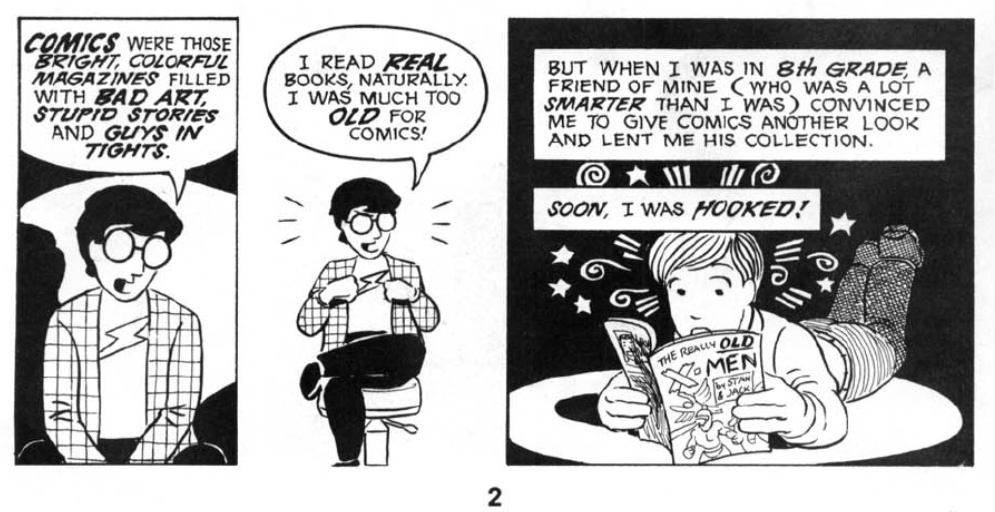
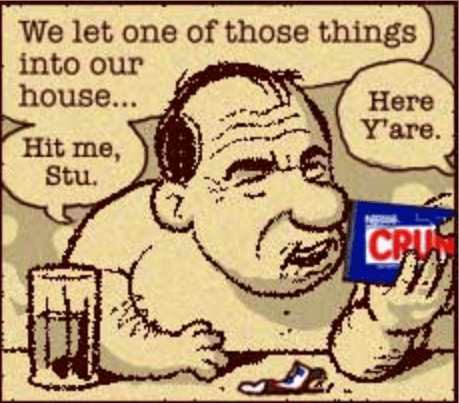
Understanding Comics by Scott McCLoud, Page 2.


After reading Eroyn Franklin’s web comics, I thought it was very interesting to see how different it is to read a print comic like McCloud’s printed book than a digital print like the web comics. Because I am always on my laptop, it felt a little bit harder to fully focus when reading the digital comics. When I was reading through the screen it felt like I needed to be doing something else on top of reading whereas when I read a print book, my eyes are glued to the paper. In this digital age, it makes me ponder the idea that since everything school-related seems to keep getting digitized as time goes on, will we just get rid of print books? Everyone has different learning and reading preferences so hopefully we can continue to have both available for as long as possible.


If I was going to create a comic, I would create it as a digital material yet easy to read like a print material. Being in the digital age, maybe some comics are too much for the digitized print so maybe making comics that are digitized a little easier to read would be helpful. For my comic(s) I would have them always read left to right and then up to down since that is usually how we read in general here in the United States. Also, I would try to get suggestions throughout the making of my comic because in reality, even though it would be digitized, I would still want readers to not get “lost” like sometimes people do through digital material.

Posted in Fall 2018 Archive (201), Uncategorized | Leave a comment

Print Versus Digital: Chandhni Jayakanth

For this blogpost, we had to read both a print comic and a digital comic – “Understanding Comics” by Scott McCloud and “Long Term Relationship” by Eroyn Franklin, respectively. Reading both of these made me look at a drastic difference between print comics and digital comics. Scott McCloud mentions how comics are a very old art form, which has been around for quite a while now. But because of the selective interest in people to enjoy a comic, it has always been seen as a fairly new art form. Therefore, digital adaptations seem acceptable because people wouldn’t have to go to a store to purchase a comic and would much rather sit at home and access it with a click.

I think the one of the chapters about the panels shows how different a print comic is compared to a digital comic. The concept of closure shows how the reader might already predict a little bit of what is about to happen even before flipping the pages. While ready Eroyn Franklin, I realised this wasn’t true with digital comics just because of how it is represented. Just with a scroll, you can read the whole comic making it strip away the blocks and panels of a stereotypical comic. Although comics don’t have to be written that exact manner, it is definitely a stereotype that defines comics and a stereotype that comic enthusiasts find tough to move away from.

I personally also wanted to compare the print versus digital Marvel comics and how it has affected the way I read them. I try to buy the printed copies of the comics whenever possible but sometimes when I cannot, I try to use the digital app to read my comics. The experience with print is the same as reading the “Understanding Comics” – it generates a personal connection, making me excited to know what is to come in the following pages. The same might be true with the digital ones but the way their page layout is created is very different. The digital comics move from one panel to another, making it focus a lot more on the art and words rather than the whole. I think this is the reason why, I would any day buy a print copy of a comic and only settle to reading the digital version when I have no other choice.

Another key statement I found very interesting in the book by Scott McCloud was the fact that printed copies made comics not just accessible to the elites, but to common people. It is interesting to note how the phase has changed from print being accessible to digital being accessible now. The upcoming generations will never know the personal connection of reading a physical comic and enjoy it the way we did in our childhood.

Posted in Fall 2018 Archive (201) | Leave a comment

Print Verse Digital: Aidan Aumell

After reading Scott Cloud’s book I honestly feel like I took away a lot of positives from reading the book. I would describe my reading experience as funky, I felt like my eyes were always moving through different places in the page trying to follow along with what Scott McCloud. I feel like even though each page or group of pages were describing one certain topic, he always rapidly would change to another topic after finishing one. This in my experience made it harder to comprehend all the information he was talking about. Also, as I read this book my eyes moved very fast from one text box to the other. I feel like this is how he designed the book to be read because he wanted to bring off the vibe that someone is speaking to you FROM the comics itself. Other comic books I read in class didn’t really offer this type of comic book narration, it was more like flipping through a picture book.

When I read McCloud Web comics I started noticing that he incorporated real life imagery into his cartoon comics. Almost merging two types of worlds into one. This is a result of using digital technology. As I read his Web Comics, I was almost reading it like a picture book too, contrast from the “Understanding comics” book, I was concentrating more on the imagery then the words. My eyes still moved fast throughout all the text boxes, but my attention focus more on what was happening in the pictures that he created. This could be because this content was shorter, but the imagery was drastically different and more detailed. Real life symbols and items were seen in the comics that I read, showing that he knew how to create Digital comics as well as print. These two types of creation have the same effect on the eyes in the sense that our eyes move freely move in chronologically order from what is being said.But in some cases, Digital technology can grab are attention more then doodles, because of how they show us certain things that come FROM real life, and look like real life…..

real-life.png

Scott webcomics Merging the hand written comic world with the digital. (Scott McCloud, ScottMcCloudWebcomics , 2003)

If I was going to write or draw a comic I would envision people reading the comics very fast. I would create a comic that would be pleasing to look at as well as read. That is how I read most of the comic books last week and I feel like as humans we are naturally read in chronological order, always looking for what is coming next. And if you can literally see what is coming next on the same page then all comics must be very appealing to the eye. Which all connect back “Understanding comics” we look at imagery and have different reactions to what we see based off our past experience.

IMG_4463 (1)

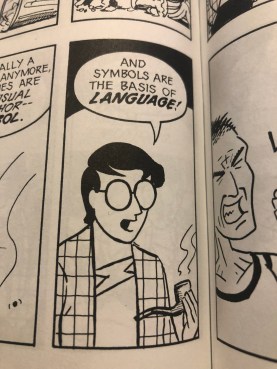
Scott describing how Symbols represent a bigger meaning
(Scott McCloud, Understanding Comics, HaperCollinsPublishers,1994, pgs 128)


Posted in Fall 2018 Archive (201), Uncategorized | Leave a comment

Print Versus Digital: Leah Henry

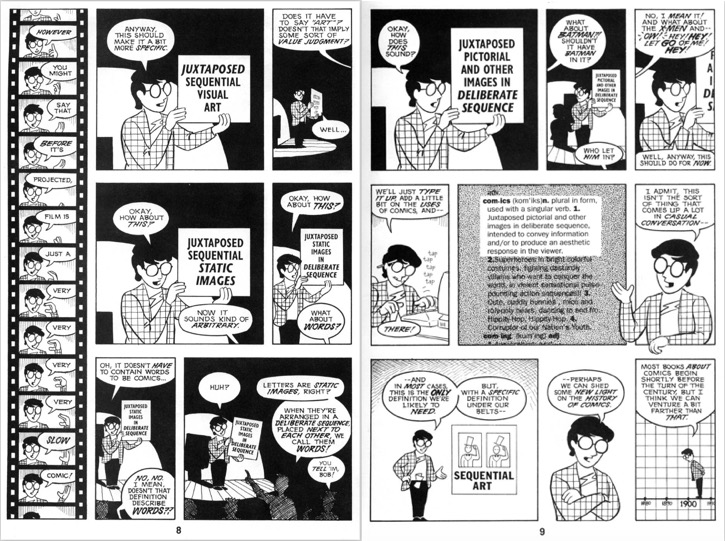
McCloud discussing the definition of comics. Scott McCloud, Understanding Comics, 1994, pg. 8-9

In the first chapter of “Understanding Comics” Scott McCloud demonstrates how difficult it is to define “comics” and tries to explain each component that should be included. In addition, he mentions that “our attempts to define comics are an on-going process that won’t end any time soon” (McCloud, 23), and that new generations will undoubtedly reject what we currently accept as the definition. McCloud says that there will always be things that we do not understand about comics, but he encourages his audience to continue the debate over it.

Before reading this book, I had never really thought about what goes into creating a comic. I learned a lot about comics overall and enjoyed the fact that this book about comics was a one itself. When I was younger I read a lot of Archie Comics, so I am familiar with what is like to read printed copies of comics. The difference between reading a printed comic and a digital copy put online is quite significant. When reading a printed copy, viewing two pages that are next to each other or physically turning a page may be essential in understanding the storyline. Then with digital comics, like Eroyn Franklin’s web comics, the experience is different in the sense that readers are scrolling down a screen instead of turning the page of a book. Also, digital comics can be more interactive with certain elements that printed copies cannot possess.

If I were to create a comic of my own, I would like for it to be somewhat “out of the box” and unique in the way that the drawings are presented. I think I would want it to be printed as a book, but the idea of having a digital version sounds interesting as well. I like the way that digital comics are usually more interactive for their audience and seem to have more possibilities than a printed copy. In whole, I learned a lot from reading Scott McCloud’s book and I now have a much better understanding of comics in general.

Posted in Fall 2018 Archive (201) | Leave a comment

Print Versus Digital: Deyanira Tovar-Moreno

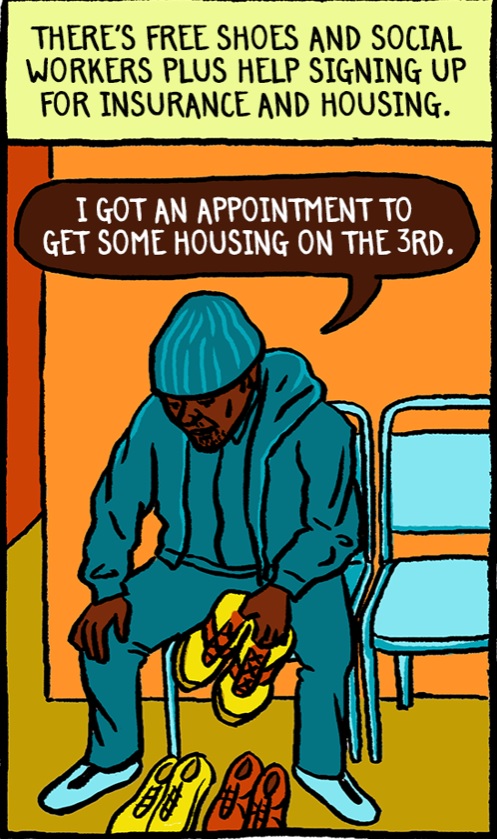
As an art aficionado, I resonated with Scott McCloud’s book, Understanding Comics. More specifically, I resonated with the idea he presented regarding the fact that as soon as our society creates a clear definition of what comics are, we will be presented with the task of creating a new definition because of the contemporary influences that comics will be met with. Forms of art are constantly changing, allowing for the definitions of certain concepts to constantly be updated. In example, as Scott McCloud stated, several art pieces from past centuries are now being considered comics due to the evolution of the definition of comics. These art pieces from the past include  a wide range- from Mexican codex to Egyptian scribes. Scott McCloud’s book represented ideas using somewhat realistic pictoral icons which mainly lacked shading but still had an outline. This did not impede my understanding of the comic because most ideas and concepts were presented via writing, with some graphic examples which did not need to be detailed to be understood. In other words, Understanding Comics used simple pictoral icons to amplify the focus kept on the story. On the other hand, the pictoral icons featured in Eroyn Franklin’s digital comics ranged from simple to realistic depending on the importance of the illustration to the viewers understanding. Eroyn Franklin’s comic Can Free Pop-Up Clinics Save American Healthcare? depicted the artist’s stance on the contemporary issue which regards pop-up clinics throughout America. Moreover, Eroyn Franklin leaned more towards the use of realistic pictoral icons, creating a clearer resemblance towards reality. This was vital to the digital comic because the topic entailed the artist’s stance on a  contemporary issue affecting a broad population in the U.S. The digital comic resonated with me more than others because of the fact that my parents rely on pop-up clinics for their healthcare needs. I was given the chance to view pop-up clinics through the perspective of Eroyn Franklin, which brought up several key aspects to the question at bay. The comic expanded much more on the issue of healthcare surrounding America, which resonated with my opinion. I agreed with the artist’s stance which was that the gap in access for healthcare provided by the American government has led to the need for pop-up clinics in places like Seattle. Expanding from that, the artist alluded that the solution to the healthcare crisis does not lay within pop-up clinics, but by closing the gap on government assistance. To include a wide variety of concepts and ideas within the comic, Eroyn used aspect to aspect transitions in his comics. Much like Eroyn, if I were to create a comic I would like it to depict my stance on a  contemporary issue so that my share of information and perspective could reach a vast array of viewers. The contemporary issue presented would be homelessness, which is something I see much of in my hometown of Seattle. Furthermore, I would use realistic pictoral icons to depict an environment and characters which would allow the viewer to further understand the impact of homelessness on the real world. A visual example of the realistic pictoral icons I would feature in my comic is show below:

EroynFranklin

Image downloaded from  a comic by Eroyn Franklim called Can Pop-up Clinics Save American Healthcare? Comic posted February 17th, 2017.


Posted in Fall 2018 Archive (201) | Leave a comment

Print Versus Digital: Timmy Huynh

I didn’t read Scott McCloud’s Understand Comics in print, but I did read a lot of the comics in class. For me, some of those comics felt great to read because of the lamination feel of the paper. Whereas, others just felt like glorified picture books. One thing that I enjoyed no matter what the comics felt like was flipping the pages. Whenever I flip pages it is satisfying and I feel as though I have won a little victory. Another thing was the flow of reading and sequencing that McCloud talks about. The way I initially read the comics was very traditional as in reading left to right, but eventually I started seeing the pages and panels as a big picture, seeing things below and around the main panel I was on, rather than a linear reading.

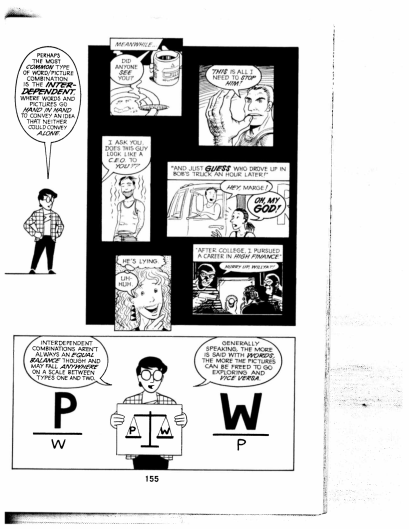
ScottMccloudComics-1

This is a visual explanation of the balance between words and pictures that McCloud uses. Credit: Understanding Comics by Scott McCloud

The web comics however did have a very distant feel to them. I felt both engaged and aloof at the same time. Seeing some of the animations and scrolling and clicking through the pages and panels was satisfying and was a different experience than the physical books. But there were a lot of distractions on those pages as well. I would get an occasional ad and that brought me out of the experience and the page directories at the top were also bringing me out of the full immersion. I do see why someone may enjoy a digital comic for the aesthetic though. It seems much cleaner and smooth depending on how the comic is done. I am on the fence on whether or not I would draw a comic in digital or physical. Aesthetically I would like to print it physically because that means if someone were to read it that meant it they’re reading and involved in one hundred percent of my work. It’s something that people would be able to show off and keep more sentimentally. Its similar to how Scott talks about the show and tell and how people explain things with a physical object except this wouldn’t be in the form of comics. However, digitally would be my preference if this was my job. It seems much more practical and people all over the world would be able to read it as long as they had internet connection. I also like the incredible options available to digital comics. It would allow for more of the balance of words and pictures as Scott describes because you would essentially be capable of combining them with animations or like in Scott’s web comic The Right Number, you could do the zooming animations which makes you feel go deeper and deeper into the story. If I had to choose between the two I would lean more towards digital as I would have the option to share quickly and easily.

Posted in Fall 2018 Archive (201) | Leave a comment

Print Versus Digital: Christian Solovey

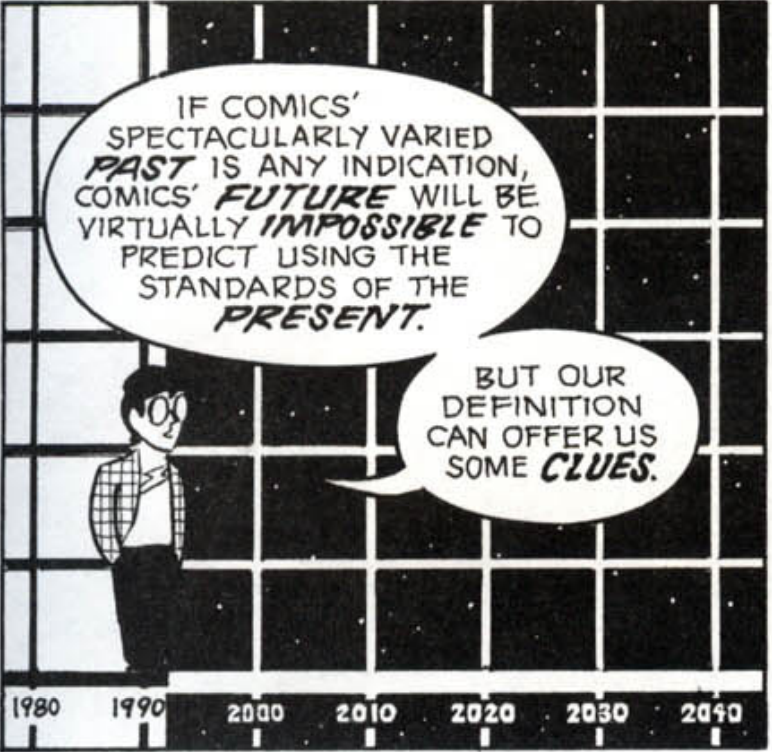
Page 21 of Understanding Comics

The future of comics – as stated by Scott McCloud in this image, “…virtually impossible to predict” in which I completely agree with. As Scott McCloud also speaks to the incredibly varied past forms of art and specifically comics, he implies that if everything changes so quickly over short periods of time, there is no real way of necessarily predicting what comics will be like in the future. However, in looking at more modern and recent comics (print and digital), I have to believe they will become more of an expression of art such that artist Eroyn Franklin portrays in her comics. In contrast to more classical form of comics such of that styled in Scott McClouds, Franklin uses a far more abstract expression in her imaging and less of the easier to follow sequential imaging McCloud speaks on in Understanding Comics. While Reading Scott McCloud’s printed book, I find it easy to follow, incredibly informative on information I never had quite wrapped my head around with comics, never had I thought they contained as much complexity to them as McCloud described.

Maleng 5 on Eroyn Franklin’s web comics.

With reading Eroyn Franklin’s web comics, I was amazed by the artistic expression, the abstract work was more enticing to someone like myself because that is my favorite form of art. With that being said I did find it very difficult to follow the story line and which direction to follow the dialogue. If I were to write a comic it would be linked somewhere in between McCloud and Franklin’s work. I find it much more aesthetically pleasing to illustrate the way Franklin did, but it would work much better by decreasing the image size slightly and refining the sequential dialogue in the reading for the readers. I would envision people reading it in print that was slightly interactive as well, where the characters and dialogues folded up off the page to interact with the reader and seem like the book was alive.

Posted in Fall 2018 Archive (201) | Leave a comment

Shawn Stephens – Blog #4

Comics are having a harder and harder time finding their place among modern media. Just like McCloud points out on page 65, “In film, closure takes place continuously– twenty-four times per second, in fact– as our minds, aided by the persistence of vision, transform a series of still pictures into a story of continuous motion.” The adolescent to young adult demographic (which I would guess were the biggest consumers of comics when they were more mainstream) now more than ever, is too spoiled by the easy accessibility and marketability of video-based media to prefer comics. It feels like much less commitment to sit down and watch something than it does to sit down and read a comic book. While McCloud lists tons of interesting ways comics can capture and immerse the reader within its’ own world, I think video-based media can do most of them much better, especially with how far production methods have come since this book was written.

As an advertising method, it’s very seldom seen. Advertising funds in company’s eyes are often probably better spent creating video advertisements. Comics are less costly, but also can’t combine video and audio to grab viewers’ attention. As an art form, it’s not relevant in adolescent culture anymore, which is what I feel like would’ve been comics’ biggest appeal when they were more popular. Going to to school, hanging out with your friends and talking about comic books is probably much rarer these days, and kids growing up today would have to go out of their way not only to attain comics, but to find other people that also like comics.

I think comics have a place online as a low-commitment entertainment medium. I think, like Eroyn Franklin’s webcomics, as with any media, they have to have some kind of catch. They have to be uniquely interesting and get readers hooked right away, and they have to be more conceptually interesting than video-based media has to be since they’re less attention grabbing.

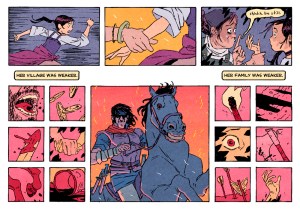
Jake Wyatt’s Necropolis takes the juxtaposition of multiple frames to paint a narrative to the next level. (Necropolis, Page 3 – Jake Wyatt)

I like Jake Wyatt’s Necropolis for its’ crazy immersive art. It also plays with the comic medium, and creates visuals that wouldn’t be as feasible in video media. I like Alison Zai’s instagram for her quirky comics. When I was way younger I used to make little forum adventures online where I would draw stories in comic form and post them online, and people would reply to them and suggest things for the character to do to control the story. I think if I were to make comics, I would want them to be interactive. I really liked that people could get invested in the story and feel like they had autonomy over the characters and narratives within them.


Posted in Fall 2018 Archive (201) | Leave a comment

Print vs Digital:Luke Schauble

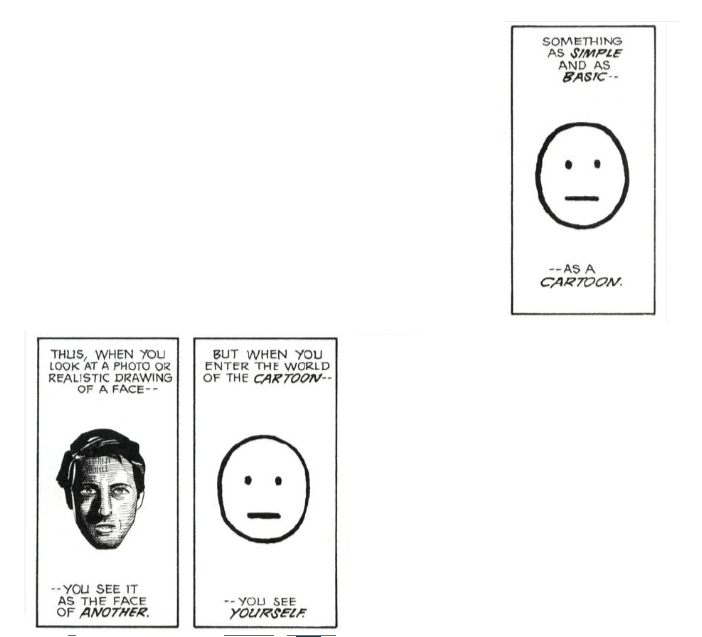
This Is a snapshot from the book highlighting how you can see yourself in cartoons
Credit: Understanding Comics by Scott McCloud

When reading Scott McCloud’s book Understanding Comics, it made me realize that comics is a artform, along with a type of literature, just as books are.  There are many stereotypes regarding comics, such as they are children’s books or what I have fallen victim to believing, they cant convey any serious topics. After reading his book, I’ve realized that not only are the stereotypes about comics wrong, but that comics have the ability to convey information, or stories, that no other type of literature can. I hate reading, so when I was in middle school, and even some of high school, I would read graphic novels if I ever had to do the dreaded “book report”. However, what started as a way to make my book report “easier”, I realized that I actually really enjoyed reading them. Now my favorite book series of all time is a comic, Bone by Jeff Smith. The reason I believe this is because, graphic novels are often made using cartoons, and as Scott McCloud says in the book, “When you enter the world of the cartoon– you see yourself”. He is showing how the more distinctive or detailed a character is, the less people the character will look like. The way you can almost cast yourself into the character because of there simplicity, is the big reasons I enjoy comics/graphic novels so much.

I read Understanding Comics using a e-book on a computer, however, when reading the printed version of it, I think it is a way better option then reading it online. When reading it online, it almost makes me feel as though the books art was made digitally, and not by hand. This is not the case when reading the book in the printed form. Secondly, it should be noted that I feel as though I have a harder time concentrating on the book when reading it digitally. This is not because of the other things on the screen at the same time, but because it takes away from the immersion when you have to constantly scroll down the page every 20 seconds to continue reading. For these reasons and more, I do not think it is fair to read his book digitally. What connects all the reasons that one should read the book in the printed form, is that this is how the author intended it to be read. Imagine watching a movie, but instead of watching it, you are looking at frame by frame pictures of the movie instead. If I was going to create a comic, I would make it a printed version as well. Turning the pages of a book “continues the story” or makes it flow in a way that scrolling on a computer can not capture.


Posted in Fall 2018 Archive (201) | Leave a comment

Print Versus Digital: Tori Bredy

When first reading Scott McCloud’s printed book, “Understanding Comics,” I had some trouble figuring out how to read and follow along with a comic as it had been so long since I have actually read one. But once I got the hang of it, it was fun and I felt the reading went by much faster. The way McCloud had written the book included a lot of personable voice which made it more casual and easier to comprehend versus a wordy, lengthy textbook trying to inform the reader about how to compose a comic. One observation I took from his book was McCloud’s emphasis on how important the sequence was. To construct a comic, the sequence in which the art is placed in is crucial to create a comic. We were taught to read from left to right so the sequence of the comic is very important to be placed in order with how the story is supposed to portrayed as.

An example of McCloud’s observation on the importance of sequences in comics (Retrieved Oct. 8, from https://canvas.umw.edu/courses/930511/files/37667942)

When reading Eryon Franklin’s web comics, I found that it was more confusing and difficult to have to scroll down to get to the next strip versus just turning the page. I chose to read Franklin’s comic, “Bikram Addict.” Franklin’s comic was interesting to read and I enjoyed how it as written to more of a mature audience with the topics mentioned throughout the comic. I am used to reading comic books as a child so being able to read one that was centered for more of an adult audience was refreshing. That being said, while I was attempting to read the comic, there were adds that popped up on my screen which took away my concentration towards the comic. Reading work as a hard copy is much less distracting and how I prefer to read any sort of written material.

I want to create a comic that would be made digitally but offered in print. I believe the traditional printed comic book has much more flare and detail to it than reading a PDF download, although that is the path commonly taken today. There is nostalgia and creativity I get when I read a picture book, or comic book in this case, that I would like captured in my comic and for my readers to get to explore for themselves.

Posted in Fall 2018 Archive (201) | Leave a comment