Pattern and Texture: Jennifer Ladwig

This photo is of a journal made by Journals by Jane, purchased at BookPeople of Moscow. This is an example of pattern, citing the repetition of the tigers and bamboo. Photo by Jennifer Ladwig

Pattern is created when points and lines come together to create a plane, and then the planes are placed together to create one cohesive image with a pattern. Patterns are repetitions, although they are sometimes not readily apparent to the eye. With the image provided, there is no apparent pattern on the front of the journal, but when the front is compared to the back, you will see that the position, size and orientation of the tigers repeats. The tigers, one can argue, at points on the journal, a single object that grabs the eye. Together, the tigers make a line, as they stack on top of each other and next to each other. A plane is created from the tigers and bamboo. Although they look at first glance to be random, it was made with a distinct pattern through the repeated positions of the tigers and bamboo.

Texture can be real or apparent. The brick wall of a building has has real grooves, providing real texture. The image I included of an art print has implied texture. The piece is simply a print of the original painting, but the brush

This is a photo of a print called “Believe in Me” by Julene Ewert, a local artist from the Moscow area. This is an example of texture, citing the paint strokes. Photo by Jennifer Ladwig.

strokes and the paint splotches gives the piece some texture. The swooping motion of the strokes and tapering of the color at the end of the strokes implies that one could feel the slight coarseness of the paint, and the ragged edge as it ends. But it feel perfectly smooth because it is only a print of the original.

Point, line, plane, space, volume, texture and pattern all help a viewer understand and mull over a piece of art. In this example, although the pattern appears to have no rhyme or reason, a line for your eye to follow is created in the image. When I first look at the cover of this book, my eye is drawn directly to the center, to the small island in the middle of the blue water — what I would argue is a point. From there, my eye is drawn down the line of points made up of the corner of the blocks with the blue waterfall. Upon reaching the bottom, my eye is drawn one of two ways. I either follow the darker blue-green path up and to the right, eventually landing on the vine that leads to the title of

This is a photo of Issue 20 of McSweeney’s Quarterly Concern, a literary journal published in 2006. This is an example of how texture and pattern interact with point, line and plane, as seen in the use of the colors and blocks on the cover. Photo by Jennifer Ladwig.

the book. Or, my eye is drawn to the vine to the left at the bottom of the waterfall, again leading me up and eventually to the vine that leads to the title and issue number. As a bonus, this particular book has some texture to it, as the text in the background is lower than the colorful pattern in the foreground, which is raised, making it easy to run your fingers along the image and vines, again, eventually leading you to the top.

This piece is not very straightforward. It’s busy and loud, and there is no apparent pattern besides the use of color and blocks. But it all works out to eventually get your eye on the goal, the title of the book. You get to that spot because of the patterns in the blocks creating a line that eventually leads you to your final destination.

Posted in Spring 2018 Archive (336) | Leave a comment

Pattern and Texture: Travis Thomas

This is a picture of tiles forming a pattern from Andrew Ridley that I got from Unsplash. This image is public domain.

A pattern is a repeating set of individual elements such as shapes lines or objects that are centered around the concepts of points, lines, and grids used to make a whole “piece” or pattern. In the Image that I attached, there is a geometric pattern being represented by what looks likes tiles on the side or on the roof of a building that are repeating in shape but differing in color. Each of the tiles acts as an individual element or shape and it is repeated to create a linear pattern. The tiles form diagonal, crisscrossing lines in the pattern as well as an intricate grid.

This is a design that I made while working at College Hill. This image represents texture.

A Texture, on the other hand, is a group of elements or points that aren’t necessarily repeating but come together to create meaning or depth when added to a design or image that allows the viewer to connect with it more. Textures can be both digital and or physical in nature. The type of surface that you print something on is an example of a physical texture. If you look at the picture that I attached to this post the distressed and the sketchy texture work together on the screen to create an optical texture that makes the design look weathered and gives it more character overall. The distressed texture that you can see the most clearly on the “S” in Spring, is made up of little rough pieces that come together to create the distressed texture as a whole.

This is a picture of sand representing texture, pattern, point, line, and plane from Bervan Ince that I got from Unsplash. This image is public domain.

The last picture that I attached represents both texture and pattern as well as point, line, and plane working together to help the viewer understand what the picture is. Without the sand texture that is in the picture the lines could look somewhat like ripples in the water rather than sand. The pattern of the lines also creates a plane that gives you context to where this picture was taken, probably in the desert somewhere because lines like that don’t occur on beaches normally. Without all of these elements, this picture would be very confusing given that the frame of the picture is so small not giving the viewer a lot of context as to what the picture is of. Both the texture and pattern are made up of lines and points creating a plane of sand that has direction because of the perspective of the plane as well as volume due to the shadows on the ridges in the sand.

Posted in Spring 2018 Archive (336) | Leave a comment

Pattern and Texture: Daniel Kim

I took this photo over winter break of 2016 when I was back in South Korea at the Gang-Won-Do sea. The style in which the fish was plated is really emphasized by basic pattern.

pattern, to me, is the basic building structure based off the repetition of lines, planes, and dots, but the purpose for patterns could vary depending on the use/reason of the pattern. On the right, a sashimi dish, is a great example of pattern being used in the culinary world for aesthetics. The pattern is used to please the eyes of the consumers and makes the people wonder if it tastes as good as it looks. This following pattern consists of basic building concepts lines, planes, and dots. The plate as a whole is a dot (point) which brings focus on what is on top of the dish. The layers of different fish meat create lines and a pattern based off fish meat. Starting with the bottom left, which is the “common” fish meat, going up towards the “better” portion of the fish, as one may tell from the color and texture of the layers. The outer right edge of the dish is composed of “fish dots” and creates a brown to pink fish meat pattern. Other than the food on the plate, the dish itself adds to the aesthetically pleasing look. The flower petals to whole flower plants also create a pattern that lets people know that food in the center of the dish is the main focus/point.

This picture is a picture of a frozen lake with snow covering the top. Taken in the winter of 2016 in South Korea, but I do not remember the exact location (somewhere in the wilderness?).

Texture is the absents of space or addition of material that creates a surface to look and feel a certain way. The photo on the right is a good example of texture because there are many presented. According to the reading Graphic Design: The New Basics texture can be physical and virtual, just like this photo. When taking the photo, I got the opportunity to feel what the snow on the frozen lake felt like, along with what the frozen lake texture was. The snow’s texture looked soft based off my first impression and when I decided to touch it with my bare hands it felt just as I expected, soft and cold. But, there is a unseeable and unexpected texture below the snow. The ice that formed over the lake was far from being soft like the snow. When falling down, the texture wasn’t soft or friction heavy, instead it was hard, slick, and bumpy. Virtually, now, the photo just shows the texture, but one cannot feel it’s physical texture. One may say it looks soft and others may say the texture looks rough. But, based on the face that the snow’s texture looks like multiple people have been stepping on it, one may take away that the ice from the frozen lake is thick and that a lot of people commute over the lake using the grip from the and security the snow gives.

Night photo of South Korea’s National History Museum in Yongsan. I took this picture of the past winter break (2017-2018).

In this photo patterns and textures play a role in my understanding of “point, line, plane (and space/volume)” in three different ways. The ceiling of the museum is a plane that consists of a pattern of points and lines. Looking at the light glare on the floor coming off of the large T.V. screen shows there is a rough texture on the floor which is divided by lines which creates a pattern of giant rough floor tiles. The windows are divided by lines creating a pattern of plane to line. Looking at the window, one may assume the texture is consistently smooth, but consists of slick and metallic textures. A person can see volume by the angle of the photo and how one may see 3D properties. The ceiling, the absents of a full back wall, and the depth from the front to back can clearly be seen.

Posted in Spring 2018 Archive (336) | Leave a comment

Figure / Ground and Framing – Sample Post by Kristin Becker

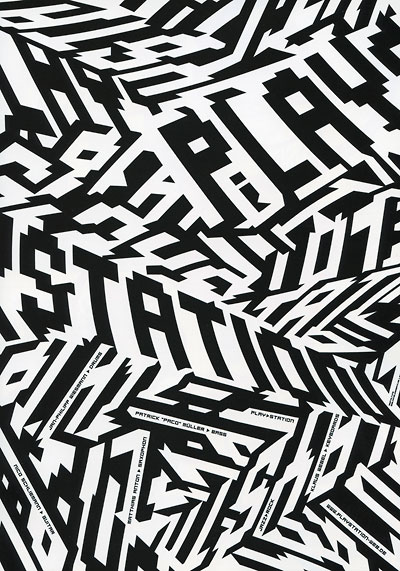
This poster was designed by Daniel Wiesmann (Berlin, Germany) for the German band Playstation (Foster, New Masters of Poster Design, p.231).

This poster was designed by Daniel Wiesmann (Berlin, Germany) for the German band Playstation (Foster, New Masters of Poster Design, p.231).

This band poster is an example of how the figure-ground relationship can be reversible, and therefore extremely dynamic. In some parts of the composition, the white areas read as ground, background, or negative space and the black areas read as legible letterforms (figures, positive space, forms), such as the part of the poster where it is fairly easy to read the words “PLAY” (top right) and “STATION” (middle left). In other parts of the composition, however, the positive forms seem to be white letterforms on a black background, such as at the bottom right corner of the poster, where there appears to be an upside-down “LAYSTA…” This figure-ground reversal draws attention to the fact that negative space need not be passive. The very active figure-ground relationship exists in part because the black and white elements in the design take up equal amounts of space and are very evenly spaced. Also, the cropping or framing of the composition is very tight, with the forms/words running off the edges of the poster on all sides (it is printed full-bleed). The active figure-ground relationship on this poster makes legibility difficult, but the legible words “PLAY” and “STATION” combined with the dynamic composition serve to draw the viewer in to the read the fine print in the lower half of the poster (small lines of black text within the white letters which show the names of band members and the instruments they play).

Posted in Fall 2018 Archive (336), Sample Posts by Your Professor | Tagged , , , , , | Leave a comment

Formstorming: Kristin Becker (Sample Post)

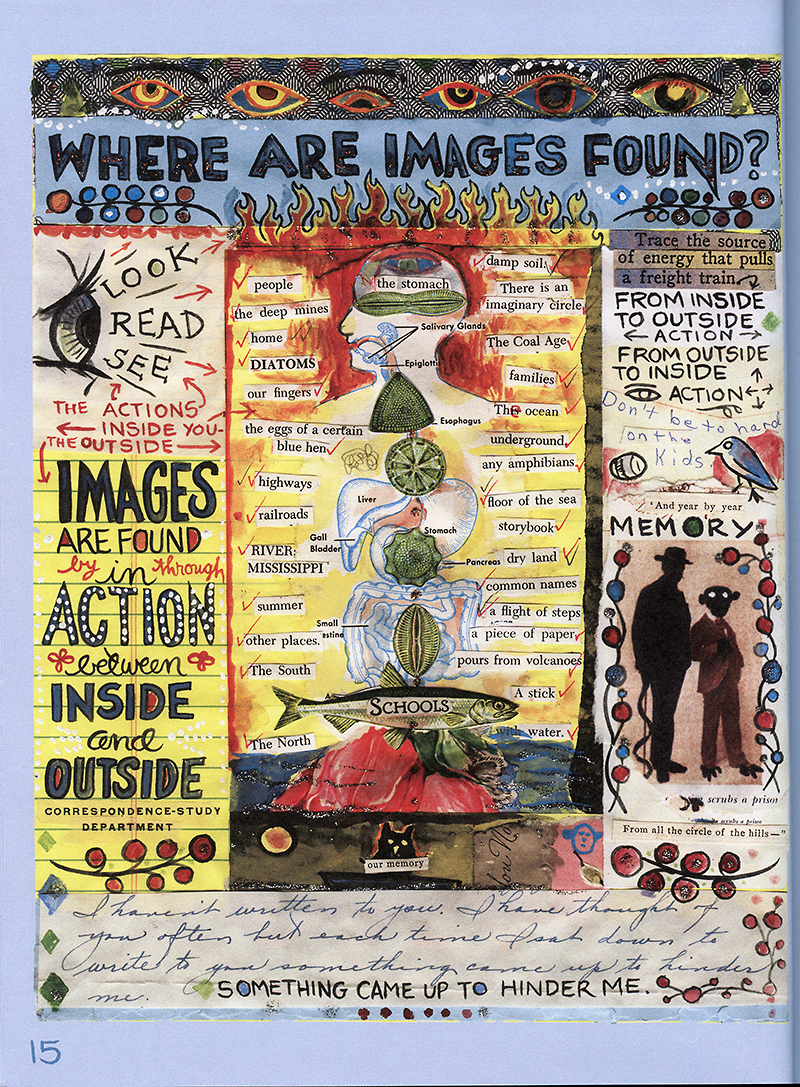
Page 15 from Lynda Barry's graphic novel, "What It Is."

Page 15 from Lynda Barry’s graphic novel, “What It Is.”

In the first fifty pages of her graphic novel, What It Is, Lynda Barry asks questions like “What is an image?” and “Where are images found?” She seems self-conscious about her ability to create successful images as an adult artist, and she seems worried that she has forgotten how to play and use her imagination like she did when she was a child. The process of formstorming described by Ellen Lupton and Jennifer Cole Phillips in Graphic Design: The New Basics relates to the creativity and playfulness Barry fears she has lost. When you engage in formstorming, you give yourself a design problem with specific parameters, and then you solve the problem over and over using various strategies until discover you an interesting and nuanced solution. Repetition leads to discovery and creativity because you get the most obvious and easy solutions out of the way first. One of the categories of formstorming is dailies: Some examples include daily designs for record covers. daily ideas for apps, and daily collage compositions. Many of the pages in Lynda Barry’s book, like pg. 15 shown here, are composed from cut-out elements, and could be considered a type of daily formstorming. She makes collages that include words cut from books or magazines, as well as what seem to be letters or school papers. There is more than one type of handwriting and some of it seems to be made by children. Each collage is different, but they feel visually cohesive, like they are using the same source material, and that is why they feel like a type of formstorming.

Posted in Sample Posts by Your Professor, Spring 2017 Archive (336) | Leave a comment

Framing: Kristin Becker (Sample Post)

2-page spread from Craig Thompson's graphic novel Goodbye, Chunky Rice (pgs. 58-59, Top Shelf Productions, 1999)

2-page spread from Craig Thompson’s graphic novel Goodbye, Chunky Rice (pgs. 58-59, Top Shelf Productions, 1999)

This spread from the graphic novel “Goodbye, Chunky Rice” by Craig Thompson shows many of the powerful and complex design options offered by the concept of framing: The individual parts of the comic strip are each frames, and some of them are delineated by a thin black border. However, a frame can also be implied in more subtle ways. It is especially interesting how these pages draw attention to the idea of frames within frames: Some of the frames fill a whole page, reminding me that a page and its edges are a sort of invisible frame that I might take for granted. On the top left I see the setting for all the action depicted very clearly: A small boat is floating in a vast ocean and the sun is setting over the water. The smaller frames beneath this image are literally placed inside the larger frame, so I infer that the turtle looking in his bag and at his stopwatch is taking place on the deck of the ship. An even cleverer shift occurs on the right page, where the third small frame, showing the words “DING DING DING”, is also part of the larger frame below, which shows the deck of the ship. Finally, another small frame on the lower right introduces a new element, a bottle, which is presumably floating in the ocean. The frames with frames and the shifts in scale of the frame sizes makes this comic more visually interesting and adds to the potential complexity of the meaning it offers.

Posted in Sample Posts by Your Professor, Spring 2017 Archive (336) | Leave a comment

Color: Kristin Becker (Sample Post)

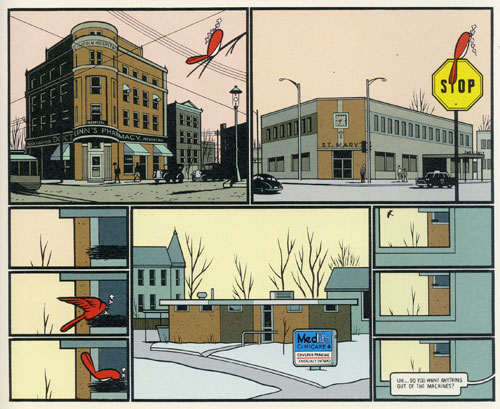
Selection from Chris Ware's graphic novel, "Jimmy Corrigan: The Smartest Kid on Earth" (Pantheon, 2003).

Selection from Chris Ware‘s graphic novel, “Jimmy Corrigan: The Smartest Kid on Earth” (Pantheon Graphic Novels, 2003).

This page from graphic novelist Chris Ware’s book, “Jimmy Corrigan: The Smartest Kid on Earth” is an excellent example of the interaction of fully saturated color with very desaturated color. The colors used in the backgrounds and buildings of each frame are tints and shades of the hues red, yellow-orange, orange, blue, and blue-green. White, black, or gray has been mixed with each of these hues to make it very desaturated. When small amounts of fully saturated hues are placed within these frames, our eye is drawn immediate to the pop of color: The fully saturated red hue used for the bird stands out strongly against the desaturated red (or pink) sky. When used again at the lower left, the red hue is paired with the blue-green background of the window, which provides another strong color interaction: Green is the complement of red, so desaturated blue-green as a background for the red bird also makes the fully saturated red stand out to the eye. The blue hue of the Medlife sign and the yellow hue of the stop sign are also fully saturated, making them stand out strongly against their desaturated backgrounds. Finally, the fully saturated hues that Chris Ware chooses to use for his main subject matter are also the primary colors: blue, yellow, and red. This may also cause them to have a powerful effect, since they are the purest colors (as opposed to secondary and tertiary colors, which are mixed from the primary
colors).

Posted in Sample Posts by Your Professor | Leave a comment

Final reflection: Evan Taylor

For my redesign of the paradise creek brewery menu, I wanted to make a minimalist design. With the use of dark color tones and white, it creates a contrast between the text and background in hopes that it would appear simple, straightforward, and easy on the eye. I think the eye starts by looking at the menu items because of the white background that is the strongest contrast and therefore stands out the most. Followed by the title at the top and then flows from left to right and down the page. On Whitney’s menu, I think visually the first thing you notice is the large stamp on the front cover followed by the logo at the bottom. Then I notice each menu page that is nicely ordered and very visually appealing and a good example of the hierarchy.

I think we both chose to use pretty simple fonts for the menu design. That’s why I wanted to compare ours even though they are presented differently. I Chose my fonts because they are simple but still grab attention. For the menu items secondary text, I used a font that resembles handwriting. I felt that represents the laid back and relaxed environment of paradise creek. Whitney’s menu is also straightforward and simple to navigate, nothing unessarcry and very user-friendly.

Whitney’s menu uses a light brown textured paper on the cover and back that fits the vibe of paradise creek very well and stuck with the rule of three for the colors. I also used a simple color layout of white, black, dark blue, and reddish brown (it was supposed to be dark red but looks more like a burnt brown).

For the sizing of my menu, I wanted a small handheld menu (printed at 8.5×11 and trimmed on the sides and bottom). The menu was printed on a high-quality thick paper with a medium gloss.  Whitney menu seemed to have been a lightweight paper because it uses seven individual pieces of paper when its put together it still feels very sturdy and like a high-quality product. It also seems like it would be easier and cheaper to replace individual pages if the got dirty or destroyed.

I really like that on Whitney menu you are able to see the label of each section from the front cover and easily flip to the page you want, very quickly and efficiently instead of scrolling through the pages. Also, her menu is cool because it doesn’t follow the typical menu design that you see at the majority of restaurants. The only improvement I would have is thicker paper, it feels like if this menu were to get wet even a little bit the pages would be ruined.


Posted in Uncategorized | Leave a comment

Final Reflection: Lillie Williams

I wanted to create a menu design that fit the theme of Paradise Creek Brewery. When designing my menu, I thought about the observations that different groups saw when they went for a visit. I wanted to put some of the ideas and content that the class came up with such as, comfortable, warm, soft, homemade, etc. When I looked at my classmate’s menu designs I thought that Camille Oppedall created a menu that fit the restaurant’s spirit well.

IMG_2712

Camille Oppedall’s menu inside

When looking at Camille’s menu my eyes scan the menu down and then to the right. The visual hierarchy is very clear because her food section titles are larger and have a different font than her meal choices and descriptions. Also, she has visuals (the pointed finger) next to each of the section titles, which makes the reader look at the section title first and know that the items under it are in that section. The descriptions under the meal choices are indented and aren’t bolded telling the audience that they are the description of the bolded meal above it.

Screen Shot 2017-12-14 at 10.48.48 PM

Lillie Williams’s menu front

In my menu design I hoped the reader would start on the left side and read it down moving to the right side. I tried to establish visual hierarchy by also making the food section titles larger and then indenting the food choices and descriptions as well underneath the section title. My meal options have a slightly heavier weight and are a bit larger than their descriptions as well. Camille’s hierarchy is a bit clearer though since she bolded her meal options, indented her descriptions more, and had visuals next to her title meal sections.

IMG_2712

Camille Oppedall’s inside visuals

Camille’s overall visual style brings out Paradise Creek Brewery’s theme. I think it is appropriate for the establishment because when the class talked about their own observations when they visited it, we all concluded how it gave a parlor type feeling. The small details like the horizontal markers underneath each page give a parlor type feel. The visuals Camille uses give off an old style that makes the menu connect with the restaurant. I really enjoyed how she used the hand pouring a beer on the right and left side of the inside flaps. The fireplace in the middle of the menu reminds me of the fireplace in the establishment.

Screen Shot 2017-12-14 at 10.48.56 PM

Lillie Williams’s menu back 

The visual style of my menu is easy to read. I think that it works well for families and the alignment makes columns that is easy for the audience to understand. I think that it is appropriate for the establishment because it gives an approaching and comfortable presence. It is easy to understand and the wood border allows the customers to focus on the meals and their descriptions inside of it. The front side title in a font goes well with the establishment as well.

Color did play a role in Camille’s menu design. She used a white-ish construction paper on the outside of the menu and a yellow-ish construction paper on the inside of the menu. It makes me think that the inside of the menu is like the inside of the restaurant. There’s a glow when you go inside of the restaurant and the yellow-ish paper inside the menu can be a symbol of that glow. I thought about pattern rather than color in my menu design. I wanted to use a wood pattern because of wood barrels that hold beer, the establishment makes their own beer though a Pullman facility. Also, I was inspired by the texture of the wood interior from the restaurant when I thought about my menu design. The point of the raw wood border was to create a focus on the menu, but also to connect it to the inside characteristics of the restaurant.

I enjoyed the way Camille put her menu together. I thought the paper type was appropriate and made her design stronger because it was a thick construction paper that gave more stability. However, the menu was small when I held it in my hands. For my menu I enjoyed the size of it because it wasn’t too big and could be held in any type of hands, from adults to children. It was small enough so the eyes wouldn’t wonder around and be confused on where to go, but was big enough to have a presence in the customer’s hands.

Camille’s strengths in her menu design include the visuals put in the menu as well as her choice of fonts and organization. The visuals made me think about the historic nature in the establishment, the fonts don’t jumble together, and the hierarchy is clear making it easy for the audience to understand. My strengths consisted of my hierarchy being easy to understand.

In terms of room for improvement, I would’ve liked for Camille’s menu to be a bit larger, that way it would appeal to more adult sized hands. In terms of my design I would’ve liked to add more visuals or even put my menu on an actual slab of wood. It would’ve given the menu more texture and been less flimsy. I think it would’ve been interesting to add a WSU logo or cougar as well. The establishment is in a college town that brings in lots of WSU students and their families.

Posted in Fall 2017 Archive (336) | Leave a comment

Final Reflection: Katrina Bittner

When looking at my classmates menu designs, I had a hard time deciding which one I wanted to compare to my own. I noticed some menu designs had similarities to mine in color, overall theme, and hierarchy- so I decided to focus on a menu that had more visual differences from mine, than similarities. Sophie Stoltman’s menu focuses on a horizontal design which is read from left to right. The simplicity of the menu allows the reader to easily focus on the menu items, which are evenly spaced and contrast from other parts of the menu. Sophie used a variety of both serif and sans serif fonts to create a simple contrast from the menu item descriptions to the rest of the menu. This also contributes to making the menu items easier to read and shows that they differ from the rest of the menu. The menu is divided up in three sections on the first page, with each section separated with an opaque grey line. My favorite thing about Sophie’s menu was that she found a way to make the prices easy to read by adding a thin line, and a bold number following the menu item description. Sophie executed her menu smoothly, keeping a modern and simple theme which is what really caught my eye. I tend to favor cleanly designed menus that lack text decoration, and use minimal colors.

My Menu differs from Sophie’s in several ways. First, I established a different hierarchy of menu items. My menu focused on vertical alignment, with the reader looking at the menu from top to bottom, then moving on to the right page. I focused on appetizers, burgers and sandwiches, and sides on the first page- where as Sophie focused on appetizers, soups, salads, and sides. I almost like her hierarchy better because it makes more sense to have the main entrees and sandwiches and hamburgers on one page. Th only thing I would change is maybe adding the sides below the entrees because this is what follows on a typical menu. Sophie’s menu also had a near white background with black font, while mine had a textured cream background with both black and white text. I also used text decorations to establish different sections of the menu, and also unify the text decoration on the title page of the menu with the sections. The white text amongst the black text decoration deeply contrasts against different parts of the menu. Instead of adding a line or dots for the price, I simple made the number next to the menu item description bold. My menu uses the same serif font throughout the entire design theme, and I was able to create differences in the text by changing the size, and making text bold or italic, or even both.

As far as improvements go, even though I really enjoy the modern theme of Sophie’s menu, I feel like it does not align with the style of the restaurant. The restaurant maintains a rustic, homey, worn in aesthetic which is very different from a modern crisp and clean style. I think Sophie’s menu could benefit from adding a few more opaque illustrations, and possibly using a different text for the title of the restaurant. I like how her menu is only one page, and is large enough to be easily read. Her menu strengths are clear in the way that it is extremely easy to read and is not overwhelming like the old menu. It feels professional, and offers simplicity where there was once chaos in the sense of too many fonts and an unclear hierarchy. For my menu, I feel as though I could rearrange my menu items to create a better hierarchy, and find a way to make the prices easier to read. I think my menu may be more sucessful if it was a bit larger, and possibly arranged to be on one sheet read front to back. I like how the chalkboard texture of my menu aligns with the style of the restaurant, which uses chalkboards throughout their restaurant. I feel like I was successful in capturing the correct theme, but was not as strong in creating a menu that was simpler and easy to follow.

bittner-menudesign

Posted in Fall 2017 Archive (336), Uncategorized | Leave a comment