Print Verse Digital: Andy Snow

In chapter one of Understanding Comics, I learned about comics and the influence that they have over their readers because it combines both pictures and words together to create an animation. Comics can be in a book, a magazine, a strip of paper, or online. In the past, I have read comics that have been in the Sunday newspaper or in books like

Understanding Comics. I have always been a fan of print literature verse digital because I enjoy holding a physical book in my hands. I find pleasure in turning the pages and even breathing in that old book smell. The future of comics, as McCloud questions is an interesting thought because I believe that comics will become more popular as time passes because during the 21st century, comics can be bought at a high price due to their antiqueness, if sold in their original packaging. In McCloud’s book, he mentions, “or definition says nothing about superheroes or funny animals…nothing about fantasy/science-fiction or reader age…no genres are listed in our definition, no types of subject matter, no styles or prose or poetry” (22). I connected to this in the first chapter because it changed my understanding of comics. Growing up I used to think that comics were mainly about fantasy and anime but after reading McCloud’s words, I now have a better understanding of comics. Reflecting on my experience with literature, I enjoy reading because there is a slight pleasure in flipping the pages. I enjoy highlighting and writing in the novels that I read so when I am told to read literature digitally, it is harder for me to focus on what the authors are saying because I have the routine of writing down notes in books as I read. When reading literature, I am a hands-on learner so I need to have the works in front of me. While reading Understanding Comics, I have a pen and highlighter in hand so I can absorb the material better. When I read Eroyn Franklin’s web comics, I enjoyed the color that she put in her work, but I still missed the hands-on feeling of holding a book. If I were going to write or draw a comic, I would you envision people reading it in a horizontal view. When reading comics, I always read each box from left to right because that is how I read novels, then I scan down the page as I read
from left to right. The black and white picture above is an excerpt from McCloud’s book where he talks about the picture of a pipe that says “This is not a pipe” at the bottom. The claim that McCloud is trying to make is that this is a picture of a pipe, not actually a physical pipe. McCloud relates this to comics by talking about how not only the picture is a drawing of a pipe, but it is a printed copy of a pipe. By using this analogy, McCloud explains that comics are the same because comics tell a story but it takes many sections in a comic to tell a story. Comics are not animated unless the author uses symbols, color, and definition in order to tell a story. There is much more to comics that I do not fully understand yet, but McCloud’s novel has helped me begin to think about how much goes into creating comics and how they give the reader a different view than novels.
Posted in Fall 2018 Archive (201) | Leave a comment

Print versus Digital: Jessica Harja

Honestly, I’m not really sure what the future of comics will be. As it has always been, print remains a very expensive form of work. There are times where it is cost-effective. But if you are an up and coming artist and trying to move out print copies, it is difficult because it is impossible to be able to afford printing mass quantities out with no income. Speaking from a student artist point of view, I’ve done research into creating art from a print perspective and I’ve seen what other online artists have discussed in terms of trying to make their work known. Most young digital artists that I am aware of nowadays use online media in order to share their work. Ultimately, taking away from what their work could be.

Don’t get me wrong, I think their work is great as it is and some comics are better designed for a digital medium. But there is something to be said about print work. Depending on the way the digital copy was created, the way in which you view or read the comic or artwork is controlled. Based upon access, how you move throughout the comic, how you experience it, etc. Whereas a print version is just that. A print version. You can read through it at your own pace, you have the feel and smell of the paper in your own hands, and it’s a much more personable experience with the effort the artist put into creating their work. When I was reading the printed copy of the textbook, it was more of a one on one experience and it was easier to take time to read through the material. However, with the online comics it was less so. Some aspects of going through the comics were controlled and it didn’t seem like it was a one on one experience anymore.

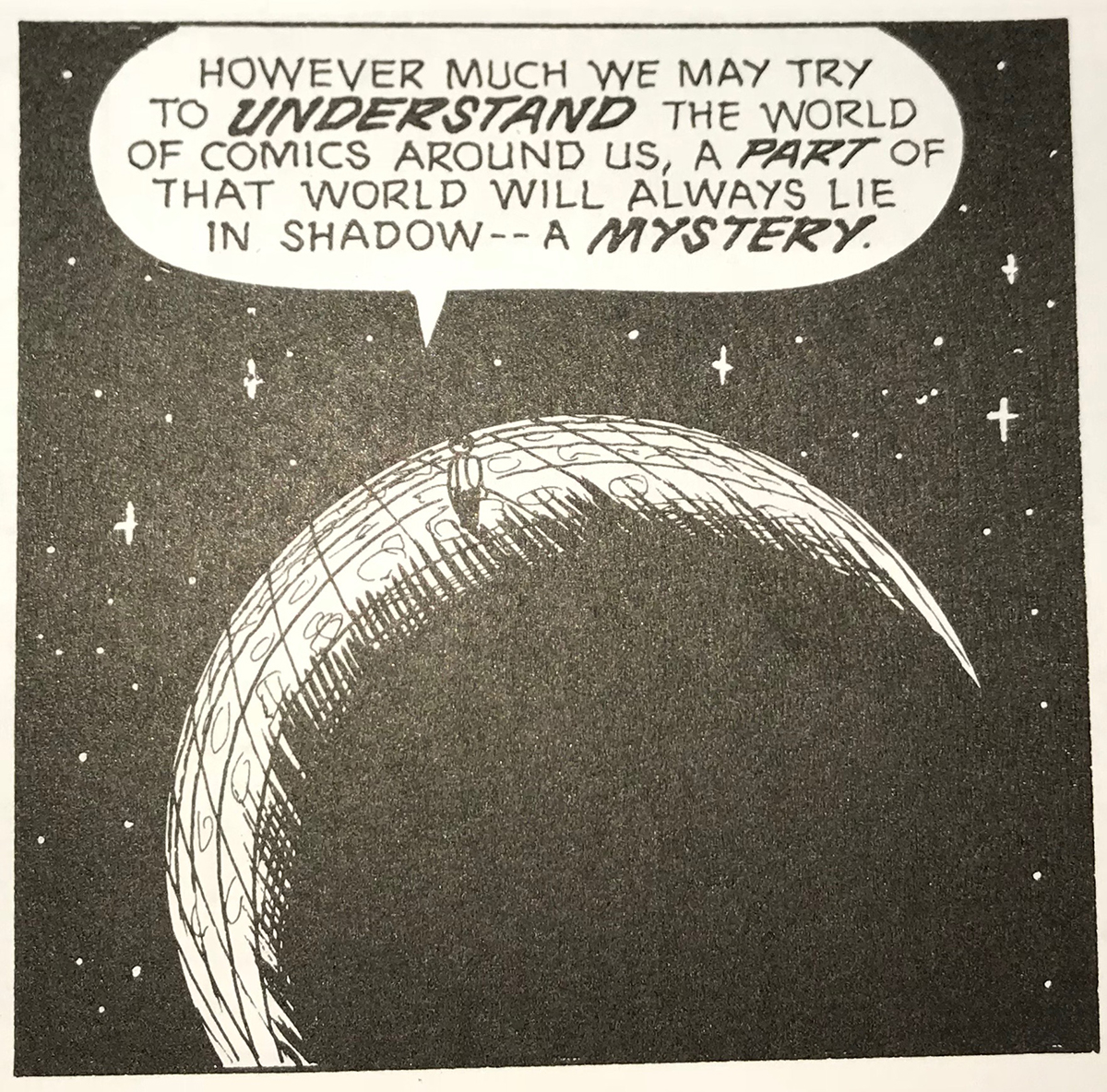
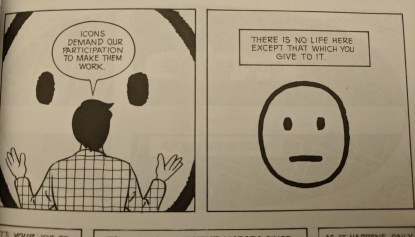
McCloud, pg. 59.

In this sequence of panels, McCloud discusses the significance of symbols and icons and how they gain their meaning from the viewer. (Scott McCloud, Understanding Comics: The Invisible Art, HarperCollins Publishers, 1993, pg. 59)

If I were to create a comic, I would want to create one that is more focused on the concept rather than making it more realistic or full of detail. On page 59, McCloud states that “Icons demand our participation to make them work. There is no life here except that which you give to it” (McCloud, pg. 59, 1993). This was one of the many statements that stood out to me while I was reading the book. I find that comic books really do have more of this interactive quality to them more than most other media. Does the hyper-realistic artwork of the comic really matter if you can’t glean the concept of it? Of why the artist dedicated time to creating it? I’d want mine to be minimalistic and simple. Some of the most inspiring comics I’ve read have hardly had much information to go off of.


McCloud, Scott. Understanding Comics: The Invisible Art. New York: Harper Collins Publishers, 1993. Print.

Posted in Fall 2018 Archive (201) | Leave a comment

Print Versus Digital: Seth Muck

When we were assigned Understanding Comics, I was very skeptical at first. I’d only ever read one comic, which was Maus by Art Spiegelman. That comic is about what the Jewish people went through during the Holocaust, and after reading it, I knew no comic could ever do what Maus did. Like McCloud says in chapter one, I thought comics, other than

A scene from Maus by Art Spiegelman

Maus, were simple super-hero children’s books. What McCloud has taught me is that they are in fact the complete opposite. I think comics, like any other art forms, can be consumed by everyone, despite age. There are children’s comics and adult comics, and I think the stigmas attached to comics as a whole are limiting people’s literary experiences. Now when reading McCloud’s book it was the same as reading Maus, at the end of each page there is a definite and obvious break. It’s sort of a chapter within a chapter, and the pause helps me take in what I’ve just seen/read. When reading Eroyn Franklin’s web comics, it was a completely different experience. Unlike Understanding Comics they are short and sweet. There is no break between scenes other than the small spaces between the frames. I also found it interesting that there are no variations in Frame size. In print comics, there are always big images and small images, however these web comics were all small square pictures telling a short story. I think if I were to make a comic book I would definitely make it in print. I think there is something about variation in frames that really helps immerse the reader. For instance, on page 10 of Understanding Comics, the entire page is a single Frame showing Scott McCloud standing in front of Egyptian hieroglyphs. Using an online medium it would be impossible to recreate this. One of the most interesting things I got out of reading Understanding Comics is when he explains the difference between animation and comics. While they would seem to be essentially the same, McCloud points out that comics are the result of images being juxtaposed upon each other in order to create movement and scene. I think it’s very interesting to think of comics in this way.

Posted in Fall 2018 Archive (201) | Leave a comment

Print Versus Digital: Milo Larson

Throughout the first chapter of Scott McCloud’s, Understanding Comics, Scott explains to the readers what separates a comic from other forms of media. McCloud first attempts to create a definition that specifically fits “comics”. He does this to show that the idea of a comic is much more than a collection of drawings/picture put into sequence. McCloud (1993) defines a comic as, “Juxtaposed pictorial and other images in deliberate sequence, intended to convey information and/or to produce an aesthetic response in the viewer” (p. 9). The future of comics resides mostly in digital media. I believe this because of the transition of print books to digital books. When Amazon released the Kindle in 2007, I feel it created the movement for electronic books. With the presence of smart phones capable of reading these E-books in today’s society, the publication of print media will continue to slow. He also states, “…comics future will be virtually impossible to predict using the standards of the present… the secret is not in what the says but in what it doesn’t say” (p. 21). What McCloud means by this is that comics have few restrictions and could be completely re-defined in the future. This book was published in 1997 when there was no presence of online comics. Online comics are just one way that the future has shaped comics.

After reading McCloud’s, Understanding Comics, the book felt simple and had a rewarding feeling as you physically held and turned each page of the book. When reading Scott McCloud’s online comic, The Right Number, it was much more visually appealing because of the variety of colors. It also had a more interactive feeling because of the animations and having to click the middle of the page to advance. With comics being in a digital format, it allows for much more creativity with layouts and website designs.


“Mimi’s last coffee” Scott McCloud, 2004.

If I were to write a comic it would probably be in a digital format. I would rely on the audience reading my comic to infer information from frame to frame. Writing and assembling a comic digitally seems easier and much more efficient. Also, digital comics presents an opportunity to be more creative. Adding various designs and colors into the frames would be as simple as cutting and clicking. In the comic to the right a timeline is laid out showing multiple endings as the reader chooses which direction to read.


Posted in Fall 2018 Archive (201) | Leave a comment

Print Versus Digital: Angela Basinger

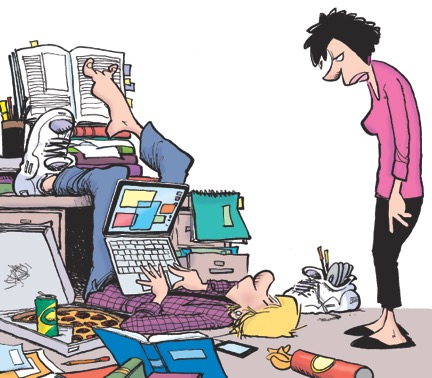
Photo from Zits, a comic written by Jerry Scott and illustrated by Jim Borgman focused on the daily life of a 16 year old.

Scott McCloud’s Understanding Comics, defines comics loosely as an adaptive genre and medium. McCloud brings many conventions of traditional and modern comics to the forefront in his book, yet he acknowledges that comics cannot be confined to these styles as the genre is adapting and ever expanding. The author sees comics’ future as boundless in the digital age and encourages readers to cultivate an ever-expanding definition of comics because of this. One topic I consider most relevant in the digital age is the ability of comics to provide connections and an interactive experience. In Understanding Comics, Scott McCloud points to the unique ability of comic visuals to put the reader in the shoe’s of the character by use of less realistic depictions. In this, a comic is able to connect with readers personally the way that many other written and visual communication may not. This connection transcends cultural barriers of language and practice, allowing comics to present themselves in a universal capacity. If I were creating a comic, I would expect it to be interpreted both visually for pictures and text and interactively as the comics are sequential and “move” with a flow from start to finish. I would expect readers to put themselves in the comic as they interact with it, developing a personal connection to both the form and the content. I used this frame from a Zit’s comic as my visual as I recall this comic in the newspaper as particularly memorable and relatable, speaking to the ability of comics to make lasting connections and to provide relatable visuals to readers. Considering again the future of comics in the digital age, I can only expect them to become more interactive with more and more tools to add layers to processes of movement and form, allowing  deeper personal connections to develop as a result.


Posted in Fall 2018 Archive (201) | Leave a comment

Print Versus Digital: Kameryn Skillingstad

Throughout the first chapter of Understanding Comicsby Scott McCloud, he gives his readers a blast through the past on the history of comics; explaining to us what he considers comics based on the definition and what he doesn’t. At the end of chapter one in Understanding Comics, McCloud leaves his readers interpreting and envisioning for themselves what comics may look like in the future. McCloud says, “nothing is said about paper and ink… No materials are ruled out by our definition. No tools are prohibited,” and I believe he is correct. In today’s age the digital world is surpassing the print world in popularity, it makes me wonder if generations from now print comics will stop being produced and will become things of artifact in museums. In the future, there may even be such advanced technology that one could simply type in a description of a scene and character and the program would create the comic for you. After reading Eroyn Franklin’s online comic it brings me a sense of sadness because I realized that I thoroughly enjoy reading McCloud’s comic in print text. I don’t know whether it was the satisfaction of turning each page and looking forward to what’s on the next or having the physical copy of a text in my hands that gave me a sensation of liking print more than digital comics. It also could be the fact the Eroyn Franklin has a very different type of comics that are unique to anything I’ve ever seen that I struggled appealing to. McCloud’s comics are my idea of classic comics that I enjoy reading every section of. Because of this, I realized for my personal comic I want to create it digitally but print it out to give my readers the same satisfaction I had of reading McCloud’s printed book.

Posted in Fall 2018 Archive (201) | Leave a comment

Print Versus Digital: Zachary Larson

It is hard to determine where the future of comics is headed in this growing digital age. The term carries so much flexibility that society will have the ability to push comics toward whatever definition they see fit. In McCloud’s book, “Understanding Comics,” he discusses the definition of comics and specifically what is not defined. McCloud elaborates on the fact that comics are not limited to superheroes or any specific genre. It says nothing about the materials used or a specific method needing to be followed. The baseline for comics is juxtaposed pictorial and other images in a deliberate sequence intended to convey a message. That being said, I believe the future of comics lyes on the digital platform. I believe it will be a combination of pictures, both still and motion, as well as words and sound effects. I picture a new age of storytelling that will allow the author to play with their audience imagination as much as they would like. I believe this is a plausible direction because it allows for a more customizable experience from the author.

My experience reading McCloud’s book differed from reading Eroyn Franklin’s online work mostly because the former was a physical edition. When reading McCloud, I could feel the texture of the pages and my eyes felt like they took a journey across the pages. Reading from a screen doesn’t care the same excitement. I felt as though I was scrolling through a slideshow. That being said, I see potential in the medium of a screen that would make for a more fulfilling read. If motion pictures were added into the comic I believe it would make for a new kind of experience. I am not saying create a full-blown animation but simple actions mixed in with the still photos might be a good technique to utilize.

When I think of writing a comic for an audience, I expect to be thinking of a mostly visual storyline. I believe I would start with an image or action in mind and from there create an analog. This method I feel I would be portraying the emotion first and then continue with the thoughts that follow.

Posted in Fall 2018 Archive (201) | Leave a comment

Print Versus Digital: Bethany Smyth

My experience reading the printed books were enjoyable verses reading comics on the web. Physically turning the pages is satisfying unlike clicking the mouse over the “next” or “turn page” curser. The graphics are more readable on physical pages rather than a bright screen.

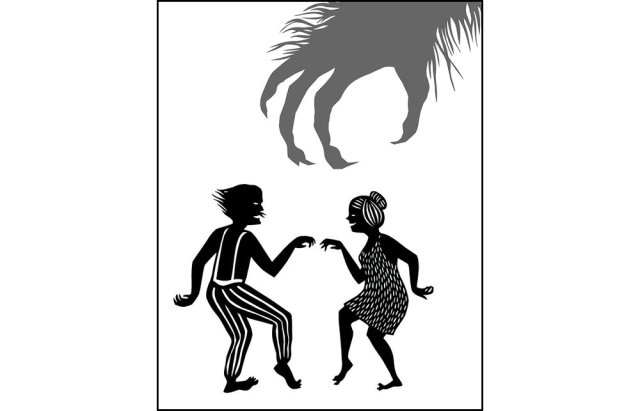
SwellingDwelling_22

This image from Eroyn Franklin’s web comic http://www.eroynfranklin.com/swelling-dwelling is a project using light sources to present a shadow puppet show. The user simply projects the image onto a solid background by shining a light behind the image therefore casting it onto the wall.

Although it was entertaining to read Eroyn’s comics on the web, it wasn’t satisfying nor was it as well retained. Its difficult to read the text on the screen as smoothly as on pages. The graphics were really great and a lot more mesmerizing but I didn’t enjoy clicking the “next button” multiple times to see what came next. In a way it works for the graphics but its a lot of work to see what comes next. Maybe my disinterest in reading web comics comes from my staring at screens majority of the day to do homework, watching videos, and doing research.

If I were to write and draw comics I would do a print form. There is something more interesting to seeing a page full of color and lines rather than on a screen. On a screen, comics can tend to look like anime shows like Naruto or cartoons such as Family Guy, Bob’s Burgers, or Archer. If I were to create a comic, it would be a graphic novel on the Vietnamese/ American War. I think seeing the war in color, especially in tropical region and a different culture as well as the atrocities of war on paper would be more stimulating to the brain. Also, on paper, it is easier to remember where a certain image was page-wise rather than clicking through a a web comic.

Posted in Fall 2018 Archive (201), Uncategorized | Leave a comment

Print Versus Digital: Jenna Walker

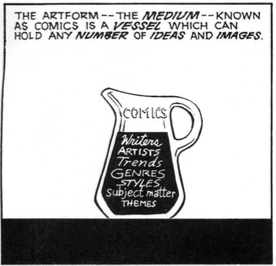
When reading McCloud’s book “Understand Comics”, what really stuck with me was when he said, “the trick is to never mistake the message—for the messenger” (McCloud, 6). Tying this in to the print versus digital question, print is easier to follow rather than online. Like the images he has included on this page, it makes it obvious that a lot of different ideas are mixed together to create a comic or graphic novel (refer to picture below). This plays in to the easier accessibility of holding a hard copy allows the reader to follow along better because when it’s online it goes vertically down page by page which at times can be confusing. Comparing that to a hard copy, it is a horizontal view so it is easier to follow along because there is more direction across the pages. In the past, I have had to read graphic novels such as, “American Born Chinese” by Gene Luen Yang and “Maus” by Art Spiegelman. My experience with the novels listed above, compared to Franklin’s web comics is much better. I chose to look at Franklin’s “Bikram Addict” web

Screen Shot 2018-10-08 at 6.13.09 PM.png

McCloud, S. (1994). Understanding comics. New York: Harper Perennial. P 6  (Universe of Comic)

comic and while I appreciate the different change of background to show that it’s a new page, it is not as easy to understand because it can get distracting. As a reader, myself, I prefer print over digital because it’s easier to navigate. Although, comics do have photos so it’s not pages on pages of words, the direction can sometimes be unclear when its digital because it isn’t able to have the pages be side by side. If I were going to create a comic, I would want them to be read in print, so it would be easier to follow along with. I would want the eye direction to be very apparent because sometimes the word bubbles and different shapes of the boxes can get a little confusing. Overall, comics provide a good break from the usual novel because it gives the reader something more to look at and can help provide a better understanding of what the author is trying to convey.

Posted in Fall 2018 Archive (201), Uncategorized | Leave a comment

Print vs Digital: Juan Guzman

Throughout history, we have seen comics change so much since their origins dating back to prehistoric times. The term comic itself is often misinterpreted as author Scott McCloud addresses in his book “Understanding Comics”. With the turn of the century comics have been used digitally and published through websites such as those of author Eryon Franklin. Upon reading McCloud’s book in print and also Franklin’s digital comic “Long Term Relationship” I have noticed a few differences that enhanced my interpretations of the readings. One is that the dynamic of how I read changes slightly. In print comics I read from left to right and seemingly like a regular book leads my eyes from one page to another. A good indication of this is McCloud’s concept of iconography. We are so used to seeing things a certain way like symbols and borders even. It’s purpose is to pose a certain way for us to interpret to the best of our ability. When I read the digital form, I had to scroll down of course and it was more of a suspenseful feel. In a printed format we can sort of preview two pages and depending the size of them we can catch a good glimpse of panels on the next page as opposed to the digital form. The digital versions seemed like a large collage that tells a story with some even having a single background representing a theme, that sits behind the panels aligned vertically indicating to scroll to continue the story. The gifs used in “Long Term Relationship” reminds me of a cartoon gif and of course differs from the conventional couple of panels known as moment to moment. Turning to McClouds discussion of what the future will look like for comics, I can sum it to be aiming now towards more of a digital approach. Specifically, comics will modernize in terms of media, ideas, and present references will begin to pop-up. In comparison many people will still be unaware what and what isn’t considered comics. New and upcoming authors will turn more to personalized website or blogs that helps display their work to increase recognition and social medias and network sites can influence that positively.

Blog 4 pic of comics

Image taken from Flickr

Posted in Fall 2018 Archive (201), Uncategorized | Leave a comment