

Detail of hand-woven Asante (Ashante) ceremonial cloth featuring red and yellow (primary colors), green (secondary color, complementary to red), and black (neutral color and the darkest tone available).
The first pattern that I found is a ceremonial cloth that I believe is the more geometric of the two. The pattern only uses straight lines, specific shapes, has a very simple symmetry, and repeats the exact same shames throughout the whole thing. It has a very grid-like pattern and uses varying types of stripes. There are no irregularities throughout the entire thing, and except for the color, it doesn’t resemble anything organic. There is a lot of this yellowish-orange throughout the pattern, and is enhanced by the black background on specific parts of the pattern. The other parts have red and green, but there is little contrast in value with this, as opposed to the yellow-orange/black.
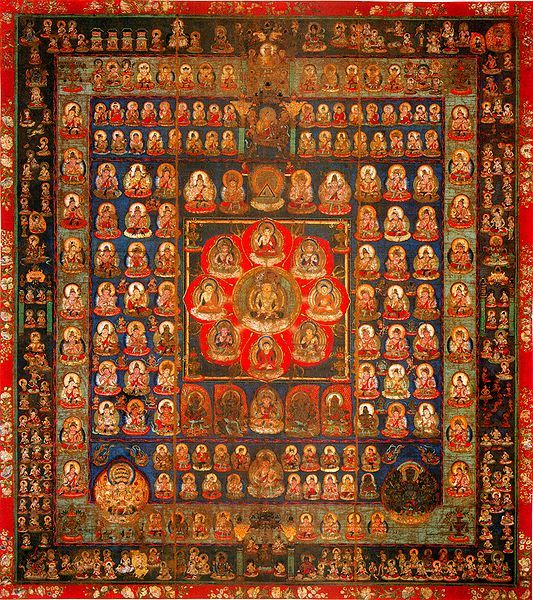
Taizokai (Womb World) mandala, second half of ninth century.
The other pattern I found was a Taizokai mandala, which I believe to be the more organic of the two. Although the pattern has symmetry, there are far more irregularities. There dots and stripes, but they are made up of small images of people. There are lots of colors, and it appears that those that are the darkest in value make up the background. The background colors (like the blue and black) make the greens, whites and reds really pop out. The dots/figures certainly stand out against the background of the low-value colors.
 Kristin Becker's DTC Classes at WSU