Print Versus Digital: Ashley Cole

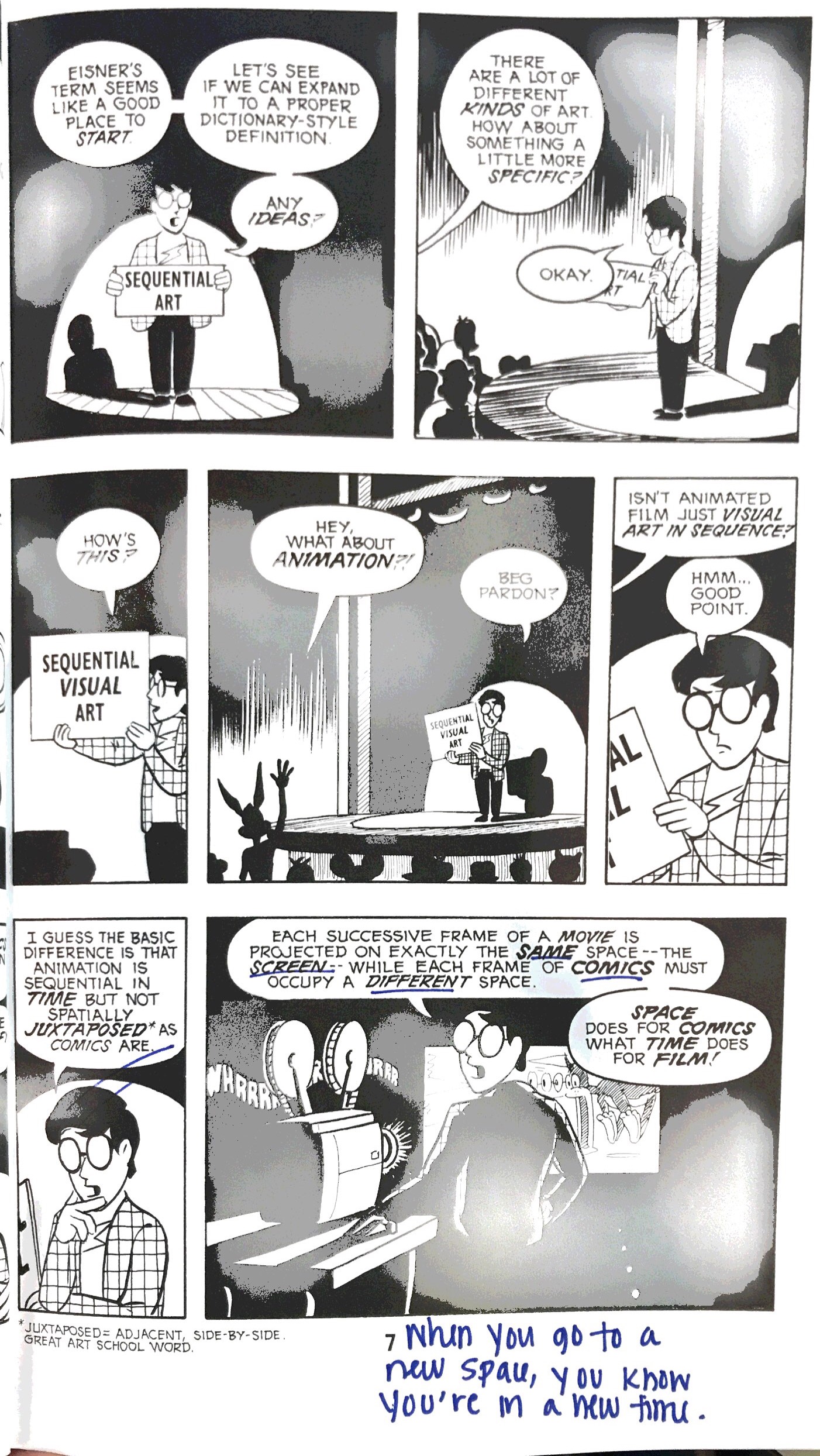
McCloud is discussing the idea that when you go to a new space in a comic, you are in a new time. Scott McCloud, HarperCollins Publishers Inc., pg. 7.

I think that comics are something that not a lot of people really read because they do not know much about them. I would definitely say that this was the case for myself before reading Understanding Comics. I thought that comic books could only be about superheroes and other things related to that genre. However, this is not true at all. A comic can be about anything. I think that if people begin to realize this, which I think is a strong possibility, comics could become a much more popular form of literature. I also know that a lot of people really like to read things that have pictures which could potentially make comics even more popular in the future. It is nice to have images that help you along in the reading of a piece of literature.

I really liked reading McCloud’s printed book because I think that we so often read books online in some form and I think that this takes away from the experience that reading should be—at least in my opinion. I love turning the pages of a book and being able to write comments in the margins, underline things, and circle things. I think that this is a really important part of reading and helps readers to be able to interact with the text most effectively. I liked that I was able to underline things and make little marks along the way as I was reading this book.

I actually really liked the online comics as well. They were so much different to read than the print book which I actually found to be really interesting. I think that online books have their own benefits even though I don’t necessarily prefer them over print. I like the idea that you can easily click back and forth to get to different frames. This makes it really easy to navigate rather than manually flipping pages. I would definitely say that there are many pros and cons to different methods of reading certain texts.

I was very interested in the part of Understanding Comics where Scott McCloud talks about the idea that each time we move to a new frame, we inherently understand that we are moving to a new time. This is something that is very obvious to me now, but also something that I had never thought of before I read this. I think that if I were to make my own comic, I would really want to capitalize on the idea of time and space and their relationship to each other. I think that it would be really interesting to explore a story in which time is moving on in large increments—possibly throughout a person’s life—but the place stays the same.


Posted in Fall 2018 Archive (201) | Leave a comment

Print Versus Digital: Brianna Esqueda

Comic have seamlessly combined two great mediums, visual art and storytelling. When done well the two work together creating a uniquely different experience. One thing that I took from reading Scott McCloud’s Understanding Comics was the use of space, and how it drives the reader in the story. The concept of the gutter is something exclusive to comics. It is the space between the panels. It also applies to the brake caused by the binding of a book, and the time and distance created by a page break or turn. Unlike how film uses music to direct the viewers emotions, the gutter allows the reader to speculate and forces them to make connections between panels.

Screen Shot 2018-10-09 at 1.15.47 PM

Image of Eroyn Franklin’s illustrations from Deluge.

Much of what we see is consume digitally. While viewing a comic on a screen can sometimes maintain the pacing that bouncing your eyes from panel to panel and turning the page creates, scrolling on a screen often takes away much of the effort put on the reader by the author. When I read Understanding Comics I went into the text knowing that it was going to read like a manual. I do not think that it is necessarily a good piece to draw from just because it is so aware of what it is. But when I read some of Eroyn Franklin’s comics online I began to understand that, when used correctly, a digital comic can bring its on facets to a piece. Deluge did it well, the comic is told slide by slide with only two panels. Like I said earlier it does something different with the gutter. By showing you two images at once, there is no need to infer what is happening in between.

In my example you can see that nothing is really changing from one panel to the next. And I think that this is a good indication of how viewing a comic on a screen instead holding the hard text changes the way the medium is understood by the reader.

Posted in Fall 2018 Archive (201), Uncategorized | Leave a comment

Print Versus Digital: Brianna Esqueda

Comic have seamlessly combined two great mediums, visual art and storytelling. When done well the two work together creating a uniquely different experience. One thing that I took from reading Scott McCloud’s Understanding Comics was the use of space, and how it drives the reader in the story.

Screen Shot 2018-10-09 at 1.15.47 PM

This image is from Eroyn Franklin’s comic Deluge. 

The concept of the gutter is something exclusive to comics. It is the space between the panels. It also applies to the brake caused by the binding of a book, and the time and distance created by a page break or turn. Unlike how film uses music to direct the viewers emotions, the gutter allows the reader to speculate and forces them to make connections between panels.

Much of what we see is consume digitally. While viewing a comic on a screen can sometimes maintain the pacing that bouncing your eyes from panel to panel and turning the page creates, scrolling on a screen often takes away much of the effort put on the reader by the author. When I read Understanding Comics I went into the text knowing that it was going to read like a manual. I do not think that it is necessarily a good piece to draw from just because it is so aware of what it is. But when I read some of Eroyn Franklin’s comics online I began to understand that, when used correctly, a digital comic can bring its on facets to a piece. Deluge did it well, the comic is told slide by slide with only two panels. Like I said earlier it does something different with the gutter. By showing you two images at once, there is no need to infer what is happening in between.

In my example you can see that nothing is really changing from one panel to the next. And I think that this is a good indication of how viewing a comic on a screen instead holding the hard text changes the way the medium is understood by the reader.

Posted in Uncategorized | Leave a comment

Print Versus Digital: Melissa Urueta

this is an example of a different type page in the book understanding comics by Scott McCloud

Reading  Scott McCloud’s book understanding comics was not the first time I had to read a comic formatted this way or even the first time that I read a comic for class. So when I read through it, it was not really new territory for me, in terms of the style in which the book was made. This book made learning about comics themselves more interesting, partly because of the less words more pictures aspect that most textbooks don’t have. It was enjoyable read and the best part was not realizing that you were actually learning about the technicalities and the history of comics. The web comics on the other hand were a different experience. Eroyn Franklin’s web comics emitted a different vibe to them, while Scott McCloud made it seem like her was narrating you flipping the pages, the web comics seemed lacking in that sense. There was not intrigue on my part and it made reading them a bit less interesting, but still somewhat entertaining for a few minutes. I did not feel like I was getting much information out of them. In Scott McCloud’s comics he used different techniques of comic books  throughout the book, for example as shown in the images, it goes from a giant picture in one page to back to multiple frames

this is an example of a more traditional kind of comic page from Scott McCloud’s book understanding comics

per page. The pages were different, they kept you busy trying to figure out how to read the next page, this is something that the web comics lacked (along with the obvious lack of the textbook information). In terms of whether the book was better because it was a printed copy, I personally do not think so. The content is what matters with comics and if someone thinks that because you turn a piece of paper a less interesting comic becomes more interesting that a web comic it makes sense why comics are fading. Web comics are the future it is inevitable the way that technology is growing.  Scott McCloud does point out that comics have been around for centuries and will continue to be around so it only makes sense that web comics are the future of the medium.

This is all something I would keep in mind when creating a comic, keeping it interesting for the reader. I want every page or every chapter to be something new. The reader needs to stay on their toes in order to keep interested with my comic.

Posted in Fall 2018 Archive (201) | Leave a comment

Print Versus Digital: Emily Burns

Before reading the book, “Understanding Comics,” I didn’t know comics were so versatile. I always thought of comics as a book that are relatively new. I was not aware of the history of comics and how broad the term comics really is. Scott McCloud’s definition of comics

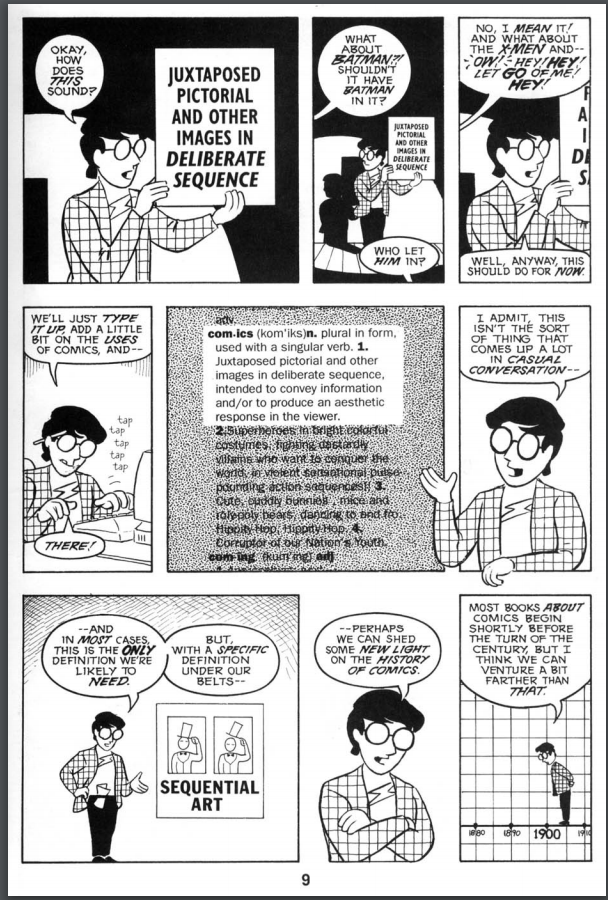
Scott McCloud’s definition of comics and how comics can appear in photography (Scott McCloud, Understanding Comics, HarperCollins Publishers, 1993, pg 20).

really stood out to me. Comics are “juxtaposed pictorial and other images in deliberate sequence, intended to convey information and/ or to produce an aesthetic response in the viewer” (20). This definition seems pretty broad to me and I feel like there are a lot of art that fall under this definition, but is not considered a comic. Right above this definition, McCloud talks about how photography can be considered comics. I thought this was interesting and this made me think about Instagram. Many people deliberately sequence their pictures to create an aesthetic for their page. I never thought of Instagram like a comic but many people use it in the way that it would fall under McCloud’s definition of comics. This definition stuck with me when he was pondering the future of comics. Scott McCloud said that there was no way of knowing what the future of comics really is, however I think the future of comics might be digitalized. There is a big debate over the print versus digital world. However, I do not think one is better than the other. I believe that the book “Understanding Comics” should be read in print because that is how the author intended it to be read. On the other hand, Eroyn Franklin’s web comics should be read digitally because that is how Franklin intended it to be read. I think comics will evolve and there will be a lot of digital comics. I think that comics should be read how the artist set them up to be read. This does not mean that one is better than the other, it is just the artists choice on how they want the viewer to interpret their comics.

Posted in Fall 2018 Archive (201) | Leave a comment

Blog #4: Print Versus Digital, Wyatt Nevins

I’m reasonably familiar with comics. I grew up reading old Marvel issues and in recent years I’ve been diving more into the literary side of graphic narrative. Superhero comics are well and good, but the genre has a lot more to offer than that. I’ve recently been rereading Sandman by Neil Gaiman, a series I read over the summer and fell in love with. Neil Gaiman is one of my favorite authors and the characters, bizarre situations and heady overtones keep me wanting to read Sandman even though I’ve finished it.

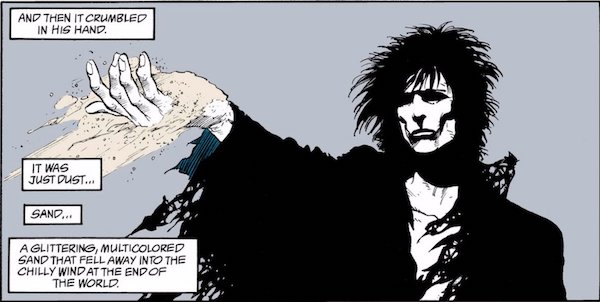
Gaiman, Neil. Sandman Vol 8: At World’s End. DC, Image Comics 1994. Dream in the Desert.

Sandman is a strange story that plays with the comic formula in a lot of interesting ways. Scott McCloud talks about the gutter, the space between two panels on a comic page. This space is a place for the reader to imagine a transition – motion in a conversation, action in an action scene etc. The gutter gets really interesting when the artist manipulates it in some way. I read a Moon Knight comic where often times the gutter is the part of the characters costume: His white cape providing the breaks between panels. Sandman is similar to this, but in a more direct way.

The protagonist of the story, Morpheus, the titular Sandman is a living embodiment of dreams. It’s essentially his job to make dreams and make sure they’re serving their proper purpose. The story goes to a bunch of strange places with this, with plot lines focusing on the strange and abstract. This is also reflected in how the art is drawn, Morpheus in particular. He’s always drawn in black clothes with pale, PALE skin. Oftentimes he will bleed in and out of the gutter, Gaiman’s way of showing how Morpheus bleeds from dream to dream.

The gutter is really interesting, genre specific tool and it’s fascinating to see someone as prolific as Gaiman work with it. I didn’t realize until I wrote this post that the front page blurb for Understanding Comics was by Gaiman himself. A funny coincidence, but it’d definitely be something that’d make Morpheus chuckle.

Posted in Fall 2018 Archive (201) | Leave a comment

Print Versus Digital: Emmalina Krist

A panel from Eroyn Franklin’s web comic, “Can Free Pop-Up Clinics Save American Healthcare?” The comic is meant to be scrolled to read, and as such only one panel can be read at a time.


Scott McCloud seemed a bit reluctant to predict definitively where the future of comics would be as a medium, as their definition is fairly broad and their potential great. However, I did read and consider two different forms of comics: those printed within a physical book, and those published online. I do not feel that either media is particularly better or worse than the other; rather, they both seem to have their own advantages and disadvantages. For example, the webcomics that I viewed were free and available to almost anyone with access to the Internet, while print books may need to be bought or borrowed from a library. However, I found the print book easier to read because I did not need to scroll; instead, my eyes were able to take in more of the panels at once. However, with this being said, I feel that with the popularity, speed, and convenience of the Internet, that digital comics that can be read online will outgrow print comics in most genres of comic. On the other hand there are some genres such as superhero comic books whose value is in part due to the fact that they are solely in print form and can be collected, so I feel that there will always be a place for print comics in popular culture.

If I were going to create a comic, I think that I would envision it being read in a printed format, because it is what I found easiest to read and held my attention for the longest period of time.

Posted in Fall 2018 Archive (201) | Leave a comment

Print Versus Digital: Emily Bruckner

Scott McCloud’s book really helped me to better understand what a comic really is; that it is essentially a sequential narrative of images with or without actual text. In this context, some ancient Egyptian stories carved into stone can be considered as early comics, which surprised and amazed me. I had always considered comics as a more recent idea than one that has been developing for centuries.

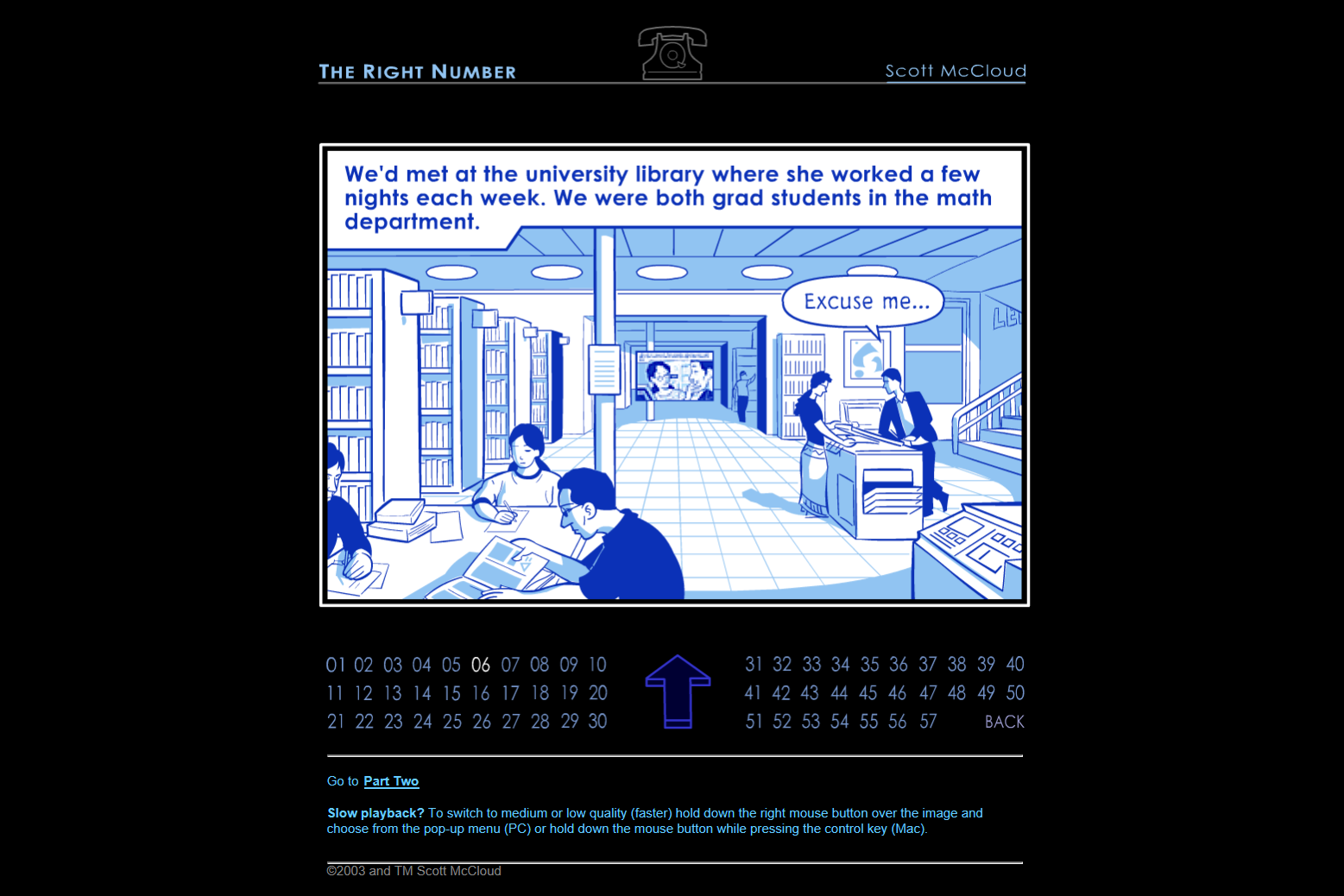
Both forms of comics, web and physical, have their advantages and shortcomings. I personally enjoy reading through a physical book of comics, it feels more tangible and real somehow. In McCloud’s web comic series “The Right Number” I found the zooming in to the next page to be an interesting mechanic to use. This mechanic did not allow you to glance ahead too far into the following sections of the narrative intentionally or otherwise. Usually in a physical comic book, I can look ahead and see what may come next and that can spoil the story but in the “The Right Number” it’s easier to focus on each individual frame as it comes along without getting too distracted. This method also allows for surprising events in the web comic to hold more weight since they are mostly unexpected. Of the comic books that I read in class, a couple stylistic choices stood out to me; in one, there was depicted a large scene which was bordered like a picture frame with smaller scenes that explained separate narratives as they were happening in the main scene. I thought this was a very clever way to include three different stories in only one page instead of dragging it out to several pages, which would make the reader much less interested. In other comic books, the use of changing the shape of the frames from the standard square to a triangle or some other shape helped to attract the eye to the difference in continuity and steer the narrative in a certain direction.

McCloud using a zooming mechanic for his web comic series.
(Scott McCloud, “The Right Number” Web Comics, 2003)

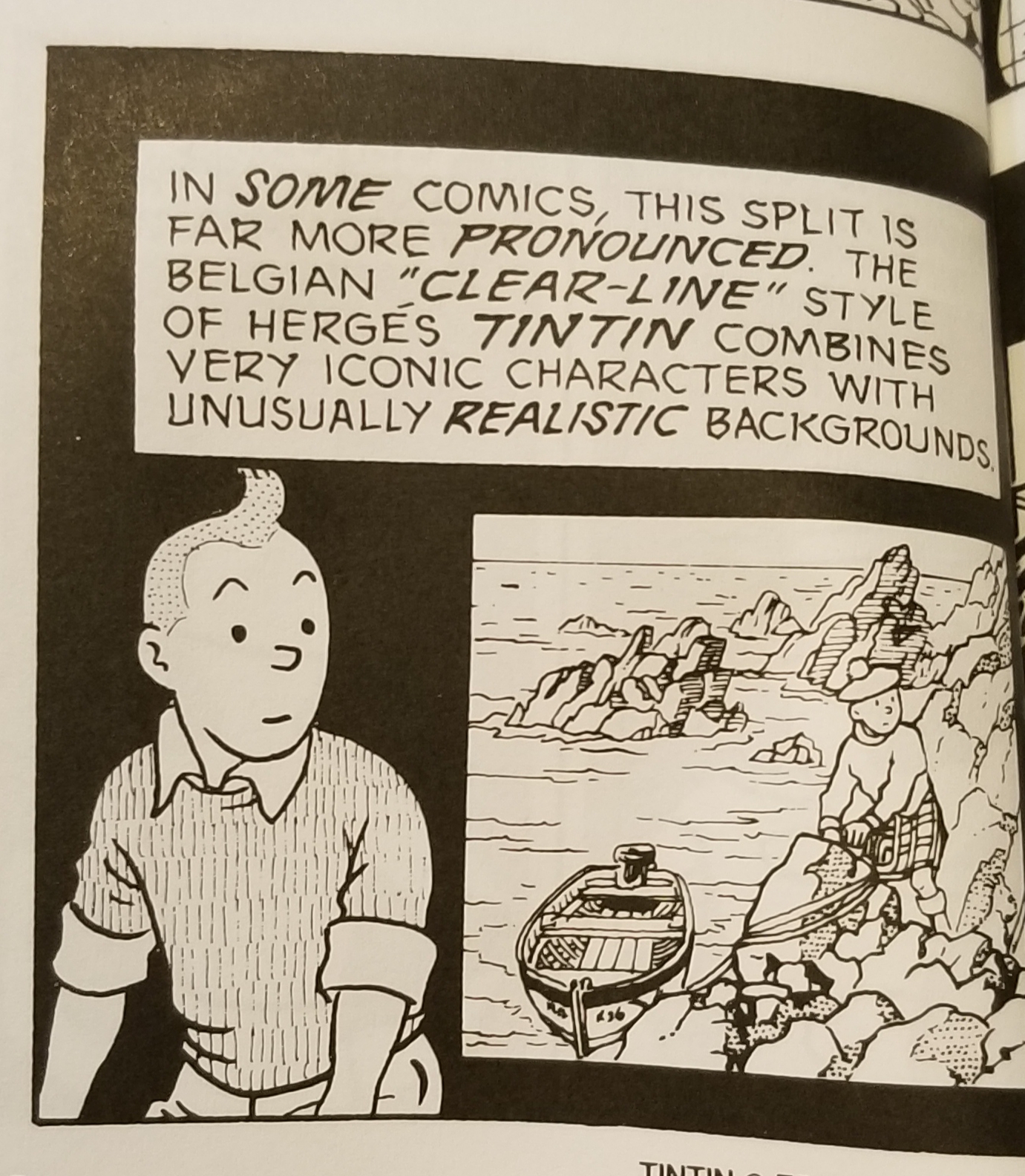
In drawing my own comic, I would most likely prefer it to be a physical object that people could pick up and read. I would like to be able to post it online, but it would be made in a style for physical printing. I’ve made a few short comic strips in the past, and I always enjoyed the more comic book style as opposed to formatting it for a web comic. One style that I love, and I would most certainly use in my comic, is the photorealistic backgrounds mentioned in “Understanding Comics.” This style gives a massive amount of weight and realism to the picture and contrasts drastically with more simplistic characters, making it more notable. This would be perfect to help the readers become more immersed and involved in the story, by envisioning themselves in that realistic-looking world.

McCloud describes a style of a realistic background used with simplistic characters.
(Scott McCloud, Understanding Comics, HaperCollinsPublishers,1994, pg. 42)


Posted in Fall 2018 Archive (201) | Leave a comment

Print Versus Digital: Ryan Ferrell


Printed Comic Frame

Understanding Comics, by: Scott McCloud, Page 21.

There is no one way to define or explain the concept of comics. As this frame to the left is interpreted to saying that there can be different viewpoints on the process and meaning of comics. There will continue to be many ways comics can change and be displayed in the future. It’s impossible to even try to predict it because it depends on the creator’s demographics, culture, understanding, and how their style is read. McCloud’s book, Understanding Comics, only represents the process, concept, and style he uses. People may think of comics in other ways, maybe more simply or even more in depth. McCloud goes into great detail in Understanding Comics about the history, the definition, styles of comics, what [he believes] counts as comics (i.e. Bayeaux Tapestry, Mexican Codex, and Egyptian Painting). He shows us the many ways comics as an art-form (rather than a novel genre/style) can be displayed, read, and interpreted. For the point of this blog, we will only focus on the print and digital versions of comics.

When i was flipping through the pages of McCloud’s book, I realized that I was really well engaged in the reading and felt like I had a better understanding of the messages in the printed text. The message can be split up by pages or even pairs. It’s easier to tell when the scene/context is changing in printed comics. The organization and reading-style of the frames can change, going from top to bottom, left-to-right, vice versa.

When I was going through Eroyn Franklin’s digital comics, I had a harder to time staying engaged and was easily distracted by my surroundings. I wasn’t fully indulged in the comics and had to try harder to understand the comics. The flow of the comics are just left to right and don’t really change.

If I were going to create a comic, I would envision people reading it in a printed format because it would be better for them to be engaged in the reading. I also want my readers to have a classic, common comic book experience. The style of printed comics, in my opinion, makes the reader feel creative and like they can relate better since most people are more inclined to print than digital as of now.

Posted in Fall 2018 Archive (201) | Leave a comment

Print vs. Digital: Rachel Lentz

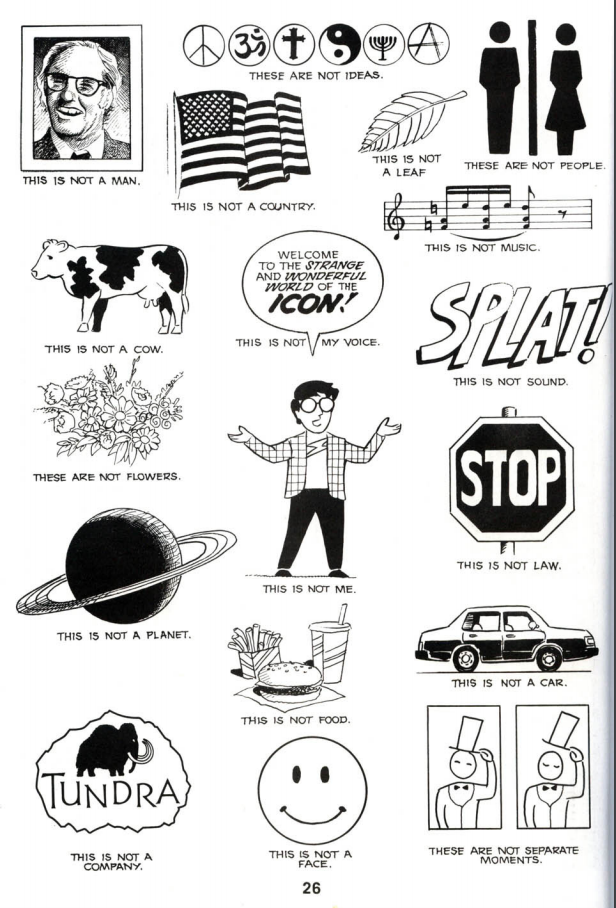
From Scott McCloud’s, “Understanding Comics” pg. 21. Commentary on the adaptability of comics.

Have you noticed the prevalence of comic book characters in our everyday lives? From movies to T.V. shows to even toys, it seems as if the popularity of comics and their ensuing characters has skyrocketed. One thing we can blame for this sudden increase in popularity is ease of access. The digitalization of comics has led to the sharing and popularization of this previously overlooked form of media. Scott McCloud predicted the changeability of comics in 1990 and it can’t be denied. Look at the how much the internet has grown and consider the types of media, like comics, it changes and popularizes.

The internet is present in nearly every aspect of our modern day lives. It is strange to find a person without some form of access to the internet be it through personal smart phones, computers, or places like a local library. The internet has become a necessity, budgeted for like electricity, water, or food. This cost is well worth it as the internet gives people around the world access to nearly infinite information. No longer do people have to carry around a dusty tomb of a book, they can just whip out their smartphone to do the job. This ease of access can lead to some interesting questions about the validity of older models of information storage, like books. If everything is on the web, what is the use of print? This debate is more of a matter of preference at this point, as access to print and web-based media is still essentially even. However, in a fast-changing world how much longer will this last?

My prediction for the future is that more and more media, and specifically comics, will be digitalized. This is due to such conveniences as ease of access and how we consume media in shorter and shorter burst of information. Even the model of distribution to the public changes format when digitalized. People can now look up their favorite types of stories on the internet instead of having to search relatively limited physical collections in stores or libraries. However, this does not say that digitalization does not leave the content of comics unchanged. Some for the worse, and others for the better.

People make comics differently than how they did in the past. It is much more convenient to have files stored in the cloud or other access devises for the sake of not only portability but changeability. As well, the creation of this media changes too. Drawing in traditional pen and pencils leave some room for change to the actual creation, but in digitized media the entire piece can be changed at the press of a button. As well, the layout and consumption of digital media can differ. Creators do not have to worry about page length restrictions or even have to fit their art onto the traditional 8x11in size of paper. In return, putting comics online give less control to artists on how their art is viewed, either in sequence or in form. Reading in print vs. digital media for comics is different as well. The physical nature of turning a page can be soothing, but I would argue that for comics it is more disruptive than cathartic. The art/story is momentarily stopped in print. However, in digital media, the comic flows at the press of a button. Analyzing the difference between reading Scott McCloud’s “Understanding Comics” in print and his further web comics online is an interesting task. In print most of the pages are filled to capacity, the size of the comic boxes changes but the rectangular border box is very prevalent, and page flipping can lead to disruption of the story. In McCloud’s web comic the comic border is still used but noticeably missing, a webpage is not noticeably filled to capacity from left to right, and the use of scrolling makes for a more seamless enterprise.

Overall these differences in perspective for the reader are not deal breakers, however, the availability of comics to readers certainly is and can attest for comics new found popularity.

From Scott McCloud’s, “Understanding Comics”, pg. 20 Definition of comics and their limitations (in single panel form).

Posted in Fall 2018 Archive (201) | Leave a comment