
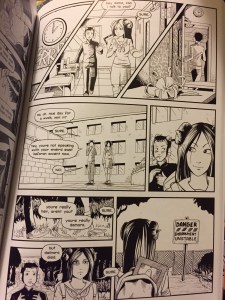
“Damara” by Mary Borsellino, Page 125 of Paradox Space
This page from Paradox Space’s “Damara” shows a variety of ways framing can make a black and white comic more interesting. Comics are made up of boxes, or “frames”, which are arranged to show sequences of action. The borders of these frames change depending on the author’s motivation and intended effect. In this one-shot comic, time lapses are frequent, so transitions are made to reflect how time is passing. The top row shows the ring of the clock, and the two characters leaving the classroom to have a chat. With this framing, we can understand that these actions are connected, and what will happen next with little dialogue.
It’s also important to understand frames in terms of the what borders don’t show. In the bottom row you can see the panel that consists only of feet, background, and some dialogue. We can infer from this frame that the same characters are walking outside, even though we don’t see their faces. The framing in this row helps add to the illusion of motion.
 Kristin Becker's DTC Classes at WSU