
Lynda Barry didn’t have an easy childhood growing up, as is apparent within the first fifty illustrious pages of her imagination-saturated novel, What It Is. In it, she begs to question a new philosophical query per page, to which she admits there are no answers, and leaves the possibilities and nuances for the audience to consider. From telling of her past, living in a trailer park with abusive parents, Lynda finds that fairy tales, stories, and fables, alongside her imagination, are her solace in a world of Brady Bunch-like TV programs. Amidst her reflection on her memories, she asks if memories are of any substance and why they
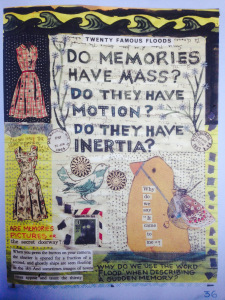
Page 36 of Lynda Barry’s What It Is.
are referred to as being floods (e.g. do they have mass, motion, or inertia), which can be seen to the left on page 36 of her book. Through formstorming, she achieves a visual representation of a flood by bordering the top of the page with waves, and carries on a sub-aquatic theme with fish and octopi throughout her no
vel, as if we are submerged in her flood of memories.
On the same page, she asks betwixt two illustrations of dresses: “Can you have the same memory twice?” I believe, however small the blurb might be, that this also directly correlates with formstorming as a means of displaying the same thought process twice, but in an innovative way, with having two very similar dresses. However, she almost answers the question with a dysmorphic “no” through exhibiting the two eerily similar, yet nonidentical, dresses. She’s essentially saying you cannot have the same memory twice, because memory adapts and changes all the time. One image you remembered two minutes ago will not be the same image two minutes from now, and so on. Her illustration, then, could arguably be considered a form of alter ego formstorming, showing two versions of the same thought, as seen on page 27 of Ellen Lupton and Jennifer Cole Phillips’ Graphic Design: The New Basics.
Through the original display of memory retrieval, or recall, we are given only a taste of some of Ms. Barry’s indelible shower thoughts. It would be interesting to see how, if she had taken a second longer on each of her collages, how different they would have turned out, based on what we see with the alter egos of the two dresses.
 Kristin Becker's DTC Classes at WSU