
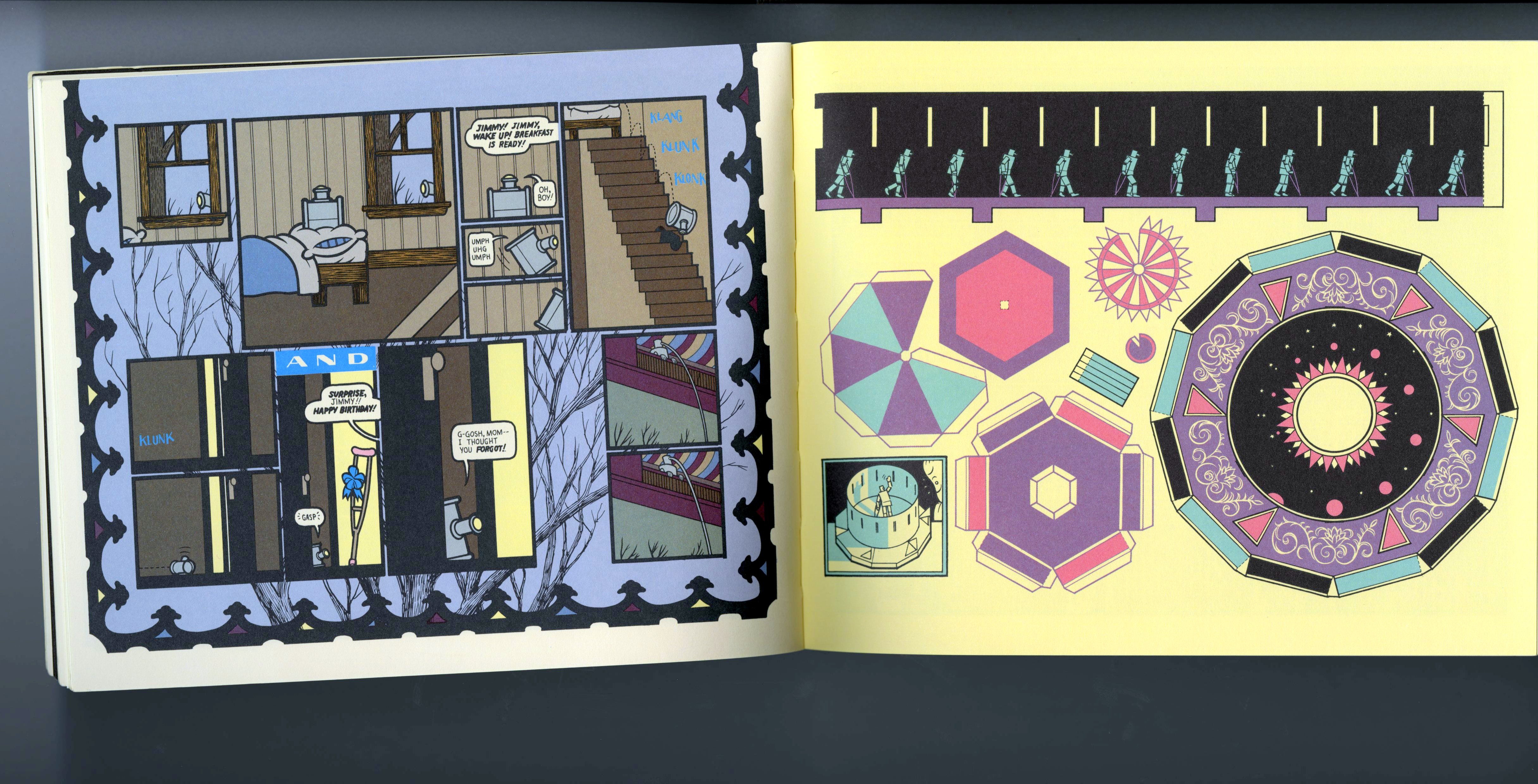
Last week I had the pleasure of reading parts of Jimmy The Smartest Kid on Earth by Chris Ware. It was an odd story to say the least. But that is not what I want to talk about, framing is the subject of the hour. Framing is an outline that place or encapsulates an image. This
Jimmy the Smartest Kid on Earth by Chris Ware
was one of the most interesting pages in the novel. On the left side there was a partial bleed page. Within the larger partial bleed frame there are several little frames, which tell part of the story. I want to also point out how the third column in there are 3 frames that go vertically instead of left to right. This is an interesting framing choice because it changes the meaning of how we read it, I read this section more quickly because it gave me the impression it was happening all at once. The author does this other places as well, still giving me the same impression. Lastly on the left page I want to point out the larger frame captured the tops of a tree with a dark blue background. By framing the tree this way, it gives me the feel of a dusky, windy, spooky night where this screen takes place.
The right side has less framing. The top time-lapse image has half borders to separate the movements, but still interconnected like a film strip. Then the image in the bottom left of this page has a tiny framed image show us the what the robot is standing in and why he is seeing these other images. The large images in the middle of the of page want to be moving, much how our eyes and the robot would see it. However, they are capture, as by a camera, and are still. Also the images are quite larger because they would be for the robot, so we see them larger as well. Even though the images don’t seem to be framed, they are. They do not extend outwardly from the filmstrip and does not dip far below the bottom of the small images in the left bottom corner. Our eyes don’t see the frame, but our brains do!
How cool!
 Kristin Becker's DTC Classes at WSU