
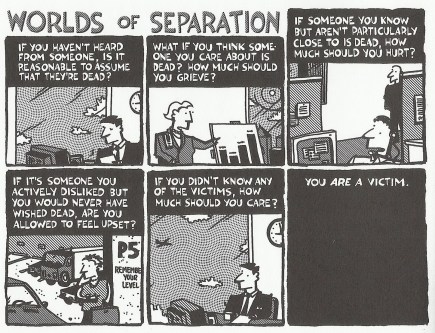
This comic strip appears in Ted Rall’s “To Afghanistan and Back,” meant to convey what occurred following 9/11. Rall, Ted. To Afghanistan and Back: A Graphic Travelogue. New York: Nantier, Beall, Minoustchine, 2002. Print.
I didn’t realize we were going to be referencing the books we looked at in the library, but I did find a strip online of the book I briefly looked over: To Afghanistan and Back by Ted Rall. His travelogue is comprised of several different comic strips and this is one I found powerful.
Point, line, and plane are more important than they seem, being the basis of images, and allowing depth through patterns and textures. Points are the beginning, standing alone or being clustered to further create lines and planes and shapes, and being the natural shading of varying grays, seen in this comic strip.
For example, the lines drawn across the sky indicates the movement of the clouds, as well as the progression of time. This also conveys different planes, inside the office and outside the office, by different points being used together to create a solid place in time and space for the reader to follow. And the progression of the story being told remains clear.
The lines in this comic are clean and clearly guide the reader, including the edges of text boxes, making text plainly distinct. Lines used in crosshatching for the sky, something clothing, and office equipment give texture to nearly every panel, also drawing focus to each individual one without being distracting. This is important due to only a grayscale being used to shade the comic. The grayscale is overall cohesive and balanced, save for the last panel, which could act as a point of the strip as a whole, being what first draws my focus. This goes back to adding depth to the image. The white text contrasting against the black not only compels attention but gives more meaning to the panel, as if screaming, “This is important!”
 Kristin Becker's DTC Classes at WSU