

This Moroccan themed navy pattern is geometrically contrived. You can see that the repeated shape is a square with a diamond in the center and three smaller squares marking the outer edges. What is most interesting about this image (found on Society6, see below, by Micklyn) is the color interaction. While the repetition in terms of the pattern lines is obvious, the color behind it gives the pattern an organic twist because the color is not repeated in this specific picture. The isolated forms or dots create a sort of grid, but the grid is not as obvious as it would be without the varying contrast of the navy tint in what reads as the ground. There is not sense of depth in the pattern because the shapes are repeated in two seperated sizes and on a clearly defined grid.
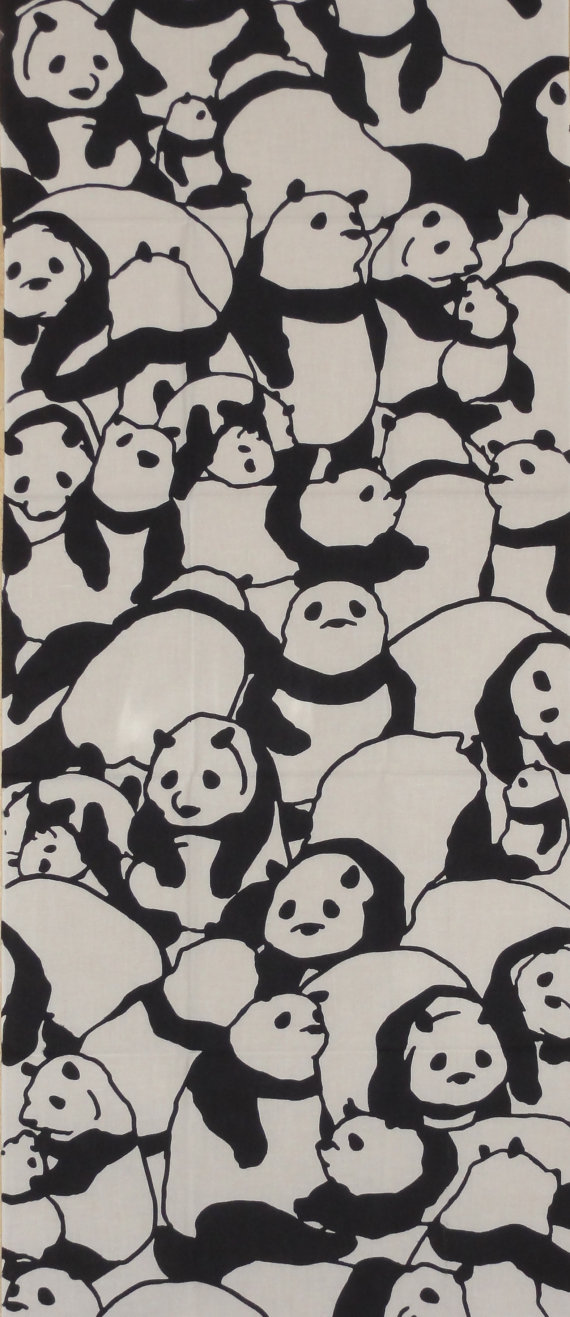
The linear form in this fabric pattern “Pile of Pandas” (found on Etsy, see bottom for link, by Kyotocollection) is hard to decipher at first. After some time of looking at it I realized that the image is a rectangle and in this portion of the pattern it is vertically mirroring itself. The fact that the shapes are organic in nature and the pattern is created using recognizable imagery enhances the organic qualities because it draws the eyes away from the repetition and towards the figures. Also, the negative space (white) is completely utilized in this panda pattern and the lack of seemingly empty space simply overwhelms the eyes into seeing a picture rather than a pattern. Just by including shapes that are not rigid, the pattern is given depth and a sense of movement. The black and desaturated white is essential to portraying the images as recognizable. It might be difficult to understand if the pandas were black and orange or brown.
Image One: Worn and Faded Navy Denim Moroccan pattern in grey blue and white
By: Micklyn
http://society6.com/micklyn/worn–faded-navy-denim-moroccan-pattern-in-grey-blue–white_print#1=2
Image Two: “Pile of Pandas”
By: Kyotocollection
 Kristin Becker's DTC Classes at WSU