
This two-page spread from Maira Kalman’s The Principles of Uncertainty is an excellent example of how scale can be interpreted objectively and subjectively. Scale isn’t just size, but the interpretation of that size literally or based off of experiences or impressions of the size an object should be.
When an individual considers scale in terms of literal dimensions, then scale is being considered objectively. When the individual uses first impressions or relates to our past experiences, then scale is being considered subjectively.
The example from The Principles of Uncertainty exemplifies both of these interpretations through its subject matter. In this spread, Kalman draws a scene from a sidewalk store. The image bleeds off of the page, continuing off the page due to a lack of a border. This cropping alone indicates a larger scale, we know the scene continues on past where we can see.
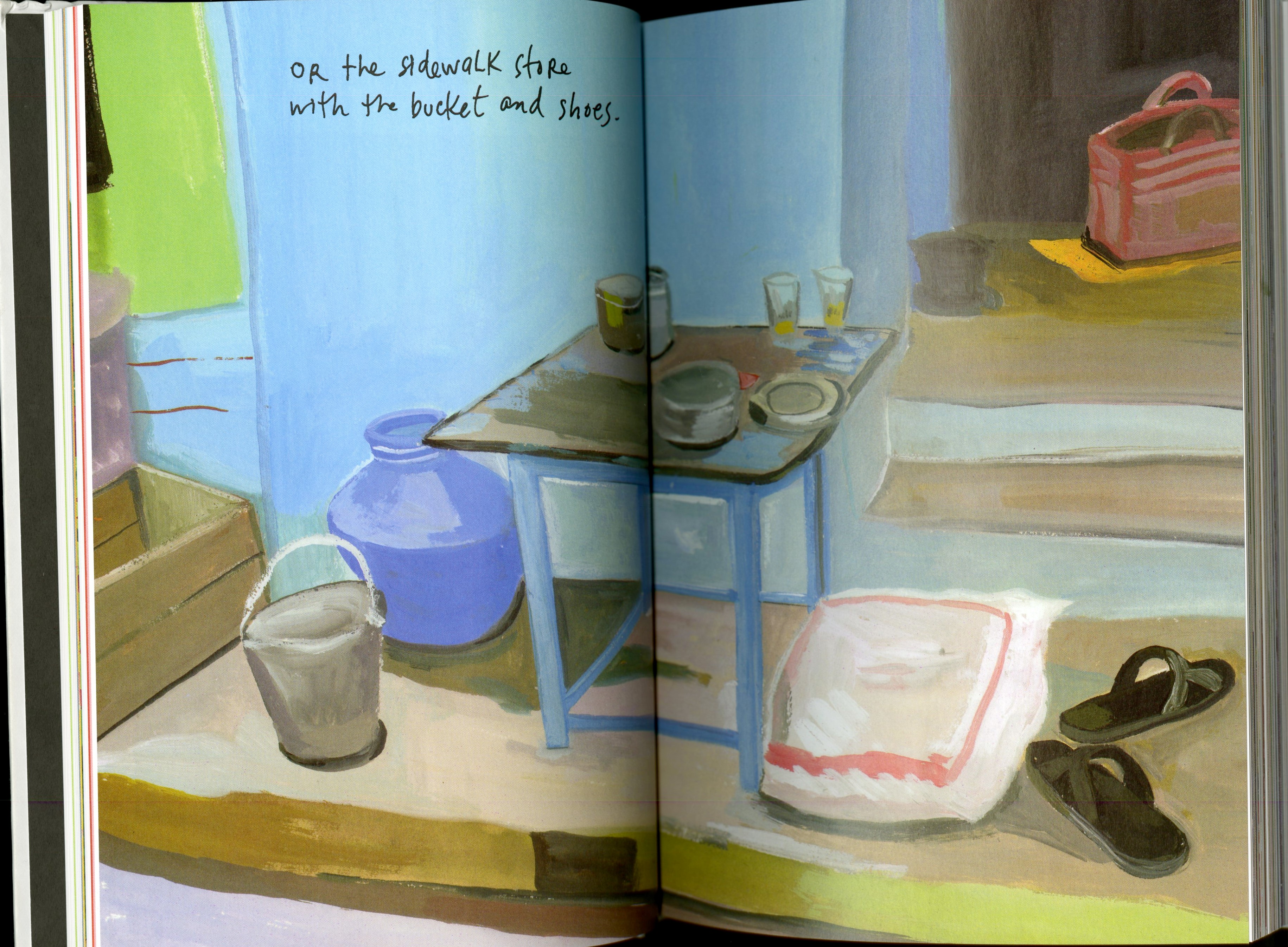
A drawing of a sidewalk store from the author’s past. (Maira Kalman, Principles of Uncertainty, Penguin Press, 2007, pgs 32-33)
The sidewalk store features a table with drinking glasses on its surface. There is a bag of flour and sandals while steps lead up into a doorway and a bucket is on the left. This could be viewed objectively, a reader could make a literal correlation between the represented objects and the real items it depicts.
But the objects drawn are not exact renditions of real world items. The bucket is a bit misshapen on one side for example and these drawings are definitely not re-creations with exact measurements re-scaled for the pages.
These pages will probably be interpreted subjectively. This page plays off of the idea that we, the audience, as seen a pair of sandals before, or staircases, or buckets, etc. If the sandals were larger than the table top while everything else remained the same, we’d think, “Those are big sandals” or “Everything is small compared to those normal sized sandals.”
The scale also provides depth though there isn’t really movement. For example, the front legs of the table are larger than the back legs, giving the table a 3D element. We know the back legs are further away.
Scale is relative and often times depends size, placement, and color of the elements around it. If all of these objects drawn were the same size we’d have an unrealistic depiction of the store. The table in relation to the flour bag in relation to the sandals gives us an idea of what the real world version would look like.

 Kristin Becker's DTC Classes at WSU