
Lynda Barry provides a perfect example different types of framing within her graphic novel, One! Hundred! Demons! In the page I chose to focus on Barry has formed a camera frame around the picture centered on her page “classifieds”. By doing this she shows us a moment that is up for interpretation. The framing image and text is used to form questions within the reader’s mind. Is the character looking for a job in this or is she the classified? Through the use of from the image of the actual page in scrap book form with text, the reader is left to interpret what the author meant when she made this image seem like it was put together by itself. It makes the reader question what the headline means. Without caption, it is a full interpretation. By having another image with a caption next to the centered photograph, Barry continues to have us interpret her drawings.
This one is captioned “Once Upon a Time” with a cut image of a woman writing. The readers are still left to analyze if this image is more important than the other. This image has been cropped instead of bordered, working the framing differently than the center photo. I would think not, since it’s frame is not defined as the picture, or even the page, is. Instead it seems to be sloppily cut and posted, not bordered in the same way the other photo was. To border in the way that Barry did here is to make the picture stand out against the other images. The cats here seem to have implied frames, standing out in their own image rather than being squared off in a separate frame like the photos are.
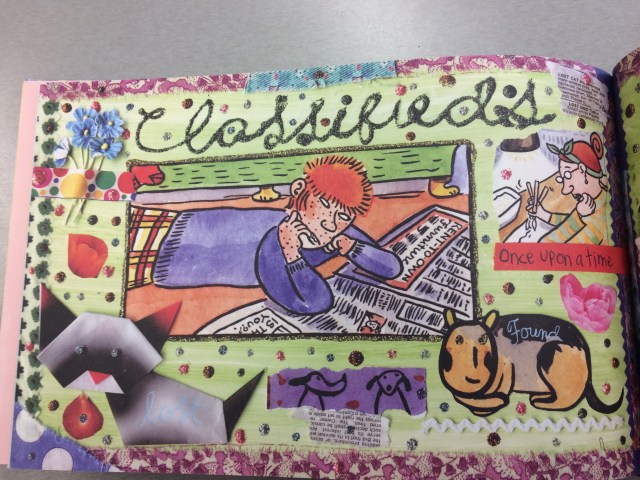
From Lynda Barry’s One! Hundred! Demons!
 Kristin Becker's DTC Classes at WSU