
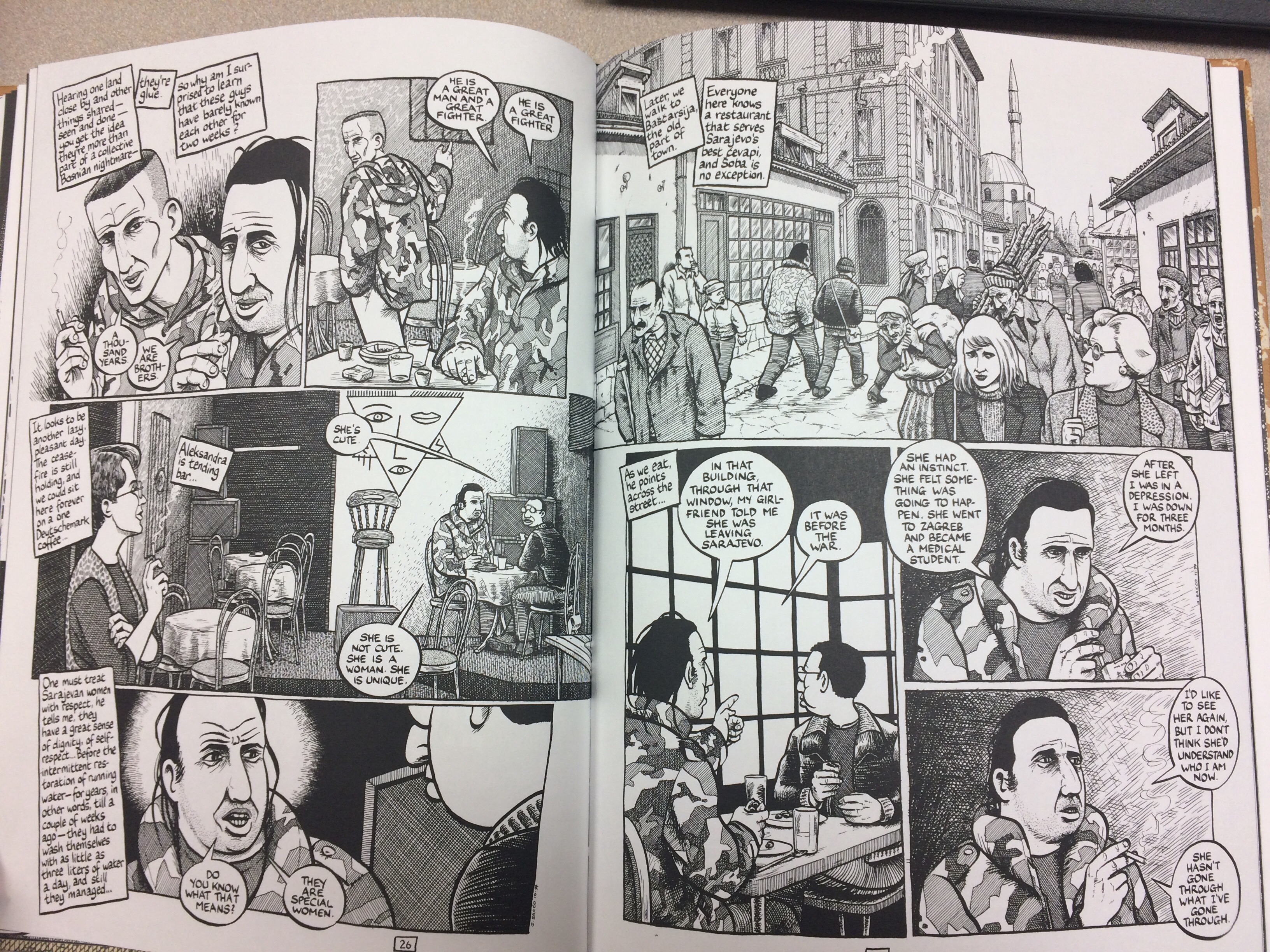
Pages 26 and 27 of Joe Sacco’s graphic novel, War’s End: Profiles from Bosnia 1995-96.
Ellen Lupton and Jennifer Cole Phillips outline the definitions of point, line, and plane and describe their uses and examples in the book, Graphic Design: The New Basics. While these elements seem like simplistic concepts, they are integrated in every part of the design world. Lipton and Phillips define a point as a marker of a position in space (page 34), a line is defined as “an infinite series of points,” (page 36), and a plane is a flat surface that may be expanded (page 38).
Examples of point, line, and plane can be found throughout Joe Sacco’s graphic novel, War’s End: Profiles from Bosnia 1995-96. Sacco’s uses a familiar comic-book type style to tell several short stories in his novel. Lipton and Phillips describe the way points and lines can be used to create images, along with shading. Something I immediately noticed about Sacco’s book was that it is entirely black and white in color, and many images were especially dark. Not only does Sacco use shading to create textures and patterns, but he also uses points and lines to shade the backgrounds of his images. This, paired with the emotionally dark nature of the stories, made Sacco’s stories especially powerful, because we see, and thus feel, the deep, painful, mysterious emotions of the novel.
Also using points and lines, Sacco creates shapes (usually squares and rectangles) to fill with individual images. These are examples of panes. Sacco creates flat spaces that vary in size and shape to tell his story with.
 Kristin Becker's DTC Classes at WSU