
In the first 50 pages of “What it is” Lynda Barry hosts a procession of superfluous philosophical questions related to creativity. If you are like me, this book may seem like a collection of creative drivel backed by a well meaning intention to derive and teach creative meaning as related to how we use images. So far, the book appears to me to be an over-extensive exercise in Formstorming. Each page is illustrated in a dramatic fashion in order to achieve creative distinction. Coupled with the illustrations, open ended questions are repeatedly asked yet rarely they have answers. In my opinion, this is an exhausting read, certainly not due to a lack of content, but rather due to the seemingly unnecessary over use of images and scrapbook like clippings. The book doesn’t have a natural flow as it often doubles back on itself to repeat questions and the like. In other words, I found it easy to dismiss the contents housed within the book. Yet, that is the point is it not?
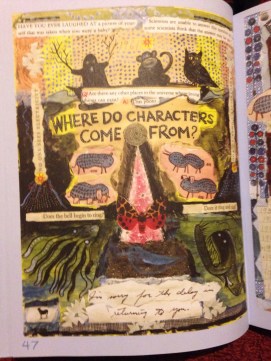
Through the repetition of dramatic illustrations Lynda Barry is accentuating our natural ability to overlook and dismiss the importance of images in our life. She claims both the memory and imagination of a being are inherently alive in one way or another. The beat which drives the hearts of these mental mechanism’s is completely dependent on the being’s ability to create and remember images. In fact, most of the questions Lynda proposes can be answered with a response which calls upon the importance of images. For example, she asks the readers where stories, characters, and personal experience come from. the answer is simple, as all these things start with images and then evolve from that point onward. In the image attached to this post she asks the reader where characters come from? Underneath the question Lynda has formstormed a few different animals which all have similar peanut shell like bodies. She does this to call attention to fact that images are the genesis of character creation.
Lynda Barry’s use of formstorming throughout the pages of “What it is” is almost impossible not to notice. Through the mass production of images she calls attention to the importance of images themselves. In this book, the images speak louder than the words. Which may be exactly what Lynda is calling attention to. Images are alive and they encapsulate our entire existence. Without images our world would be in a danger of becoming lifeless.
-Conor Reich
 Kristin Becker's DTC Classes at WSU