
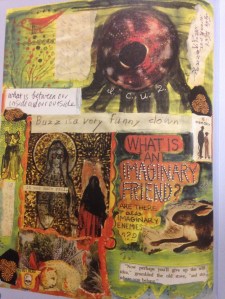
Page 29 from Lynda Barry’s graphic novel, “What It Is.”
In Lynda Barry’s graphic novel, What It Is. The reader is moved from page to page by a collage of images and different texts pulled from magazines, newspapers and other handwritten notes or essays. We see a repetition of this through the book followed by some what clearer drawings and writing that allow the readers a break from the broken and mismatched texts. These pages have the same style of drawings and writing on them as to portray a clearer line of thought and further development in these pages. The pages that are not as developed are still just as important as the ones that are, for they show Linda’s process of formstorming as defined by Ellen Lupton and Jennifer Cole Phillips in Graphic Design: The New Basics. This helps her reach that same childhood feeling that she fears she has lost with age. On page 29 of What It Is Lynda uses drawings of imaginary friends and maybe even imaginary enemies to help develop the question she poses on this page, “What is an imaginary friend? Are there also imaginary enemies?” This page begins the next set of ideas that Lynda talks about as a child on page 37. But here on page 29 we begin seeing an idea of the unseeable being able to see us, with her use of “I.C.U.2” near images of dark eyes, bringing the thoughts to life and giving what is not there, a form of existence. This she develops into the blinking cat and her eventual realization that it does not exist.
 Kristin Becker's DTC Classes at WSU