
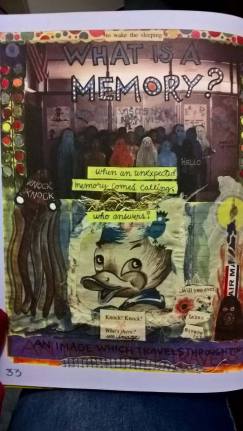
Page 33 from Lynda Barry’s graphic novel, “What It Is.”
The first 50 pages of the graphic novel, What It Is by Lynda Barry, explores very heavy ideas such as the loss of innocence and imagination that comes with age. Many of the pages feature text that asks questions such as, “What is an idea made of?”, “Are there images inside of us?” and “What is an imaginary friend? Are there also imaginary enemies?” The tone of the illustrations continuously feels melancholy, there a many dark shadows and strange creatures lingering in the background. This tone and the many questions Lynda Barry poses through cut out letterings and scratchy inkings seems to convey this fear that she has about growing up and losing the dreams and illusions that come with childhood.
In Graphic Design: The New Basics, Ellen Lupton and Jennifer Cole Phillips introduce the process of formstorming. This process really relates to the themes of losing imagination over time in the sense that formstorming requires and invokes creative thinking. When you formstorm you take a design with specific problems that you want to fix and then you rework that problem over and over again in various ways. By engaging in formstorming, you get all of the obvious and easy solutions out of the way and begin to use more creative, nuanced solutions which results in discovering a more unique outcome.
One of the ways that Lynda Barry engages in formstorming is by using the technique called dailies. Dailies are a creative act daily with a constant conceptual theme. Some examples include drawing a word several different ways or designing album covers each day. In this way, the artist is pushed to try increasingly new and different ideas. An example of this can be seen in Lynda Barry’s book. She definitely repeats several types of creatures on each page and repurposes old text from novels or notebooks. Reusing those elements in a new way is an example of formstorming, like a collage project. For example, on page 33 we can see several instances of repurposed images and text, from the fabric with the duck to the cut out strips of print and paper. All of these elements create a collage that seems both professional and childlike. This page also features the dark figures huddled in a group that appear throughout the pages. The collage style is consistent throughout the book, making What It Is reminiscent of formstorming.

 Kristin Becker's DTC Classes at WSU